
⚙️ Configure Error Monitoring for Shopify
Configure GermainUX to detect, classify, prioritize, and analyze Shopify errors according to their effect on customers, conversion, revenue, and critical business processes.
The objective is not to treat every technical event as equally important. GermainUX helps teams focus on failures that affect real customers while separating expected validation and low-impact technical noise.
📋 Prerequisites
Before configuring error monitoring:
🏷️ Error classifications
Use the following classifications consistently across Shopify KPIs, dashboards, alerts, and reports.
|
Classification |
Example |
|---|---|
|
User-facing application error |
Add-to-cart fails and displays an error |
|
Silent application error |
An inventory request fails silently and leaves stale availability data |
|
User validation |
A required address field is missing |
|
Technical event |
A handled JavaScript warning with no customer impact |
|
Business failure |
Checkout completes without the required order integration |
|
Payment decline |
The issuing bank declines the transaction |
|
Custom |
<your custom classification> |
Do not group user validation with application errors. Validation indicates that the application is operating as designed; an application error indicates that the software is not operating correctly.
🔍 Error sources
GermainUX can detect Shopify errors from browser, network, application, and integration telemetry.
💻 Browser and JavaScript errors
Monitor:
-
JavaScript exceptions
-
Unhandled promise rejections
-
Resource-loading failures
-
Browser freezes
-
Failed event handlers
-
Theme and application errors
-
Third-party script failures
-
Custom application error events
☁️ Network errors
Monitor:
-
Failed HTTP and fetch requests
-
Timeouts
-
Connection failures
-
Incorrect HTTP status codes
-
GraphQL errors
-
Responses that report a failure despite returning HTTP
200 -
Shopify API failures
-
Third-party service failures
👥 Customer-visible errors
Monitor error messages associated with:
|
Feature |
Feature |
|---|---|
|
Product search |
Product availability |
|
Product variants |
Add-to-cart |
|
Cart updates |
Discount codes |
|
Authentication |
Customer accounts |
|
Shipping |
Checkout |
|
Payment |
Order submission |
|
Returns and support |
|
🖥️ Backend and integration errors
When the GermainUX Engine is configured, monitor:
-
Shopify API errors
-
Webhook failures
-
Product or inventory synchronization
-
Order-processing integrations
-
Payment and tax services
-
CRM and ERP integrations
-
Fulfillment and warehouse systems
-
Scheduled jobs
-
Rate limits and authentication failures
🚀 Enable error monitoring
Go to:
Germain Workspace > Analytics > UX Monitoring Profiles
Select the profile used by the Shopify store.
Depending on the GermainUX version and enabled components, review:
-
JavaScript error monitoring
-
Unhandled promise rejection monitoring
-
HTTP and fetch monitoring
-
Request and response processing
-
Browser console monitoring
-
Popup and visible-message monitoring
-
Resource error monitoring
-
Session Replay
-
Network request-body capture
-
Error categorization
-
Application-specific rules
Enable only the collection required for the analysis. Avoid capturing full request or response bodies unless necessary and approved.
📁 Detect functional errors in successful HTTP responses
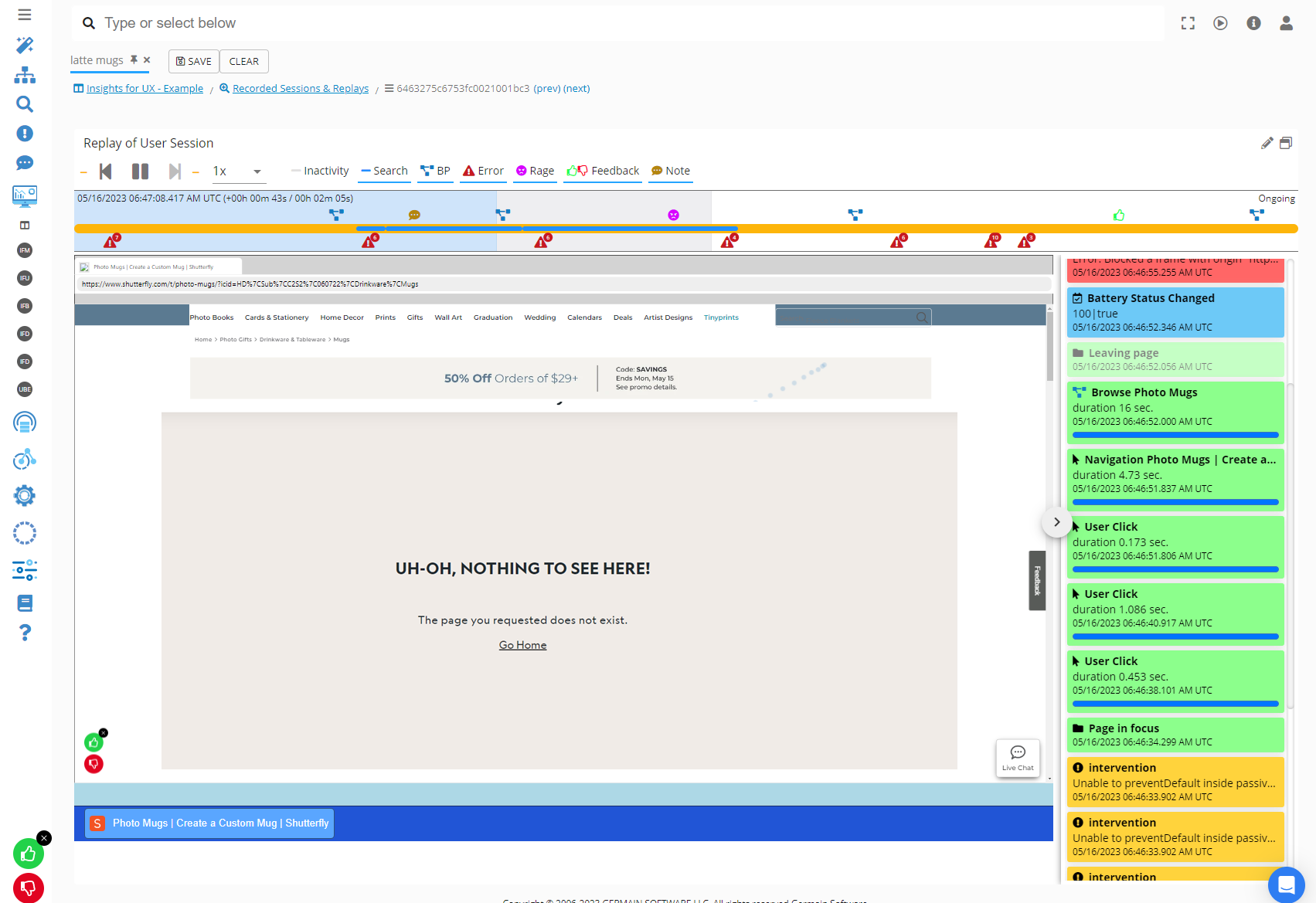
Some Shopify themes and third-party services return HTTP 200 even when the response represents a functional failure. In these cases, configure a response processor to identify the failure based on the response content.
The following example detects common “page not found” responses:
settings.plugins.network.requestAndResponseBodyProcessor = function (fact) {
    if (
        fact.myClassName !== "OutboundDocumentRequest" ||
        !fact.responseBody
    ) {
        return;
    }

    const responseText = fact.responseBody.toLowerCase();

    const pageNotFound =
        responseText.includes("404 not found") ||
        responseText.includes("page not found") ||
        responseText.includes(
            "page you were looking for does not exist"
        );

    if (pageNotFound) {
        fact.success = false;
        fact.http = fact.http || {};
        fact.http.status = "404";
        fact.http.message = "404 - Page Not Found";

        germainApm.api.createEvent("Shopify Page Not Found", {
            success: false,
            errorClassification: "user-facing-application-error",
            http: fact.http
        });
    }
};
Because Shopify themes can customize the missing-page content, update the matching expressions for each store and language.
 Important limitations
Response-body inspection can expose sensitive information or increase browser processing. Before enabling it:
Limitations and precautions:
-
Limit processing to the required endpoints.
-
Avoid storing the full response body.
-
Exclude checkout and payment responses unless explicitly approved.
-
Remove personal, order, authentication, and payment information.
-
Test the processor against legitimate responses to prevent false positives.
-
Confirm that the monitored response type is text before searching it.
🔧 Capture custom Shopify errors
When a store-specific failure cannot be detected automatically, create a custom event from the theme or application code.
Example:
germainApm.api.createEvent("Shopify Add to Cart Failed", {
    success: false,
    errorClassification: "user-facing-application-error",
    operation: "AddToCart",
    productId: productId,
    variantId: variantId,
    message: sanitizedErrorMessage
});
Do not include customer email addresses, names, authentication values, payment data, or other sensitive values in custom error attributes.
Use stable event names such as:
-
Shopify Add to Cart Failed -
Shopify Cart Update Failed -
Shopify Discount Application Failed -
Shopify Checkout Failed -
Shopify Search Failed -
Shopify Order Submission Failed -
Shopify Integration Failed
🔎 Configure error categorization
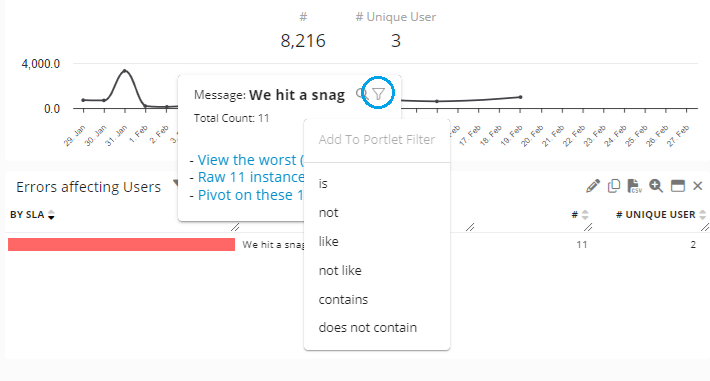
Categorization groups repeated occurrences of the same underlying error so teams can analyze problems instead of individual noisy events.
Go to:
Germain Workspace > Analytics > Categorization
Create categorization rules using stable attributes such as:
-
Error name
-
Normalized message
-
Stack signature
-
Page or logical route
-
Request endpoint
-
HTTP status
-
Shopify operation
-
Third-party service
-
Business-process step
-
Theme or application version
Remove variable values that create unnecessary categories, including:
-
Product identifiers
-
Cart identifiers
-
Checkout tokens
-
Order identifiers
-
Customer identifiers
-
Timestamps
-
Random values
-
Request correlation IDs
For example, these messages should normally belong to one category:
Product 12345 could not be added to cart
Product 78492 could not be added to cart
Normalized category:
Product {productId} could not be added to cart
💡 Identify new and changing errors
Use categorization and baseline comparison to identify:
-
New error categories
-
Errors introduced after a theme or application release
-
Sudden increases
-
Errors affecting additional customers
-
Errors spreading to new browsers or devices
-
Previously resolved errors that have returned
-
Errors associated with conversion loss
A technically new message is not necessarily a new root cause. Normalize variable content before using “new error” alerts.
⚖️ Configure business-impact analysis
Prioritize errors using their effect on customer and business outcomes.
Measure:
-
Number of occurrences
-
Unique affected customers
-
Affected sessions
-
Conversion rate
-
Abandoned carts
-
Failed checkouts
-
Lost or at-risk revenue
-
Affected products
-
Affected bus
-
Affected products
-
Affected business-process steps
-
Duration of impact
-
First and most recent occurrence
-
Store, market, browser, device, and release
An error occurring thousands of times in an unused background operation may be less important than an error affecting a small number of high-value checkout sessions.
Recommended prioritization
|
Priority |
Suggested criteria |
|---|---|
|
Critical |
Prevents checkout or purchase for many customers, affects significant revenue, or creates a security or data-integrity risk |
|
High |
Breaks a major journey such as search, product selection, cart, login, or checkout |
|
Medium |
Degrades the experience but permits completion through an alternative path |
|
Low |
Limited impact, isolated occurrence, or non-customer-facing technical noise |
Adjust these criteria to the store’s transaction volume, revenue, and service-level objectives.
📈 Configure an error dashboard
Create or update a dashboard portlet with the following settings.
📊 KPIs
Use one or more relevant KPIs, such as:
-
Browser Event
-
JavaScript Error
-
Unhandled Promise Rejection
-
Outbound HTTP Request
-
Resource Error
-
Application Error
-
Shopify custom error KPIs
📏 Measures
Recommended measures include:
-
Count
-
Unique Users
-
Sessions
-
Error Rate
-
Failed Transactions
-
Conversion Rate
-
Abandonment Rate
-
Revenue Impact
-
Average Duration
-
95th-percentile Duration
🔀 Pivots
Recommended pivots include:
-
Error Category
-
Name
-
Normalized Message
-
Page
-
Request Endpoint
-
Business-Process Step
-
Product
-
Collection
-
Browser
-
Device
-
Country
-
Store
-
Environment
-
Release
🔎 Filters
Use filters such as:
-
Error classification
-
Success equals
false -
Application
-
Store
-
Environment
-
Date and time
-
Business-process step
-
New error
-
User-facing
-
Silent
-
User validation
Older configurations may store application errors under legacy fields such as User Error or userError. Retain those fields only for compatibility with historical data. For new configurations, use explicit classifications that distinguish visible application failures, silent failures, and user validation.
🔎 Analyze an error
For each important error, investigate:
-
How many customers and sessions were affected?
-
Is the failure visible to the customer?
-
Which page, product, or checkout step is affected?
-
Does the error prevent conversion?
-
What happened immediately before the error?
-
Which browser request failed?
-
Is the issue limited to a browser, device, country, or release?
-
Did the same customer retry or find another path?
-
Is the problem new, recurring, or increasing?
-
What technical evidence identifies the likely cause?
Use Session Replay to reconstruct the customer’s actions around the error. Correlate replay with clicks, pages, Shopify events, network requests, console activity, and business-process steps.
Session Replay is an event-based reconstruction, not a video recording.
⛔ Include and exclude errors
Use rules and filters to control which error categories appear in operational dashboards and alerts.
Exclude an error only when:
-
It is expected behavior.
-
It has no meaningful technical or business impact.
-
It is generated by a known browser extension or bot.
-
It is duplicate telemetry.
-
It contains unusable third-party noise.
-
Another KPI already represents it more accurately.
Do not delete or permanently ignore an error merely because it occurs frequently. First verify its impact on customers and conversion.
Where possible, retain excluded events in a lower-priority analytical view so they remain available if their behavior changes.
🔔 Configure alerts
Go to the GermainUX alert configuration and create notifications for actionable conditions.
Recommended alerts include:
-
New critical error category
-
Checkout error-rate increase
-
Add-to-cart failure increase
-
Search failure increase
-
Application error affecting multiple customers
-
Error correlated with conversion degradation
-
Third-party service failure
-
Shopify API or webhook failure
-
Previously resolved error recurrence
Avoid sending one alert for every error occurrence. Use aggregation, categorization, deduplication, cooldown periods, and business-impact thresholds.
📄 Suggested alert content
An error alert should include:
-
Error category and classification
-
First and most recent occurrence
-
Number of occurrences
-
Unique affected customers
-
Affected store and environment
-
Page or business-process step
-
Conversion or revenue impact
-
Related release
-
Link to analysis
-
Link to affected sessions or Session Replay
🗂️ Configure reports
Schedule reports for trends that do not require immediate notification.
Recommended report sections include:
-
New errors
-
Most frequent errors
-
Errors affecting the most customers
-
Errors with the greatest conversion impact
-
Checkout failures
-
Errors by release
-
Resolved and recurring errors
-
User validation trends
-
Silent application errors
-
Third-party service failures
Keep user validation in a separate section from software failures.
✅ Validate the configuration
Test the configuration safely using a non-production store or Shopify test mode when possible.
Verify:
-
JavaScript errors are captured.
-
Unhandled promise rejections are captured.
-
Failed HTTP requests are captured.
-
Functional failures returned with HTTP
200are detected correctly. -
Visible application errors use the correct classification.
-
Silent failures remain distinct.
-
Expected validation is not counted as an application error.
-
Sensitive values are masked or excluded.
-
Categories normalize dynamic values.
-
New errors can be identified.
-
Dashboards show affected customers and sessions.
-
Session Replay opens at the relevant point.
-
Alerts are deduplicated and routed correctly.
-
Test errors do not contaminate production reporting.
🧰 Troubleshooting
🔇 Too many insignificant errors
Suggested actions:
-
Add categorization and normalization.
-
Exclude known browser-extension noise.
-
Filter bot and crawler traffic.
-
Separate technical events from confirmed application errors.
-
Apply minimum occurrence or affected-user thresholds.
-
Alert only on new, increasing, or business-impacting categories.
🔁 One error creates many categories
Normalize dynamic product, cart, checkout, order, timestamp, and correlation values before categorization.
🎞️ Errors appear without Session Replay
Confirm that:
-
Session Replay is enabled.
-
The session was selected by the replay sampling rules.
-
Consent permitted replay.
-
The page is within capture scope.
-
The error and replay use the same application and session identifiers.
❓ A visible error is not detected
Determine whether the error is:
-
Rendered as DOM text
-
Displayed in a popup
-
Returned in a network response
-
Logged only to the console
-
Produced inside a cross-origin iframe
-
Generated by a third-party checkout
Configure the appropriate capture method. GermainUX running in a parent page cannot directly inspect protected content inside a cross-origin iframe.
🔧 A request returns HTTP 200 but failed functionally
Add a narrowly scoped response processor or create a custom event from the application code. Do not mark all HTTP 200 responses as successful without considering the application result.
📖 Related documentation
-
Deploy Monitoring for Shopify
-
Configure Shopify Events
-
Configure Error Monitoring for Shopify
-
Configure User Feedback for Shopify
-
More details on Error Analysis
ℹ️ Get Help
The Germain Team can help you set this up. Contact GermainUX Support.
Component: Engine, Mobile App, RUM JS
Feature Availability: 2023.3 or later