
⚙️ GermainUX Engine Deployment
This guide explains how to deploy the GermainUX Engine on Windows, Linux, or Docker.
The GermainUX Engine runs monitoring, diagnostic, and automation components close to the systems being monitored. Each Engine host includes an Engine Manager, which connects to Germain Enterprise and controls one or more Engine instances.
🧭 Choose a deployment method
|
Method |
Recommended use |
|---|---|
|
Windows installer |
Standard Windows service deployment |
|
Windows silent installer |
Automated deployment to multiple Windows hosts |
|
Windows binary |
Customized Windows service deployment |
|
Linux |
Standard production deployment on modern Linux |
|
Linux System V service |
Older Linux distributions |
|
Foreground process |
Initial validation and troubleshooting |
|
Docker Compose |
Containerized environments |
For production, run the Engine as an operating-system service or managed container so it starts automatically and can be monitored.
📋 Prerequisites
Before deploying an Engine, confirm that:
|
Requirement |
|---|
|
A GermainUX-approved Java version is installed. |
|
|
|
The host can reach Germain Enterprise. |
|
Required network ports are open. |
|
Proxy details are available when direct connectivity is not permitted. |
|
The host can reach every system the Engine will monitor. |
|
Required JDBC drivers are available for database monitoring. |
|
The Engine service account can access the required files, services, commands, and endpoints. |
|
Docker Compose 1.29 or later is installed for Docker deployment. |
|
Sufficient CPU, memory, and disk capacity are available. |
📏 Reference sizing
The documented reference sizing is:
|
Workload |
CPU |
Memory |
Local storage |
|---|---|---|---|
|
Low scale—up to 1 million units per day |
Approximately 5% |
2 GB |
500 MB–30 GB |
|
Medium to large—1 to 100 million units per day |
Approximately 5% |
2 GB |
500 MB–30 GB |
|
Big data—more than 100 million units per day |
Approximately 5% |
2 GB |
500 MB–30 GB |
These are planning estimates. Actual requirements depend on:
|
Factor |
|---|
|
Number and type of monitoring components |
|
Component execution frequency |
|
Log and telemetry volume |
|
Local buffering requirements |
|
Synthetic transactions |
|
Database queries |
|
Automation workload |
|
Local state-store size |
Monitor actual resource consumption and resize the Engine or distribute its workload when necessary.
📡 Network connectivity
The Engine must be able to connect to Germain Enterprise.
Typical HTTP ports include:
80
8080
For HTTPS, the actual port depends on your reverse proxy, load balancer, or Tomcat configuration.
Legacy GermainUX releases using ActiveMQ may also require:
61616
ActiveMQ applies only to GermainUX releases earlier than 2024. Use the messaging and network requirements supplied for your installed GermainUX version.
Also confirm that the Engine can reach the applications, databases, files, APIs, and servers it will monitor.
📂 Install Java
Install the Java version approved for your GermainUX release.
Verify it:
java -version
Verify JAVA_HOME.
Windows Command Prompt:
echo %JAVA_HOME%
PowerShell:
echo $env:JAVA_HOME
Linux:
echo $JAVA_HOME
If the wrong Java version is returned, review JAVA_HOME, the system PATH, the service configuration, and any other installed Java versions.
⬇️ Download the Engine
The current Windows distributions are available from the GermainUX Workspace:
-
Sign in to the Workspace.
-
Open Wizards.
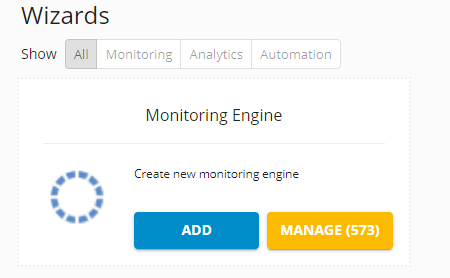
Engine Wizard - Germain UX -
Select Engine.
-
Download the appropriate package:
-
Windows Installer
-
Windows Binary
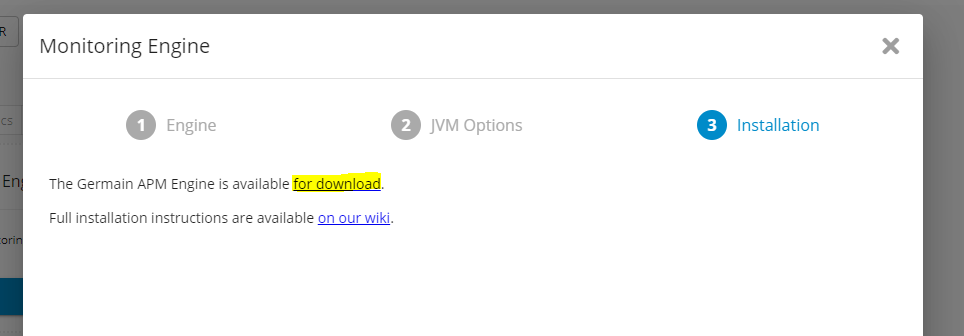
Download link for Germain UX Engine
-
For Linux or Docker deployments, use the Engine distribution provided for your GermainUX release.
📁 Engine installation directory
Create or select the directory where the Engine will be installed.
Examples:
Windows: D:\Germain\engines
Linux:   /opt/germain/engines
This guide refers to that directory as:
ENGINE_HOME
Extract the Engine distribution into ENGINE_HOME.
📦 Install database drivers
If the Engine will monitor a database, copy the applicable JDBC driver into:
ENGINE_HOME/lib
Examples include:
MySQL:  mysql-connector-j-<version>.jar
Oracle: ojdbc<version>.jar
Use a JDBC driver compatible with the monitored database, Java runtime, and GermainUX version. Do not copy obsolete drivers from older deployments without reviewing their compatibility and security status.
🔗 Configure the Engine Manager connection
Open:
ENGINE_HOME/config/germain-bootstrap.properties
Configure the following properties as applicable.
🌐 Germain Enterprise URL
germain.bootstrap.configService=<germain-enterprise-url>
Example:
germain.bootstrap.configService=https://germain.example.com
🔑 Authentication
germain.bootstrap.configUser=<username>
germain.bootstrap.configPassword=<password>
Use a dedicated service account for production. Restrict access to this file because it may contain credentials.
💻 Monitoring node
germain.bootstrap.node=
Two options are available:
-
Leave the value empty to let the Engine Manager register a new node automatically. This is preferred.
-
Enter the hostname of an existing node under
germain.apm.monitoringNode.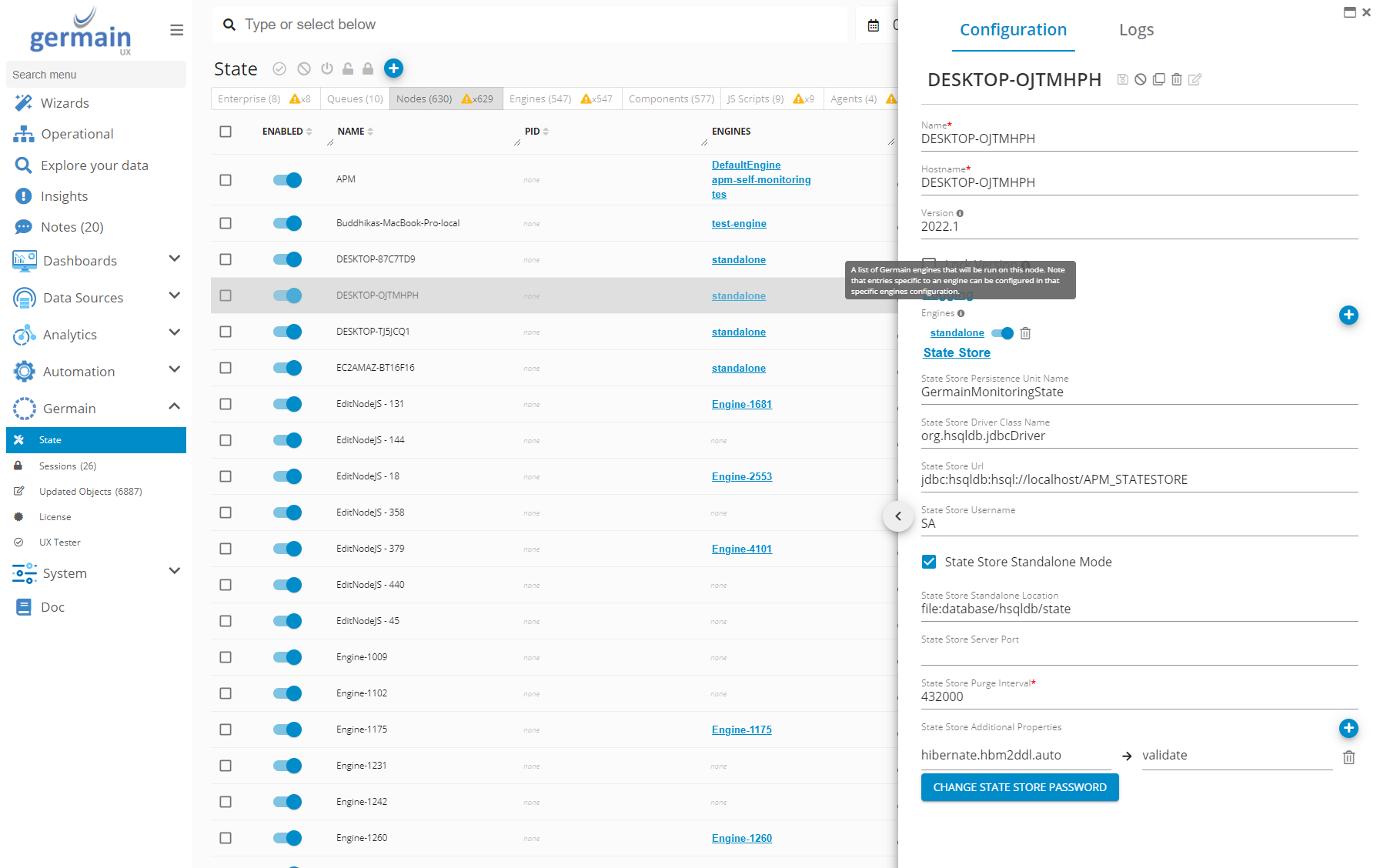
Authorize Node (Engine Manager)
📨 Messaging
Older Engine distributions may contain:
germain.activemq.url=<hostname>:61616
Configure this only for a legacy GermainUX release that uses ActiveMQ. For GermainUX 2024.2 or later, use the transport configuration provided with the current Engine distribution.
👀 Run the Engine in the foreground
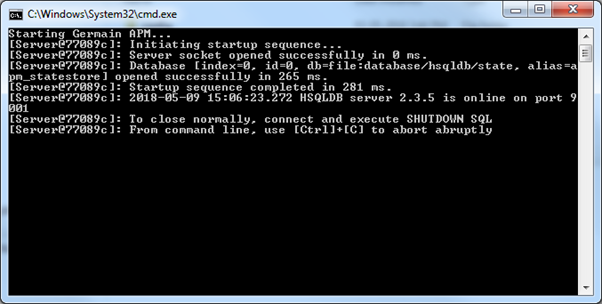
Foreground execution is useful for initial validation because startup errors appear directly in the terminal.
It is not recommended for routine production operation.
😎 Windows
Open:
ENGINE_HOME\bin\startEngine.bat
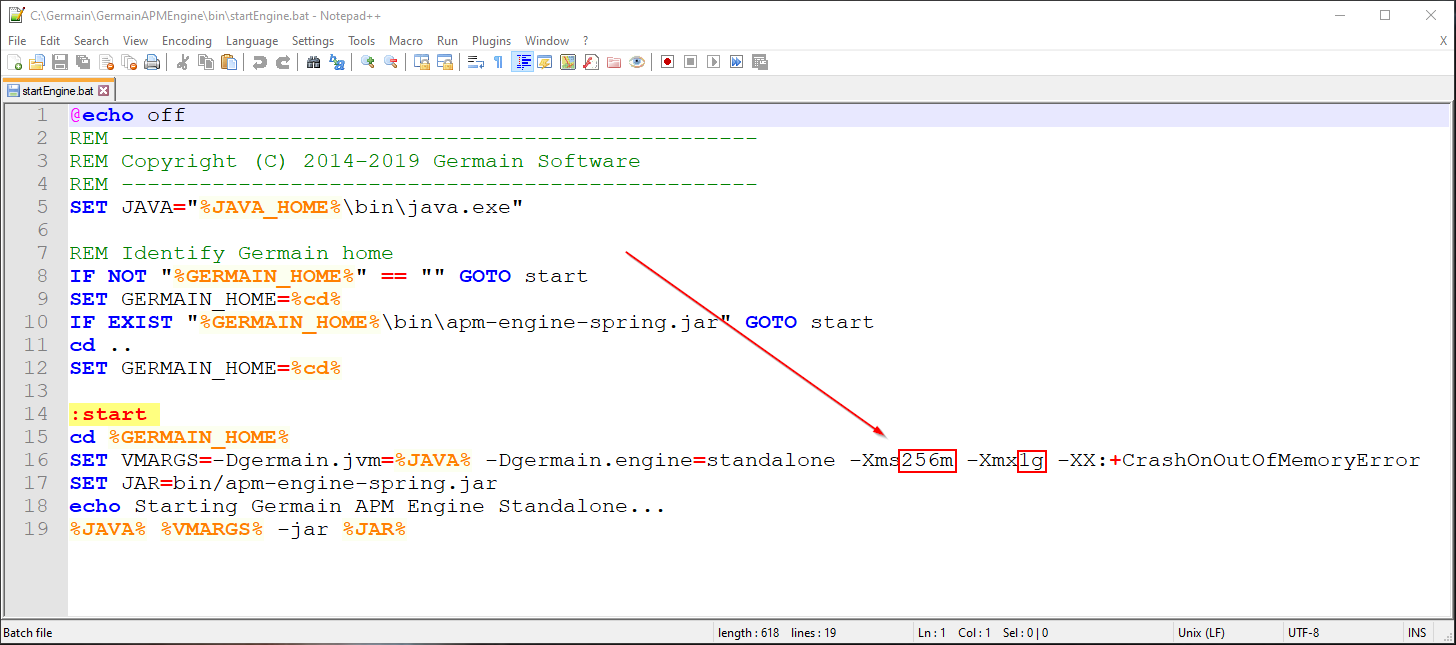
Review the JVM memory settings, then open Command Prompt and run:
cd /d <ENGINE_HOME>
bin\startEngine.bat
Keep the command window open while the Engine runs.
🐧 Linux
Open:
ENGINE_HOME/bin/startEngine.sh
Review its JVM memory settings, then run:
cd "$ENGINE_HOME"
./bin/startEngine.sh

Run the Engine using a dedicated operating-system account. Root privileges should not be required unless a specific monitoring component needs privileged access and that access has been approved.
🪟 Deploy with the Windows installer
1️⃣ 1. Run the installer
Run the downloaded Engine .msi file.
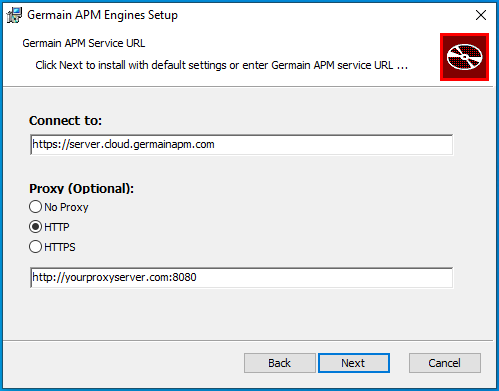
2️⃣ 2. Configure the Germain Enterprise address
Enter the Germain Enterprise URL.
Example:
https://germain.example.com
3️⃣ 3. Configure the proxy
If the Engine reaches Germain Enterprise through a proxy, enter:
-
Proxy protocol
-
Proxy hostname
-
Proxy port
Leave these fields empty when no proxy is required.
4️⃣ 4. Select the installation directory
Enter the desired installation path and continue.
✅ 5. Complete the installation
Select Install, wait for the installation to finish, and then select Finish.
The installer registers the Engine Manager as a Windows service.
⚙️ Silent Windows installation
Use the silent installer to automate deployment.
Example:
msiexec.exe /QN /I "C:\Install\GermainAPMEngines.msi" ^
  INSTALLFOLDER="C:\germain\engines" ^
  APM_SERVICEURL="https://germain.example.com"
With an HTTP proxy:
msiexec.exe /QN /I "C:\Install\GermainAPMEngines.msi" ^
  INSTALLFOLDER="C:\germain\engines" ^
  APM_SERVICEURL="https://germain.example.com" ^
  PROX="http" ^
  APM_HTTPPROXY="http://proxy.example.com:8080"
|
Argument |
Required |
Description |
|---|---|---|
|
|
Yes |
Runs the installer without a user interface |
|
|
Yes |
Specifies the MSI package |
|
|
No |
Specifies the installation directory |
|
|
Yes |
Specifies the Germain Enterprise URL |
|
|
No |
Specifies |
|
|
No |
Specifies the proxy URL and port |
Because /QN suppresses the interface, installation errors may not be visible. Capture an MSI log:
msiexec.exe /QN /I "C:\Install\GermainAPMEngines.msi" ^
  /L*v "C:\Install\GermainEngine-install.log" ^
  INSTALLFOLDER="C:\germain\engines" ^
  APM_SERVICEURL="https://germain.example.com"
Review the log if the service is not installed successfully.
📁 Deploy the Windows binary as a service
Use this method when you need direct control over the Engine files and Windows service definition.
1️⃣ 1. Extract the binary
Extract the downloaded archive and place its engines directory in the desired location.
That directory becomes ENGINE_HOME.
🔧 2. Configure JVM memory
Open:
ENGINE_HOME\bin\GermainEngineStandalone.xml

Review the Java executable, working directory, Engine name, log path, and JVM options.
Typical options include:
<argument>-Xms256m</argument>
<argument>-Xmx1024m</argument>
<argument>-XX:+CrashOnOutOfMemoryError</argument>
<argument>-Dgermain.engine=standalone</argument>
⚙️ 3. Configure the service wrapper
Open Command Prompt as an administrator and navigate to:
cd /d <ENGINE_HOME>\bin\WinSW
Run the script matching the installed .NET Framework:
set-dotnet-2.bat
set-dotnet-4.bat
set-dotnet-461.bat
Choose the highest applicable version.
4️⃣ 4. Install the service
Navigate back to the bin directory:
cd ..
GermainEngineStandalone.exe install
✅ 5. Verify the service
Open:
services.msc
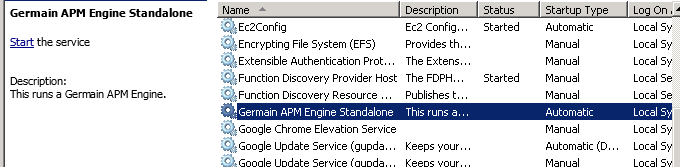
Confirm that the Germain Engine service appears and starts successfully.
🐧 Install as a Linux systemd service
Modern Linux distributions should use systemd.
Review the service definition supplied under:
ENGINE_HOME/bin/germain-engine.service
Ensure that it contains:
-
A dedicated service account
-
The correct
ENGINE_HOME -
The correct Java executable
-
The correct startup command
-
Restart behavior
-
Required environment variables
-
Appropriate file permissions
A representative service definition is:
[Unit]
Description=GermainUX Engine
After=network-online.target
Wants=network-online.target

[Service]
Type=simple
User=germain
WorkingDirectory=/opt/germain/engines
Environment="ENGINE_HOME=/opt/germain/engines"
ExecStart=/opt/germain/engines/bin/startEngine.sh
Restart=on-failure
SuccessExitStatus=143

[Install]
WantedBy=multi-user.target
Copy the reviewed service file:
sudo cp "$ENGINE_HOME/bin/germain-engine.service" \
  /etc/systemd/system/germain-engine.service
Reload systemd:
sudo systemctl daemon-reload
Enable automatic startup:
sudo systemctl enable germain-engine.service
Start the service:
sudo systemctl start germain-engine.service
Check its status:
sudo systemctl status germain-engine.service
Use the supplied service definition when it differs from the representative example above.
⚙️ Install on a System V distribution
For older distributions using System V, follow the service procedure supplied with the Engine package.
A legacy deployment may create a link under:
/etc/init.d/germain-engine
The service can then be managed with:
sudo service germain-engine start
sudo service germain-engine stop
sudo service germain-engine restart
Prefer systemd on distributions that support it.
🐳 Deploy with Docker Compose
1️⃣ 1. Extract the Docker package
Extract the GermainUX Docker files.
Example:
/opt/germain
2️⃣ 2. Create the Docker network
docker network create germain
If the network already exists, verify that the supplied Compose files use it.
3️⃣ 3. Start the required infrastructure
cd /opt/germain
docker-compose -f compose/apm-infrastructure.yaml up -d --force-recreate
Wait until the required infrastructure containers are ready.
⚙️ 4. Configure GermainUX
Review:
cd /opt/germain/config
nano bootstrap.zk
Configure the required database, SMTP, infrastructure, and environment-specific settings.
Protect credentials using your organization’s secret-management process.
🚀 5. Start the GermainUX Services
cd /opt/germain
docker-compose -f compose/apm-services.yaml up -d --force-recreate
⚙️ 6. Configure the Engine
Open:
cd /opt/germain/config
nano engine.env
Configure the Germain Enterprise URL and other Engine settings.
▶️ 7. Start the Engines
cd /opt/germain
docker-compose -f compose/apm-engines.yaml up -d --force-recreate
✅ 8. Validate the containers
docker-compose -f compose/apm-engines.yaml ps
docker-compose -f compose/apm-engines.yaml logs
Confirm that the Engine Manager connects successfully and waits for authorization when required.
🔒 Authorize the Engine Manager
A newly deployed Engine Manager may need approval before it can finish loading.
In the GermainUX Workspace:
-
Open Germain > State.
-
Select Nodes.
-
Search for the new node.
-
Select the lock in the Sessions column.
-
Select Confirm.
The Engine Manager retries authorization periodically. After approval, the log should report a successful authorization and continue initialization.
The default Engine is normally named:
standalone
You can rename it or create additional Engines for the node.
📋 Validate the deployment
After installation, confirm that:
|
Check |
|---|
|
The Engine Manager process, service, or container is running. |
|
The correct Java version is active. |
|
The Engine Manager connects to the expected Germain Enterprise instance. |
|
The new node appears under Germain > State. |
|
The node is authorized. |
|
The Engine Manager heartbeat appears. |
|
The expected Engine instances are listed. |
|
Required Engines are enabled. |
|
Monitoring components start successfully. |
|
New telemetry appears in GermainUX. |
|
CPU, memory, and disk usage remain within acceptable limits. |
|
Automatic startup works after a controlled host restart. |
Review:
ENGINE_HOME/logs/EngineManager.log
A successful startup includes:
Started EngineManagerApplication in <duration> seconds
⬆️ Upgrades
The Engine Manager automatically restarts after an Engine upgrade.
After upgrading, verify that:
-
The expected Engine version is running.
-
The Engine Manager restarted successfully.
-
The node remains authorized.
-
The expected Engines are enabled.
-
Custom JDBC drivers remain available.
-
Monitoring components resumed execution.
-
No Java, network, messaging, or configuration errors appear.
Component: Engine
Feature Availability: 8.6.0 or later