
📝 Notes and Tickets
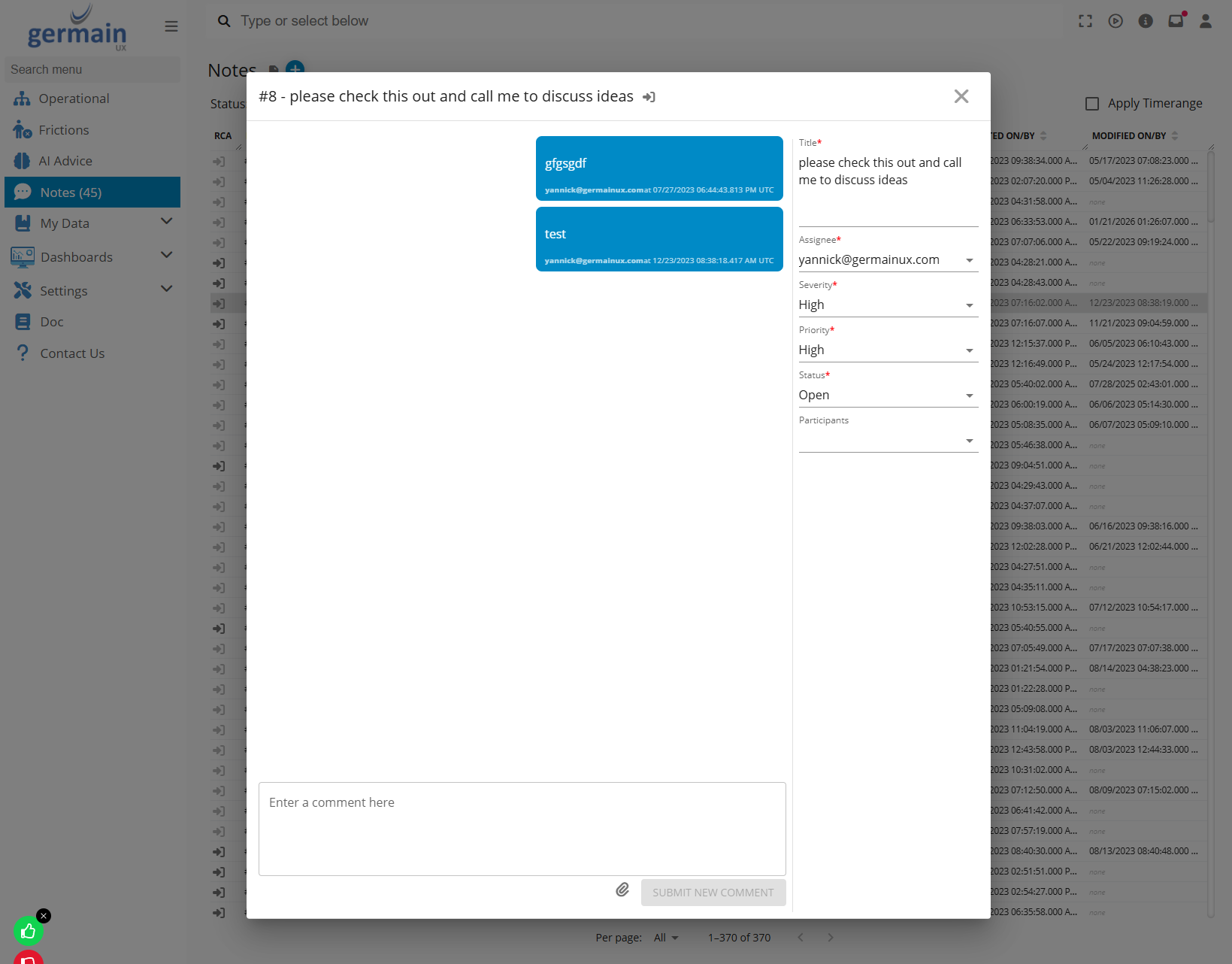
GermainUX includes a built-in ticketing and collaboration system that allows teams to create a Note on any metric, dashboard, individual instance, or user session.
A Note turns an insight discovered in GermainUX into an actionable ticket. Teams can document the finding, discuss it through comments, assign responsibility, and follow the investigation without losing the original analytical context.
Notes help eliminate the need to repeatedly copy information between GermainUX and external ticketing systems. The issue and the discussion remain connected to the metric or user experience where they were identified.
❓ What Is a Note?
A Note is a collaborative ticket attached to GermainUX data.
Use a Note to:
|
Use |
|---|
|
Comment on a metric or detected issue |
|
Document an observation or diagnosis |
|
Assign an issue to a user |
|
Collaborate through additional comments |
|
Preserve the dashboard, metric, instance, or session context |
|
Communicate progress and updates |
|
Track an issue from discovery through investigation and resolution |
When a Note is created or updated, GermainUX automatically emails the relevant users so they can review the change and take action.
💡 Why Use Notes?
Monitoring and analytics identify what is happening. Notes help teams coordinate what happens next.
For example, a user can:
-
Identify a conversion decline, adoption issue, workflow bottleneck, error, or performance problem.
-
Create a Note directly from the affected metric.
-
Describe the finding and its potential impact.
-
Assign the Note to the person responsible for investigating it.
-
Add comments as new evidence becomes available.
-
Keep the discussion connected to the original GermainUX data.
This creates a continuous workflow from:
Detection → Analysis → Assignment → Collaboration → Resolution
🔗 What Can a Note Be Attached To?
Notes can be created from several areas of Germain Workspace.
📄 Dashboard
Create a Note from an Aggregate or other supported dashboard to comment on the overall situation represented by that dashboard.
This is useful when the issue affects several KPIs or when the Note concerns a broader business or technical condition.

📊 Metric
Create a Note directly from a KPI or metric to preserve the selected metric, time range, filters, and analytical context.
Examples include:
|
Example |
|---|
|
A conversion-rate decline |
|
A CRM adoption issue |
|
An increase in user-facing errors |
|
A slow application transaction |
|
A workflow drop-off |
|
A productivity loss |
|
A service or application availability problem |
🔍 Drill-through Instance
Create a Note from an individual row in a Drill-through Dashboard when the ticket concerns a specific event, transaction, error, or data point.
This allows the assignee to return to the exact instance that triggered the investigation.
📈 Analysis Dashboard
Create a Note while investigating a KPI or individual instance in the Analysis Dashboard.
The Note can document:
|
Item |
|---|
|
Whether the KPI is abnormal |
|
Related KPIs that changed with it |
|
Leading Factors |
|
Affected users, sessions, pages, products, or versions |
|
Trace findings |
|
The suspected root cause |
|
Recommended corrective actions |
🎞 Session Replay
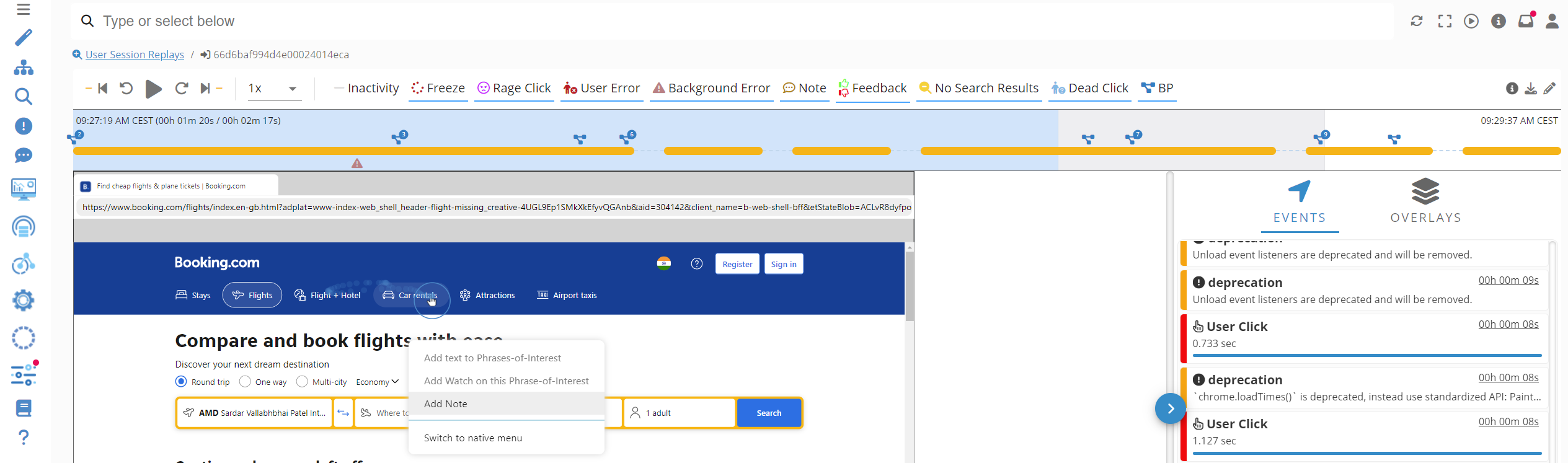
Create a Note at the exact moment or UI element where an issue occurs during Session Replay.
Notes can be added in two ways:
|
Method |
Action |
|---|---|
|
Timeline |
Right-click the Session Replay Timeline and select Add Note.
|
|
Element |
Right-click an element within the replay and select Add Note from the context menu.
|

After a timeline Note is created, a Note indicator appears at the corresponding point in the replay. Hover over the indicator to view the associated message.
This allows teams to annotate the precise moment when a user encountered confusion, an error, a delay, a rage click, a dead end, or another experience issue.
✏️ Create a Note
To create a Note:
-
Open the relevant dashboard, metric, instance, Analysis Dashboard, or Session Replay.
-
Select Add Note from the available actions or context menu.
-
Enter a clear description of the issue, observation, or requested action.
-
Assign the Note to the appropriate user, when applicable.
-
Save the Note.
The Note remains associated with the GermainUX context from which it was created.
💡 Writing an Effective Note
A useful Note should explain:
|
Question |
What to include |
|---|---|
|
What happened: |
The issue or observation |
|
Business impact: |
How it affects users, conversion, adoption, productivity, or technology performance |
|
Who or what is affected: |
Relevant users, sessions, applications, pages, processes, products, environments, or versions |
|
Evidence: |
Metrics, trends, Leading Factors, traces, errors, or Session Replay findings |
|
Next action: |
What should be investigated, corrected, or validated |
|
Owner: |
The person responsible for the next step |
Example:
Salesforce record-view actions are degraded by 45.5% compared with the recent baseline, affecting three users across ten sessions. Analysis indicates increased server wait time on the related Lightning request, accompanied by user-facing errors and rage clicks. Please investigate the backend response-time increase and add the findings to this Note.
👥 Assign a Note
A Note can be assigned to a GermainUX user so that responsibility for the next action is clear.
Assignment can be used to route work to:
|
Role |
|---|
|
Application owners |
|
Developers |
|
Support teams |
|
SRE or operations teams |
|
Product managers |
|
UX teams |
|
Business-process owners |
|
Conversion teams |
|
Other responsible users |
The assignee can review the Note in GermainUX, return to its original context, and add comments or updates.
💬 Comment and Collaborate
Users can add comments to an existing Note as the investigation progresses.
Comments can be used to:
|
Purpose |
|---|
|
Ask for additional information |
|
Record diagnostic findings |
|
Share a proposed solution |
|
Document corrective actions |
|
Confirm that a fix was deployed |
|
Record validation results |
|
Communicate the current status to other participants |
Keeping comments in the Note preserves the history of the investigation alongside the supporting evidence.
📧 Email Notifications
GermainUX automatically sends an email when a Note is created or updated.
Notifications help assignees and participants remain informed without continuously monitoring the Notes Dashboard.
The email directs recipients back to the Note and its associated GermainUX context.
📁 Manage Notes
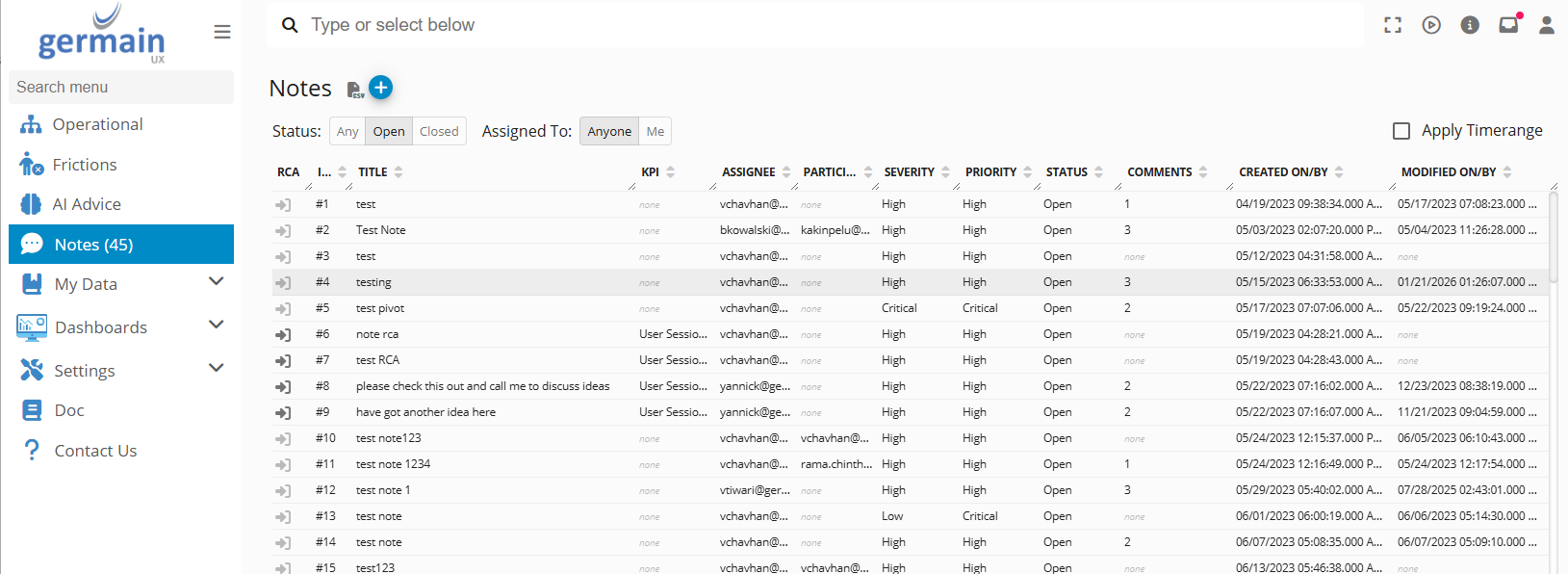
To view and manage all Notes, go to:
Germain Workspace > Notes
The Notes Dashboard provides a centralized view of tickets created across GermainUX.
Use it to:
|
Action |
|---|
|
Review existing Notes |
|
Find Notes assigned to a user |
|
Open the dashboard, metric, instance, or session associated with a Note |
|
Read the discussion and investigation history |
|
Add comments |
|
Update the assignment |
|
Continue the investigation |
⚙️ Recommended Workflow
🔎 1. Detect
Identify an issue through a dashboard, alert, SLA violation, Friction Dashboard, Analysis Dashboard, or Session Replay.
🔬 2. Analyze
Determine the business impact, affected population, related signals, Leading Factors, and likely cause.
📓 3. Create a Note
Create the Note directly from the most relevant metric, instance, or Session Replay moment.
👤 4. Assign
Assign the Note to the person responsible for the next action.
🤝 5. Collaborate
Add findings, questions, decisions, and corrective actions as comments.
🛠️ 6. Correct
Implement the appropriate business, UX, workflow, configuration, or technology change.
✅ 7. Validate
Return to the original metric or session context to confirm that the issue has been resolved and document the result in the Note.
🔁 Notes and External Ticketing Systems
The GermainUX Notes system can be used as the primary ticketing workflow for issues discovered through GermainUX.
It can also complement external systems such as Jira, GitHub, Rally, or another enterprise ticketing platform. In that case, the GermainUX Note can preserve the detailed monitoring and analytical evidence while the external ticket supports the organization's broader development or service-management process.
Feature Availability: 8.6.0 or later