
GermainUX Categorization automatically groups similar errors, exceptions, crashes, and other events. This helps teams separate known issues from newly detected ones, reduce duplicate noise, and prioritize the problems that require investigation.
⚙️ Categorization overview
Categorization is preconfigured for many applications built with standard technologies, including Java, Go, PHP, JavaScript, and C++.
 When custom categorization may be required
|
Condition |
|---|
|
An application generates complex or application-specific errors. |
|
Similar exceptions contain dynamic values that prevent direct matching. |
|
A crash must be identified using multiple attributes. |
|
Categorization requires data from multiple sources. |
|
The default category identifier needs a clearer business label. |
Custom logic can be implemented through a JavaScript processor.
🔑 Access Categorization
Go to:
Germain Workspace > Settings > Analytics > Categorization
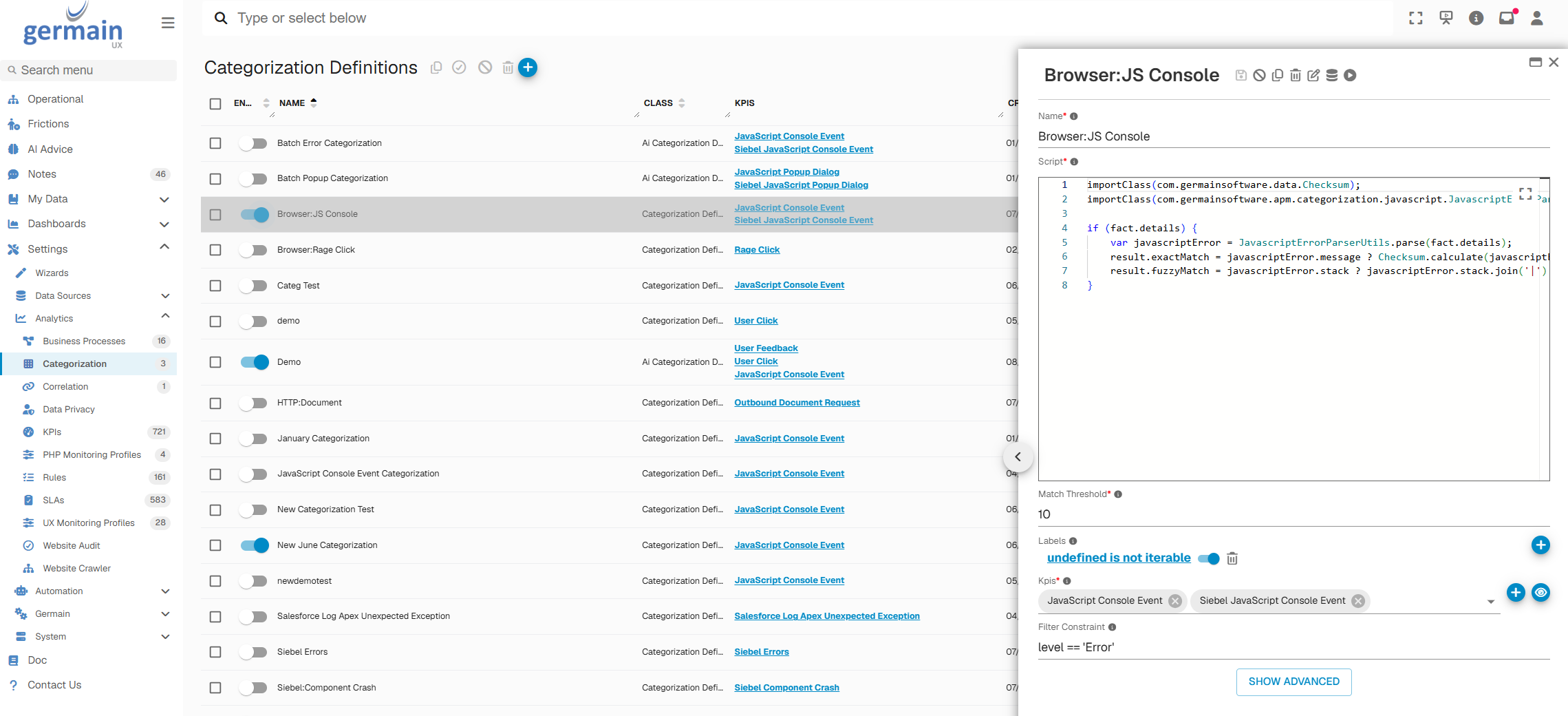
From this view, you can create, update, test, and manage categorization definitions.
💻 Technology-Specific Configuration
☕ Java Exceptions
Java exception categorization is generally available out of the box. Custom processing can be added for application-specific exception structures or naming requirements.
For assistance, contact GermainUX.
🌐 JavaScript Errors
Errors captured by RUM JS or the RUM Browser Extension can be categorized using their message, stack trace, source, application, page, and other available attributes.
For assistance with custom JavaScript error categorization, contact GermainUX.
☁️ Salesforce Apex Exceptions
See Configure Salesforce Apex Exception Categorization.
📦 Oracle Siebel Object Manager Crashes
See Configure Siebel Object Manager Crash Categorization.
🏷️ Assign Human-Readable Category Labels
GermainUX automatically generates category IDs for identified groups of similar events. You can assign human-readable labels to these categories so users can understand and analyze them more easily.
For example, a generated category ID can be labeled as:
|
Example label |
|---|
|
Checkout payment failure |
|
Salesforce Apex governor-limit exception |
|
Siebel Object Manager crash |
|
JavaScript error in product search |
|
Authentication service timeout |

Human-readable labels improve dashboards, reports, alerts, filters, and error analysis without changing the underlying category logic.
✅ Validate Categorization
GermainUX includes a tester that applies the selected categorization logic to historical data before it is used for real-time analysis.
To validate a categorization:
-
Open Germain Workspace > Settings > Analytics > Categorization.
-
Select the categorization definition you want to test.
-
Select the historical time range to analyze.
-
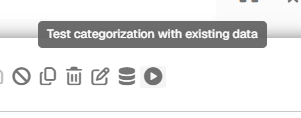
Click the Play button in the right-side panel.
Validate Categorization - GermainUX -
Review the events grouped under each identified category.
-
Refine the processor or labels if the results are too broad, too narrow, or unclear.
-
Repeat the test until the results accurately represent the issues you want to identify.
Testing against historical data helps confirm that the categorization logic produces meaningful results before it processes new events in real time.
📦 Additional Resources
-
Troubleshoot GermainUX
-
Management Features.
ℹ️ Get Help
The Germain Team can help you set this up. Contact GermainUX Support.
Service: Analytics
Feature Availability: 2015.1 or later