
✨ Configuration & Customization of GermainUX Analytics and Automation
GermainUX provides centralized management capabilities for configuring and administering its monitoring, analytics, automation, AI, data sources, security, user access, Session Replay, and platform operations.
Most configuration is performed from the Settings area of Germain Workspace. An additional Config Console is available for advanced or legacy configurations that are not yet accessible from Workspace.
Together, Workspace and the Config Console provide the controls required to configure, operate, and maintain a GermainUX environment.
⚙️ Settings
The Settings menu is the primary interface for configuring GermainUX. It is organized into six areas:
|
Area |
|---|
|
Wizards |
|
Data Sources |
|
Analytics |
|
Automation |
|
Germain |
|
System |
The options available to each user depend on their roles and permissions.
✨ Wizards
Wizards guide administrators through the configuration of GermainUX features and supported technologies.
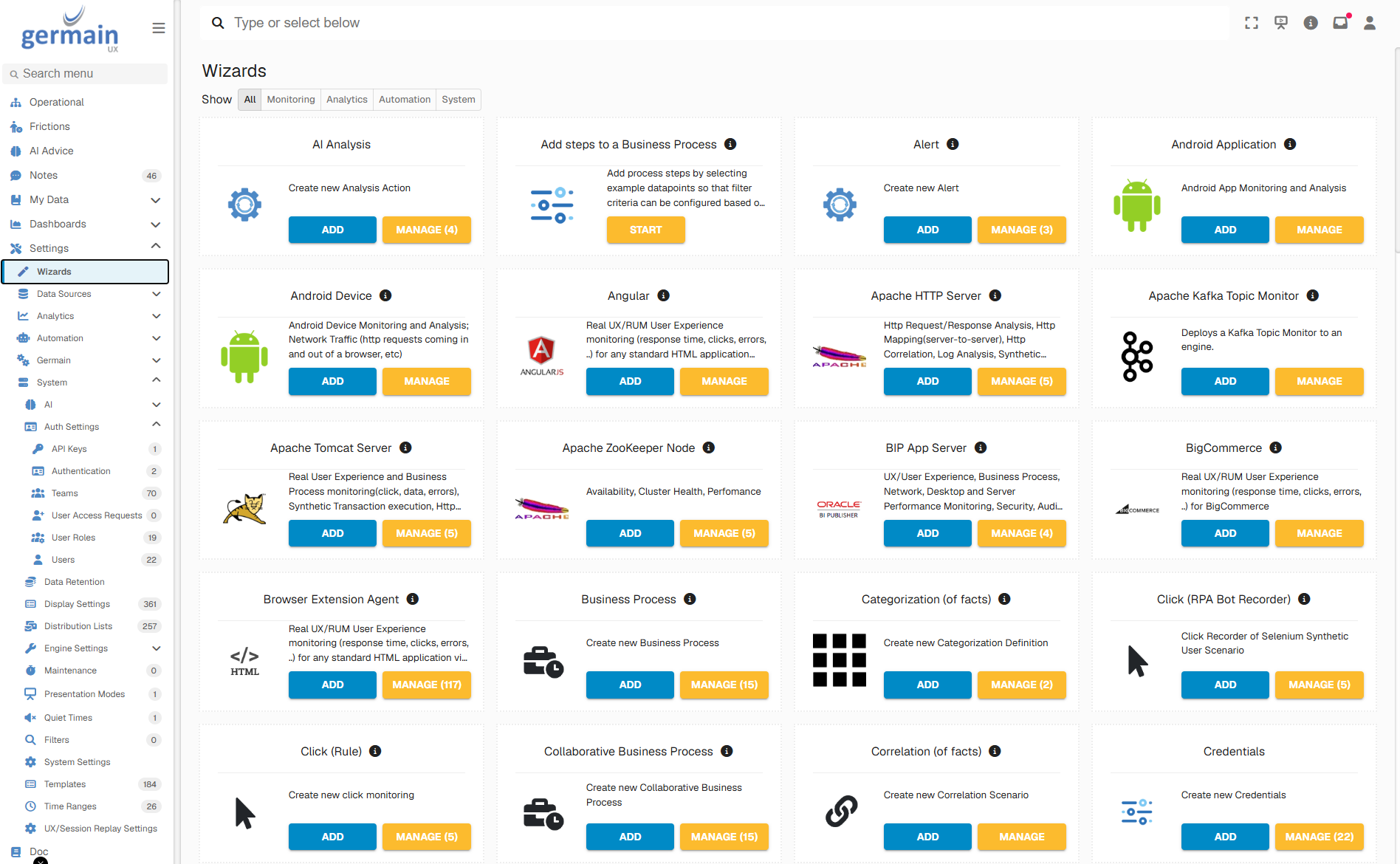
GermainUX provides:
|
Type |
Details |
|---|---|
|
Preconfigured Wizards |
for common monitoring, analytics, and automation use cases |
|
Custom Wizards |
for organization-specific configuration requirements |
Wizards reduce configuration time, promote consistency, and help administrators apply the appropriate settings without manually configuring every underlying component.
🗂️ Data Sources
Data Sources represent the applications, systems, services, infrastructure, and other resources from which GermainUX collects data or against which it executes transactions.
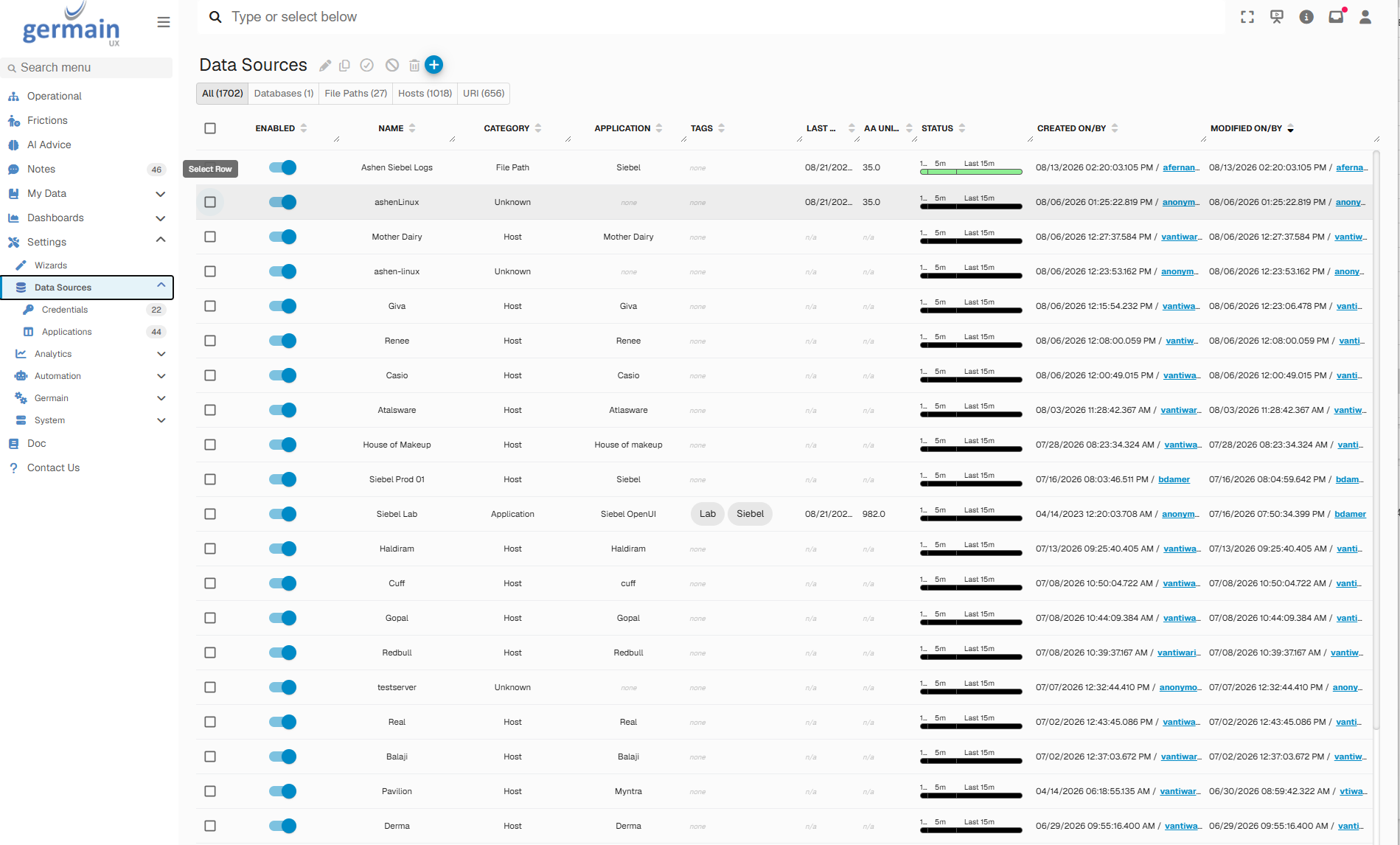
A data source can represent:
|
Type |
|---|
|
Web, mobile, or native applications |
|
CRM, ERP, and eCommerce platforms |
|
Application servers |
|
Databases |
|
APIs and web services |
|
Log files |
|
Cloud services |
|
Hosts, containers, and infrastructure |
|
Third-party systems |
Use Data Sources to define the systems GermainUX monitors, the applications to which they belong, and the credentials required to access them.
🔑 Credentials
Manage the credentials GermainUX uses to connect to monitored systems or execute transactions.
Credentials may be used for:
|
Use |
|---|
|
Application authentication |
|
API access |
|
Database connections |
|
SSH connections |
|
WMI connections |
|
Synthetic transactions |
|
Other authenticated monitoring or automation operations |
Access to credentials should be restricted to authorized administrators.
📦 Applications
Define and manage the applications associated with monitored data sources.
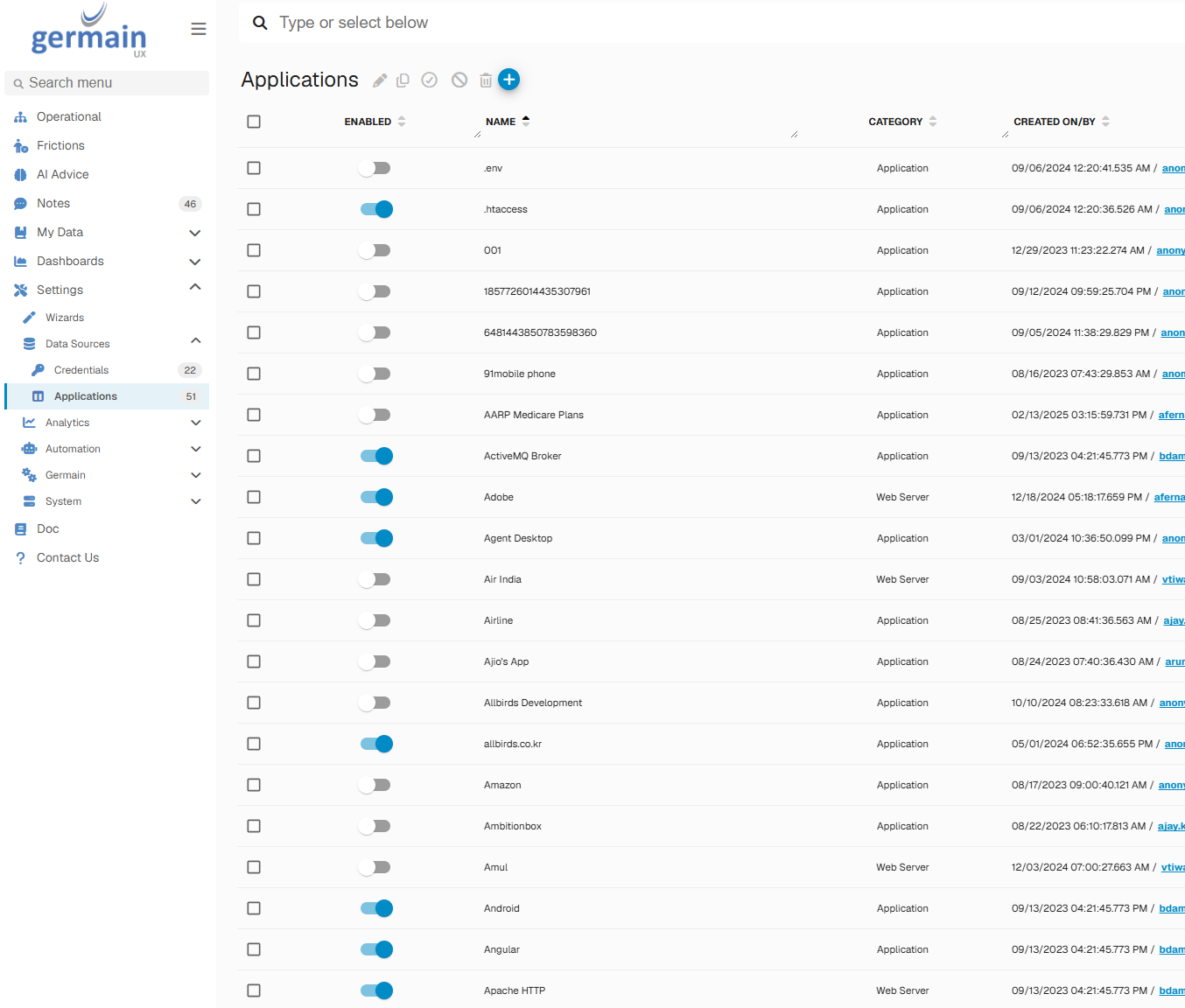
Application configuration helps organize collected data by:
|
Classification |
|---|
|
Application |
|
Environment |
|
Business function |
|
Technology |
|
Owner |
|
Other organization-specific classifications |
This makes it easier to filter, analyze, and report on data across the GermainUX platform.
📊 Analytics
Analytics settings determine how GermainUX interprets, organizes, correlates, evaluates, and protects collected data.
Use this area to configure the KPIs, SLAs, business processes, monitoring profiles, correlations, rules, privacy policies, and other definitions used by GermainUX automatic analytics.
📋 Business Processes
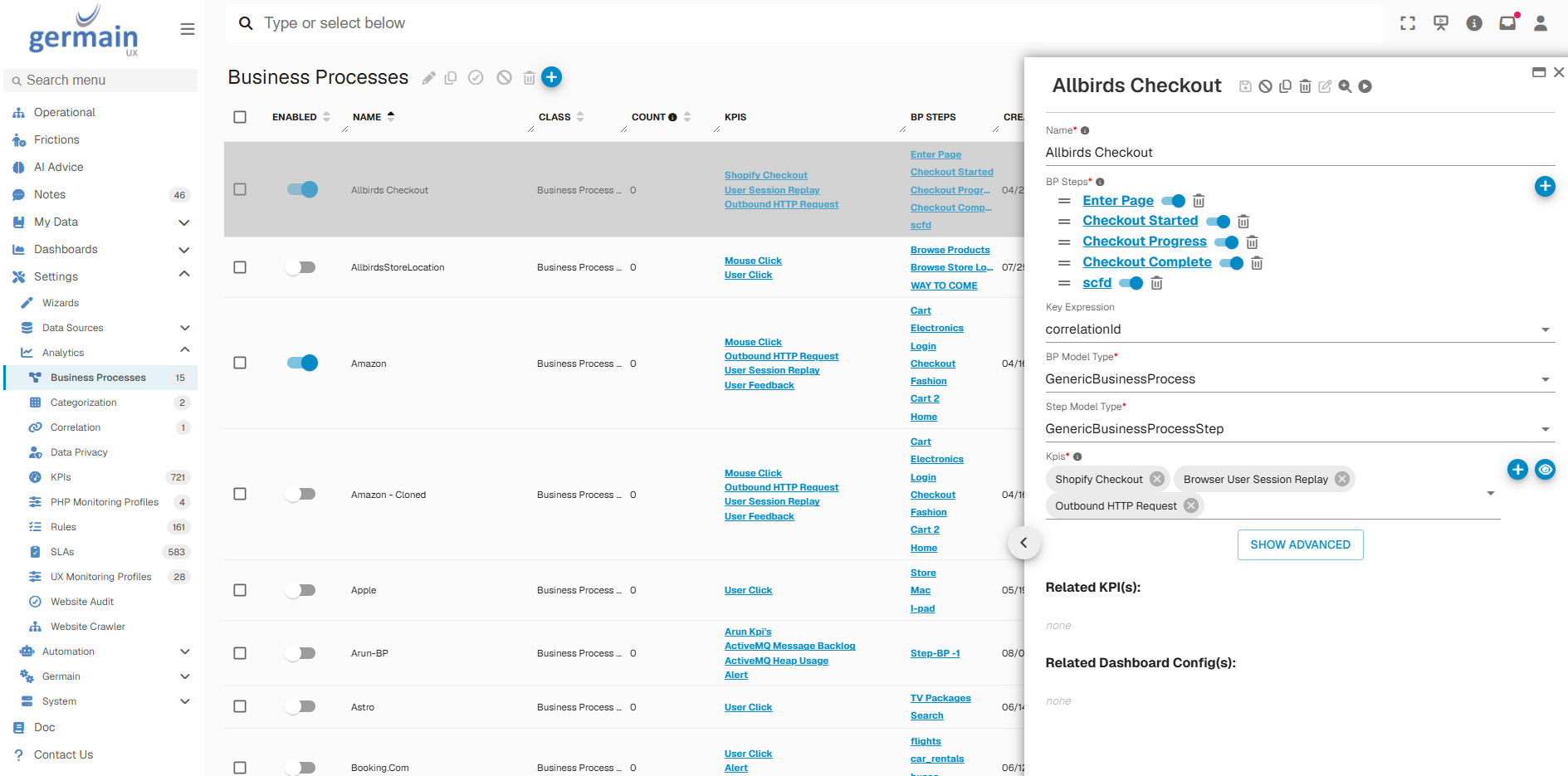
Define multi-step business processes, workflows, and user journeys.
Business Process configuration allows GermainUX to:
|
Capability |
|---|
|
Track progress across process milestones |
|
Measure completion and abandonment |
|
Detect drop-offs and stalled processes |
|
Identify workflow bottlenecks |
|
Calculate processing time and lost productivity |
|
Analyze adoption and conversion |
|
Determine which steps contribute most to business loss |
Examples include an eCommerce checkout, CRM data-entry process, employee onboarding workflow, insurance application, or customer-service procedure.
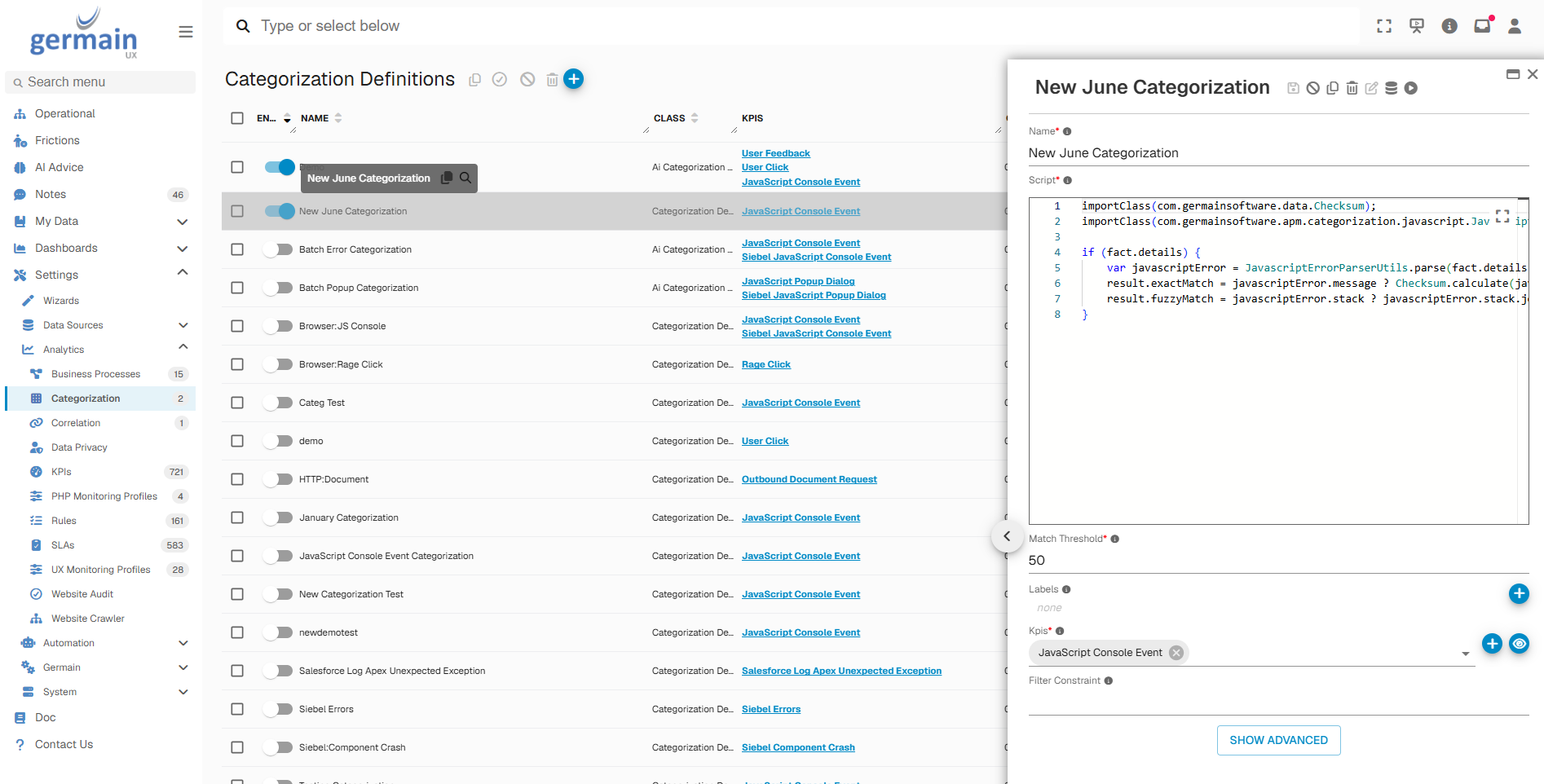
🏷️ Categorization
Convert raw values into meaningful categories that are easier to analyze.
Categorization can group errors, pages, user actions, products, workflows, technologies, or other values into business- or technology-relevant segments.
These categories can then be used in dashboards, filters, pivots, analytics, alerts, and reports.
🔗 Correlation
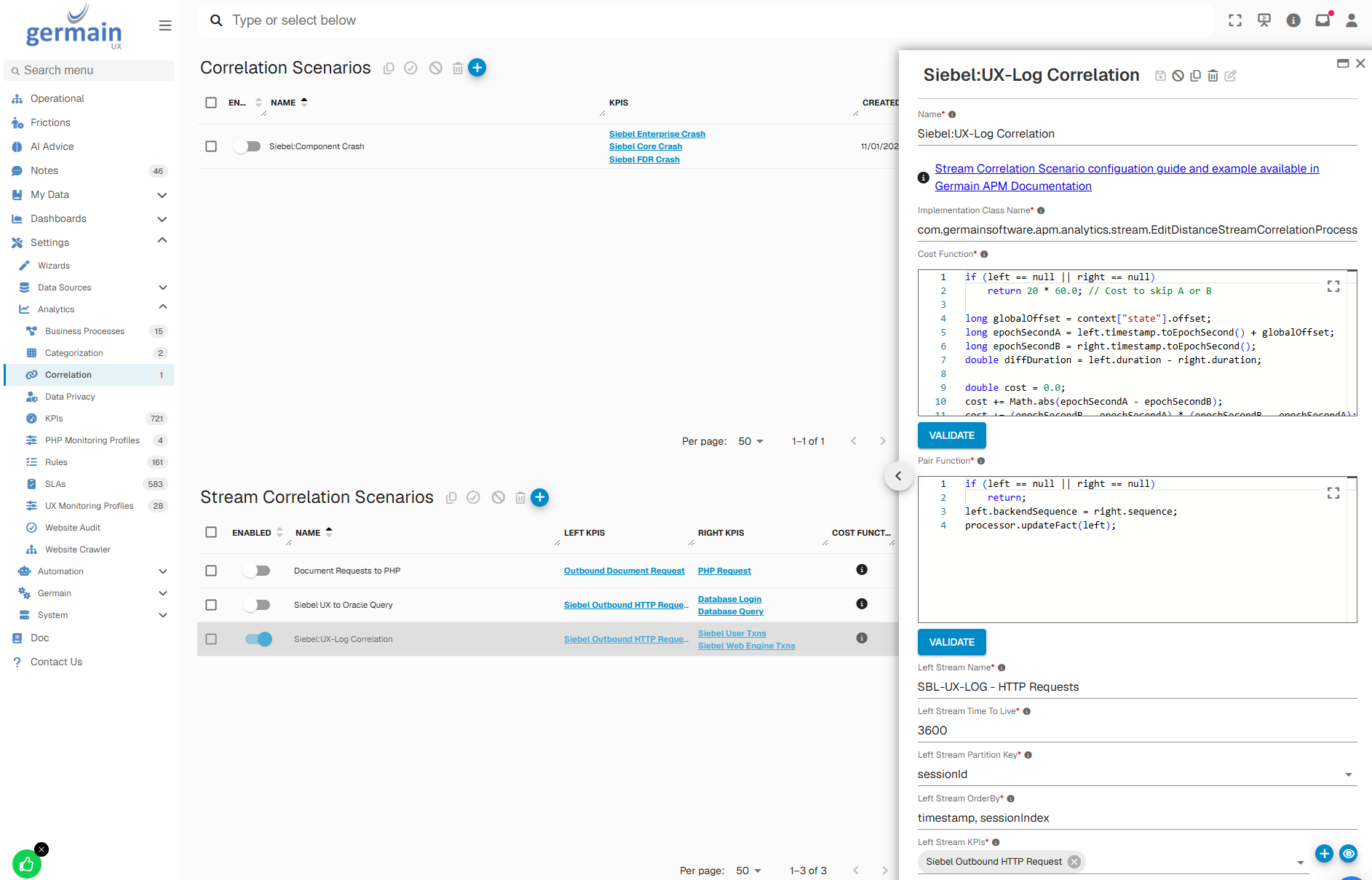
Configure how GermainUX connects related events and KPIs.
Correlation enables GermainUX to associate user actions, requests, errors, transactions, services, workflows, and other activity across an investigation.
It supports capabilities such as:
|
Capability |
|---|
|
End-to-end transaction tracing |
|
Related KPI analysis |
|
Root-cause investigation |
|
Cross-component analysis |
|
User-session reconstruction |
|
Business-impact attribution |
🔒 Data Privacy
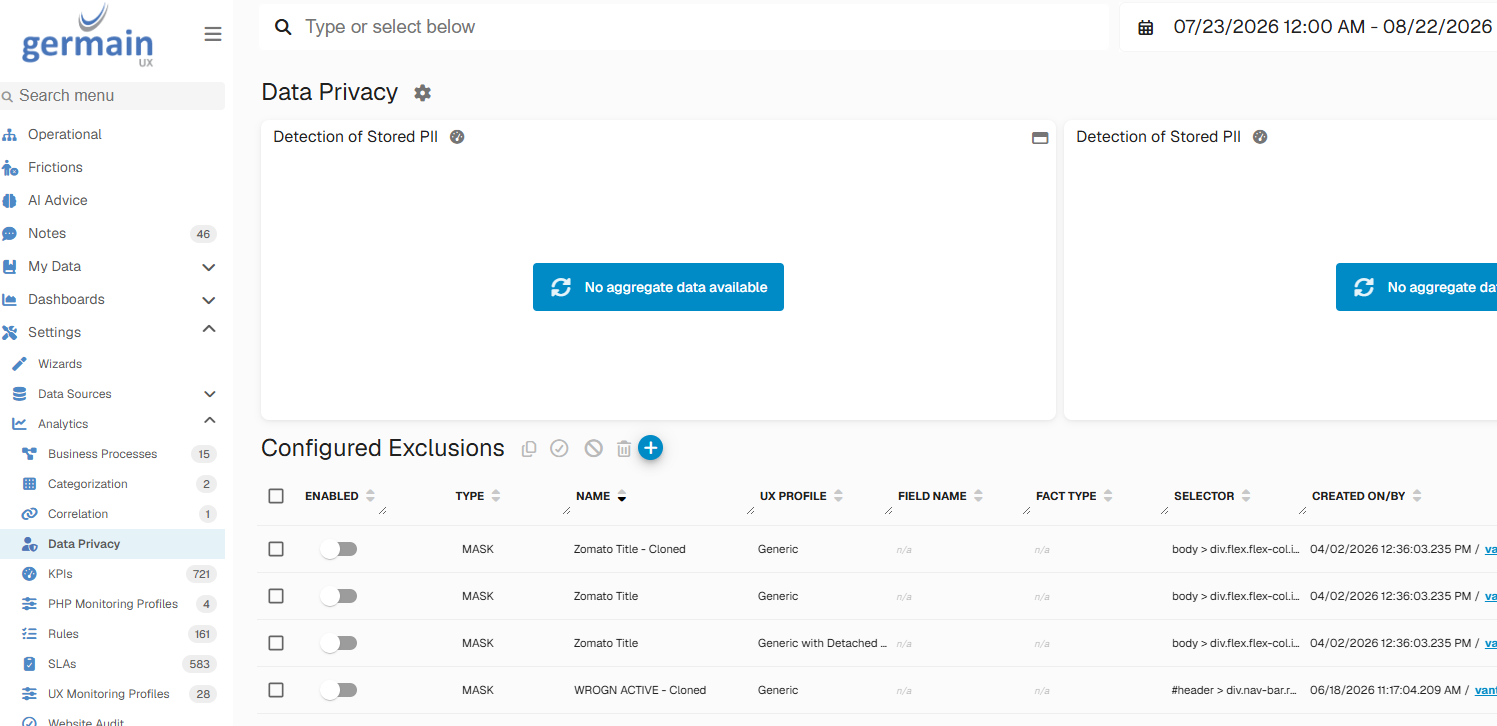
Configure how GermainUX protects sensitive information collected through monitoring, analytics, and Session Replay.
Data Privacy settings can be used to:
|
Action |
|---|
|
Mask sensitive values |
|
Anonymize personal information |
|
Exclude fields or elements from collection |
|
Redact captured content |
|
Apply application-specific privacy rules |
|
Protect data displayed in Session Replay and technical traces |
Privacy rules should be configured before monitoring production applications that may contain personal, confidential, regulated, or payment-related information.
🎯 KPIs
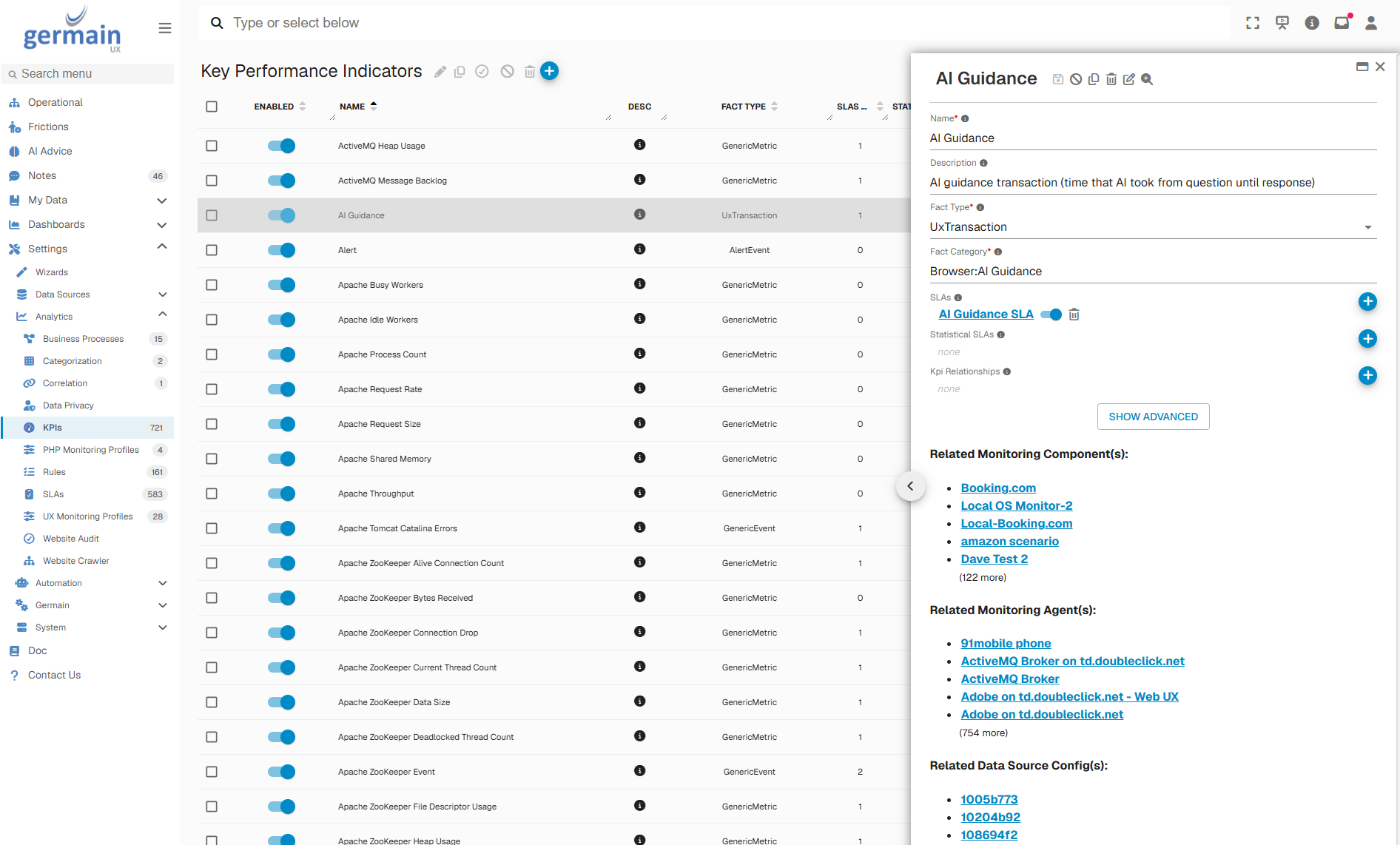
Define the Key Performance Indicators analyzed and displayed by GermainUX.
A KPI can represent:
|
Represents |
|---|
|
A business outcome |
|
A user action |
|
A workflow milestone |
|
A conversion |
|
An error |
|
A transaction |
|
A performance measurement |
|
A system metric |
|
An alert |
|
Another measurable event or condition |
KPI configuration can include:
|
Setting |
|---|
|
Name and description |
|
Fact type and category |
|
Measures |
|
Dimensions |
|
Display names |
|
SLAs |
|
Statistical SLAs |
|
Relationships |
|
Matching fields |
|
Scoring and visualization behavior |
KPIs are used throughout GermainUX dashboards, automatic analytics, alerts, reports, Analysis Dashboards, and automations.
PHP Monitoring Profiles
Configure how GermainUX monitors PHP applications.
PHP Monitoring Profiles determine which PHP activity, transactions, performance data, errors, and related technical information GermainUX collects and analyzes.
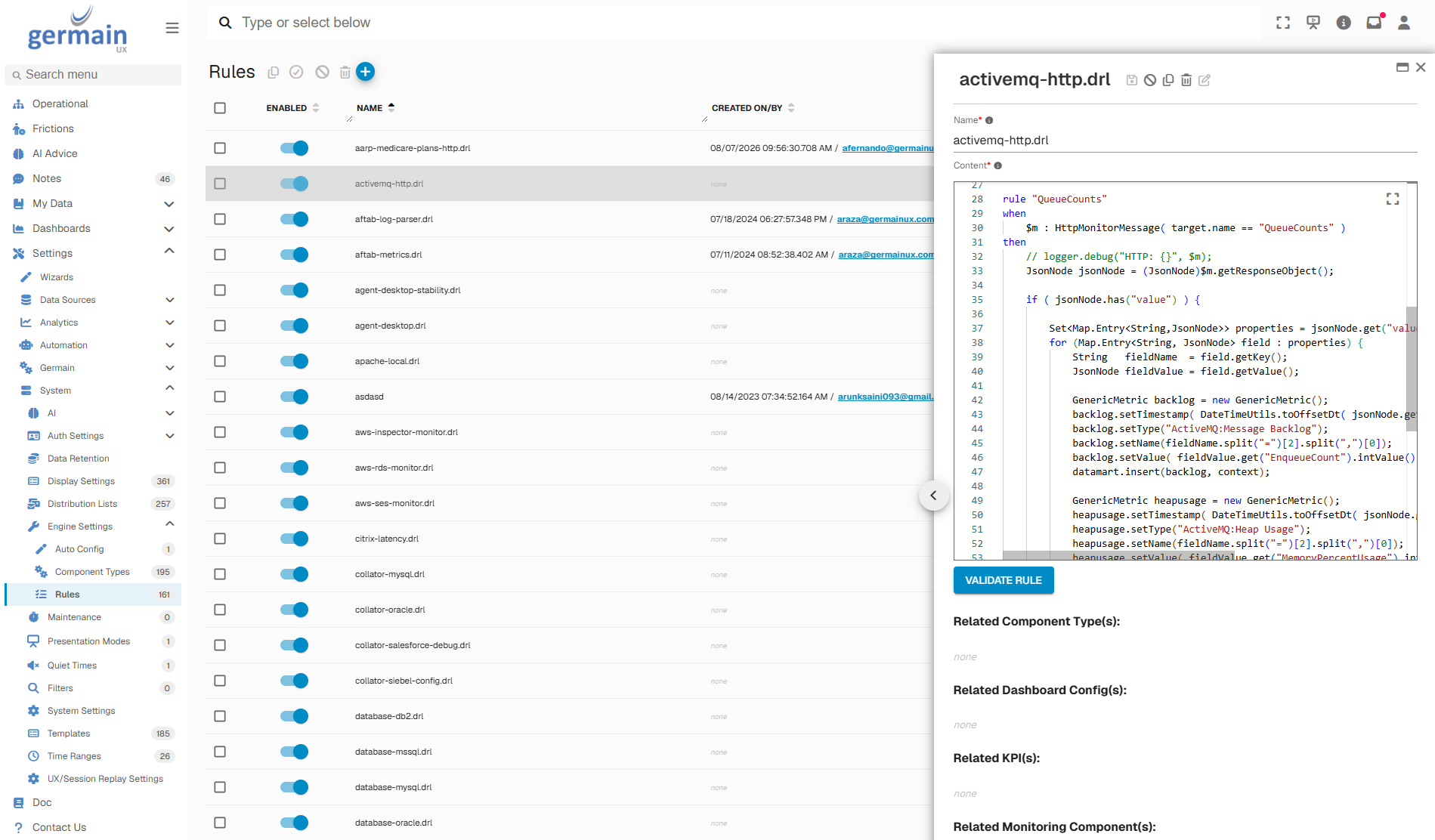
Rules
Define conditions used to identify, classify, or process monitored data.
Rules can support:
|
Function |
|---|
|
Issue and friction detection |
|
Data enrichment |
|
Categorization |
|
Alerting |
|
Automation |
|
KPI generation |
|
Business-process analysis |
|
Other configurable analytics behavior |
SLAs
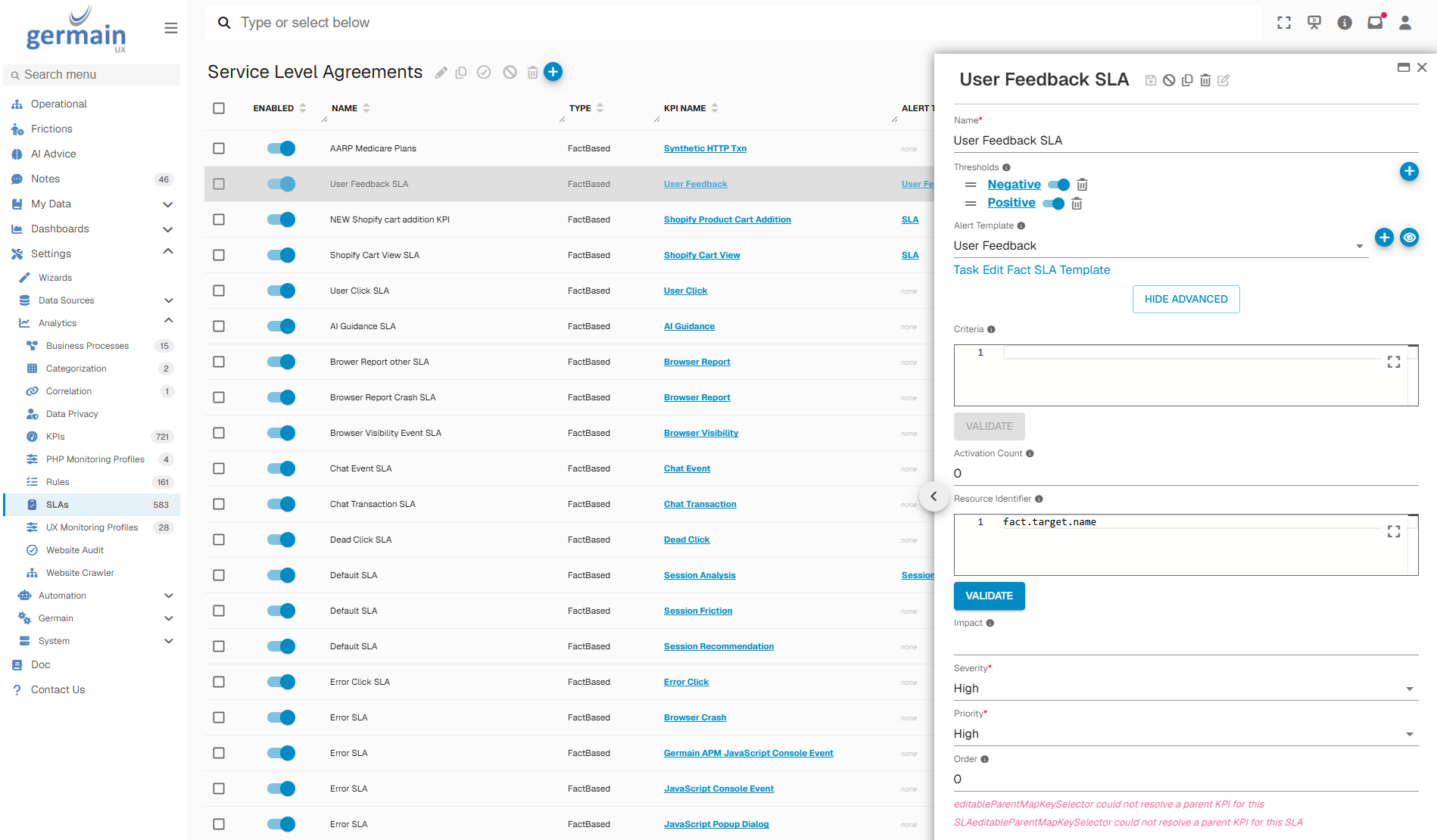
Define the thresholds and conditions GermainUX uses to determine whether a KPI is performing as expected.
SLAs can specify:
|
Attribute |
|---|
|
Acceptable and unacceptable values |
|
Severity and priority |
|
Fixed thresholds |
|
Statistical or baseline-relative thresholds |
|
Violation conditions |
|
Email priority |
|
Actions triggered when a violation occurs |
SLA configuration drives KPI status, dashboard coloring, violations, alerts, prioritization, and automatic analysis.
UX Monitoring Profiles
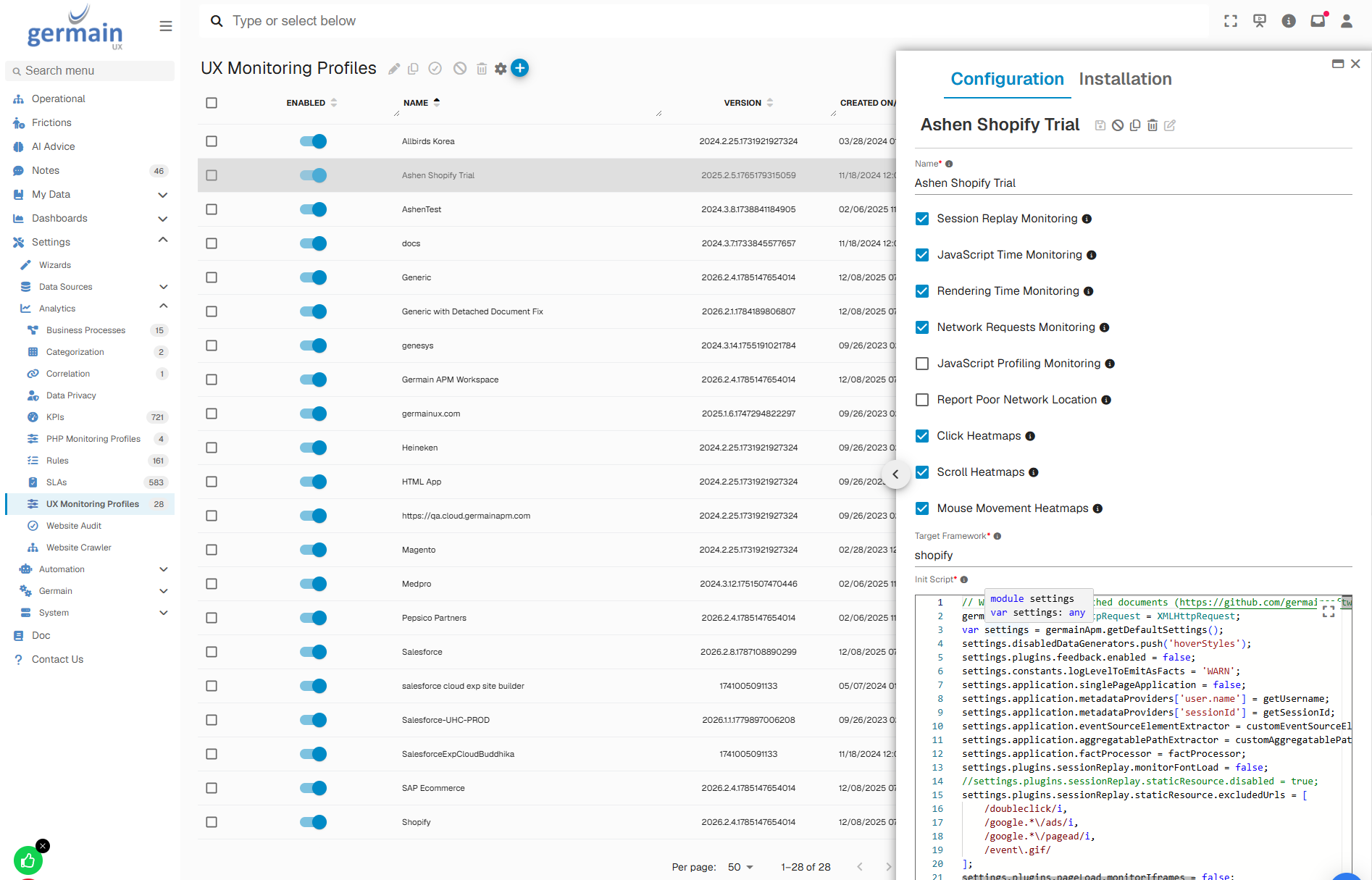
Configure the user-experience data GermainUX collects from web or native applications.
Depending on the monitored technology, a UX Monitoring Profile can control the collection of:
|
|
|---|
|
User actions |
|
Clicks and key presses |
|
Page and screen changes |
|
Navigation |
|
Errors |
|
Rage clicks and dead clicks |
|
Search activity |
|
Performance measurements |
|
User sessions |
|
Session Replay |
|
Other UX-related events |
Privacy and capture requirements should be reviewed when configuring UX Monitoring Profiles.
Website Audit
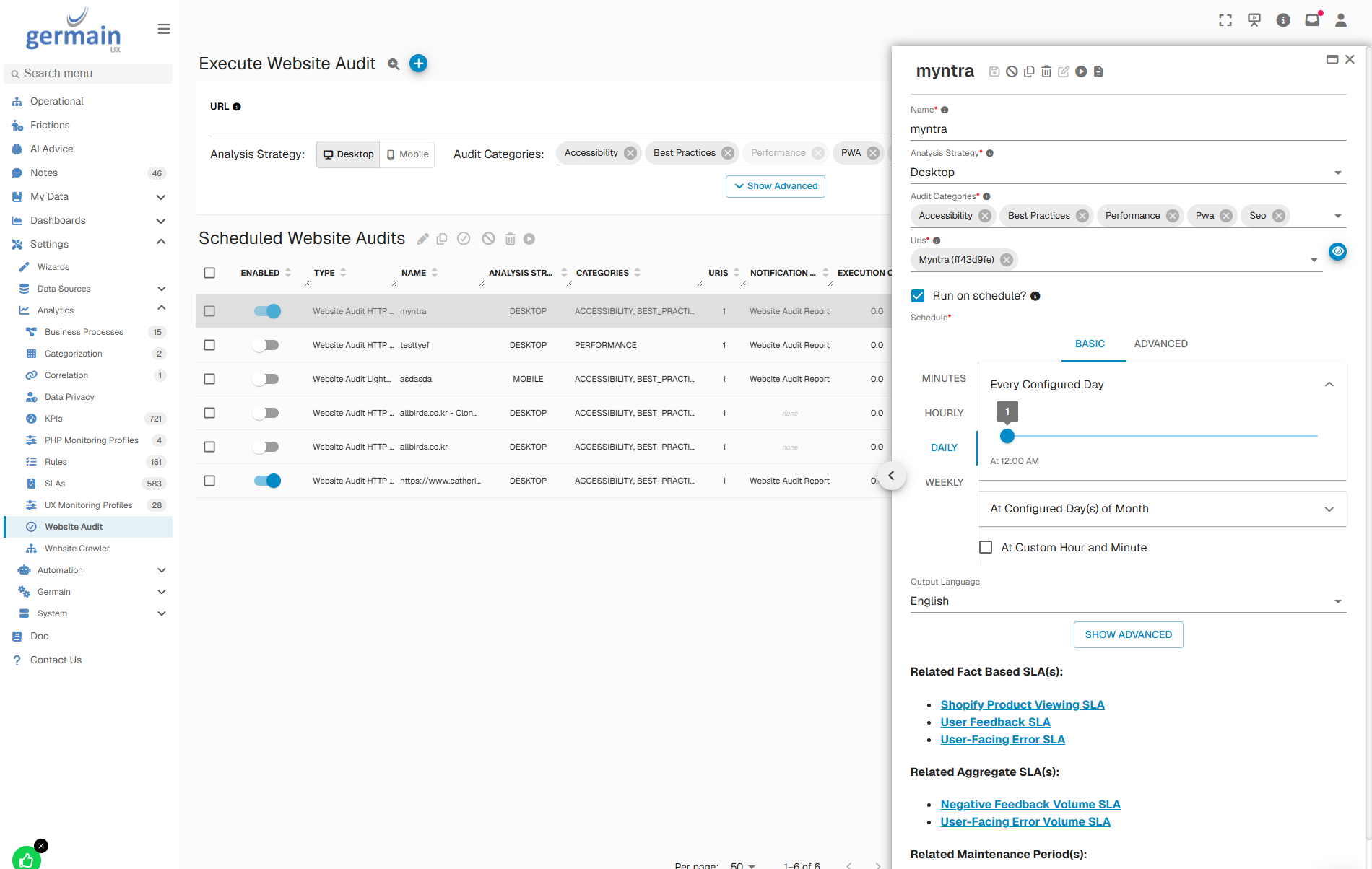
Configure automated website quality and performance assessments.
Website Audit can evaluate areas such as:
-
Performance
-
Accessibility
-
Search-engine optimization
-
Website quality
-
Technical best practices
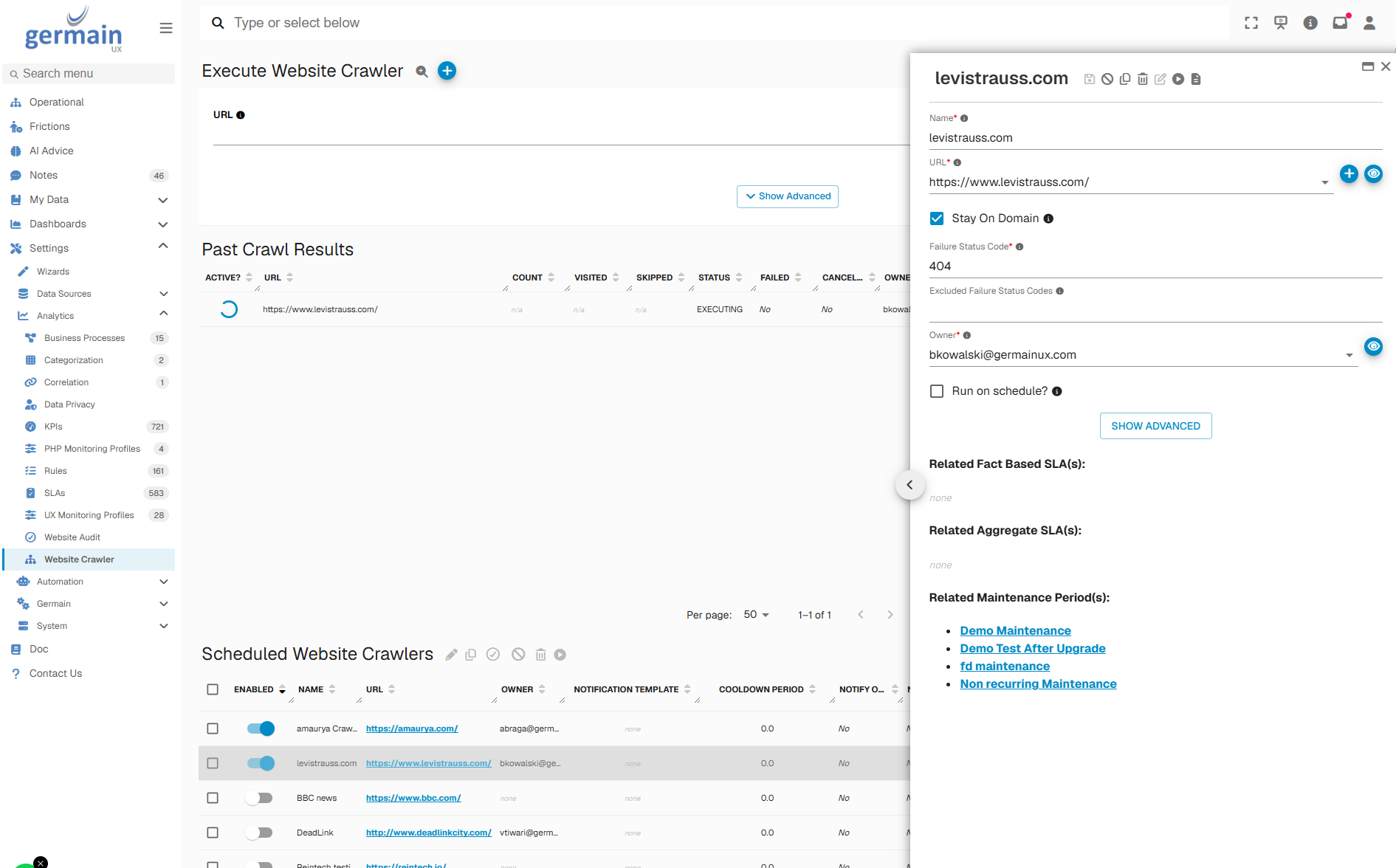
Website Crawler
Configure automated crawling of websites and web applications.
The Website Crawler can discover and inspect pages, links, resources, and structural website issues. It can be used to support website audits, availability checks, and other automated analysis.
🤖 Automation
Automation settings define the actions GermainUX can execute automatically or on demand.
Automations can be triggered by:
|
Trigger |
|---|
|
SLA violations |
|
Detected issues or frictions |
|
Monitoring events |
|
Watches |
|
Schedules |
|
User actions |
|
Other configured conditions |
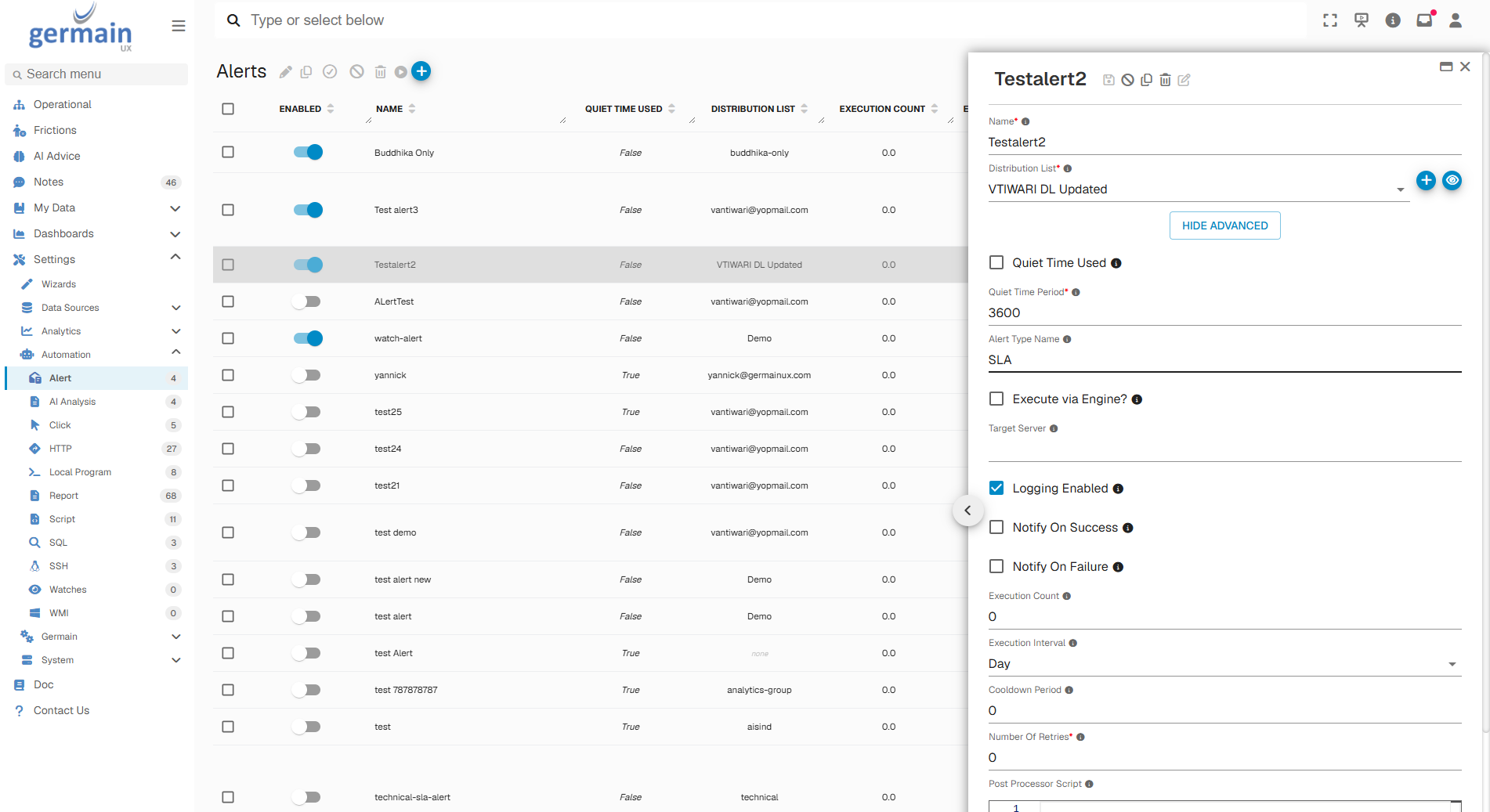
Alert
Configure alerts and notifications generated when specified conditions occur.
Alerts can communicate:
|
Condition |
|---|
|
SLA violations |
|
Performance regressions |
|
Errors |
|
Availability problems |
|
Business-process issues |
|
User-experience frictions |
|
Other monitored conditions |
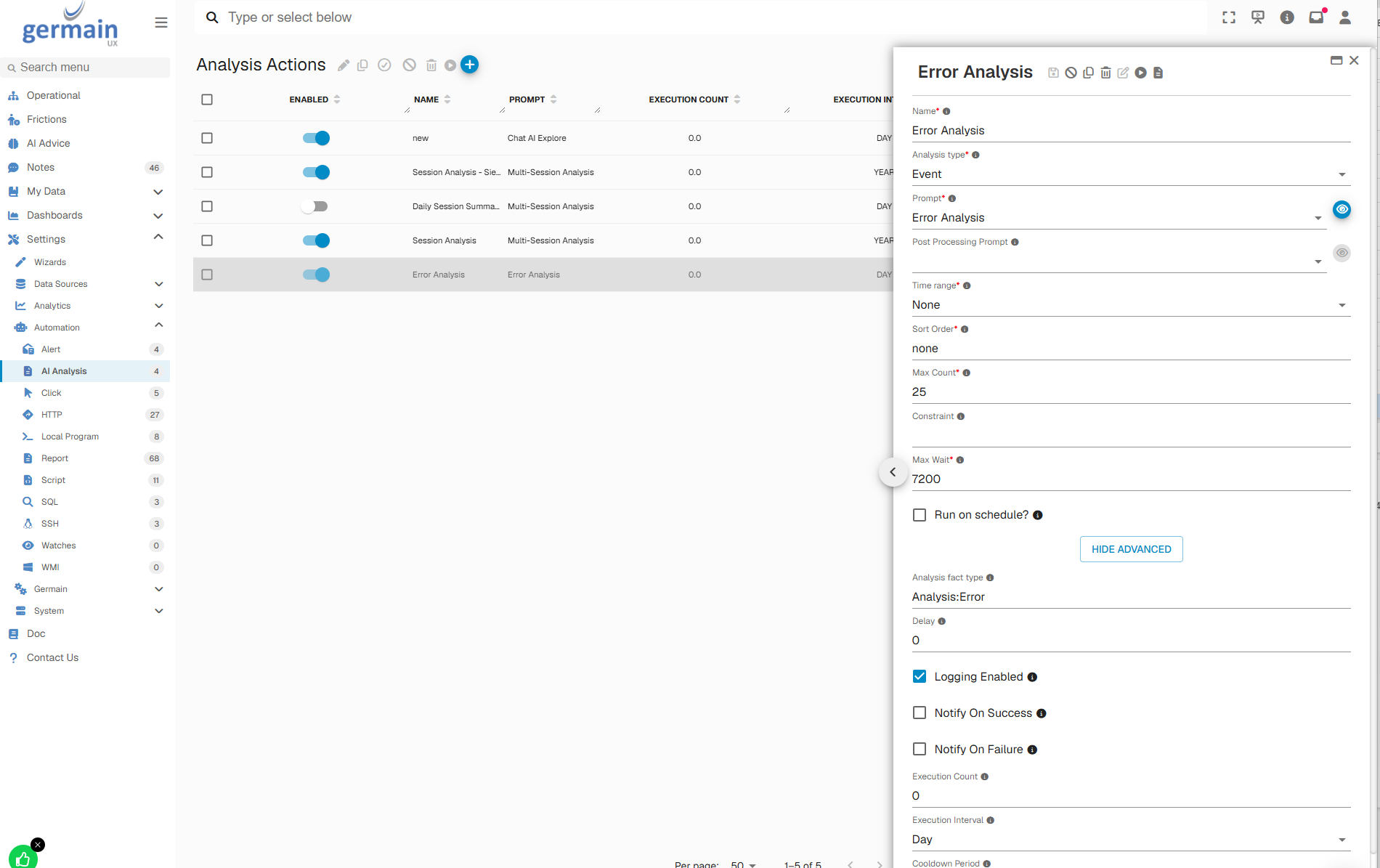
🧠 AI Analysis
Configure AI-powered analysis as an automated action.
AI Analysis can evaluate selected data or detected conditions and generate an explanation, summary, classification, or recommendation based on the configured prompt and AI settings.
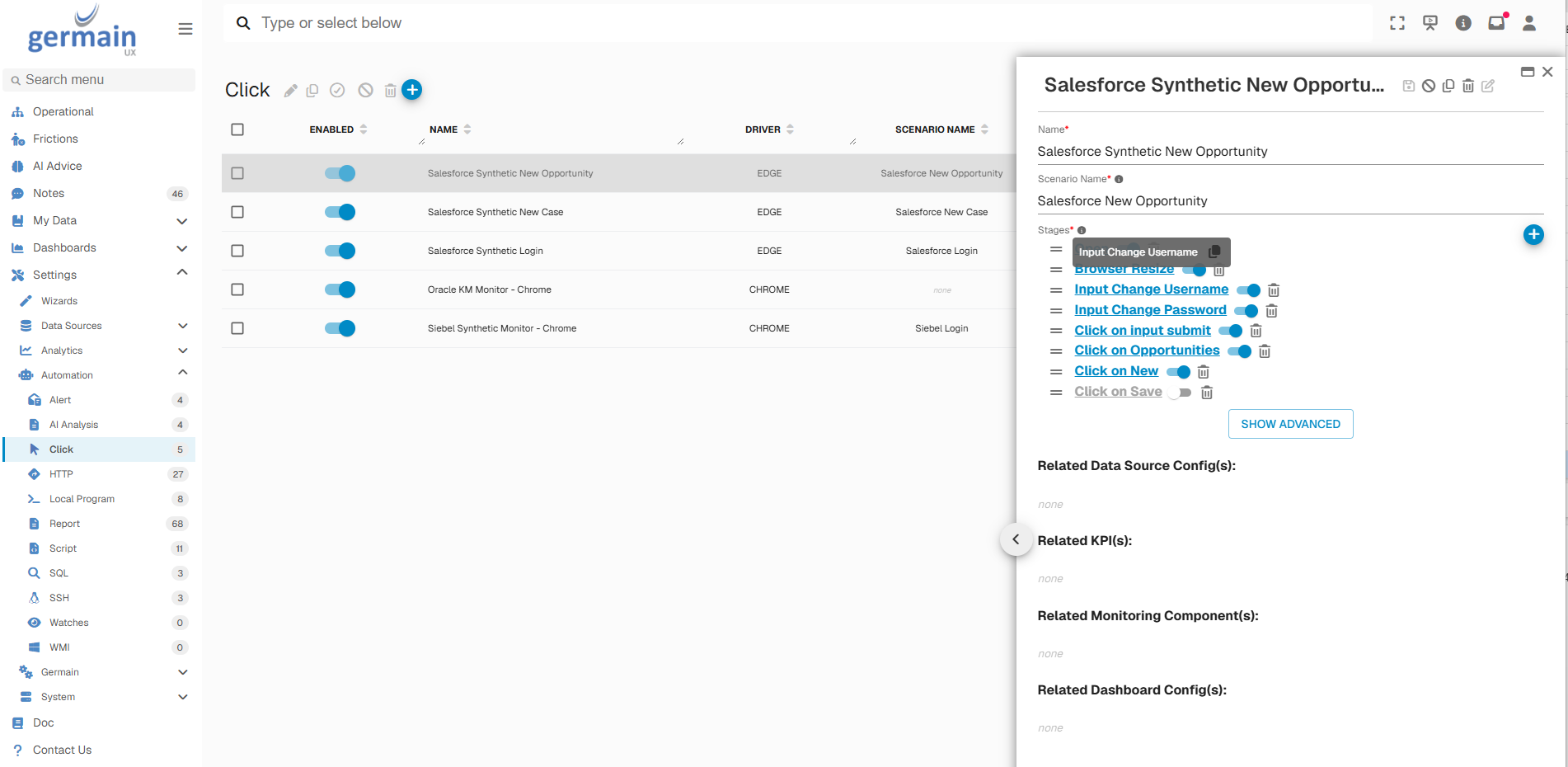
Click
Configure an automated click action as part of a synthetic transaction or automated workflow.
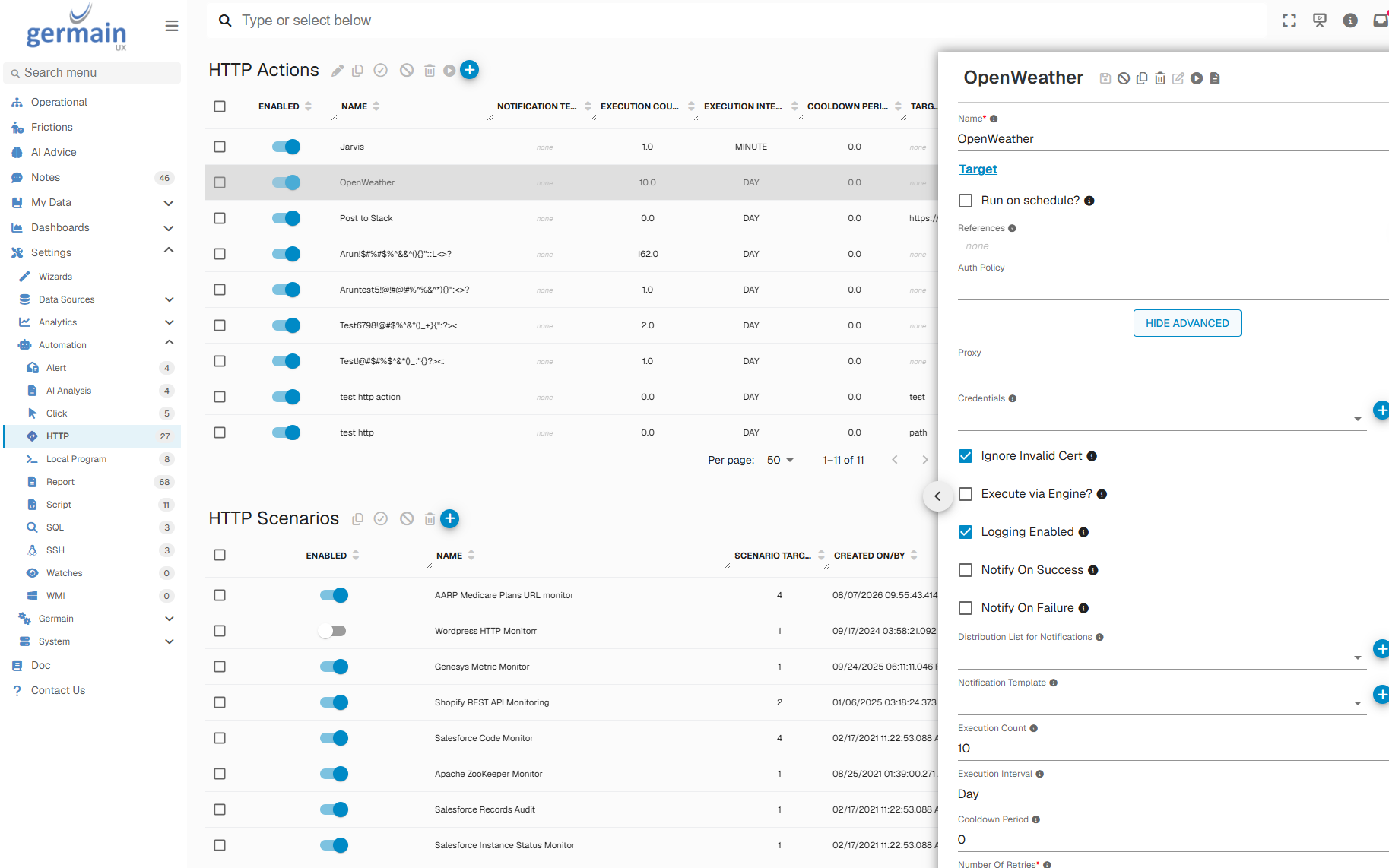
HTTP
Configure GermainUX to send an HTTP request.
HTTP actions can be used to:
|
Use |
|---|
|
Call an API |
|
Trigger a webhook |
|
Execute a remote operation |
|
Validate an endpoint |
|
Integrate GermainUX with another system |
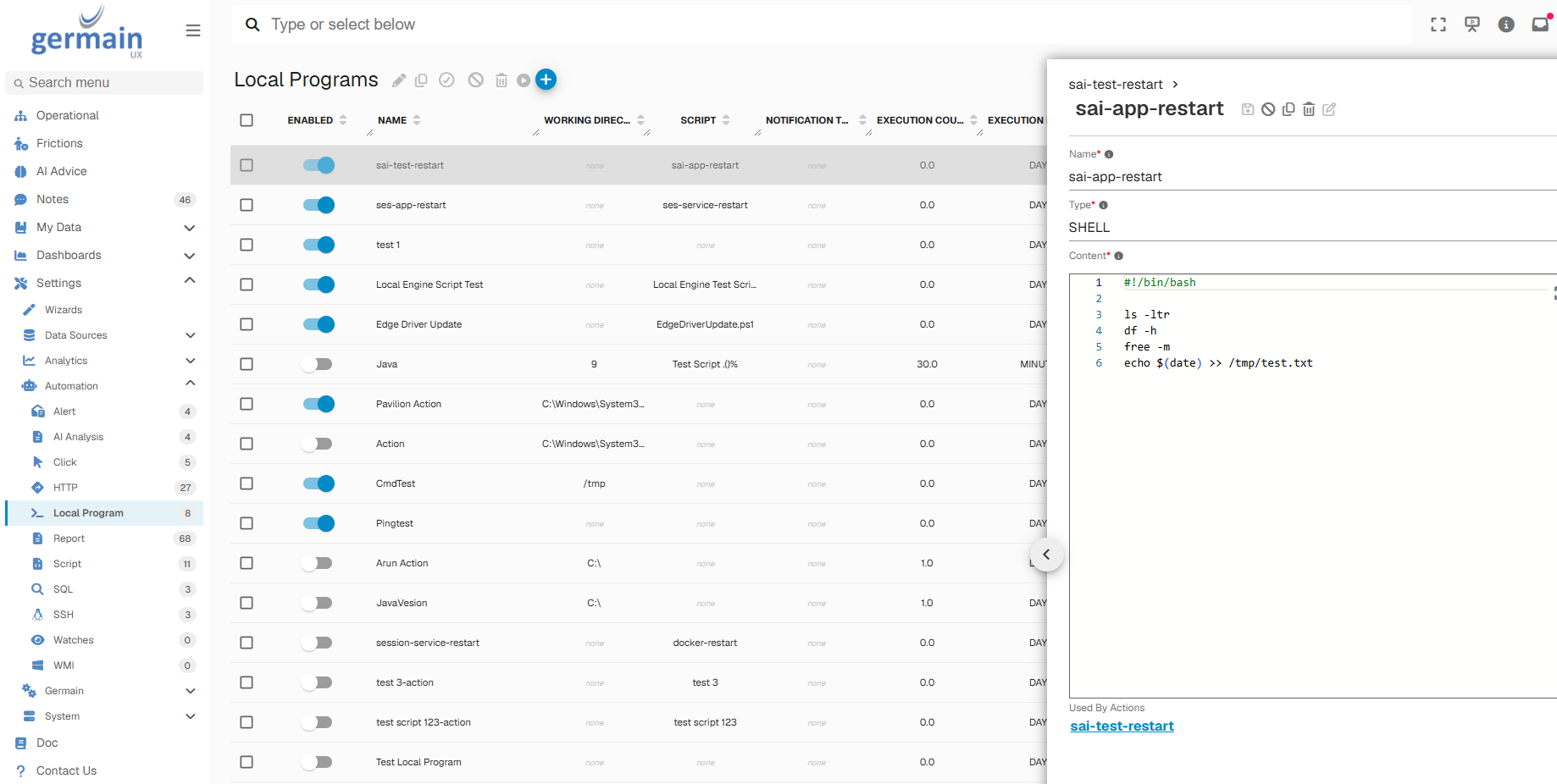
Local Program
Configure the execution of a program on an authorized local system.
This action can support custom integrations, administrative operations, validation, or remediation workflows.
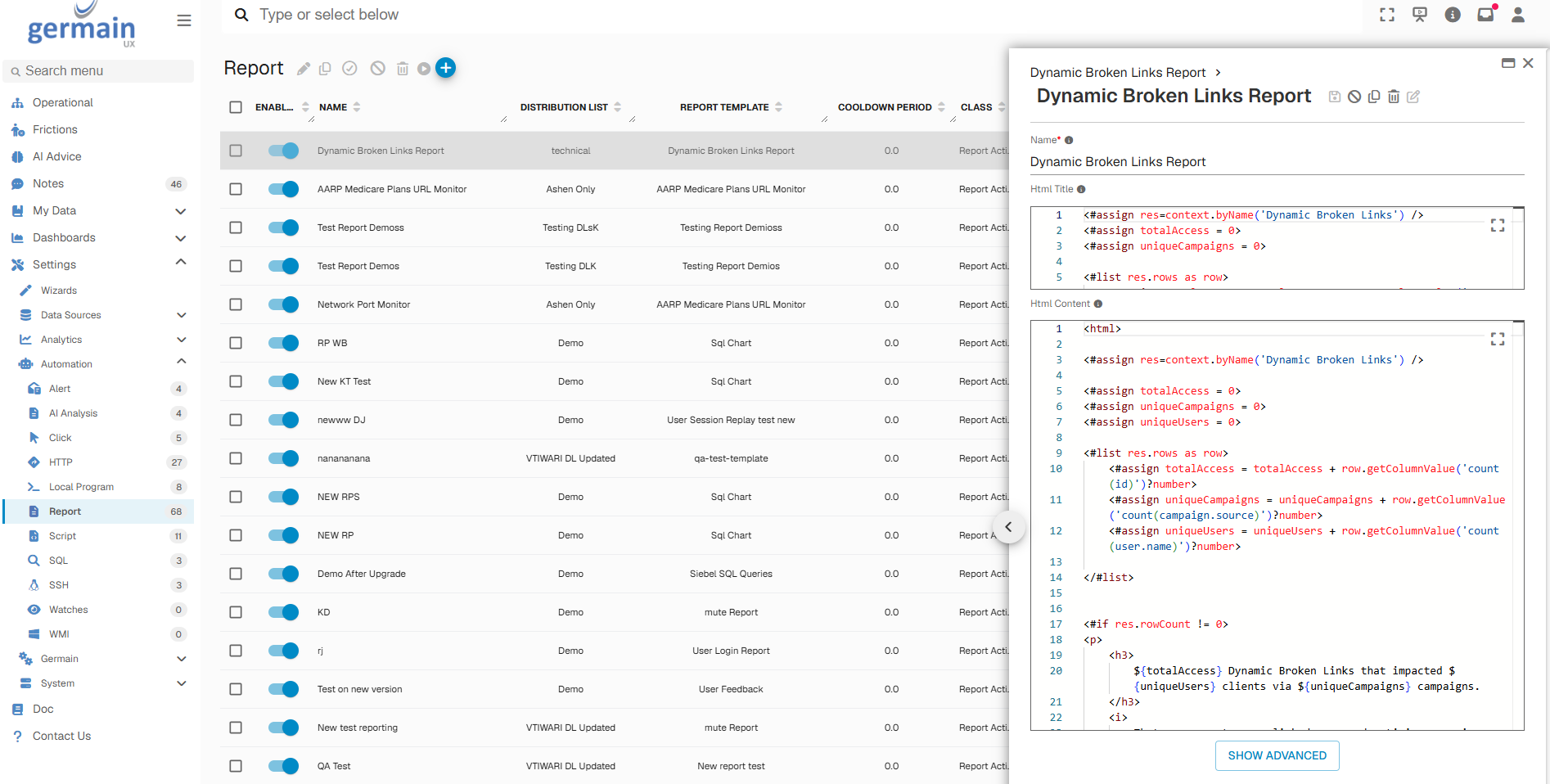
Report
Configure the automatic generation or distribution of a GermainUX report.
Reports can be created or delivered according to a schedule or in response to a monitored condition.
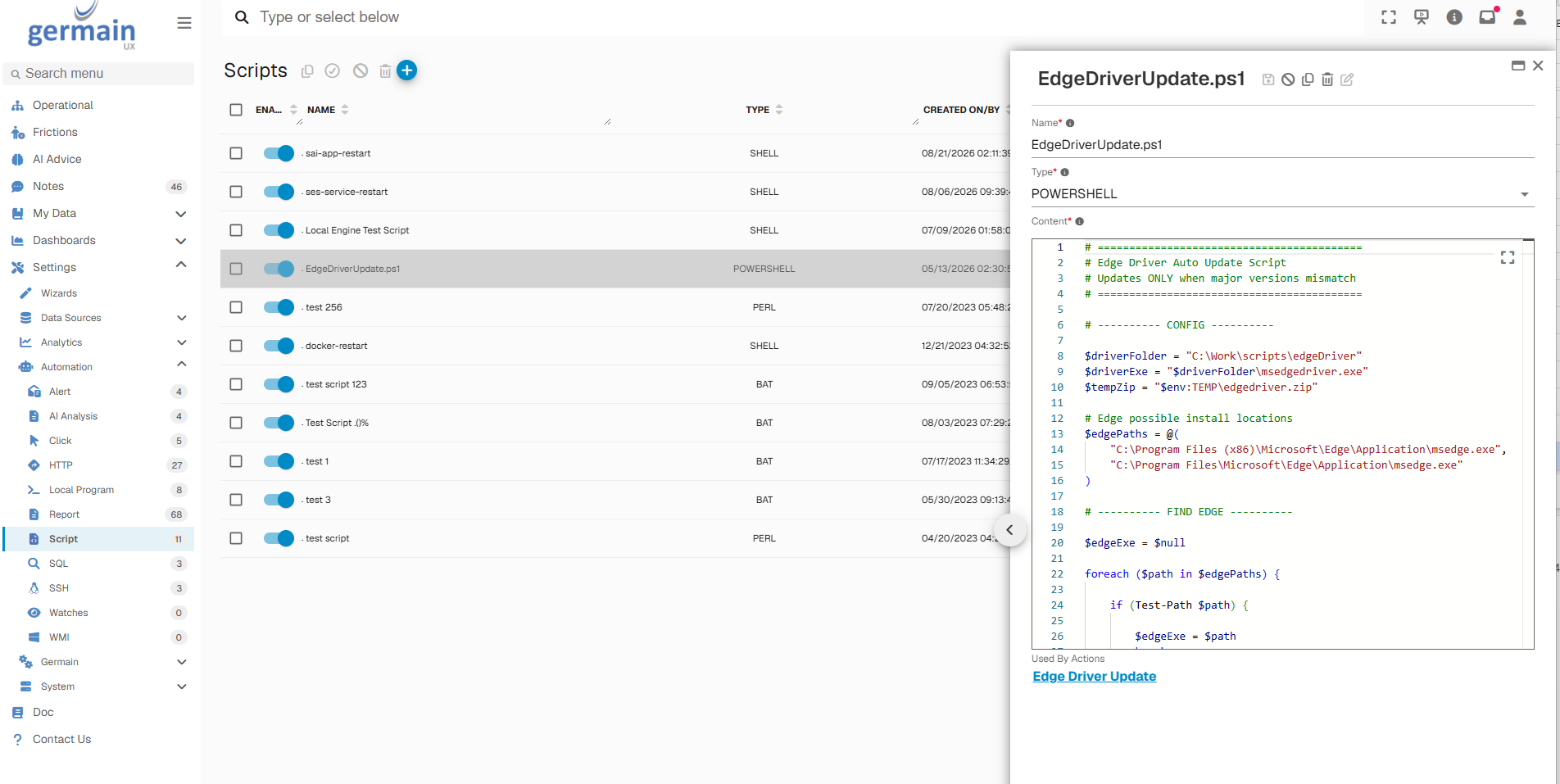
Script
Configure the execution of a script.
Scripts can support custom processing, integrations, validation, enrichment, or remediation.
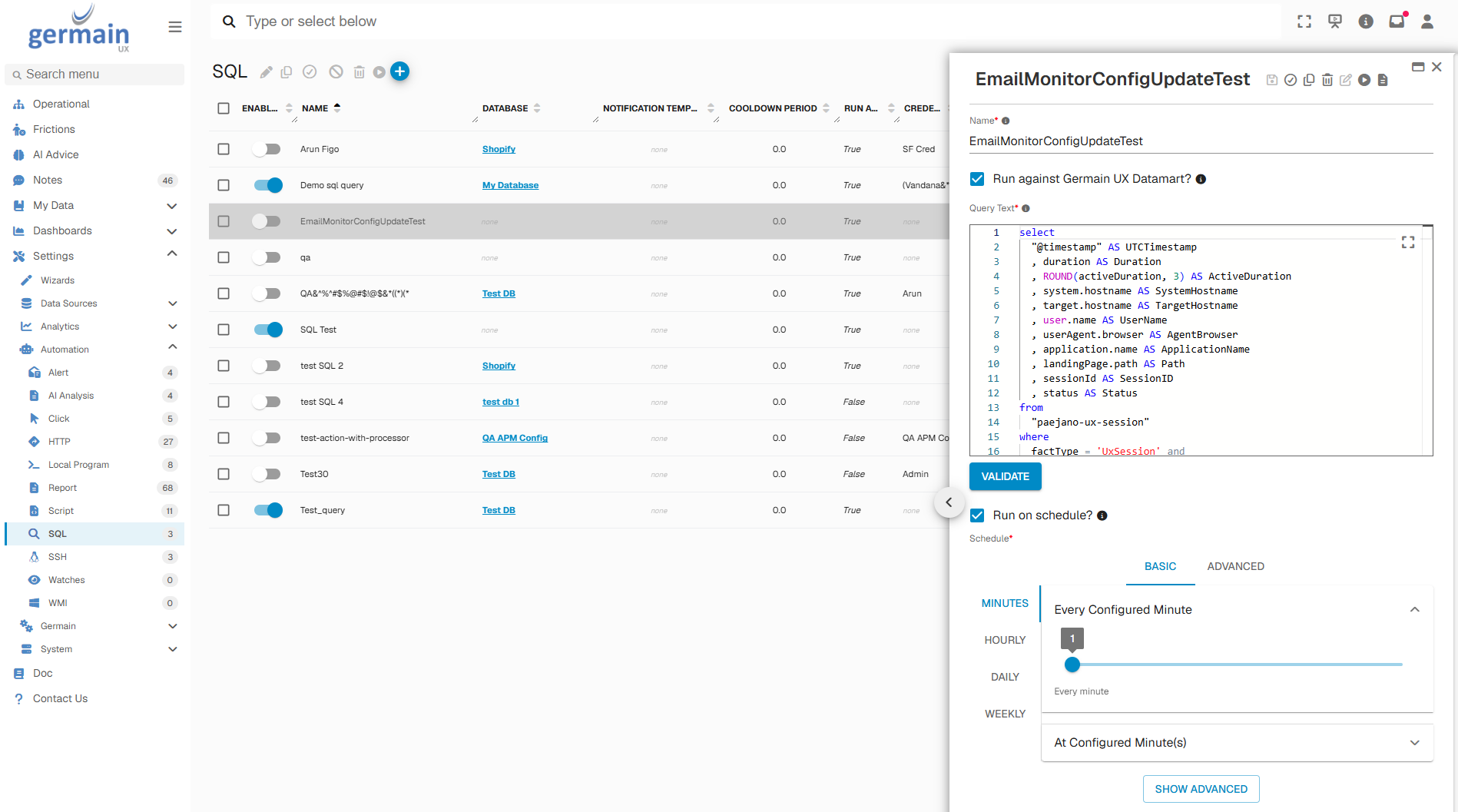
SQL
Configure GermainUX to execute a SQL statement against an authorized database.
SQL actions can be used for:
|
Use |
|---|
|
Data retrieval |
|
Validation |
|
Updates |
|
Automated remediation |
|
Integration with business systems |
SQL actions should be carefully secured and limited to authorized operations.
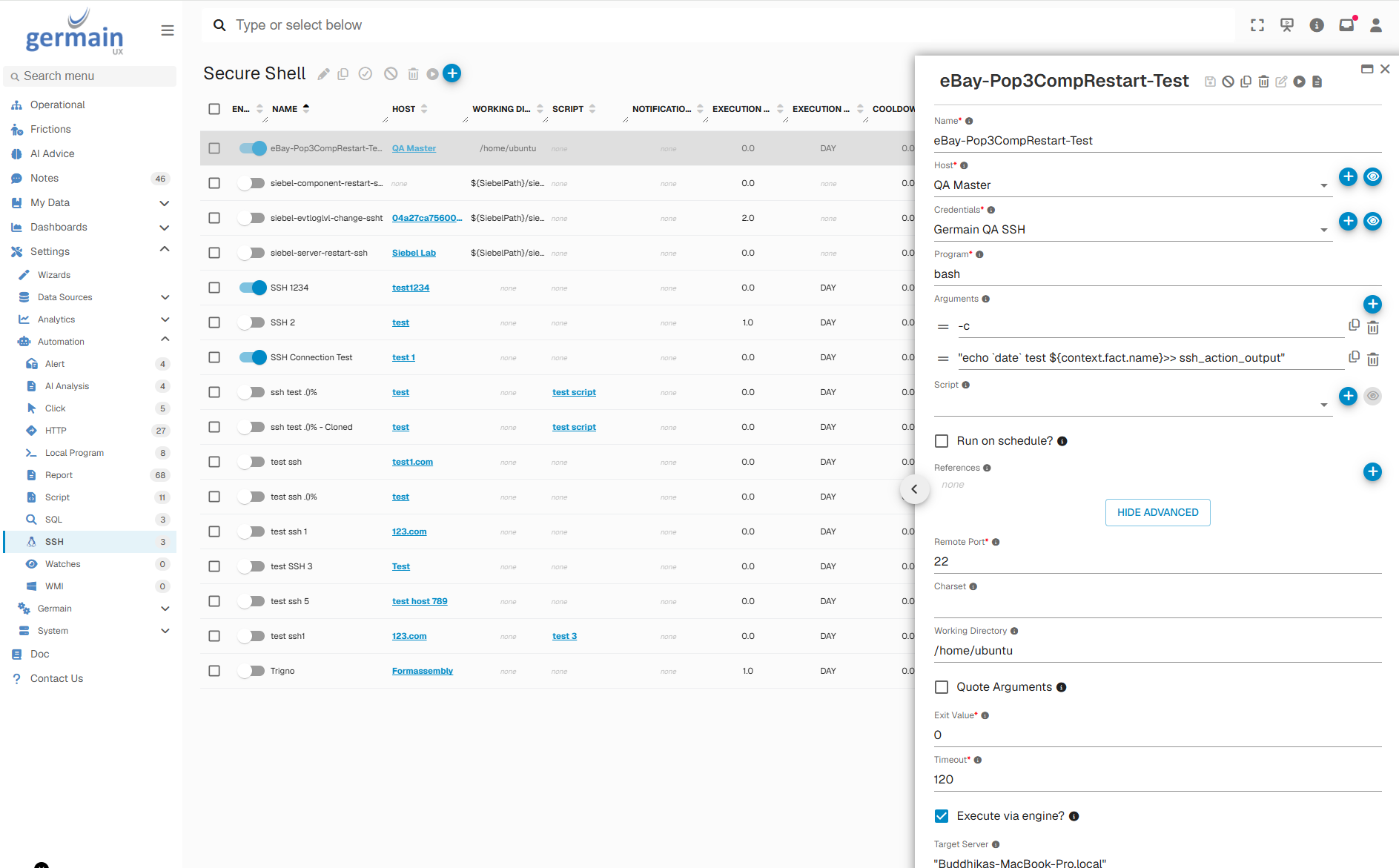
SSH
Configure a command to be executed remotely through SSH.
SSH actions can support system checks, administrative operations, automation, and remediation on authorized hosts.
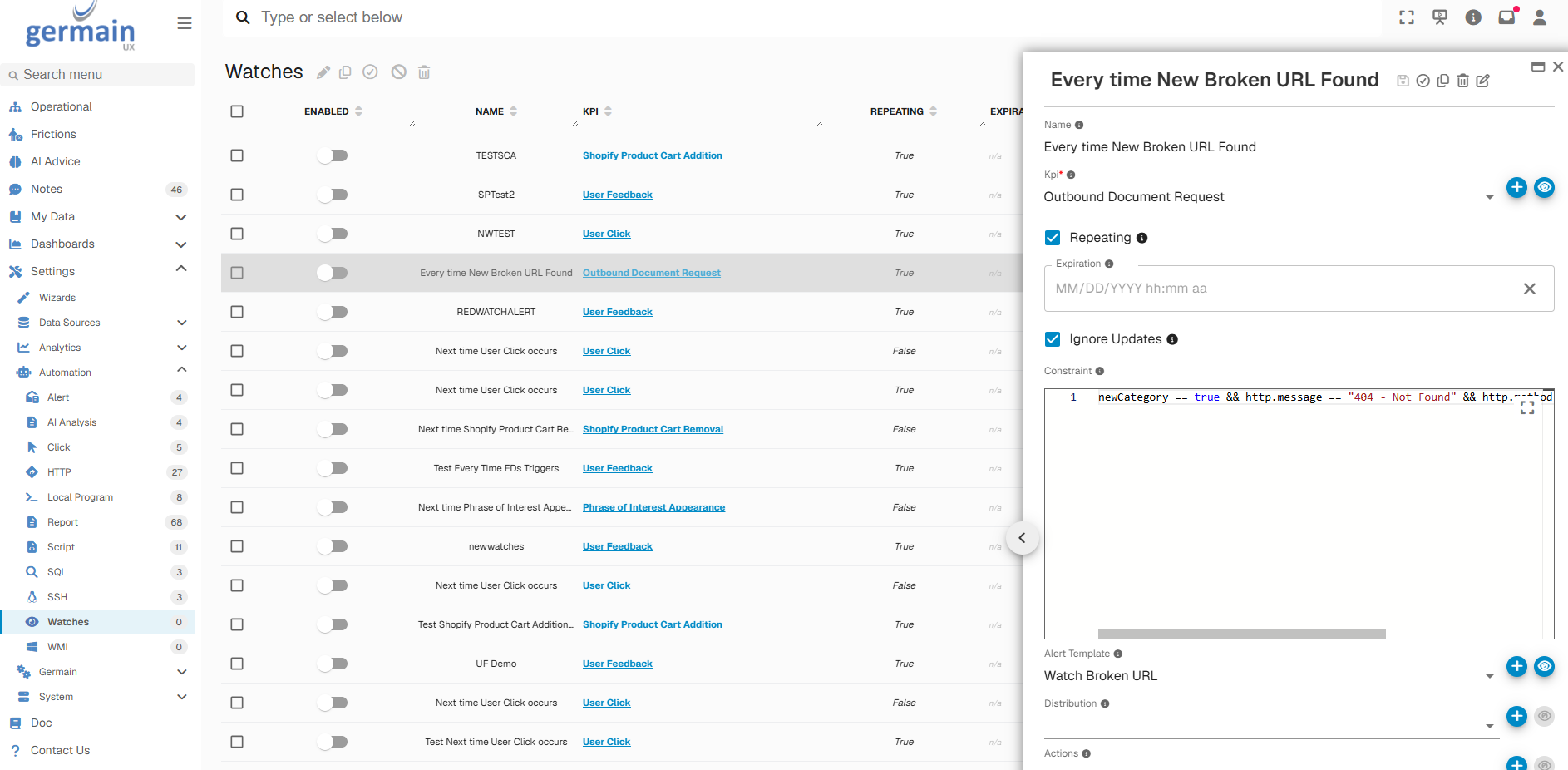
Watches
Configure a Watch for a KPI and condition.
A Watch can monitor a metric continuously and initiate an alert or another action when its configured condition is met.
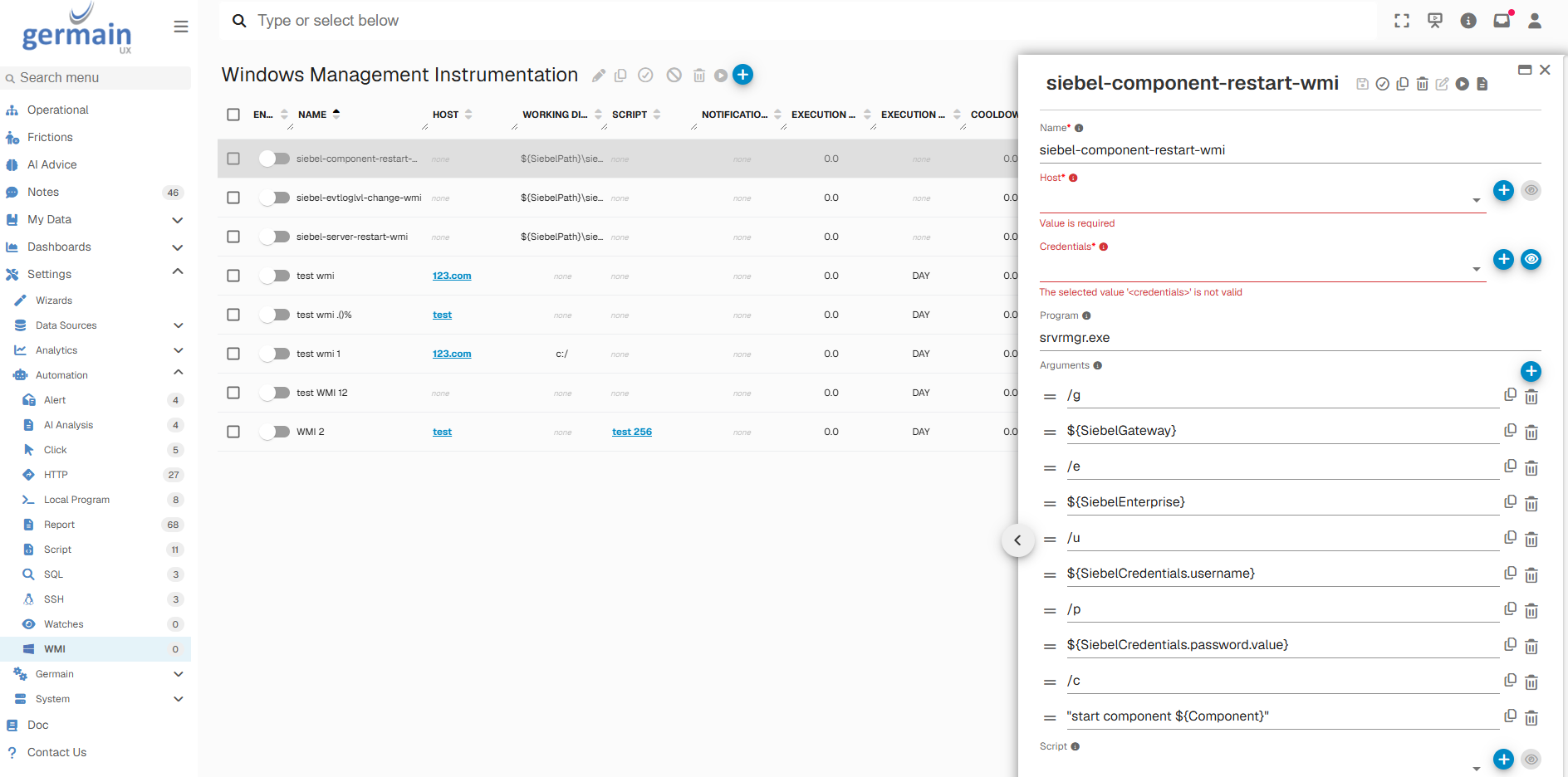
WMI
Configure Windows Management Instrumentation operations for authorized Windows systems.
WMI actions can be used to query or manage Windows resources as part of monitoring, automation, or remediation.
🏭 Germain
The Germain settings area manages the operation and internal state of the GermainUX platform.
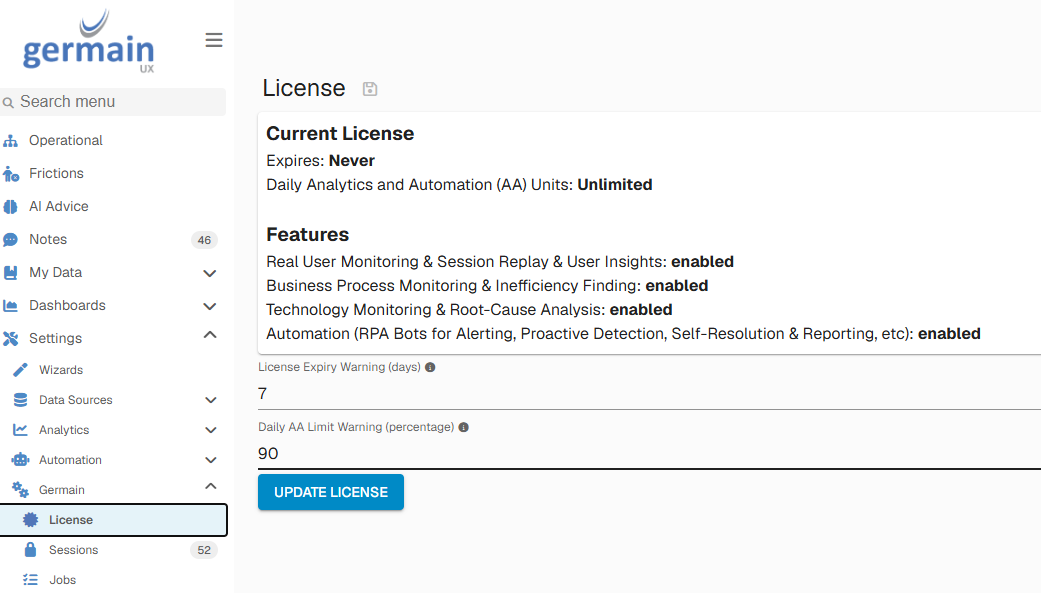
License
View and manage the GermainUX license and enabled platform capabilities.
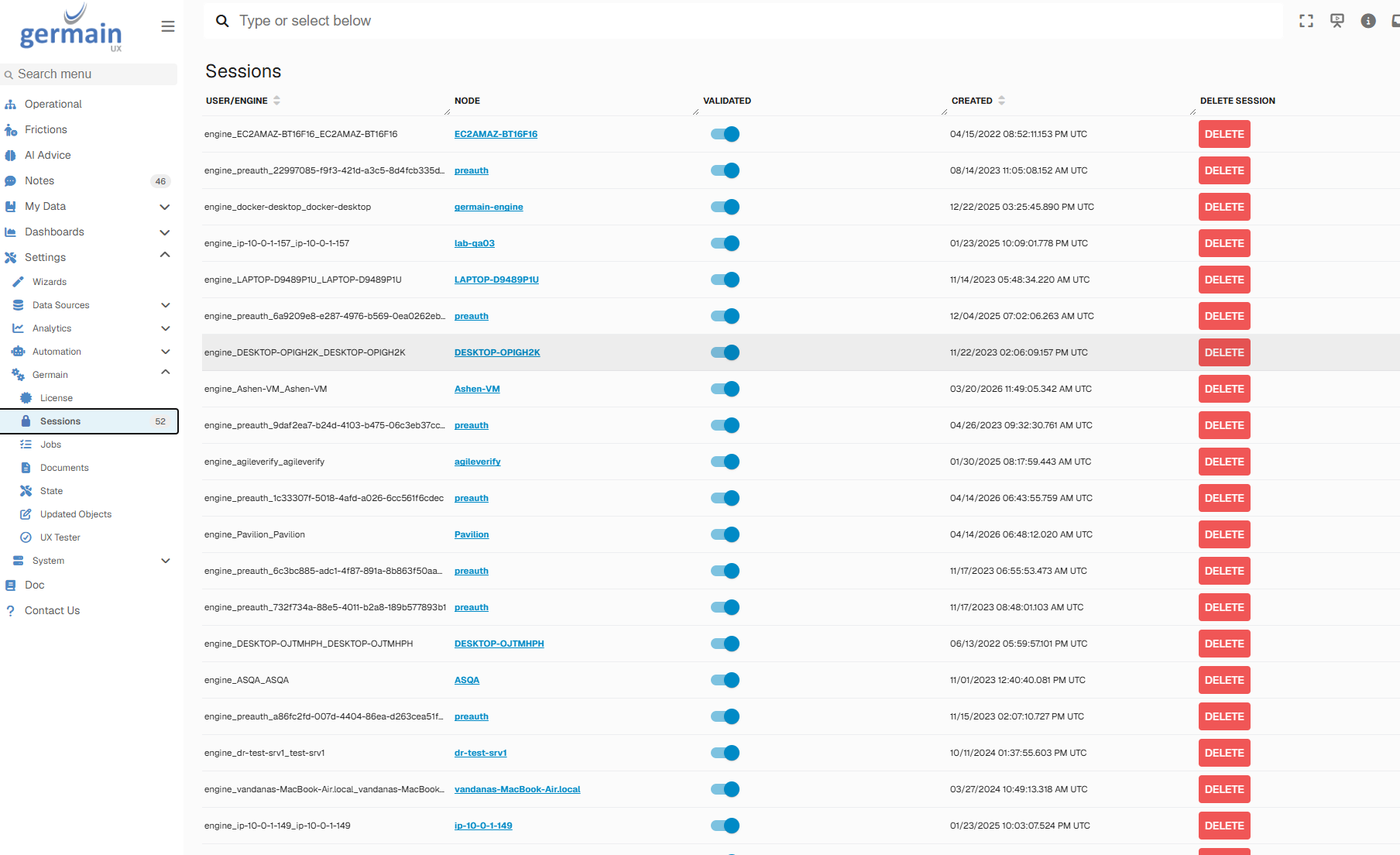
Sessions
View and manage active GermainUX platform sessions.
These are administrative platform sessions and should not be confused with the monitored user sessions displayed in UX analytics and Session Replay.
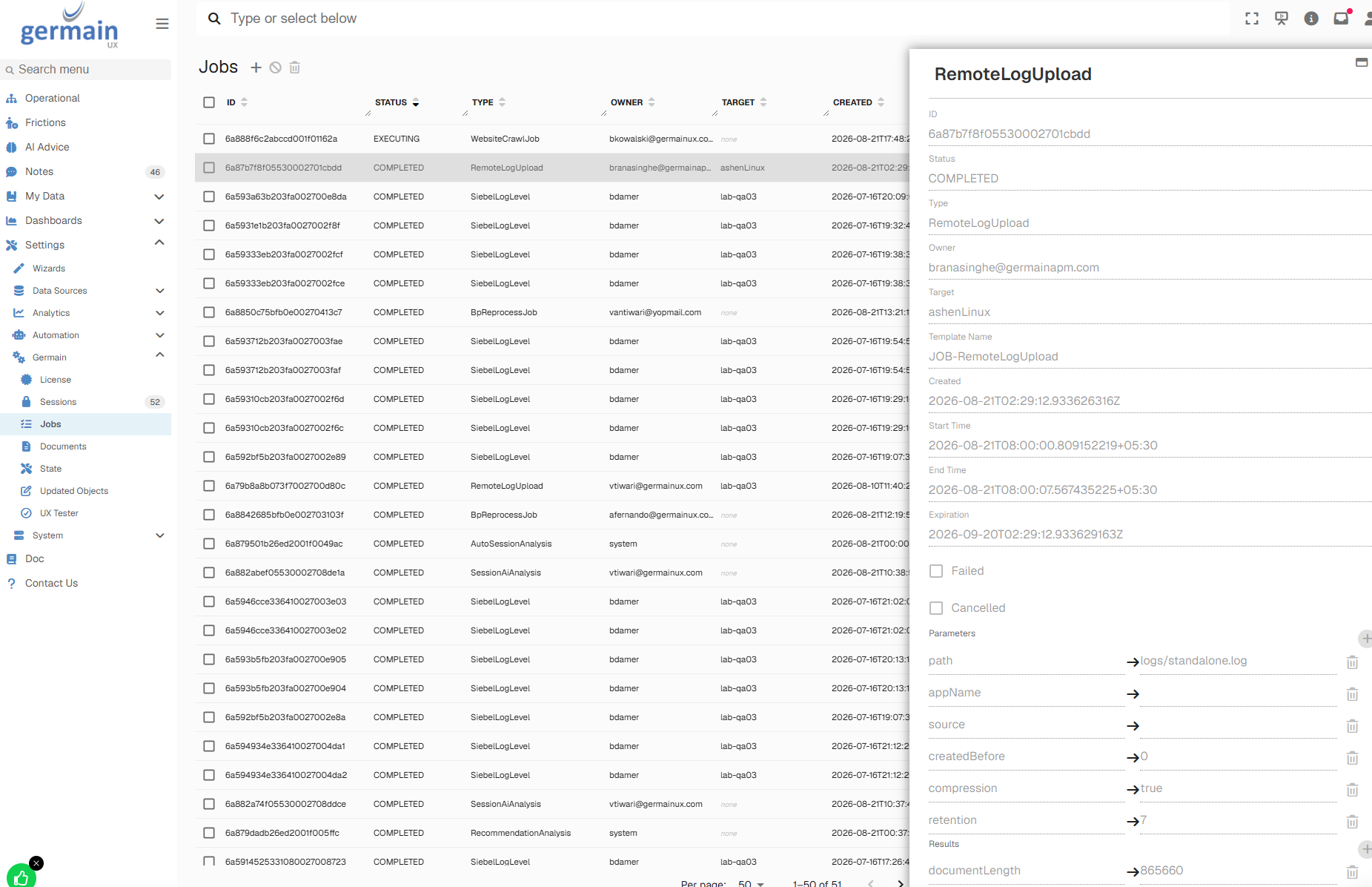
Jobs
View and manage GermainUX background jobs and scheduled processing activity.
Use Jobs to inspect execution status and identify failed, delayed, or long-running platform operations.
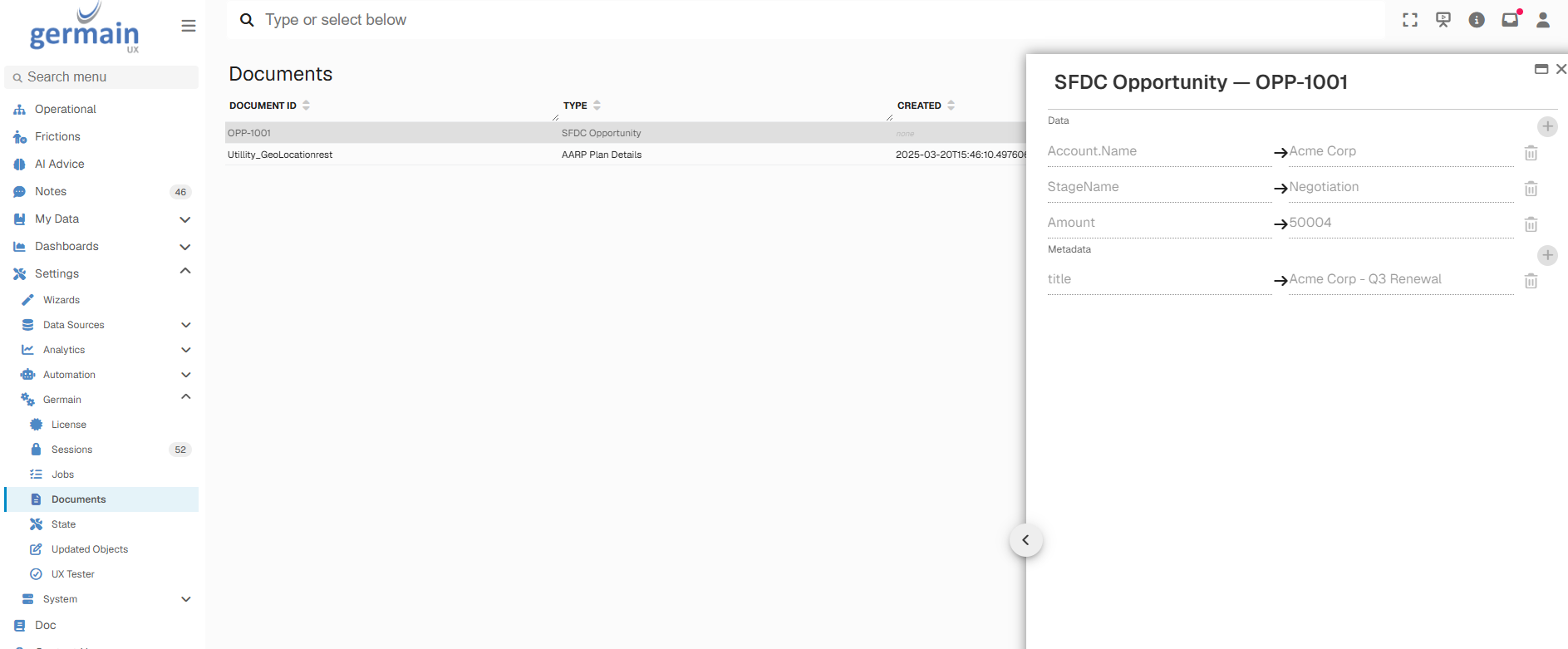
Documents
View and manage documents generated, stored, or used by GermainUX features.
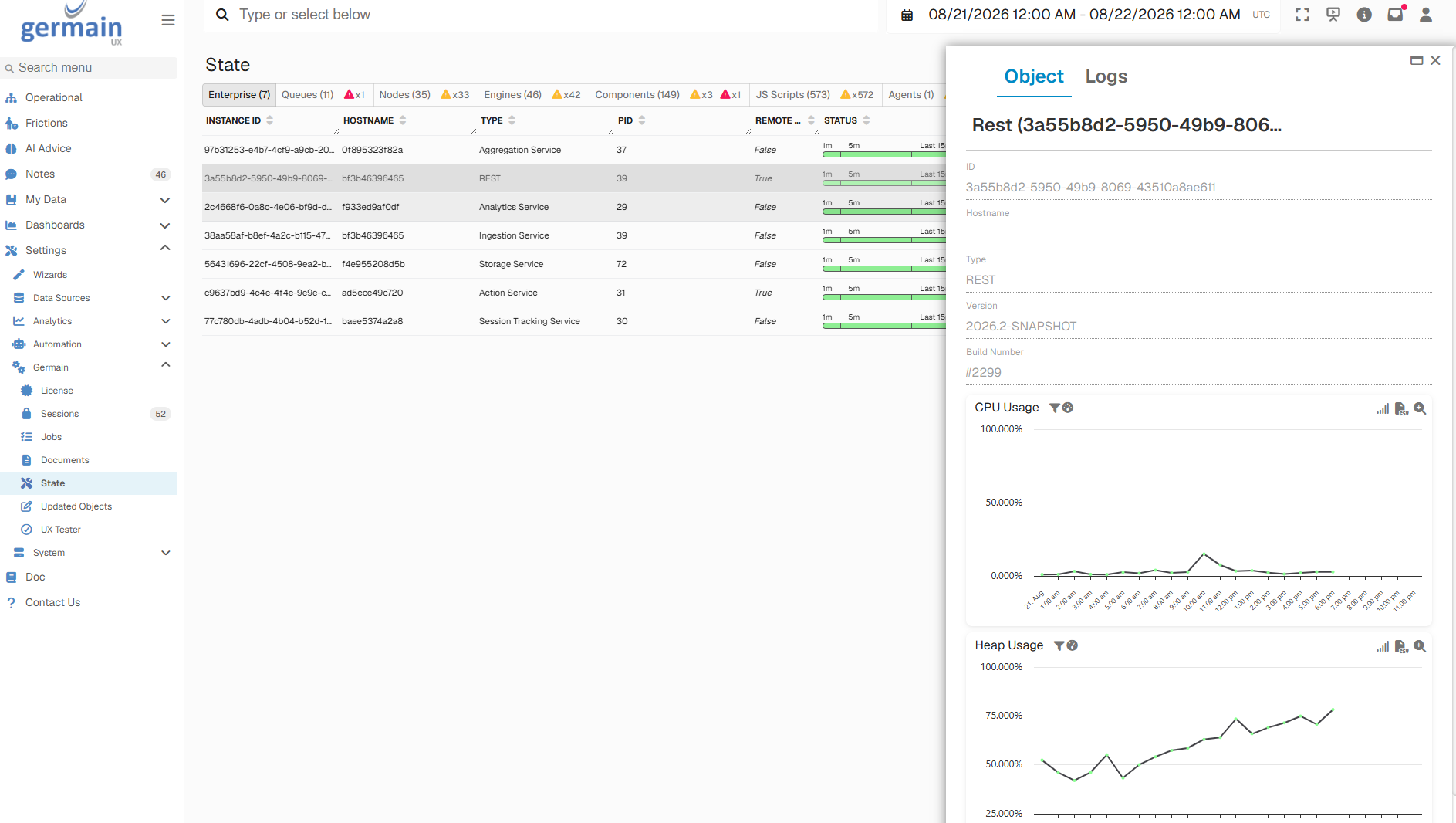
State
Review the current operational state of GermainUX components and services.
This helps administrators confirm that the platform is operating correctly and identify components requiring attention.
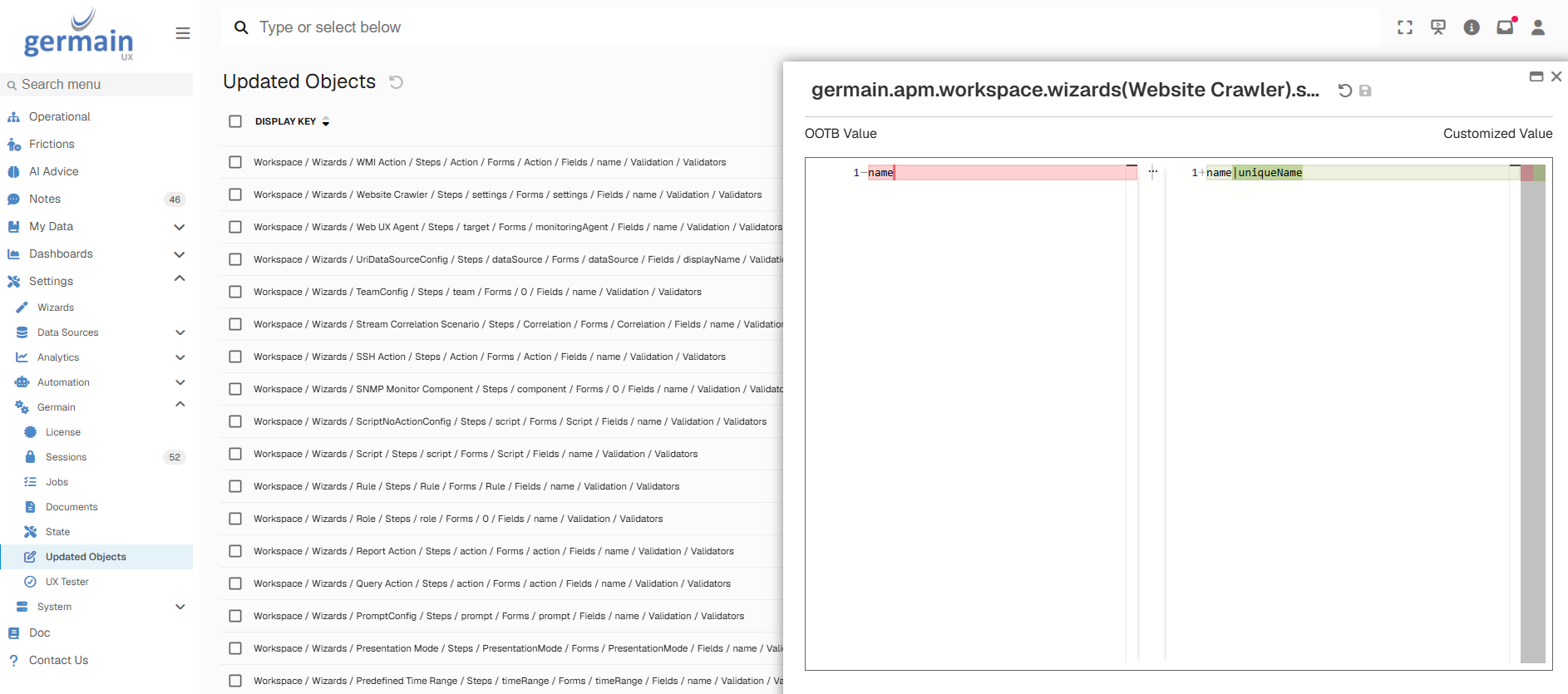
Updated Objects
Review objects that have recently been created or modified within the GermainUX configuration.
This can help administrators understand configuration changes and identify recently updated items during troubleshooting.
🧪 UX Tester
Use UX Tester to validate applicable UX monitoring and configuration behavior.
It can help administrators confirm that monitored user actions and UX data are being captured and processed as expected.
💻 System
System settings control platform-wide behavior, access, retention, display, maintenance, AI, and other shared configuration.
🤖 AI
Configure the artificial-intelligence capabilities used by GermainUX.
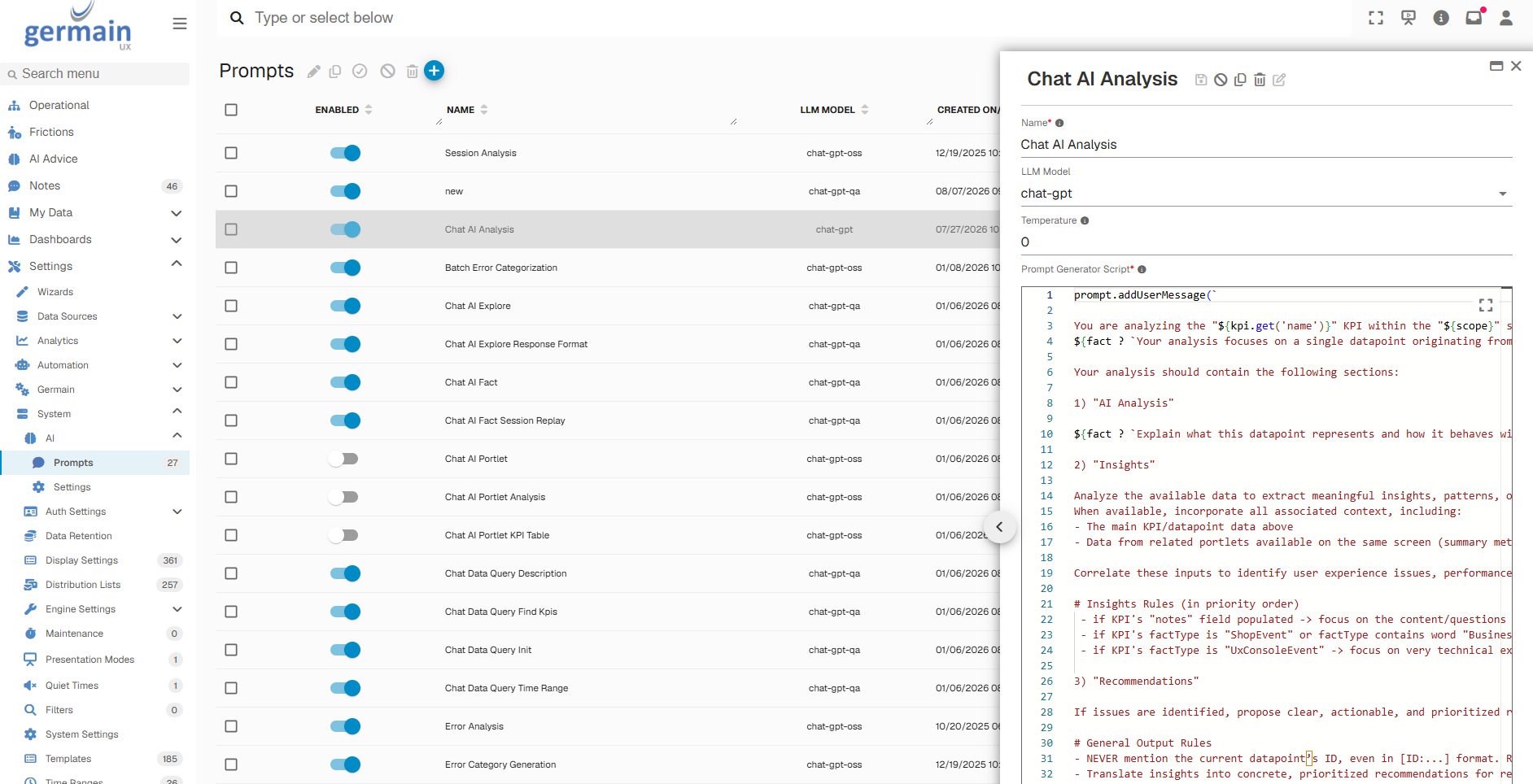
Prompts
Create and manage prompts used by AI-powered features such as automated analysis, explanations, classification, and recommendations.
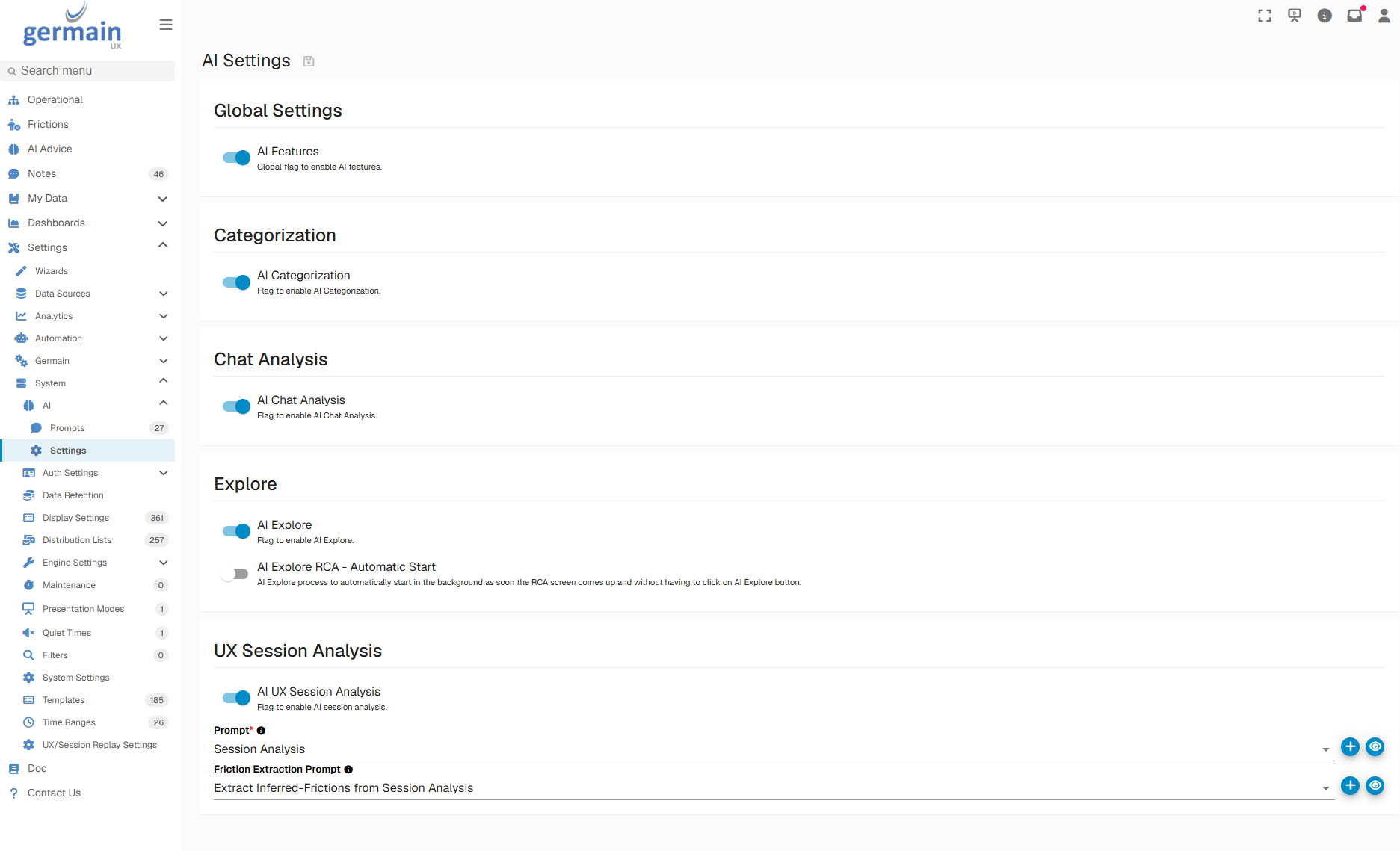
Settings
Configure the AI services, models, parameters, and other settings used by GermainUX AI capabilities.
Authentication Settings
Configure how users and systems authenticate with GermainUX and what they are authorized to access.
API Keys
Create and manage API keys used by authorized applications, integrations, or services.
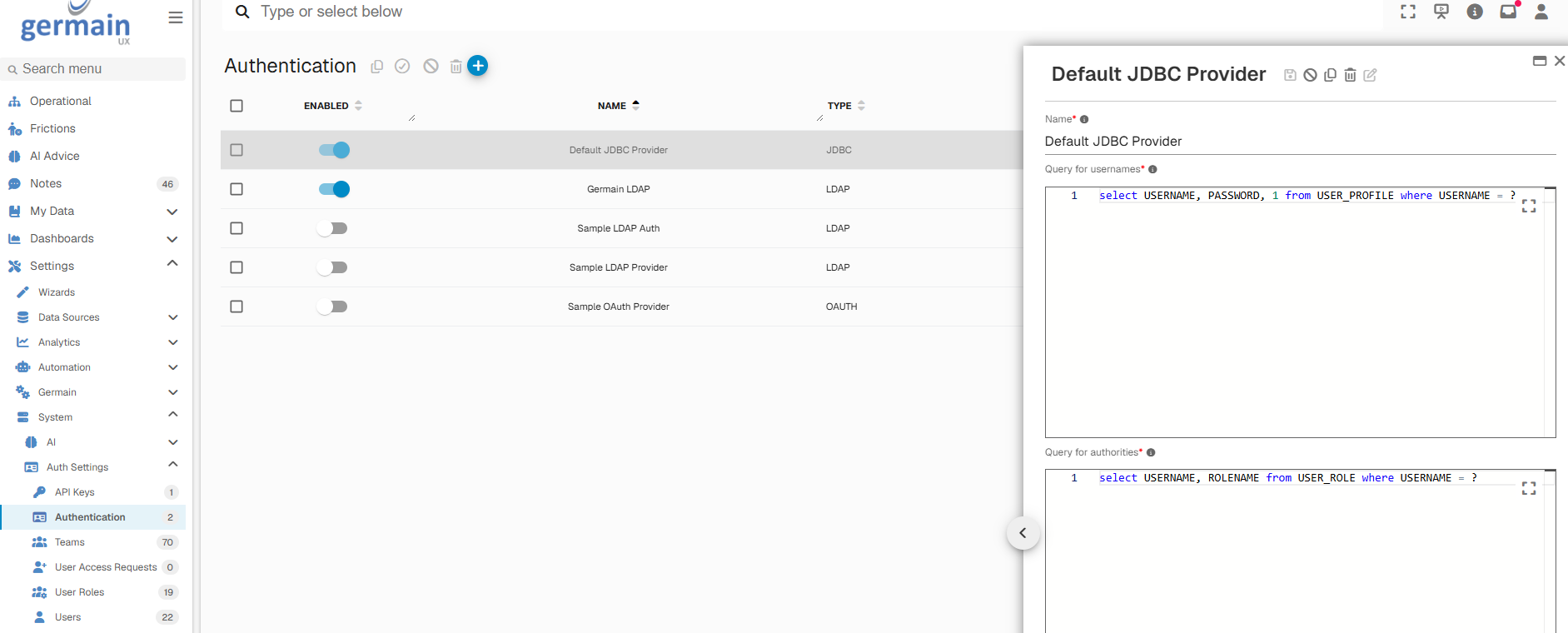
Authentication
Configure authentication methods and identity-provider settings.
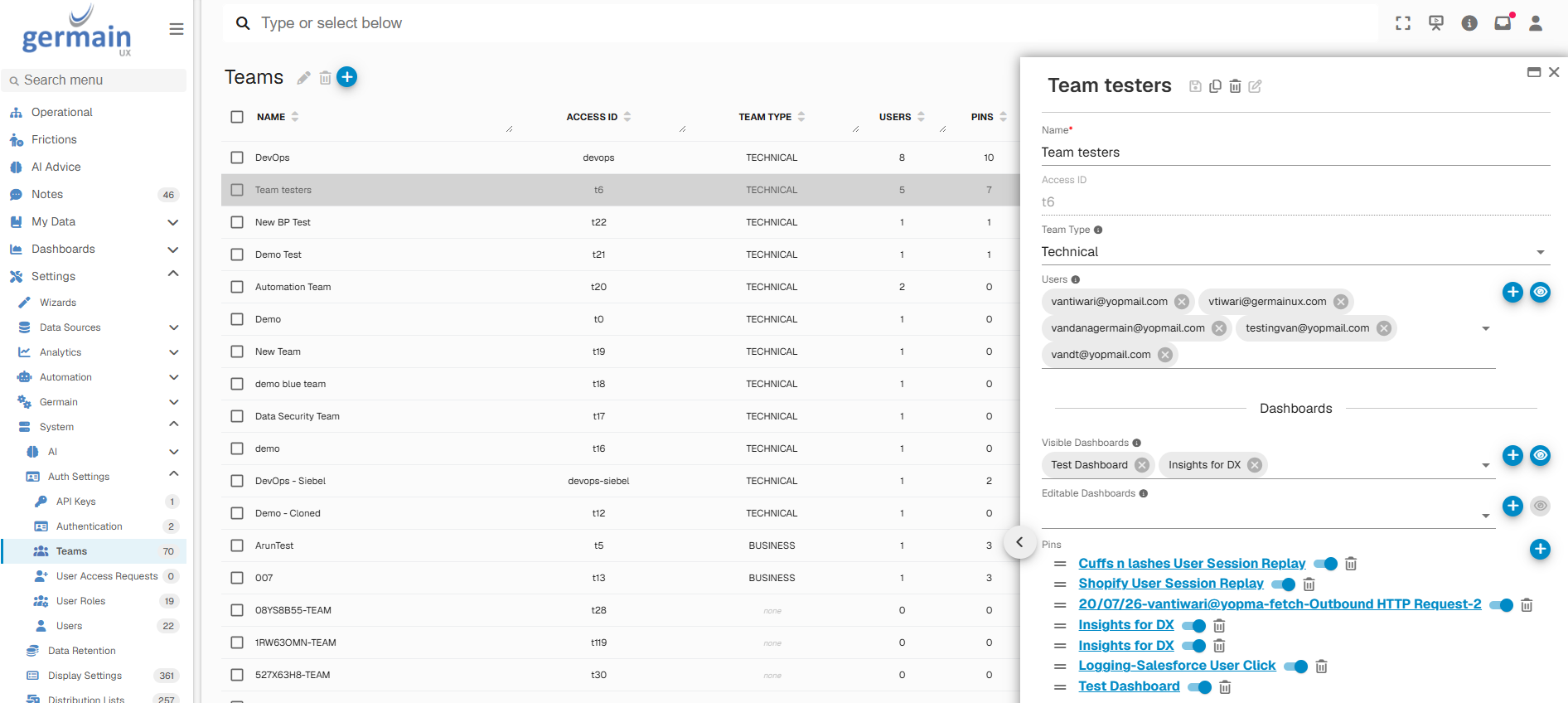
Teams
Create and manage teams used to organize users, permissions, dashboard visibility, and access to business or technical capabilities.
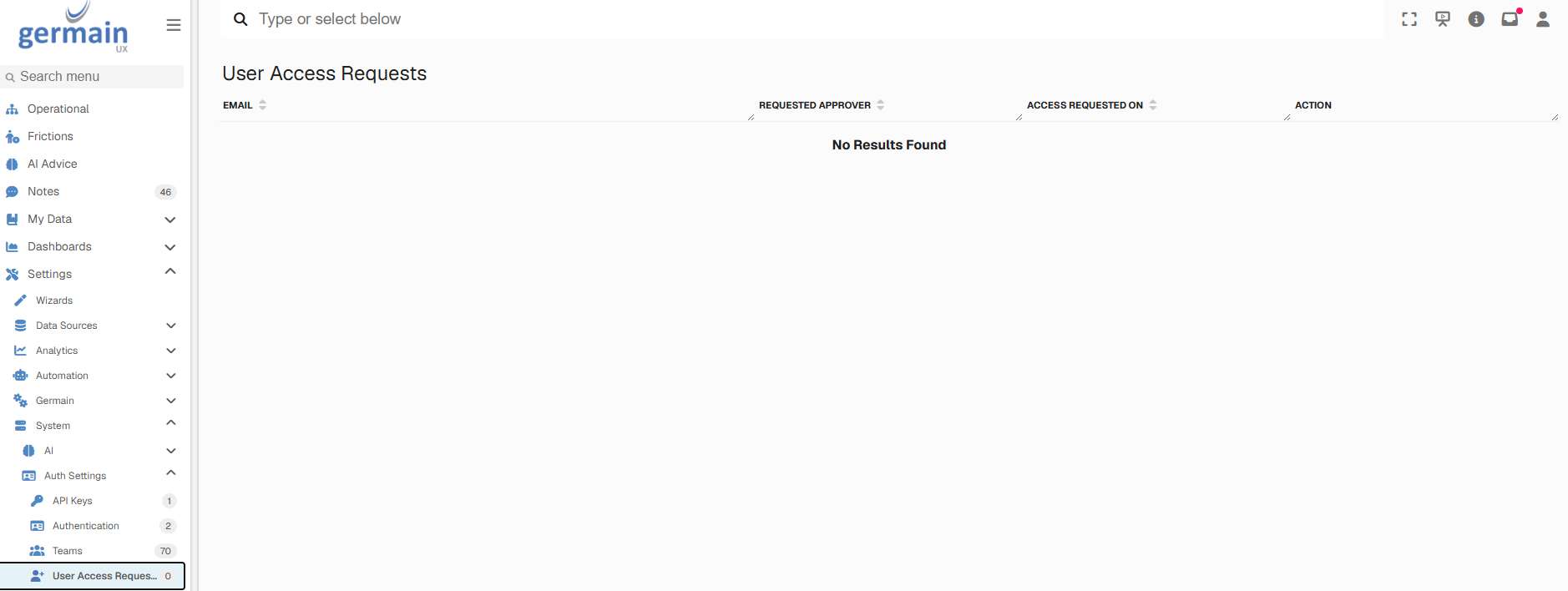
User Access Requests
Review and manage requests from users who need access to GermainUX.
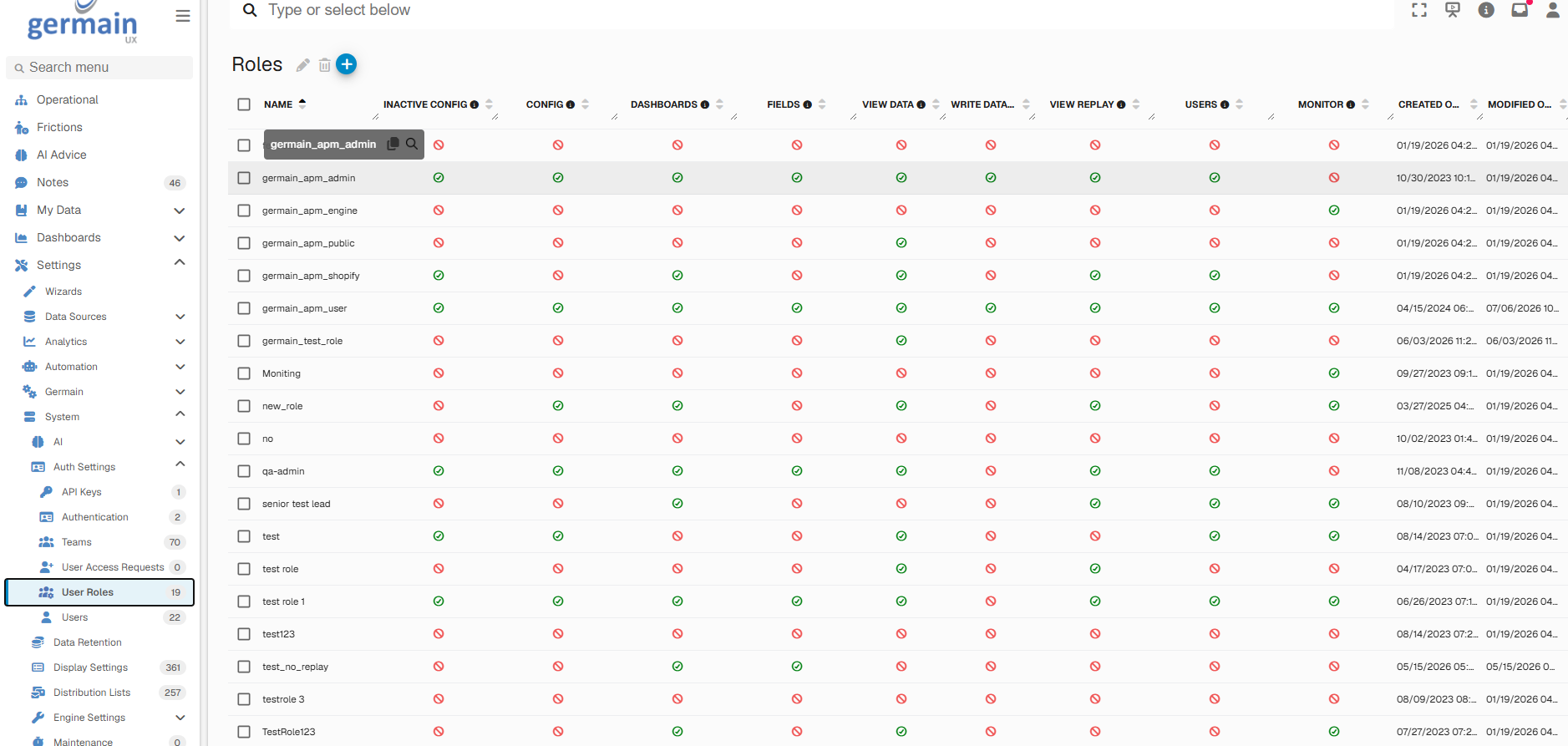
User Roles
Define roles and their associated permissions.
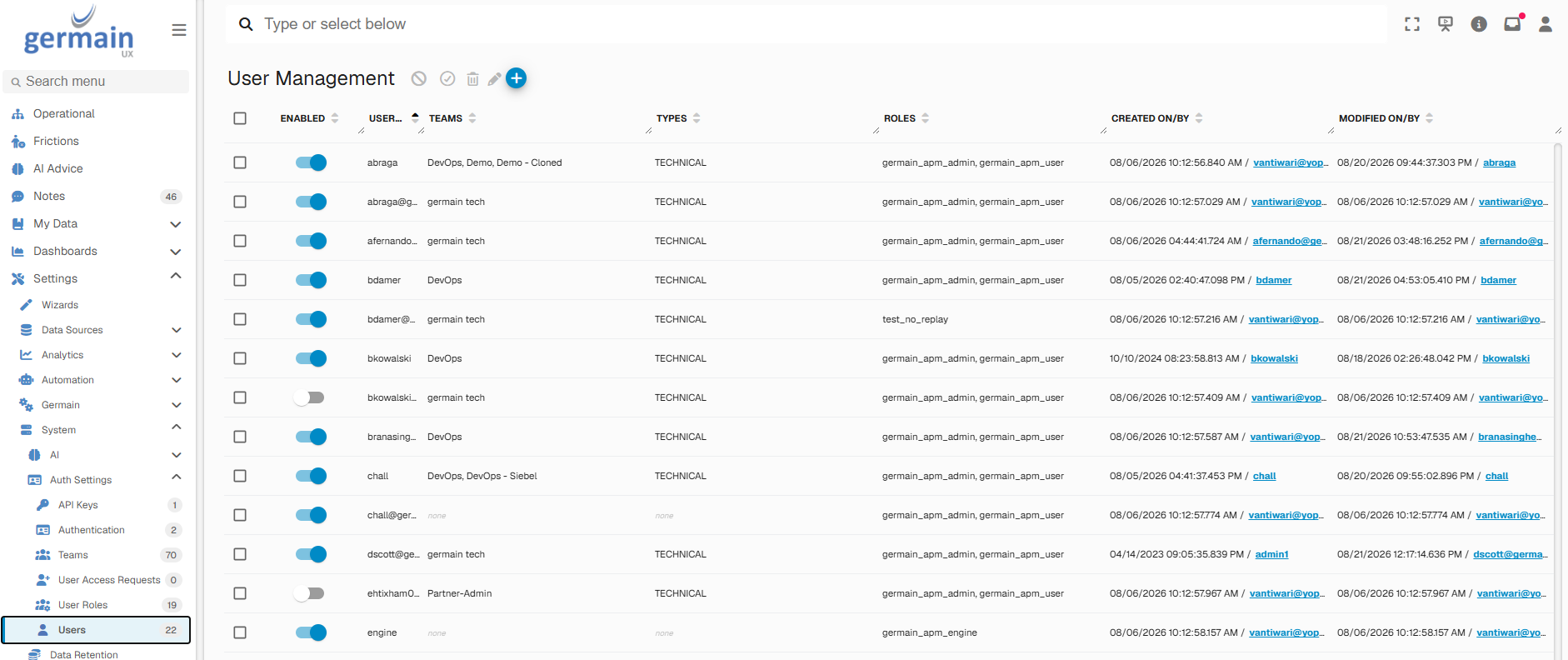
Users
Create, update, disable, and manage GermainUX user accounts.
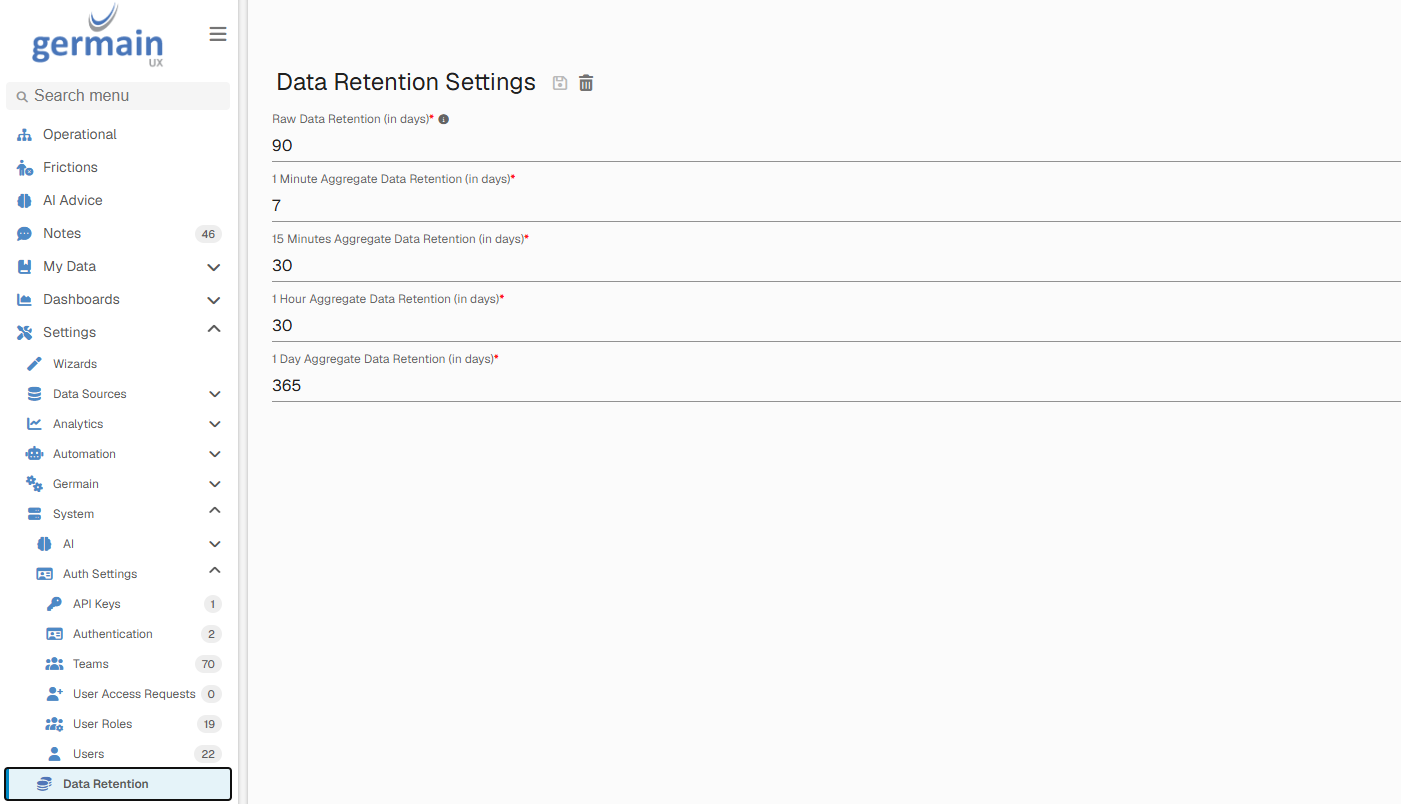
Data Retention
Configure how long GermainUX retains different categories of data.
Retention can affect:
|
Data Category |
|---|
|
Aggregated KPI data |
|
Raw instances |
|
User sessions |
|
Session Replay |
|
Traces |
|
Logs |
|
Other monitored information |
Aggregate data may be retained longer than raw instance data. Retention should be aligned with the organization's investigation, compliance, privacy, and storage requirements.
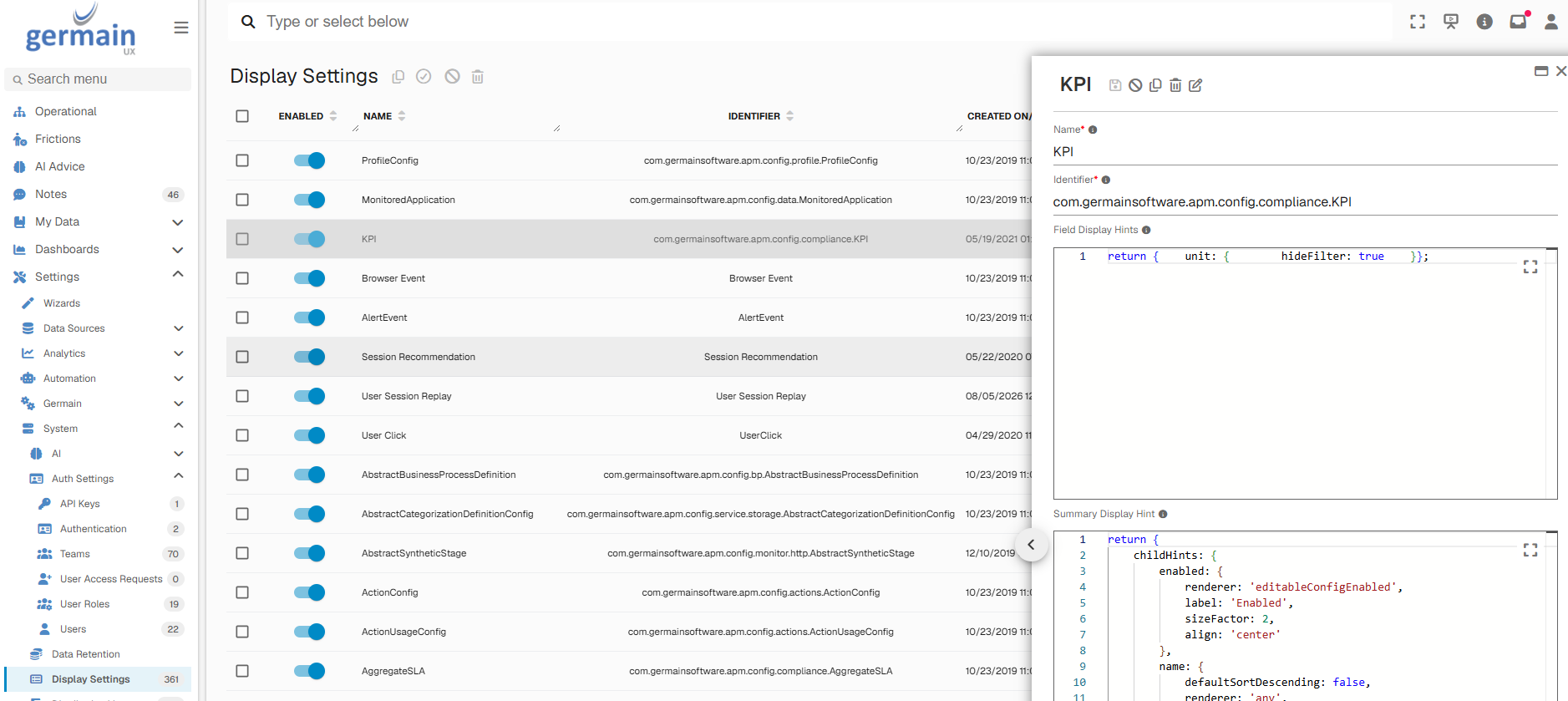
Display Settings
Configure Workspace display preferences and default visualization behavior.
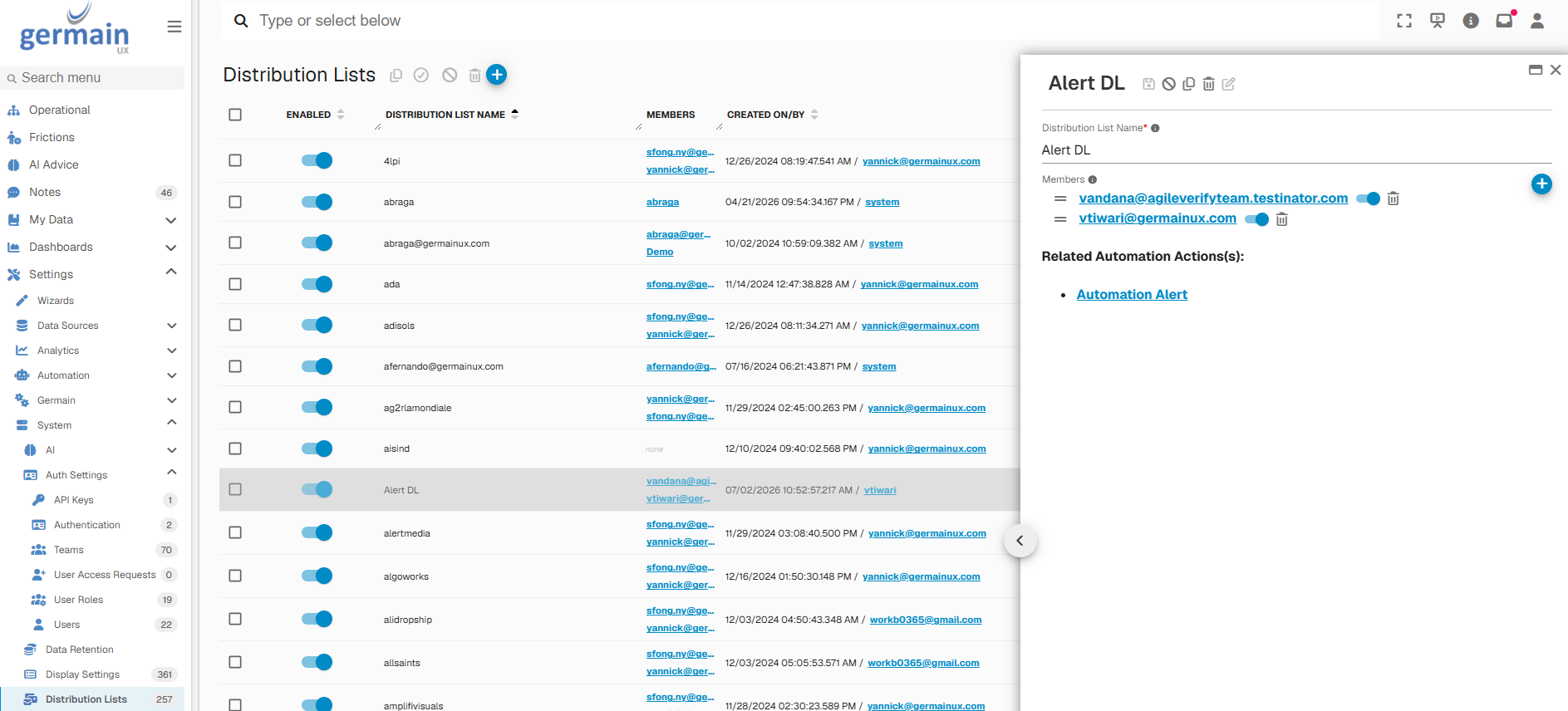
Distribution Lists
Create and manage recipient lists used for alerts, reports, notifications, and other communications.
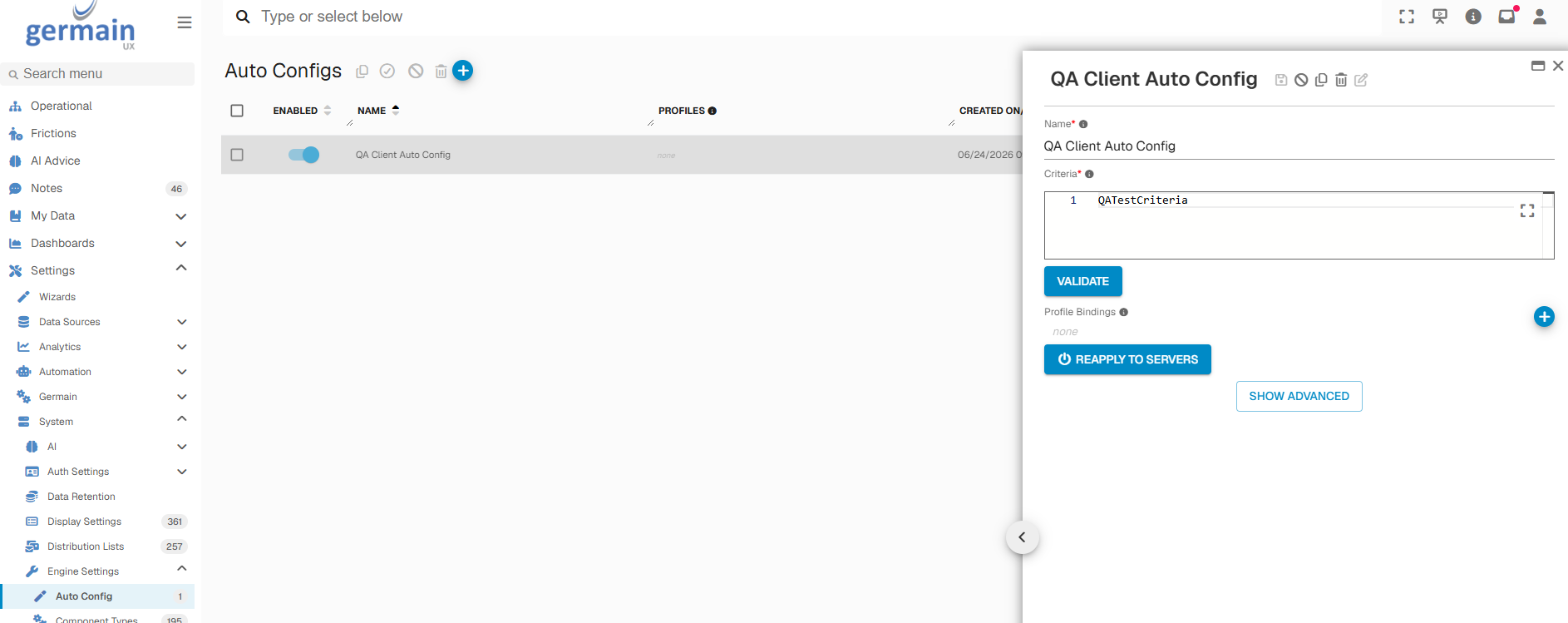
Engine Settings
Configure the behavior and operating parameters of GermainUX Engines.
Changes to Engine Settings should be performed by authorized administrators who understand their effect on data collection and processing.
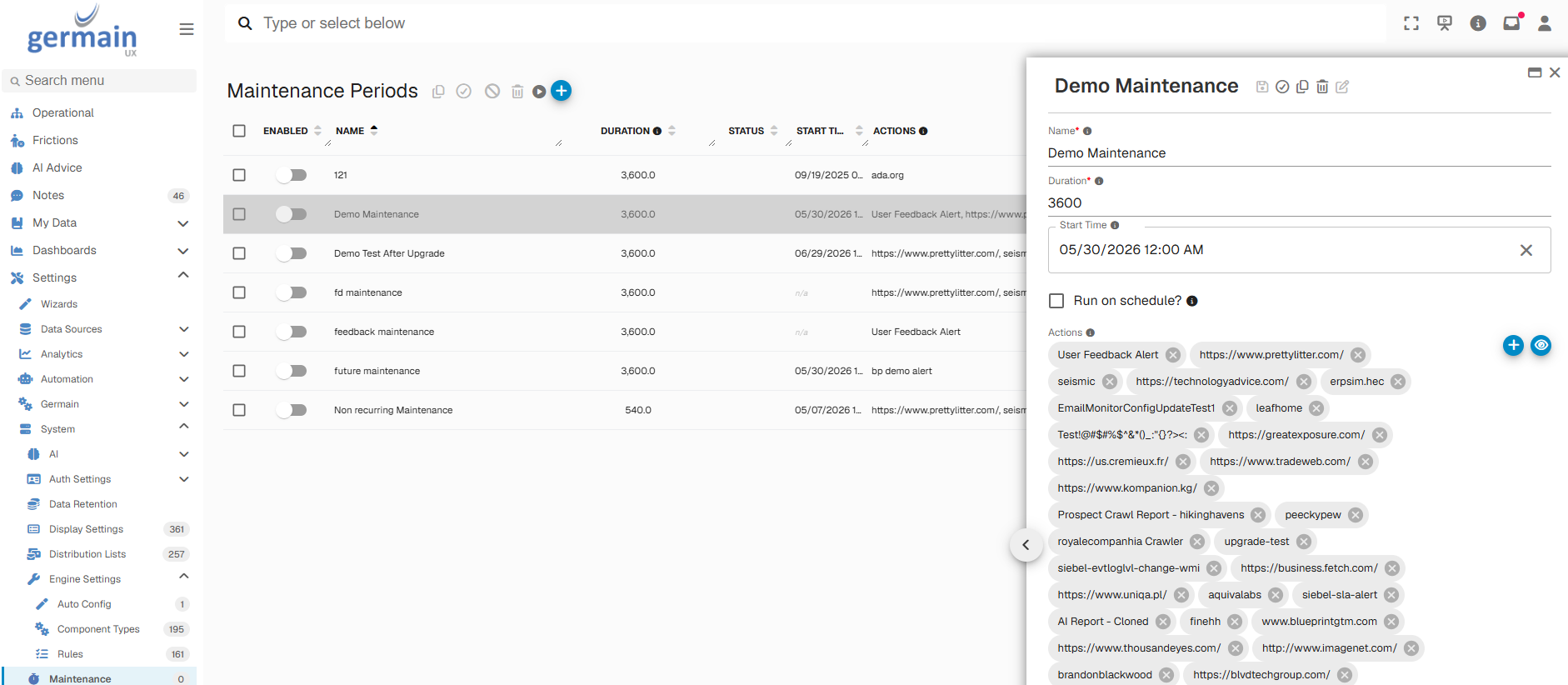
Maintenance
Configure and manage platform or monitored-system maintenance periods.
Maintenance settings can prevent expected maintenance activity from being treated as an unexpected incident or SLA violation.
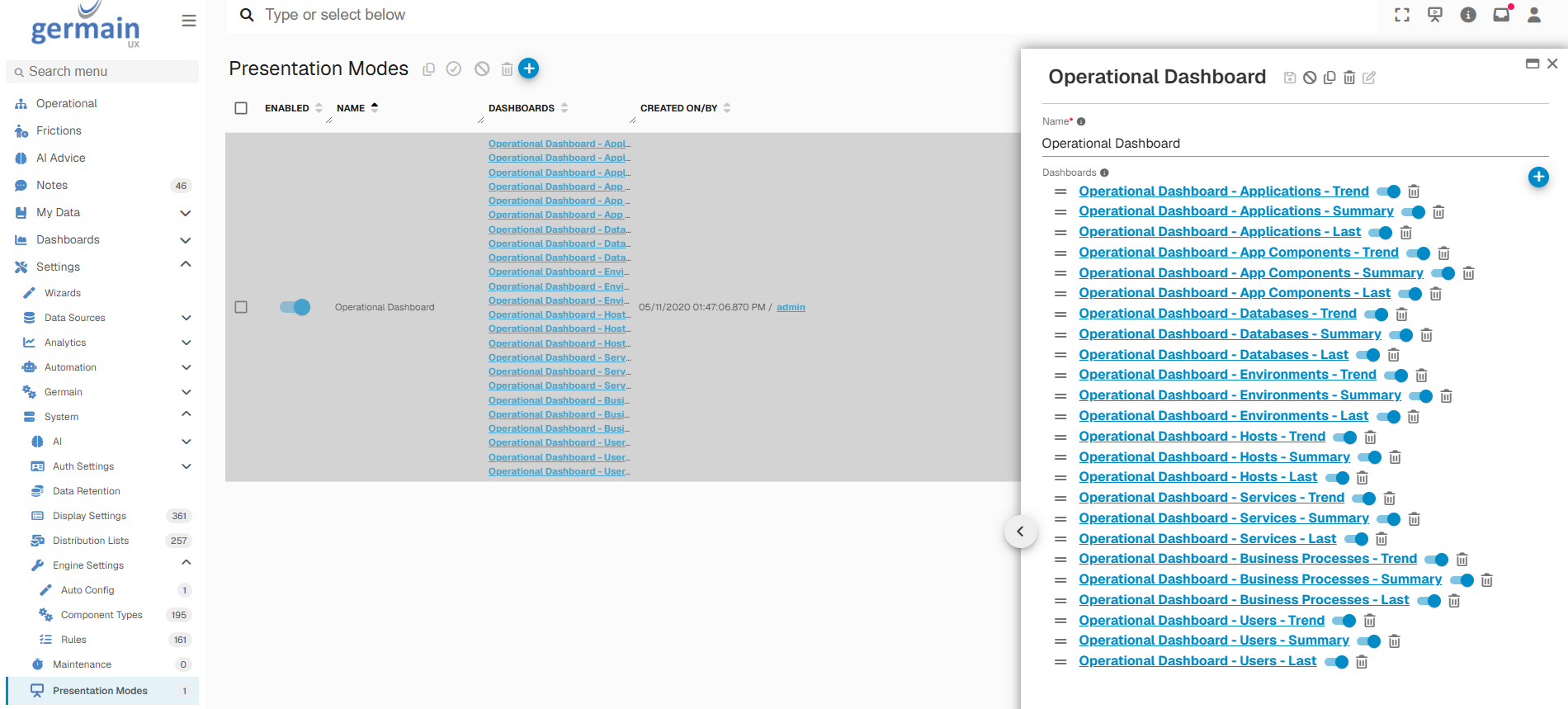
Presentation Modes
Configure how GermainUX information is displayed for different presentation or viewing scenarios.
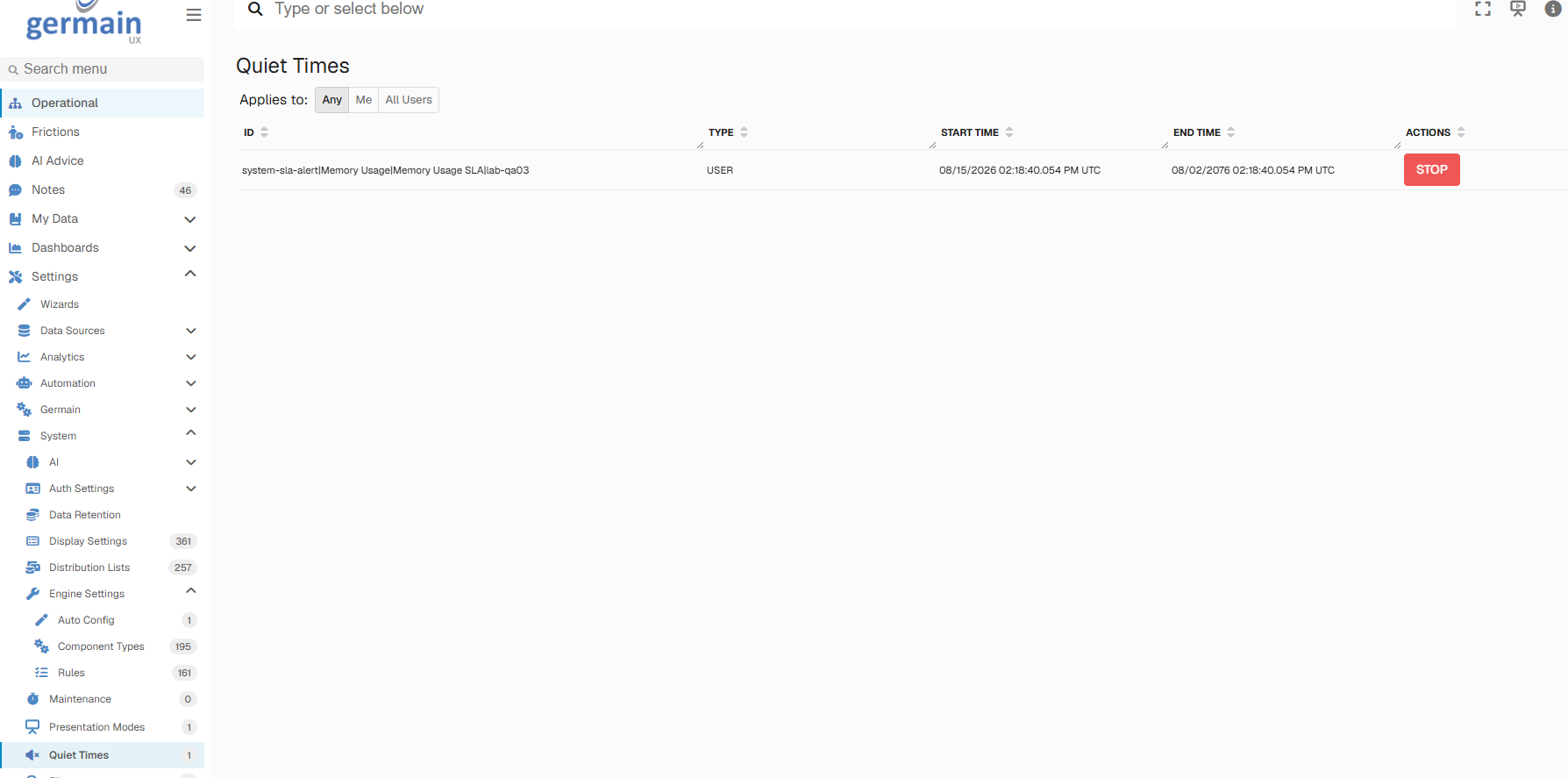
Quiet Times
Define periods during which selected alerts, notifications, Watches, or automated actions should be suppressed or handled differently.
Filters
Create and manage reusable filters that can be applied across GermainUX features.
System Settings
Configure general platform-wide settings that do not belong to another dedicated management area.
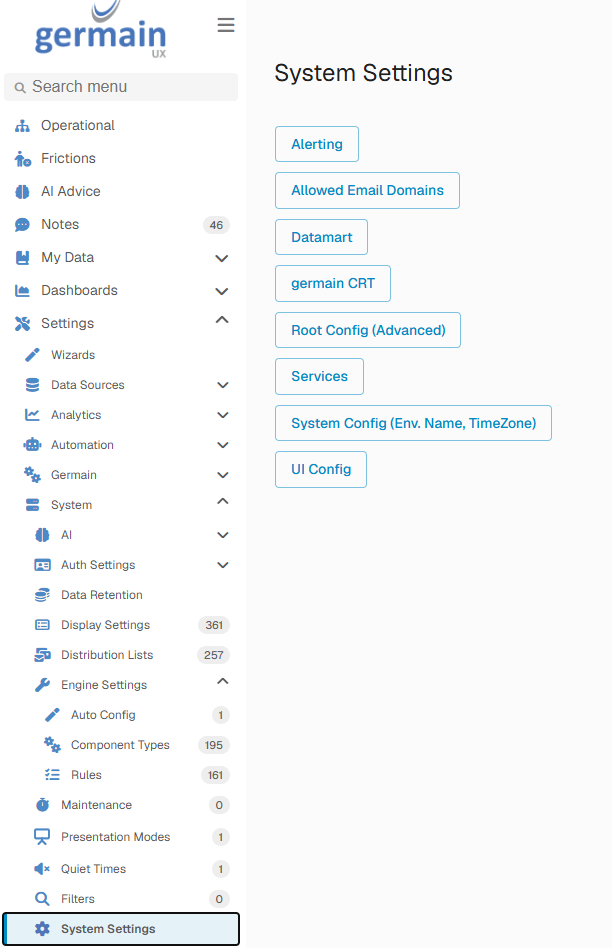
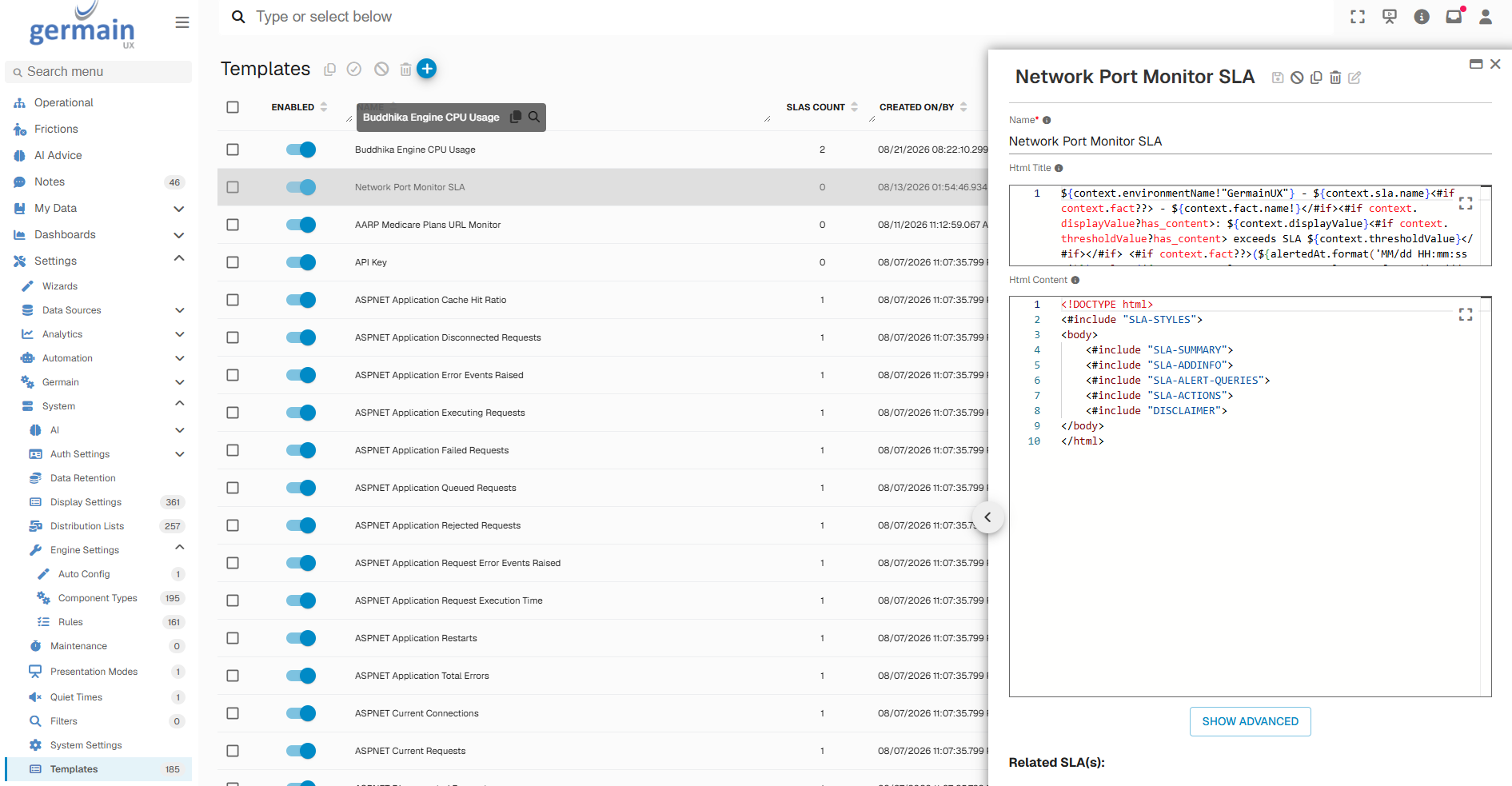
Templates
Create and manage reusable templates for supported GermainUX configurations and outputs.
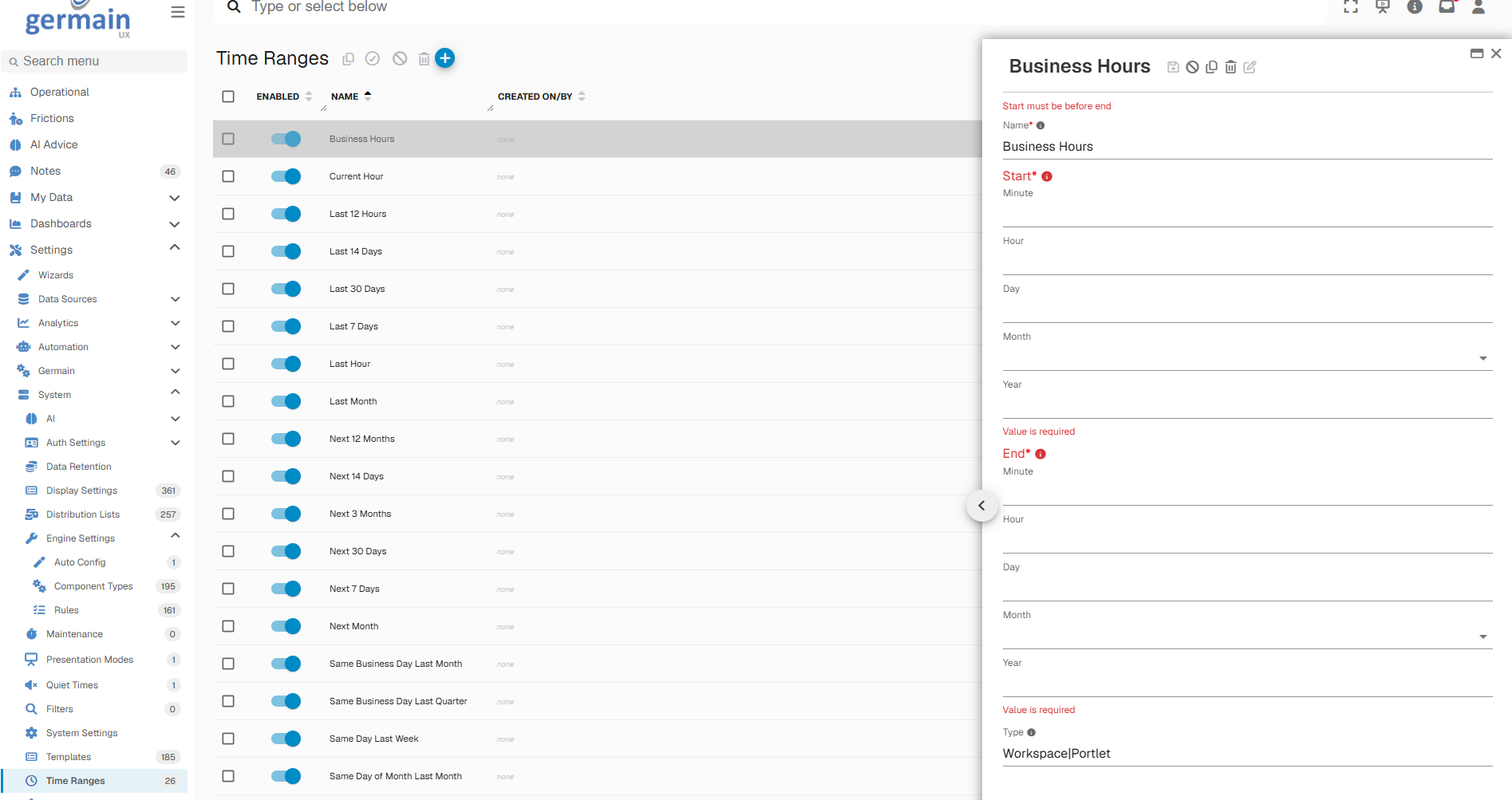
Time Ranges
Configure the time ranges available for dashboards, analysis, reports, and other time-based views.
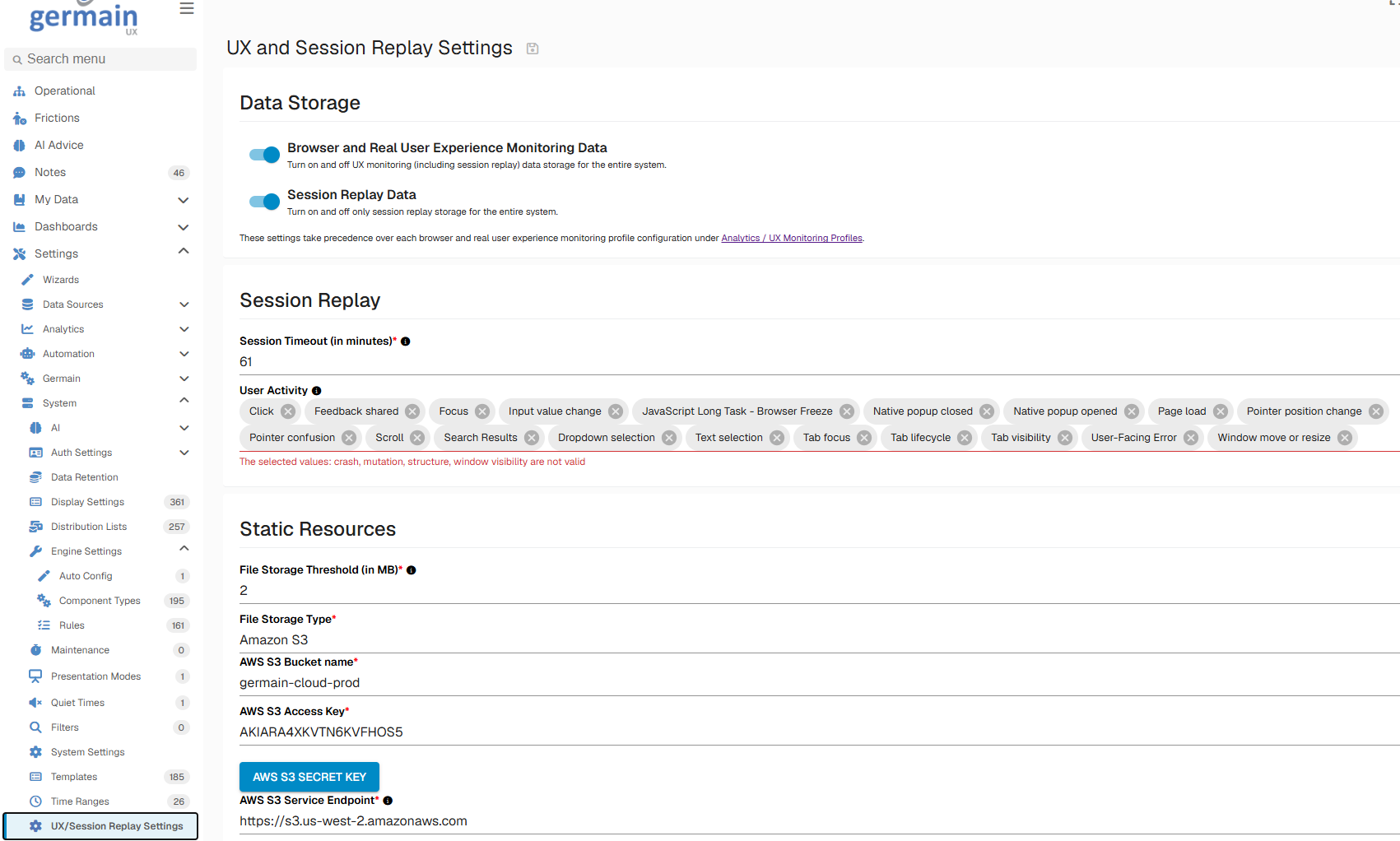
UX/Session Replay Settings
Configure platform-wide settings for user-experience monitoring and Session Replay.
These settings can control:
|
Setting |
|---|
|
Session capture and processing |
|
Replay behavior |
|
Privacy and masking |
|
Retention |
|
Access |
|
Display |
|
Other UX and Session Replay options |
They work together with Analytics > UX Monitoring Profiles and Analytics > Data Privacy.
🔧 Config Console
The Config Console is the advanced configuration interface for GermainUX. It provides access to detailed or legacy settings that may not yet be available in Workspace.
It is primarily intended for GermainUX administrators, implementation specialists, and support personnel handling advanced configuration scenarios.
Use Workspace whenever the required setting is available there. Use the Config Console only when the configuration cannot be completed through Workspace or when directed by GermainUX Support.
🔗 Access the Config Console
Open:
https://INSTANCE_NAME/germainapm/console
It may also be accessible from Workspace through:
Settings > System > System Settings
📧 Request Access
Contact your GermainUX administrator to request access.
Config Console access should not normally be provided to regular users because it exposes advanced settings that can affect monitoring, analytics, automation, security, and the overall GermainUX environment.
🧰 Typical Uses
Authorized administrators can use the Config Console to:
|
Use |
|---|
|
Configure features not yet exposed in Workspace |
|
Access advanced or legacy settings |
|
Configure monitoring, analytics, alerts, and automation |
|
Manage dashboards and reports |
|
Diagnose configuration problems |
|
Perform advanced platform administration |
ℹ️ Get Help
The Germain Team can help you set this up. Contact GermainUX Support.
Component: Workspace
Feature Availability: 2014.1 or later