
🔍 Heatmaps for User Behavior and Friction Analysis
GermainUX provides six heatmaps and behavioral overlays that show where users engage, hesitate and struggle within monitored web pages.
Heatmaps can be analyzed for an individual session or across a larger user population. They help UX, product, conversion and application teams identify patterns that may be difficult to recognize from dashboards or individual recordings alone.
When combined with Session Replay, journey analysis, errors and business outcomes, heatmaps help teams understand not only where interaction occurs, but also why it occurs and whether it helps or prevents users from completing their goals.
💼 Business Outcomes
GermainUX heatmaps help organizations:
|
Outcome |
|---|
|
Identify page elements attracting the most interaction. |
|
Detect confusing, ineffective or malfunctioning interface elements. |
|
Understand how far users progress through page content. |
|
Compare behavior across users, sessions, devices and outcomes. |
|
Find UX friction contributing to abandonment, poor adoption or lost productivity. |
|
Prioritize improvements according to the frequency and business impact of the observed behavior. |
|
Move from an aggregated pattern to the relevant Session Replay for investigation. |
🔢 Six GermainUX Heatmaps
|
Heatmap |
What it reveals |
|---|---|
|
Mouse Movement |
Where users move or pause the pointer, indicating possible interest, hesitation or exploration |
|
Error Clicks |
Where clicks are associated with errors or failed application behavior |
|
Rage Clicks |
Where users click repeatedly within a short period, indicating possible frustration |
|
Dead Clicks |
Where users click elements that produce no meaningful response |
|
Clicks |
Where users click and how interaction is distributed across the page |
|
Scroll |
How far users progress down the page and which content is reached |
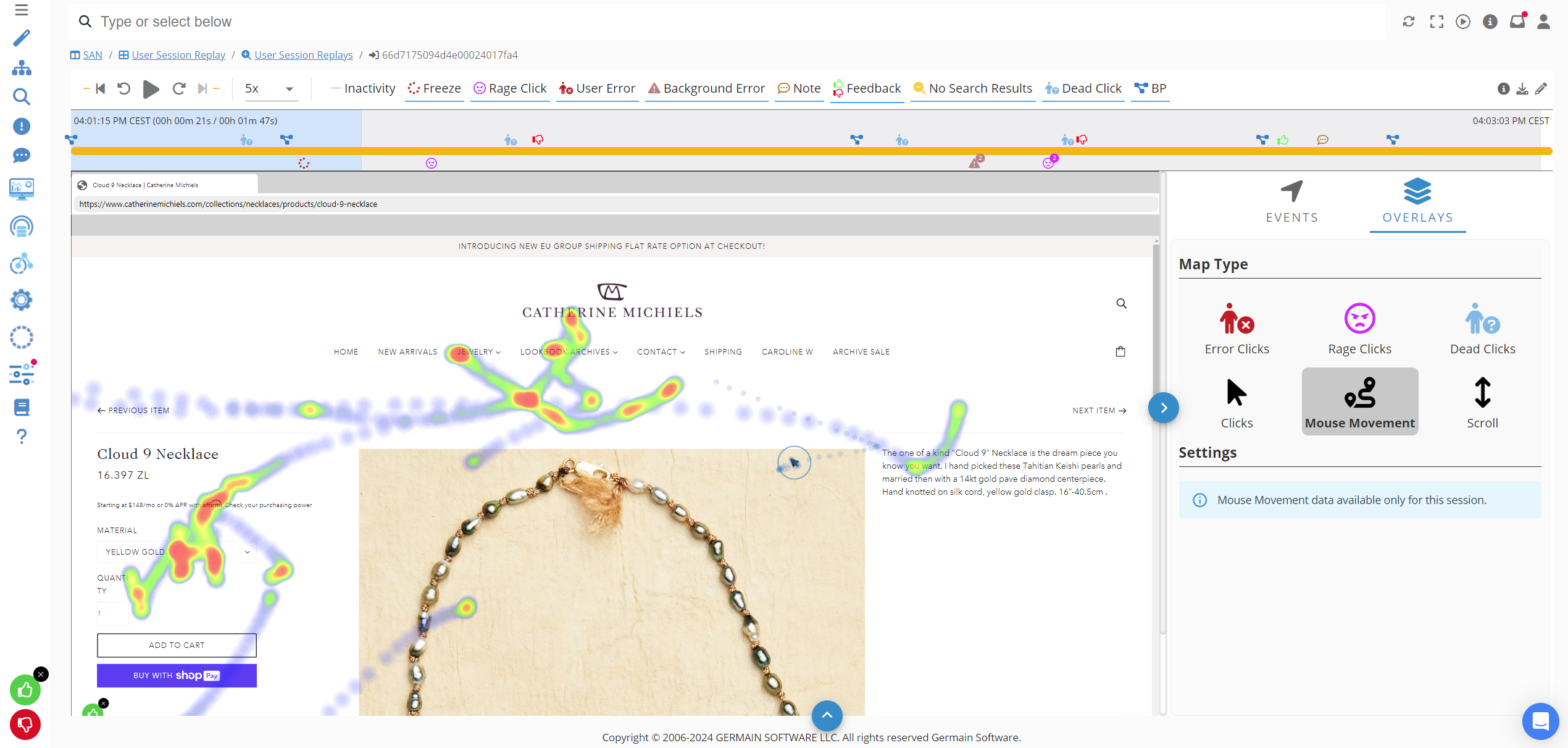
🖱️ Mouse Movement Heatmap
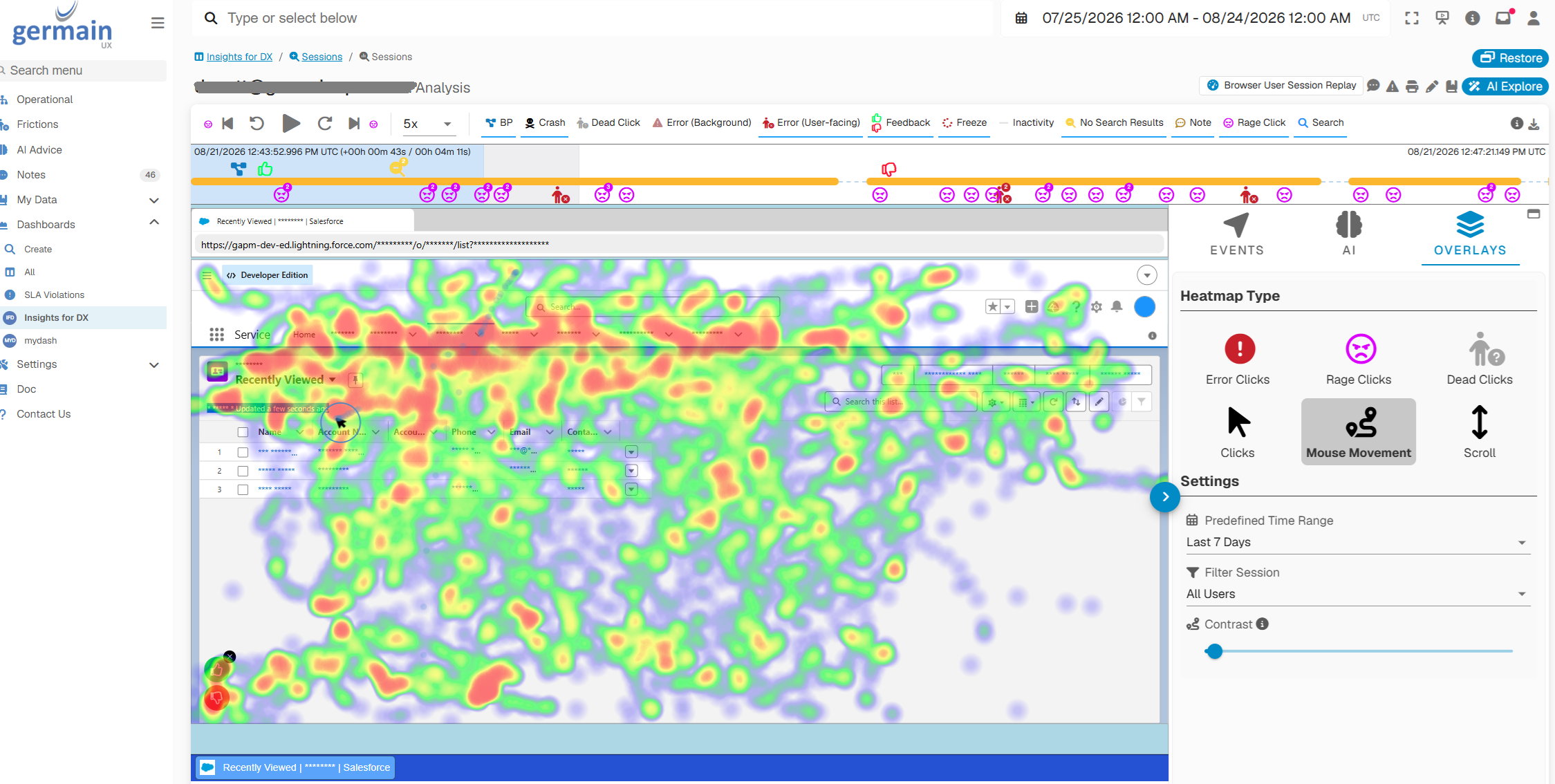
The Mouse Movement Heatmap visualizes pointer movement and concentration across a page.
It can help identify:
|
Signal |
|---|
|
Areas users explore before making a selection |
|
Elements that create hesitation |
|
Content or controls attracting pointer activity |
|
Regions users repeatedly move between |
|
Differences in behavior between successful and unsuccessful sessions |
Mouse movement is a useful behavioral signal, but it is not definitive proof of visual attention or intent. Interpret it alongside clicks, scroll behavior, journey progression and Session Replay.
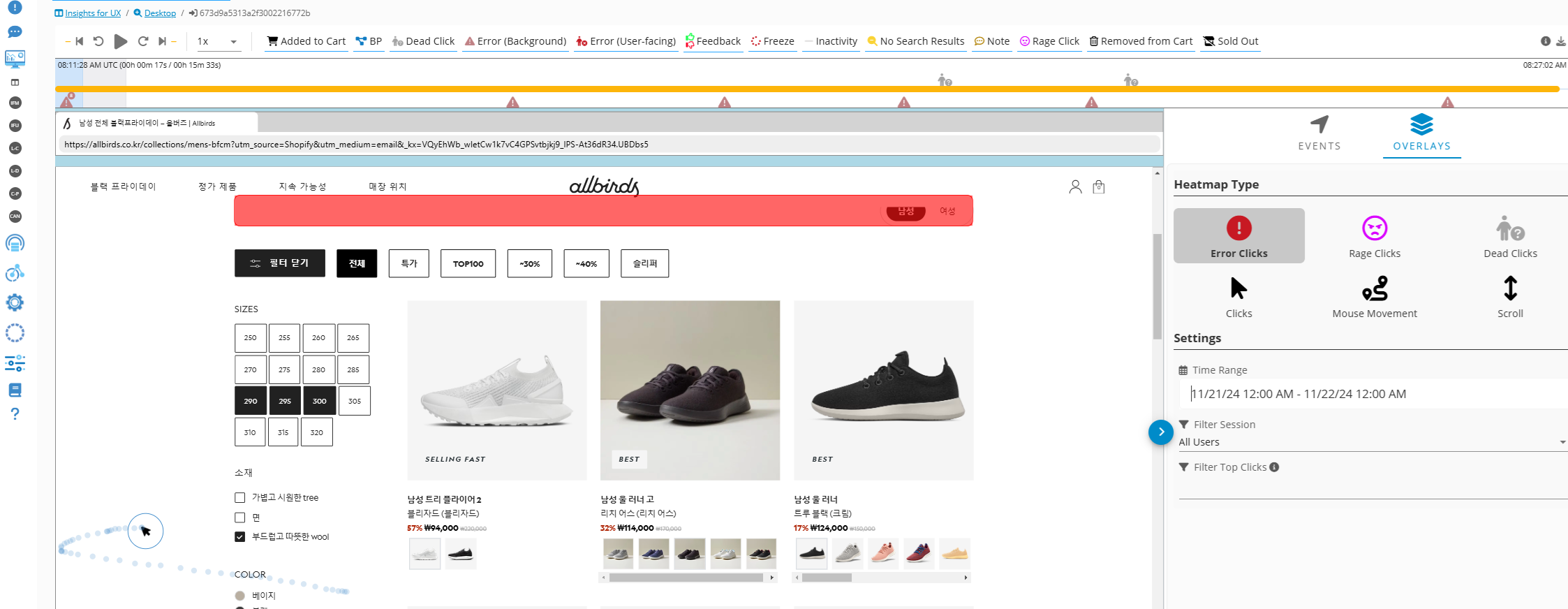
 Error Clicks Heatmap
The Error Clicks Heatmap highlights locations where user clicks are associated with an error or failed application behavior.
It can reveal:
|
Signal |
|---|
|
Broken links or actions |
|
Controls that trigger application errors |
|
Failed form, cart or workflow operations |
|
Errors concentrated around a particular page element |
|
Interface failures affecting many users |
An error occurring near a click does not always mean the click itself caused the failure. Session Replay, console events, network requests and transaction evidence help establish the actual relationship.
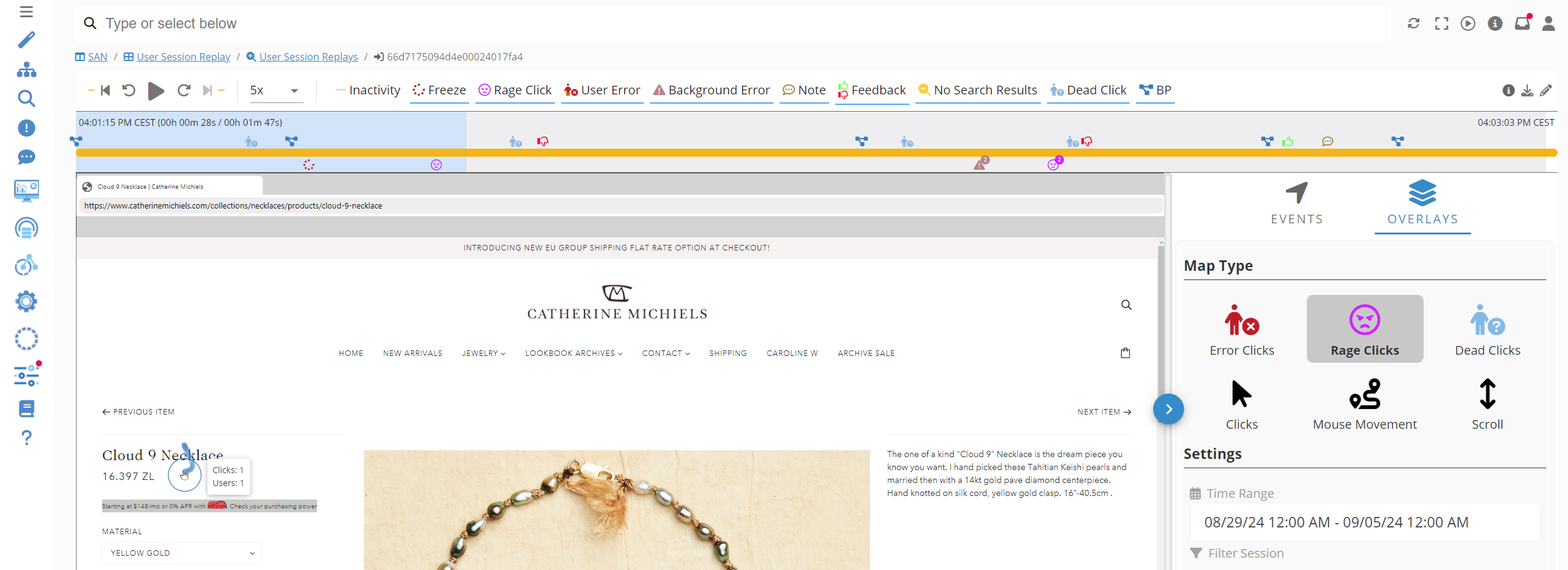
😠 Rage Clicks Heatmap
The Rage Clicks Heatmap shows where users click repeatedly within a short period.
Rage clicks may indicate:
|
Possible Cause |
|---|
|
A control that appears interactive but does not respond |
|
Slow application feedback |
|
Confusing navigation |
|
A failed or partially loaded component |
|
A user attempting repeatedly to continue a blocked workflow |
Repeated clicks do not always represent frustration. They should be reviewed with the application context, timing and corresponding Session Replay.
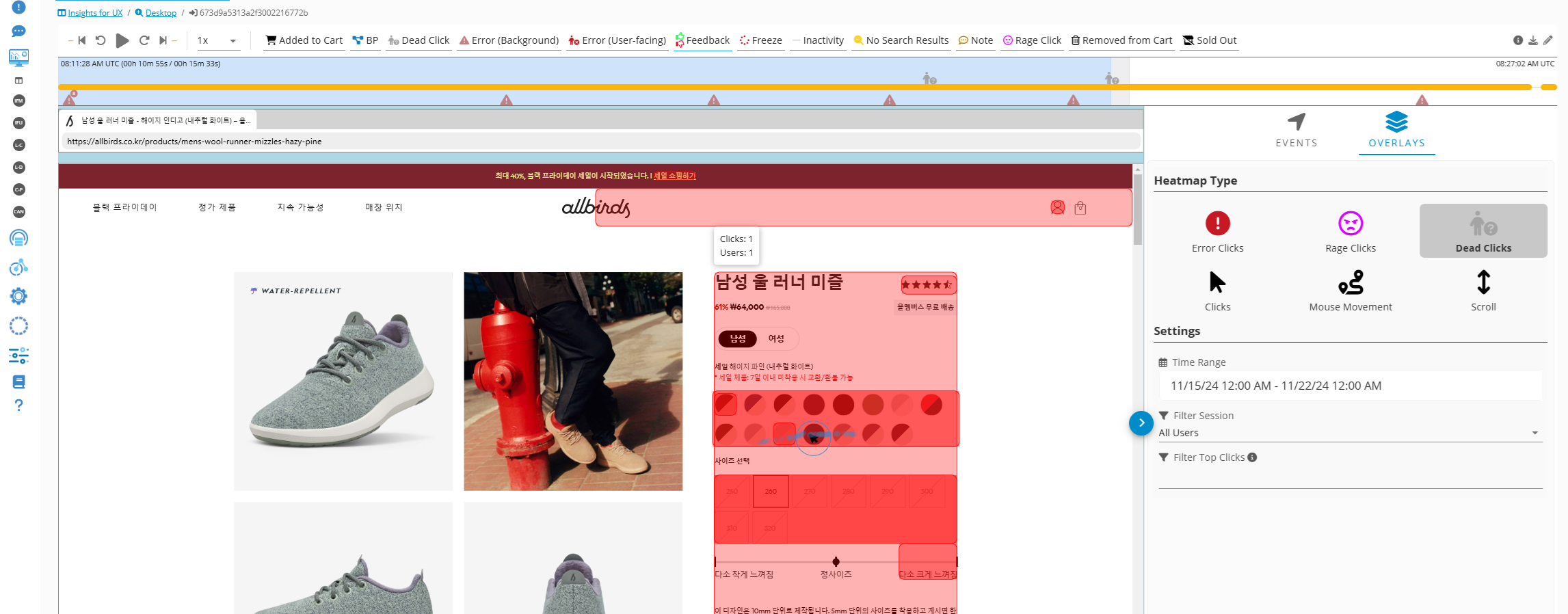
⛔ Dead Clicks Heatmap
The Dead Clicks Heatmap identifies clicks on elements that produce no meaningful response.
It can help uncover:
|
Signal |
|---|
|
Text, images or visual elements users expect to be interactive |
|
Buttons or links that are not functioning |
|
Misleading page design or affordances |
|
Areas where users waste time attempting an unavailable action |
|
Opportunities to improve navigation and calls to action |
Dead-click patterns are particularly valuable when they recur across many users or appear at an important journey stage.
🖲️ Clicks Heatmap
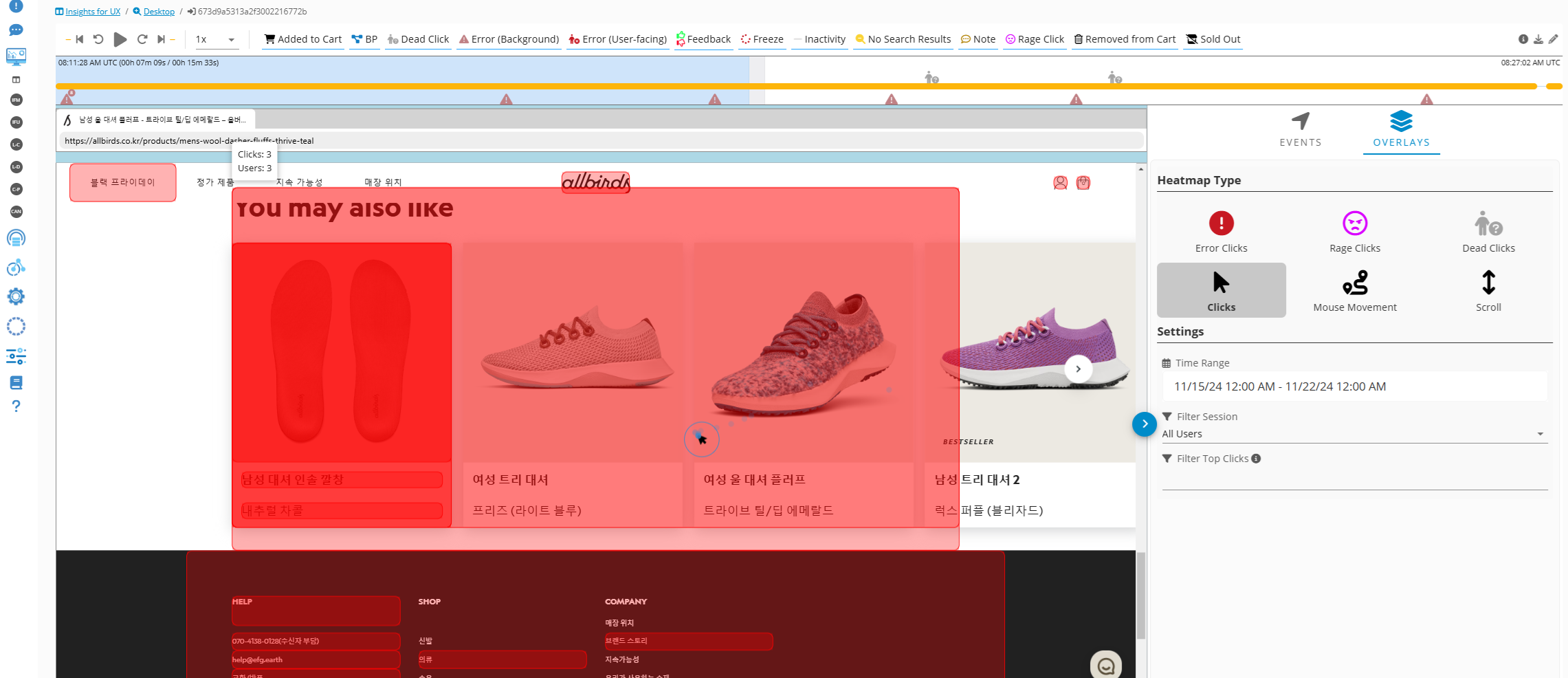
The Clicks Heatmap displays the distribution and concentration of all captured clicks on a page.
It helps teams understand:
|
Insight |
|---|
|
Which navigation elements and calls to action receive the most interaction |
|
Which important elements receive little or no interaction |
|
Whether users engage with expected content |
|
How interaction differs across audiences or outcomes |
|
Whether clicks lead to successful journey progression |
A heavily clicked element is not necessarily effective. Combine click volume with conversion, workflow completion, errors and downstream behavior.
📜 Scroll Heatmap
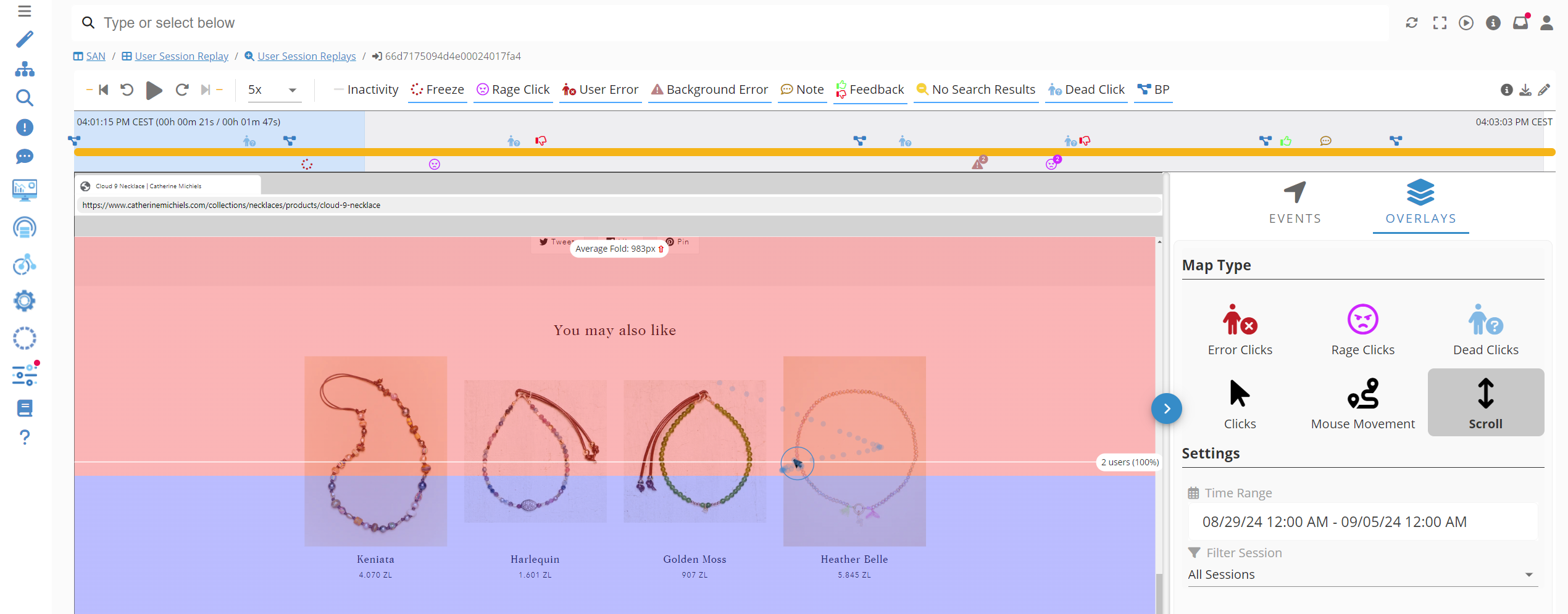
The Scroll Heatmap shows how far users progress through a page and the proportion of users reaching each content region.
It can help teams identify:
|
Signal |
|---|
|
Content seen by most users |
|
Important information positioned below common stopping points |
|
Sections associated with abandonment |
|
Pages that are unnecessarily long |
|
Differences in page consumption across devices or user segments |
Scroll depth indicates exposure, not comprehension or engagement. Use clicks, active time, journey events and Session Replay to understand whether users actually interacted with the content.
👥 Individual Sessions and Analysis at Scale
GermainUX heatmaps support two complementary forms of analysis:
|
Scope |
Best used for |
|---|---|
|
Individual session |
Understanding what one user did and investigating the precise context of an issue |
|
Multiple sessions |
Identifying recurring patterns and quantifying behavior across a selected population |
Aggregated analysis can be filtered or segmented by dimensions such as:
|
Dimension |
|---|
|
Page, application or environment |
|
New versus returning user |
|
Successful versus abandoned journey |
|
Product, feature or business process |
|
Device, browser or application version |
|
Region, role, team or other authorized attributes |
|
Error, performance or feedback condition |
The available segments depend on the application data and privacy configuration.
🎞️ Heatmaps and Session Replay
Heatmaps identify where behavior is concentrated. Session Replay explains the context surrounding that behavior.
A typical investigation can follow this sequence:
-
Identify an interaction pattern in a heatmap.
-
Quantify the users and sessions affected.
-
Filter by the relevant page, segment or outcome.
-
Open representative Session Replays.
-
Review the user journey, errors and performance events.
-
Determine the likely cause and business impact.
-
Prioritize and validate the appropriate corrective action.
This prevents teams from making design decisions based solely on visual density or isolated sessions.
🔓 Access Heatmaps in GermainUX
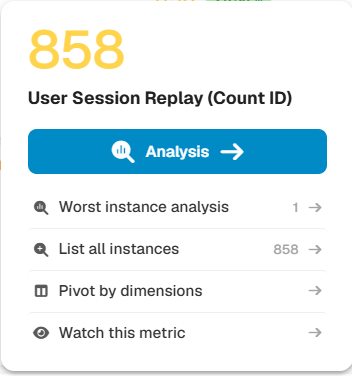
Heatmaps are associated with the User Session Replay KPI and are available from the Session Replay analysis view.
To access them:
-
Open an Aggregate Dashboard containing a portlet configured with the User Session Replay KPI.
-
Drill down using The Worst (Analysis/RCA) or Raw Instances, depending on the available dashboard action and GermainUX version.
-
If using Raw Instances, select the session you want to investigate.
-
Open the Overlays tab on the right side of the Session Replay Workspace.
Overlays Tab to see Heatmaps - GermainUX -
Select the heatmap or overlay to display.
The legacy fourth-level dashboard may be labeled RCA, while newer GermainUX versions may use Analysis terminology.
⚖️ Interpreting Heatmaps Responsibly
Heatmaps show behavioral patterns, not definitive user intent. Before making a design, workflow or technical change:
|
Check |
|---|
|
Confirm that the pattern affects enough users to be meaningful. |
|
Compare successful and unsuccessful journeys. |
|
Review representative Session Replays. |
|
Check for errors, slowness and application-state differences. |
|
Segment by device, browser, user type and other relevant attributes. |
|
Connect the behavior with conversion, adoption, productivity or another business outcome. |
|
Validate the effect after the change is deployed. |
🔒 Security and Privacy
Heatmaps are generated from captured user interactions. Collection and access should follow the organization’s consent, privacy, retention and security requirements.
GermainUX can be configured to mask or exclude sensitive fields and content, anonymize identifiers and restrict access to authorized users. Only approved applications and page contexts should be monitored.
ℹ️ Get Help
The Germain Team can help you set this up. Contact GermainUX Support.
Service: Analytics
Feature Availability: 2017.1 or later