
🌐 Browser Deprecated Features and Policy Violations Monitoring
GermainUX RUM JS collects supported reports generated by the browser when a monitored application uses deprecated functionality, violates a browser policy, or triggers a browser intervention.
This monitoring helps developers identify browser compatibility, security-policy, and future-support issues affecting real users.
✨ Benefits
GermainUX helps teams:
|
Benefit |
|---|
|
Identify deprecated browser features still used by an application. |
|
Detect Content Security Policy violations. |
|
Detect Permissions Policy violations. |
|
Identify browser interventions that alter or block application behavior. |
|
Determine which users, pages, browsers, and application versions are affected. |
|
Analyze whether violations increased after a release. |
|
Correlate browser reports with user activity, errors, network requests, and Session Replay. |
|
Prioritize corrections according to frequency and user impact. |
|
Notify developers when an important browser report is detected. |
⚙️ Preconfigured monitoring
Browser-report monitoring is preconfigured in GermainUX RUM JS.
When supported by the browser, GermainUX automatically collects the following report types:
|
Report type |
Description |
|---|---|
|
Content Security Policy violation |
Application content or behavior violates the page’s configured CSP |
|
Permissions Policy violation |
Application code attempts to use a browser capability restricted by policy |
|
Deprecated feature |
Application uses a browser feature that is deprecated or scheduled for removal |
|
Browser intervention |
The browser modifies, blocks, or restricts application behavior |
|
Other supported browser report |
Another browser-generated report exposed through the applicable browser API |
No customization is normally required. Additional configuration is needed only when customers want to change the default collection, filtering, categorization, or notification behavior.
🛡️ Content Security Policy violations
Content Security Policy controls which scripts, styles, images, frames, connections, and other resources a page can use.
GermainUX can collect supported CSP violations such as:
|
Violation |
|---|
|
Blocked script |
|
Blocked stylesheet |
|
Blocked image or font |
|
Blocked network connection |
|
Blocked frame |
|
Inline script or style violation |
|
Disallowed resource origin |
|
Other violations reported by the browser |
CSP reports can help explain why an application feature, third-party integration, or GermainUX monitoring component did not load correctly.
A CSP violation does not necessarily indicate an attack. It can also result from an incomplete policy, an application change, a browser extension, or an unexpected third-party resource.
🔒 Permissions Policy violations
Permissions Policy allows an application to control access to browser capabilities.
Depending on browser support, GermainUX can detect attempts to use a restricted capability, such as:
|
Capability |
|---|
|
Camera |
|
Microphone |
|
Geolocation |
|
Clipboard |
|
Fullscreen |
|
Payment |
|
Autoplay |
|
Other policy-controlled browser features |
The precise capabilities and report details vary by browser version.
 Deprecated features
Browsers can report when an application uses a feature that is deprecated or planned for removal.
These insights help development teams:
|
Action |
|---|
|
Find obsolete browser APIs. |
|
Identify pages and workflows that still depend on them. |
|
Determine which users and browsers encounter the deprecated behavior. |
|
Prioritize remediation before browser support is removed. |
|
Validate that a new application release no longer uses the feature. |
A deprecation report is a compatibility warning. It does not necessarily mean that the feature has already failed.
🛠️ Browser interventions
A browser intervention occurs when the browser changes, blocks, or restricts behavior to protect performance, security, privacy, or usability.
Examples can include:
|
Example |
|---|
|
Blocking an unsupported or unsafe action |
|
Restricting autoplay |
|
Preventing an inefficient operation |
|
Altering resource-loading behavior |
|
Applying another browser-defined intervention |
GermainUX records only the interventions exposed through supported browser reporting APIs.
📥 Collected information
Depending on the browser and report type, a browser-report fact can contain:
|
Property |
|---|
|
Report type |
|
Report name |
|
Message |
|
Page or document URL |
|
Source file |
|
Line and column |
|
Blocked resource or directive |
|
Browser and browser version |
|
Application and environment |
|
Application version |
|
Event timestamp |
|
User session |
|
Other authorized metadata |
Not every browser or report provides all properties.
📊 Analysis
Browser reports can be analyzed using measures such as:
|
Measure |
|---|
|
Report count |
|
Unique users affected |
|
Unique sessions affected |
|
Unique pages affected |
|
Report rate |
|
New report count |
|
SLA-violation count |
Results can be segmented by:
|
Segment |
|---|
|
Report type |
|
Report name |
|
Message |
|
CSP directive |
|
Page or route |
|
Source file |
|
Application |
|
Environment |
|
Application version |
|
Browser |
|
Browser version |
|
Operating system |
|
User or team |
|
Time period |
Useful analytical questions include:
|
Question |
|---|
|
Which CSP directive produces the most violations? |
|
Did new violations appear after a release? |
|
Are violations isolated to one browser version? |
|
Which pages or workflows are affected? |
|
Did the report coincide with a failed feature, JavaScript error, or user abandonment? |
Review the available KPIs for Browser Monitoring.
🎞️ Session Replay and correlation
When Session Replay is enabled, a browser report can be associated with the user session in which it occurred.
GermainUX can help correlate the report with:
|
Correlation |
|---|
|
User interactions |
|
Page navigation |
|
JavaScript errors |
|
Console events |
|
Network requests |
|
Popup dialogs |
|
Business-process milestones |
|
Application version |
|
User-visible errors |
|
Abandonment or workflow failure |
This helps determine whether a browser report had a visible effect or was only a technical warning.
🔔 Notifications
A browser-report insight can be used to:
|
Use |
|---|
|
Trigger an alert when an SLA is violated. |
|
Notify interested GermainUX users through a Watch. |
|
Appear in a dashboard or report. |
|
Initiate an approved development or investigation workflow. |
For example, a Watch can notify a development team when a previously unseen deprecated-feature report appears in production.
A Watch applies a notification to an existing browser insight; it does not create a new insight.
🔧 Optional customization
Customize the preconfigured monitoring only when required.
Possible customizations include:
|
Customization |
|---|
|
Include or exclude selected report types. |
|
Exclude known, accepted, or third-party violations. |
|
Categorize reports by application area or owner. |
|
Associate reports with an application version. |
|
Change severity according to report type. |
|
Define a custom SLA. |
|
Create a Watch for a specific report. |
|
Correlate a violation with an application or business-process KPI. |
Avoid filtering all reports from a third-party library without first confirming that they have no effect on the monitored application.
🌍 Browser support
Browser-report monitoring depends on browser reporting APIs.
The documented GermainUX capability is primarily available in supported Chromium-based browsers, including:
|
Browser |
|---|
|
Google Chrome |
|
Microsoft Edge |
|
Opera |
Supported report types and properties vary by browser and browser version. A report available in one browser may not be exposed by another.
Validate this capability using the browser versions deployed to the monitored users.
🚫 Limitations
Browser Deprecated Features and Policy Violations Monitoring is not:
|
Not |
|---|
|
A complete application-security scanner |
|
A penetration-testing tool |
|
Proof of regulatory compliance |
|
A complete CSP-management solution |
|
A guarantee that every deprecated API will be reported |
|
A replacement for browser compatibility testing |
|
A record of policy violations that occur before RUM JS starts |
|
A source of reports that the browser does not expose |
GermainUX records browser-generated reports available within the monitored page context. Cross-origin frames, third-party pages, extensions, and browser-internal processes may not be accessible to RUM JS.
🔑 Security and privacy
Browser reports can contain URLs, source filenames, blocked origins, and other application details.
Before production use:
|
Action |
|---|
|
Review which report properties are collected. |
|
Exclude sensitive URL parameters. |
|
Remove authentication tokens and secrets. |
|
Mask sensitive user or business identifiers. |
|
Restrict access to detailed technical reports. |
|
Apply appropriate retention policies. |
|
Review reports originating from browser extensions or third parties before sharing them externally. |
✅ Validation
-
Deploy GermainUX RUM JS.
-
Open the monitored application in a supported browser.
-
Confirm that the browser supports the required reporting API.
-
Generate an approved test violation or deprecated-feature event.
-
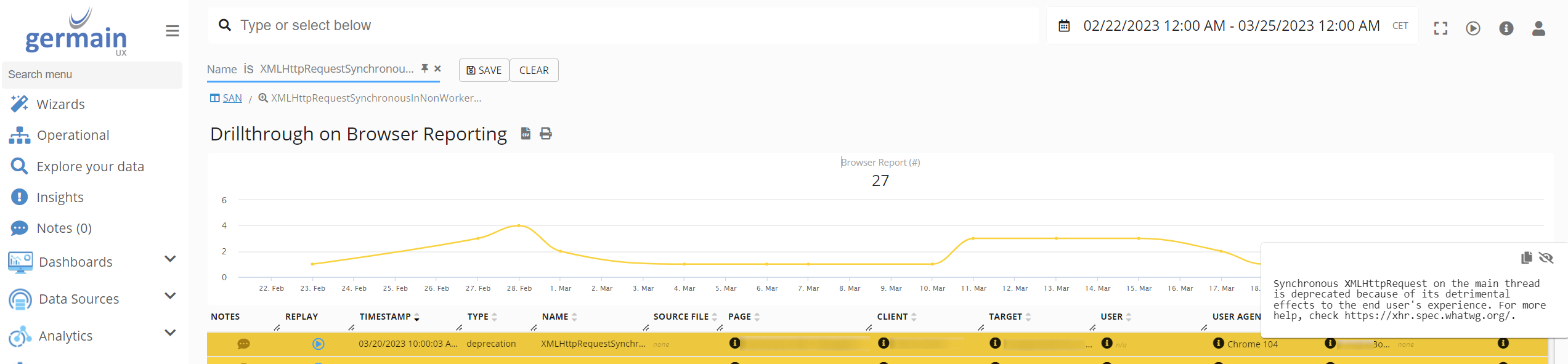
Confirm that a browser-report fact appears in GermainUX.

-
Verify its type, message, page, browser, and timestamp.
-
Confirm that it is associated with the correct user session.
-
Validate any configured category, SLA, alert, or Watch.
-
Repeat the test with the browser versions used in production.
🔧 Troubleshooting
If browser reports are not collected:
-
Confirm that RUM JS is loaded and running.
-
Verify that the browser supports and exposes the expected report type.
-
Confirm that browser-report monitoring is enabled in the UX Monitoring Profile.
-
Check whether the event occurred before RUM JS initialized.
-
Verify that the application URL matches the monitoring profile.
-
Check consent, sampling, and privacy settings.
-
Confirm that telemetry reaches GermainUX.
-
Review browser-console errors.
-
Verify that the tested condition actually generates a browser report.
-
Test in a supported Chromium-based browser.
📋 Deployment and configuration
|
For browser-report monitoring |
|---|
|
Deploy GermainUX RUM JS. |
|
Use the preconfigured browser-report monitoring unless customization is required. |
|
Validate CSP, Permissions Policy, deprecated-feature, and intervention reporting in supported browsers. |
|
Review the available Browser Monitoring KPIs. |
|
Configure exclusions, categories, SLAs, alerts, Watches, dashboards, or reports only when required. |
|
Correlate reports with Session Replay, JavaScript errors, network requests, application versions, and business processes. |
|
Review URL and source information for sensitive data before production rollout. |
ℹ️ Get Help
The Germain Team can help you set this up. Contact GermainUX Support.
Component: JS Profiler, RUM JS, RUM Extension
Feature Availability: 2022.3 or later
Browser Support: only latest Chrome, Edge and Opera