
📡 RUM JS Deployment for Oracle Siebel CRM
GermainUX RUM JS monitors the availability, performance, errors, user activity, and business processes of Oracle Siebel Open UI. It can also provide Session Replay and detailed evidence of the issues affecting Siebel users.
✨ Capabilities
After deployment, RUM JS can capture:
-
User sessions
-
User clicks and navigation
-
Screen, view, and applet activity
-
Page and interaction response times
-
Browser and JavaScript errors
-
Network and integration requests
-
User-facing errors
-
Business-process steps
-
Workflow overruns and lost productivity
-
Browser, device, location, and application context
-
Session Replay, when enabled
-
Data required for adoption and behavior analysis
See User Session Monitoring and Session Replay.
⚙️ How deployment works
The Siebel OpenUI wizard creates:
-
A GermainUX application for the Siebel environment
-
A UX Monitoring Profile
-
The environment-specific RUM JS installation instructions
The generated instructions define how GermainUX RUM JS must be loaded into Siebel Open UI. Because URLs, versions, paths, and deployment architectures vary, follow the instructions generated for the selected UX Monitoring Profile.
📋 Prerequisites
Before starting, collect the following information:
|
Requirement |
Details |
|---|---|
|
Application name |
A descriptive name for the monitored Siebel application |
|
Environment |
Production, UAT, QA, Development, or another environment |
|
Siebel URL |
The base URL users access for Siebel Open UI |
|
GermainUX endpoint |
The GermainUX environment that will receive RUM data |
|
Siebel administrative access |
Access required to deploy the generated JavaScript integration |
|
Browser connectivity |
User browsers must be able to download RUM JS and send telemetry |
|
Security approval |
Approval for the required script source and network connections |
|
Privacy requirements |
Fields and content that must be masked, anonymized, or excluded |
|
Test users |
Users who can validate the deployment before broad rollout |
Use separate GermainUX application definitions or UX Monitoring Profiles when environments require different URLs, privacy rules, or monitoring settings.
🏗️ Create the Siebel monitoring profile
-
Sign in to GermainUX.
-
Go to Workspace > Settings > Wizards.
-
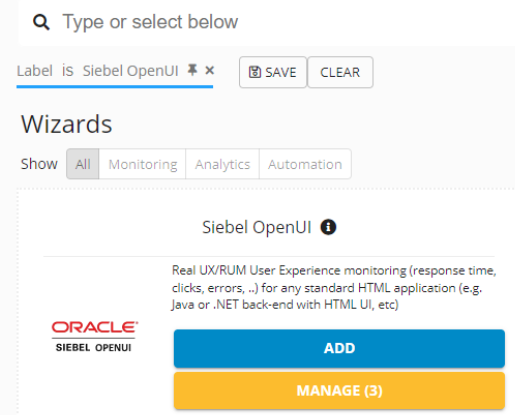
Select Siebel OpenUI.
-
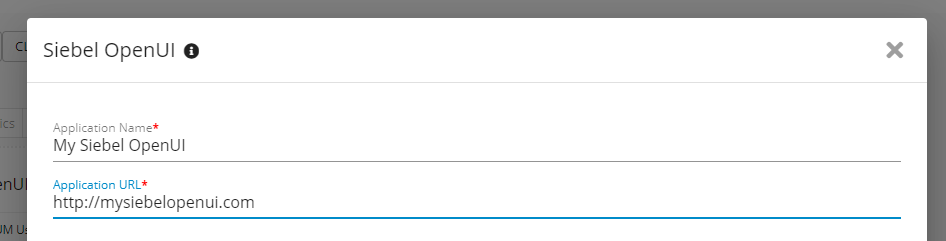
Enter the Application Name.
-
Enter the Siebel Open UI URL.
-
Select or enter the requested environment settings.
-
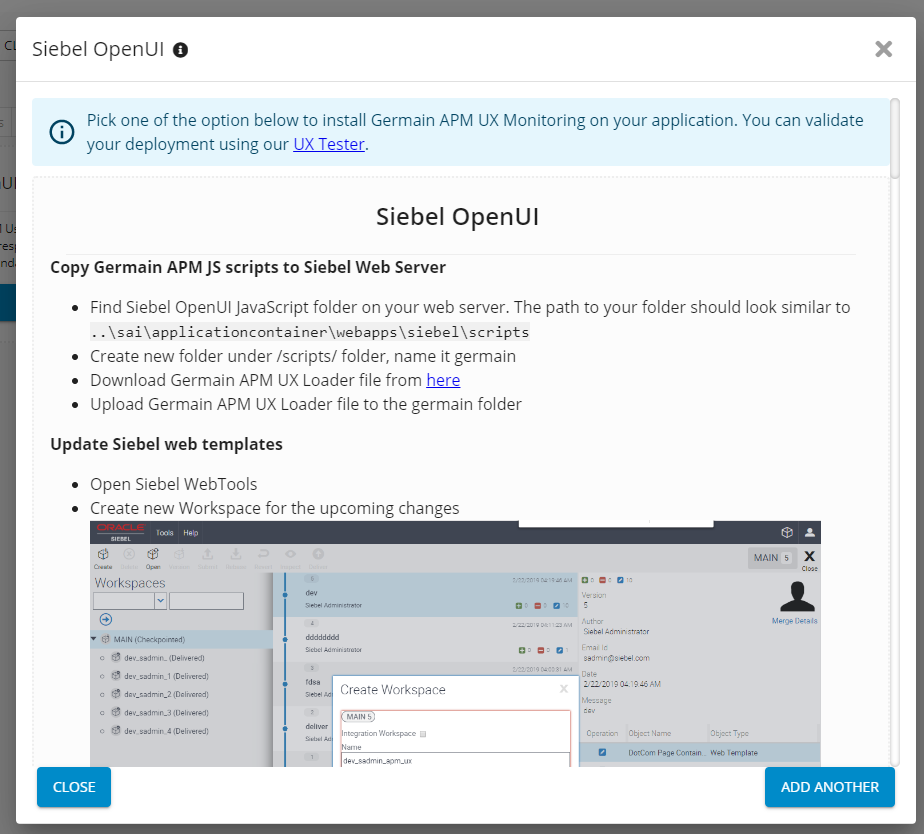
Review the generated configuration.
Siebel CRM OpenUI wizard in Germain UX -
Complete the wizard.
Use an application name that clearly identifies the application and environment, for example:
Siebel CRM - Production
or:
Siebel Call Center - UAT
Enter the URL used by the targeted users. Include the correct protocol, hostname, port, and applicable path.
🔎 Review the generated installation instructions
At the end of the wizard, GermainUX displays a deployment summary containing the installation steps for the new UX Monitoring Profile.
Follow those instructions to deploy RUM JS in the intended Siebel Open UI environment.
To return to the instructions later:
-
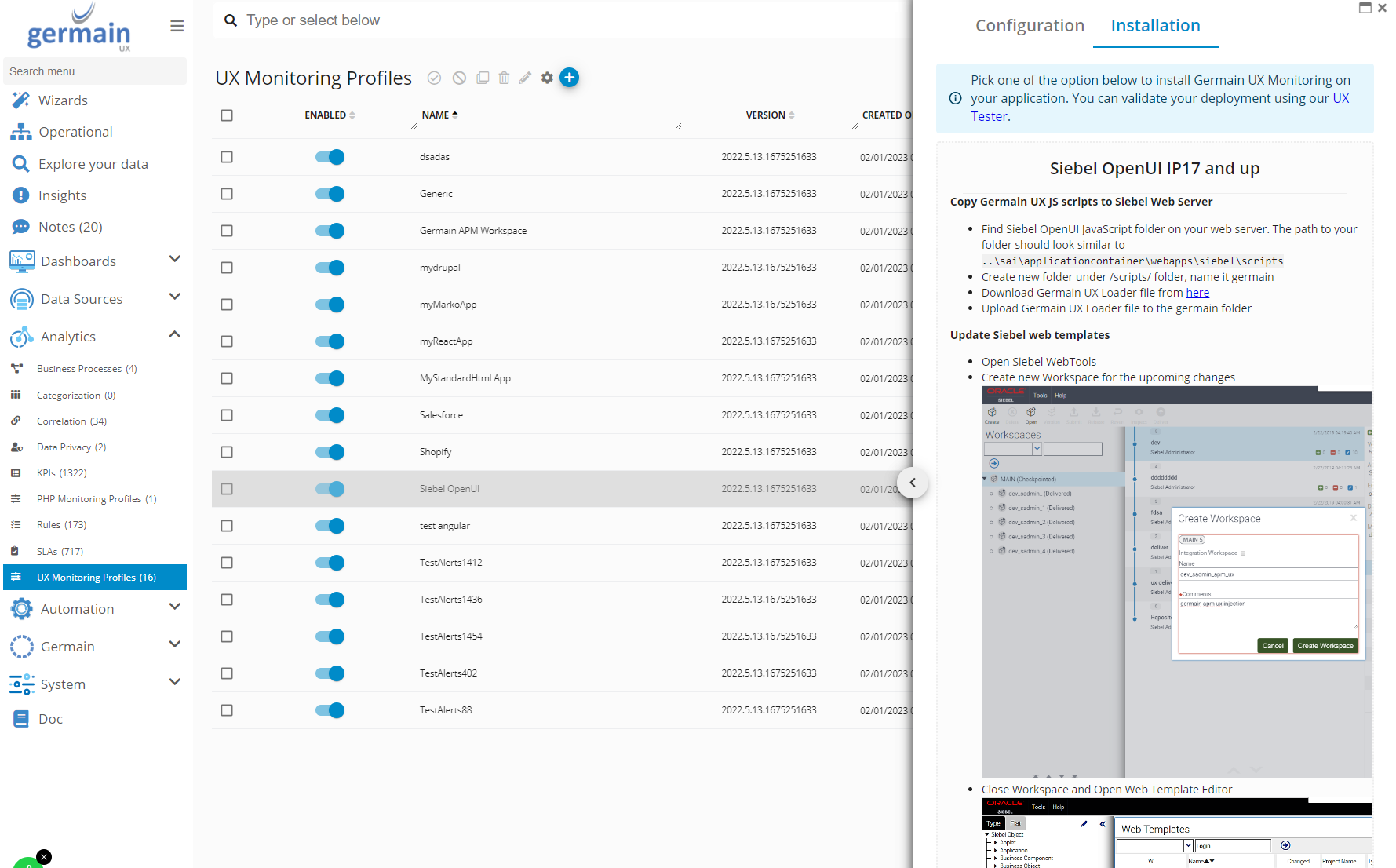
Go to Workspace > Analytics > UX Monitoring Profiles.
-
Select the profile created for Siebel Open UI.
-
Open the Installation section in the Configuration Editor.
-
Follow the displayed deployment instructions.
Use the installation instructions generated by GermainUX for the selected profile. Do not copy installation values from another application or environment.
📎 Deploy RUM JS in Siebel Open UI
The exact integration steps depend on the Siebel version, web-server configuration, and UX Monitoring Profile.
The deployment must ensure that:
-
The GermainUX loader runs when Siebel Open UI starts.
-
The script uses the configuration generated for the intended environment.
-
Monitoring initializes only on the intended Siebel URLs.
-
The user’s browser can download the required GermainUX resources.
-
RUM telemetry can be sent to GermainUX.
-
The integration remains available after Siebel application restarts.
-
Deployment is applied consistently across the required Siebel servers.
Where the Siebel environment contains multiple web servers or nodes, deploy the integration consistently to every node serving the monitored application.
🔒 Network and security configuration
User browsers may require permission to connect to the GermainUX endpoints referenced by the generated installation instructions.
Review:
-
Firewall rules
-
Proxy configuration
-
DNS resolution
-
TLS certificates
-
Content Security Policy
-
Script-source restrictions
-
Connection-source restrictions
-
Load balancers and reverse proxies
-
Browser security policies
Use encrypted HTTPS connections in production.
If a Content Security Policy is enabled, allow only the GermainUX origins required for script delivery and telemetry. Use the exact endpoints generated for the environment instead of broad wildcard rules whenever possible.
🛡️ Configure data privacy
Review privacy settings before enabling monitoring for production users.
Configure masking, anonymization, or exclusion for:
-
Passwords
-
Authentication tokens
-
Session identifiers
-
Personally identifiable information
-
Customer details
-
Payment information
-
Protected health information
-
Confidential business data
-
Sensitive notes and attachments
-
Custom Siebel fields containing restricted information
Review all relevant Siebel screens, views, applets, fields, dialogs, and custom components. Standard and customized Siebel interfaces may expose different data.
Test Session Replay and captured telemetry using representative workflows before completing the production rollout.
🚀 Recommended rollout
Deploy RUM JS progressively:
-
Development
-
QA or test
-
UAT
-
A controlled production user group
-
All intended production users
During each phase, validate:
-
Script loading
-
Application recognition
-
User-session creation
-
Data accuracy
-
Session Replay
-
Sensitive-data protection
-
Browser performance
-
Network consumption
-
Compatibility with custom Siebel functionality
A controlled rollout makes it easier to identify URL-matching, security-policy, privacy, or application-compatibility issues.
🧹 Clear caches after deployment
Siebel Open UI resources may be cached at multiple levels. After deploying or updating RUM JS, clear or refresh the applicable caches according to the organization’s Siebel deployment procedures.
These may include:
-
Siebel application caches
-
Web-server caches
-
Reverse-proxy or CDN caches
-
Browser caches
Restart only the Siebel services required by the generated installation instructions or by the organization’s standard deployment procedure.
Users may need to close existing Siebel tabs and start a new browser session before the updated integration becomes active.
✅ Validate script loading
Open the browser developer tools and load Siebel Open UI.
Confirm that:
-
The GermainUX script request succeeds.
-
No
404,403, certificate, or Content Security Policy errors appear. -
The request is not blocked by the proxy or browser policy.
-
The expected GermainUX endpoint is used.
-
Monitoring initializes once.
-
Duplicate copies of RUM JS are not loaded.
Also confirm that the script is loaded only for the intended Siebel environment.
📋 Validate monitoring data
Perform a representative Siebel workflow:
-
Sign in.
-
Open a screen or view.
-
Search for a record.
-
Open or update a permitted test record.
-
Navigate between views.
-
Trigger a known validation message when safe.
-
Sign out.
Then verify in GermainUX that:
-
A user session was created.
-
The correct application and environment were assigned.
-
The Siebel user was identified as configured.
-
Pages, views, clicks, and requests were captured.
-
Response times were recorded.
-
Errors and validations appeared under the intended KPIs.
-
Business-process steps were correlated correctly.
-
Session Replay was generated when enabled.
-
Sensitive values were masked or excluded.
📊 Validate application performance
Compare the monitored Siebel experience before and after deployment.
Review:
-
Application startup time
-
View-navigation time
-
Click response time
-
Browser CPU consumption
-
Browser memory consumption
-
Network traffic
-
Errors in the browser console
If an unexpected impact occurs, confirm that RUM JS is loaded only once and review the enabled monitoring features, capture scope, and Session Replay settings.
 Troubleshooting
❌ RUM JS does not load
Verify:
-
The generated installation steps were completed.
-
The correct UX Monitoring Profile was used.
-
The script URL is correct.
-
User browsers can reach the GermainUX endpoint.
-
DNS and proxy settings are correct.
-
TLS certificates are trusted.
-
Content Security Policy permits the required script source.
-
The deployed Siebel resources and browser caches were refreshed.
❓ RUM JS loads, but no data appears
Check:
-
The profile is enabled.
-
The Siebel URL matches the configured application URL.
-
Telemetry requests are not blocked.
-
The GermainUX server endpoint is correct.
-
The application and environment assignments are valid.
-
Privacy or filtering rules are not excluding all activity.
-
The profile configuration has been saved and published.
👥 Some Siebel users are not monitored
Compare:
-
Siebel URLs used by affected and unaffected users
-
Load-balancer nodes
-
Application configurations
-
Browser and proxy policies
-
User or group targeting rules
-
Cached Siebel resources
-
Profile inclusion and exclusion settings
If the deployment is file-based across multiple Siebel servers, verify that every relevant node contains the same integration.
🎥 Session Replay is unavailable
Confirm that:
-
Session Replay is enabled in the UX Monitoring Profile.
-
The user and application are within the recording scope.
-
Required browser resources and telemetry requests succeed.
-
Privacy settings do not exclude the entire page.
-
The session contains recordable user activity.
-
The user started a new session after configuration changes.
🔁 RUM JS loads more than once
Duplicate initialization can distort measurements and increase browser overhead.
Check:
-
Whether the script was added through more than one Siebel customization
-
Whether a proxy or tag-management system also injects it
-
Whether multiple presentation-model or physical-renderer customizations load it
-
Whether both an old and new deployment remain active
Keep one approved deployment method for each Siebel environment.
⬆️ Upgrade RUM JS
When upgrading GermainUX or changing the UX Monitoring Profile:
-
Review the current installation instructions.
-
Compare them with the previously deployed integration.
-
Test the updated configuration in a non-production environment.
-
Back up customized Siebel files before modifying them.
-
Deploy the update using the normal Siebel release process.
-
Clear the applicable caches.
-
Validate script loading and telemetry.
-
Confirm that privacy rules still behave correctly.
Do not assume that an older generated installation package or configuration remains correct after a significant GermainUX upgrade.
⏪ Roll back the deployment
Before deployment, retain a copy of every Siebel file or configuration changed by the integration.
To roll back:
-
Remove or disable the GermainUX RUM JS integration using the reverse of the generated installation procedure.
-
Restore the previous Siebel configuration or files.
-
Clear the applicable caches.
-
Restart required services when necessary.
-
open a new browser session.
-
Confirm that the GermainUX script no longer loads.
-
Verify normal Siebel operation.
Disabling the UX Monitoring Profile prevents further processing but does not necessarily remove the deployed script from Siebel. Use the appropriate Siebel rollback procedure when the integration must be removed completely.
📚 Related Documentation
-
Other Analytics Features
-
Other Automation Features
ℹ️ Get Help
The Germain Team can help you set this up. Contact GermainUX Support.
Component: Engine
Feature Availability: 2014.1 or later