
🚀 Deploy GermainUX Enterprise on Apache Tomcat
📋 Overview
GermainUX Enterprise can be deployed on Apache Tomcat within your organization’s data center, private cloud, or cloud account.
This deployment includes the central services used to:
|
Service |
|---|
|
Configure monitoring and automation |
|
Receive and process telemetry |
|
Query the GermainUX datastore |
|
Provide Workspace, dashboards, reports, and Session Replay |
|
Manage users, alerts, integrations, and system configuration |
This guide covers a traditional Tomcat deployment. For container-orchestrated environments, use the Kubernetes or OpenShift deployment guides.
🏗️ Architecture
A typical GermainUX Enterprise deployment includes:
|
Component |
Purpose |
|---|---|
|
Apache Tomcat |
Hosts GermainUX Enterprise web applications and services |
|
Configuration database |
Stores GermainUX configuration |
|
Datamart or Elasticsearch |
Stores monitoring and analytical data |
|
Kafka |
Provides messaging between GermainUX components |
|
Hazelcast |
Supports internal distributed processing |
|
ZooKeeper |
Stores centralized GermainUX configuration where required |
|
GermainUX Services |
Provide configuration, ingestion, querying, analytics, and other platform capabilities |
ActiveMQ is not supported for current GermainUX releases beginning with 2024.2. It applies only to older deployments.
📋 Before You Begin
Confirm with Germain Software:
|
Item |
|---|
|
GermainUX version |
|
Supported Java version |
|
Supported Tomcat version |
|
Supported datastore and driver |
|
Kafka, Hazelcast, and ZooKeeper requirements |
|
Required server distribution |
|
License |
|
Hardware sizing |
|
Network ports |
|
Authentication method |
|
High-availability architecture |
Do not independently upgrade Tomcat, Java, Kafka, Hazelcast, ZooKeeper, or the datastore without confirming compatibility.
⚙️ Requirements
Prepare:
|
Requirement |
|---|
|
A supported 64-bit operating system |
|
Supported JDK |
|
Supported Apache Tomcat |
|
GermainUX Server distribution |
|
GermainUX license |
|
Prepared configuration database |
|
Prepared datamart or Elasticsearch cluster |
|
Kafka |
|
Hazelcast and ZooKeeper when required |
|
SMTP account |
|
DNS name and TLS certificate |
|
Service account |
|
Required JDBC drivers |
|
Network connectivity between all components |
See:
⬇️ Recommended Installation Order
-
Prepare the datastore.
-
Install and configure ZooKeeper.
-
Install and configure Kafka.
-
Install Hazelcast when required.
-
Install GermainUX Enterprise on Tomcat.
-
Configure datastore connections.
-
Configure messaging.
-
Configure email and authentication.
-
Initialize the GermainUX configuration.
-
Start GermainUX services.
-
Validate the complete deployment.
-
Configure Sentinel for platform self-monitoring.
📦 Install GermainUX Enterprise
1️⃣ 1. Extract the Distribution
Extract the GermainUX Server distribution into a temporary directory.
The distribution includes a Tomcat directory named according to the supported version, such as:
tomcat
tomcat9
Move this directory to the approved installation location.
Examples:
C:\GermainUX\Tomcat
/opt/germainux/tomcat
The final directory is referenced below as:
CATALINA_HOME
⚙️ 2. Set CATALINA_HOME
💻 Windows
Set:
CATALINA_HOME=C:\GermainUX\Tomcat
🐧 Linux or Unix
Example:
export CATALINA_HOME=/opt/germainux/tomcat
Configure the environment variable for the service account that runs Tomcat.
🔍 3. Verify the Java Runtime
Confirm that Tomcat uses the supported JDK:
java -version
Set JAVA_HOME to the approved JDK installation.
Do not rely on an unrelated system Java installation.
🔧 Configure Tomcat
🔗 HTTP and HTTPS Ports
Tomcat commonly listens on port 8080 during initial setup.
The HTTP connector is configured in:
$CATALINA_HOME/conf/server.xml
Example:
<Connector
    port="8080"
    protocol="HTTP/1.1"
    connectionTimeout="20000"
    redirectPort="8443" />
For production:
-
Expose GermainUX through HTTPS.
-
Use a reverse proxy or secured Tomcat connector.
-
Restrict direct access to internal Tomcat ports.
-
Do not expose the Tomcat shutdown or AJP ports unless required.
-
Disable unused connectors.
The public URL should normally use port 443.
📦 Memory
Configure JVM options in:
$CATALINA_HOME/bin/setenv.sh
or:
%CATALINA_HOME%\bin\setenv.bat
Example:
export CATALINA_OPTS="$CATALINA_OPTS -Xms8g -Xmx8g -XX:+CrashOnOutOfMemoryError"
Memory settings must be based on the environment’s sizing assessment. Do not assume that 8 GB is sufficient for production.
Retain enough physical memory for the operating system and other services.
👥 Service Account and Permissions
Run Tomcat using a dedicated, non-personal service account.
The account requires access to:
|
Area |
|---|
|
Tomcat installation |
|
Configuration |
|
Logs |
|
Temporary and working directories |
|
Java runtime |
|
Mounted certificates and truststores |
|
Required network destinations |
Do not run Tomcat as root or a domain administrator.
🖥️ Install as a Windows Service
Open an elevated command prompt:
cd %CATALINA_HOME%
bin\service.bat install GermainAPMServer
This creates a Windows service with a name similar to:
Apache Tomcat <version> GermainAPMServer
Use the Tomcat service-management executable supplied with the installed Tomcat version to configure:
|
Setting |
|---|
|
Java Virtual Machine |
|
Initial and maximum memory |
|
JVM options |
|
Service account |
|
Startup mode |
|
Log locations |
Add the following JVM option when approved:
-XX:+CrashOnOutOfMemoryError
This causes the JVM to terminate on an unrecoverable out-of-memory condition so the service manager or monitoring platform can restart it.
🗄️ Configure the Datastore
GermainUX normally uses separate connections for:
|
Connection |
|---|
|
Configuration data |
|
Datamart data |
|
Elasticsearch indexing and analytics, when Elasticsearch is used |
Install the supported JDBC driver under the location specified by the GermainUX release.
🔧 Configuration Database
Configure:
|
Key |
|---|
|
Driver class |
|
JDBC URL |
|
Username |
|
Password |
|
TLS |
|
Connection pool |
|
Connection timeout |
Applicable configuration keys include:
/config/germain/application/germain.config.driverClassName
/config/germain/application/germain.config.url
/config/germain/application/germain.config.username
/config/germain/application/germain.config.password
📊 Datamart
Applicable keys include:
/config/germain/application/germain.datamart.driverClassName
/config/germain/application/germain.datamart.url
/config/germain/application/germain.datamart.username
/config/germain/application/germain.datamart.password
Example structure:
set /config/germain/application/germain.datamart.driverClassName "<supported-driver>"
set /config/germain/application/germain.datamart.url "<secured-jdbc-url>"
set /config/germain/application/germain.datamart.username "<datamart-user>"
set /config/germain/application/germain.datamart.password "<secure-password>"
Do not use example accounts or disable TLS in production.
Store passwords through the secure credential mechanism supported by your GermainUX release rather than in scripts or source control.
🔎 Elasticsearch
When Elasticsearch is used, configure:
/config/germain/application/germain.indexer.url
Example:
set /config/germain/application/germain.indexer.url "https://elasticsearch.example.com:9200"
Also configure the required authentication and certificate trust.
Do not use unsecured HTTP for production Elasticsearch connectivity.
🛰️ Configure Kafka
Kafka replaces ActiveMQ in GermainUX 2024.2 and later.
When Kafka runs on another host, configure its broker URL:
set /config/germain/application/germain.kafka.brokerUrl "<kafka-host>:9092"
Use the actual secured listener configured for your environment.
Production Kafka should include:
|
Requirement |
|---|
|
Authentication |
|
TLS |
|
Restricted network access |
|
Replication |
|
Monitoring |
|
Appropriate retention |
|
High availability where required |
See Apache Kafka Setup.
⏳ Legacy ActiveMQ Configuration
ActiveMQ applies only to GermainUX releases earlier than 2024.2.
Legacy configuration key:
/config/germain/application/germain.messaging.brokerUrl
Do not configure ActiveMQ for a current GermainUX deployment unless Germain Software explicitly confirms that it is required.
📧 Configure Email
Configure SMTP for alerts, scheduled reports, notifications, and administrative email.
Applicable keys include:
/config/germain/application/spring.mail.from
/config/germain/application/spring.mail.host
/config/germain/application/spring.mail.username
/config/germain/application/spring.mail.password
/config/germain/application/spring.mail.port
/config/germain/application/spring.mail.properties.mail.smtp.auth
/config/germain/application/spring.mail.properties.mail.smtp.starttls.enable
Example structure:
set /config/germain/application/spring.mail.from "germain-alerts@example.com"
set /config/germain/application/spring.mail.host "smtp.example.com"
set /config/germain/application/spring.mail.username "<smtp-user>"
set /config/germain/application/spring.mail.password "<secure-password>"
set /config/germain/application/spring.mail.port "587"
set /config/germain/application/spring.mail.properties.mail.smtp.auth "true"
set /config/germain/application/spring.mail.properties.mail.smtp.starttls.enable "true"
Use your organization’s approved SMTP encryption and authentication settings.
🔑 Configure Authentication
GermainUX supports:
|
Method |
Use |
|---|---|
|
Database authentication |
Default GermainUX-managed accounts |
|
LDAP |
Enterprise directory authentication |
|
Microsoft Active Directory |
Windows enterprise identity |
|
OAuth |
External identity-provider authentication |
Configure the selected method before production rollout and retain an approved recovery administrator account.
Test:
-
Sign-in
-
Sign-out
-
User provisioning
-
Role assignment
-
Disabled-user handling
-
Session expiration
-
Identity-provider failure
-
Administrative recovery
▶️⏸️ Start and Stop Tomcat
🐧 Linux or Unix
Start:
cd $CATALINA_HOME
bin/startup.sh
Stop:
cd $CATALINA_HOME
bin/shutdown.sh
For production, operate Tomcat through an approved service manager such as systemd rather than relying exclusively on interactive shell scripts.
💻 Windows Command Line
Start:
cd %CATALINA_HOME%
bin\startup.bat
Stop:
cd %CATALINA_HOME%
bin\shutdown.bat
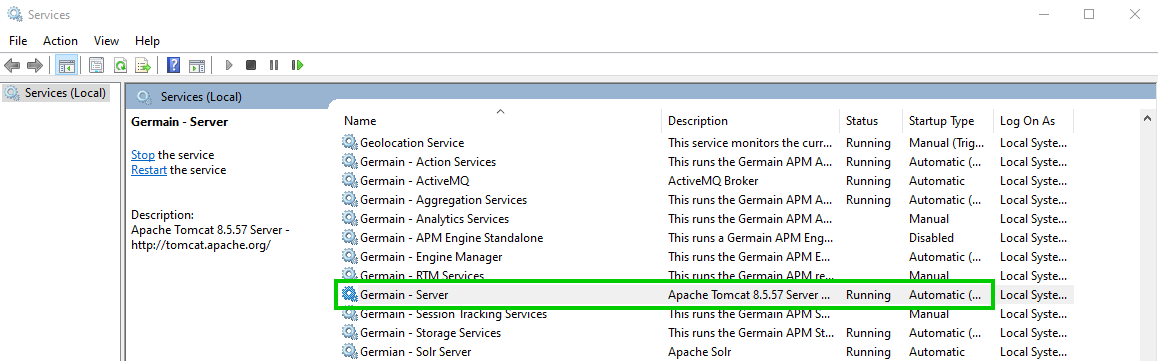
⚙️ Windows Service
Use the Windows Services console or your approved service-management tooling to start and stop:
GermainAPMServer
✅ Validate the Deployment
Start infrastructure and GermainUX components in this order:
-
Datastore
-
ZooKeeper
-
Kafka
-
Hazelcast
-
Tomcat and GermainUX core services
-
Remaining GermainUX services
-
GermainUX Engines and collectors
Then confirm:
|
Check |
|---|
|
Tomcat remains running. |
|
GermainUX Enterprise connects to the configuration database. |
|
GermainUX Enterprise connects to the datamart or Elasticsearch. |
|
Kafka connectivity succeeds. |
|
Hazelcast and ZooKeeper are healthy when used. |
|
GermainUX Workspace opens. |
|
Administrator authentication works. |
|
Configuration can be saved and retrieved. |
|
Monitoring data is received. |
|
Dashboards and analyses return data. |
|
Email can be delivered. |
|
No recurring startup errors appear in logs. |
📄 Logs
Logs are located under:
$CATALINA_HOME/logs
Common files include:
|
Log |
Purpose |
|---|---|
|
|
Primary Tomcat output on Linux or Unix |
|
|
Tomcat lifecycle and container messages |
|
|
GermainUX Windows-service output |
|
|
Configuration-service activity |
|
|
Query-service activity |
|
|
Data-ingestion activity |
Review logs for:
-
License errors
-
Database connectivity failures
-
Kafka connectivity failures
-
TLS or certificate errors
-
Authentication problems
-
Port conflicts
-
Out-of-memory errors
-
Schema-version mismatches
-
Service startup failures
⏪ Rollback Plan
Before changing or upgrading the deployment:
-
Back up the GermainUX configuration database.
-
Back up or snapshot the datamart.
-
Back up Tomcat configuration.
-
Back up ZooKeeper configuration.
-
Record Kafka and datastore settings.
-
Preserve the previous GermainUX distribution.
-
Document the current service-start order.
-
Test the rollback in a non-production environment.
If deployment validation fails:
-
Stop Engines and collectors.
-
Stop GermainUX services.
-
Restore the previous Tomcat and GermainUX files.
-
Restore the previous configuration.
-
Restore databases only when required.
-
Start the infrastructure.
-
Start GermainUX services.
-
Validate connectivity and data reception.
📚 Related Installation Guides
-
ZooKeeper Setup
-
GermainUX Services
-
Troubleshooting
For version-specific packages, configuration values, or deployment assistance, contact Germain team.
Service: Enterprise
Feature Availability: 2014.1