
✨ Deploy Monitoring for Squarespace
Deploy GermainUX monitoring on Squarespace to capture Real User Monitoring, Session Replay, performance, browser errors, forms, customer journeys, conversion, and third-party service activity.
GermainUX can also monitor customer-accessible APIs and integrations and execute synthetic website, form, booking, membership, and commerce scenarios.
For a complete description of the available capabilities, see Squarespace Monitoring.
✅ Select the required deployment
|
Monitoring requirement |
GermainUX component |
Deployment location |
|---|---|---|
|
Real User Monitoring and Session Replay |
Squarespace pages that support code injection |
|
|
Customer-journey and conversion analysis |
RUM JS and GermainUX business-process configuration |
Website and supported commerce pages |
|
Deeper browser and JavaScript diagnostics |
Selected administrator, QA, development, or support browsers |
|
|
APIs, webhooks, and integrations |
A system with access to the required endpoints |
|
|
Synthetic website transactions |
GermainUX RPA Bot Recorder and Engine |
Recorder browser and synthetic-execution environment |
|
Native mobile application monitoring |
Customer-controlled native mobile application, when applicable |
⚙️ Deployment workflow
|
Step |
Action |
|---|---|
|
1 |
Identify the Squarespace sites, domains, pages, forms, integrations, and customer journeys to monitor. |
|
2 |
Confirm that the Squarespace plan supports the required code-injection capabilities. |
|
3 |
Create the application and UX monitoring profile in GermainUX. |
|
4 |
Configure privacy, consent, masking, exclusions, retention, and bot filtering. |
|
5 |
Add GermainUX RUM JS to the Squarespace header code. |
|
6 |
Save the configuration and validate monitoring on the published website. |
|
7 |
Configure forms, commerce events, campaigns, and business processes. |
|
8 |
Deploy the Engine, JS Profiler, and synthetic scenarios when required. |
|
9 |
Configure analytics, KPIs, SLAs, dashboards, alerts, and approved automated actions. |
📋 Requirements
Before starting, confirm the following:
|
Requirement |
Details |
|---|---|
|
Squarespace permissions |
An authorized administrator must be able to manage code injection and website settings. |
|
Squarespace plan |
The selected plan must support custom code or code injection. |
|
GermainUX environment |
The GermainUX environment must be deployed and accessible through HTTPS. |
|
Network access |
Visitors’ browsers must be allowed to download RUM JS and send monitoring data to GermainUX. |
|
Supported pages |
Confirm that Squarespace permits injected code to execute on every page or browser context that must be monitored. |
|
Consent |
Define whether monitoring starts before or after the visitor provides the required consent. |
|
Privacy |
Identify sensitive pages, fields, content, URLs, and visitor attributes before production deployment. |
|
Third-party contexts |
Identify checkout, payment, scheduling, authentication, and embedded services that may not permit GermainUX code. |
🔧 Configure Squarespace in GermainUX
In GermainUX:
-
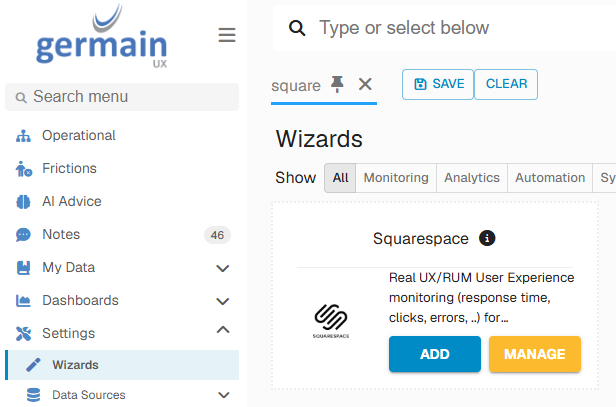
Go to Workspace > Settings > Wizards.
-
Select Squarespace.
-
Enter the required configuration.
|
Setting |
Description |
|---|---|
|
Application name |
Name used to identify the Squarespace website |
|
Website URL |
Published Squarespace or custom-domain URL beginning with 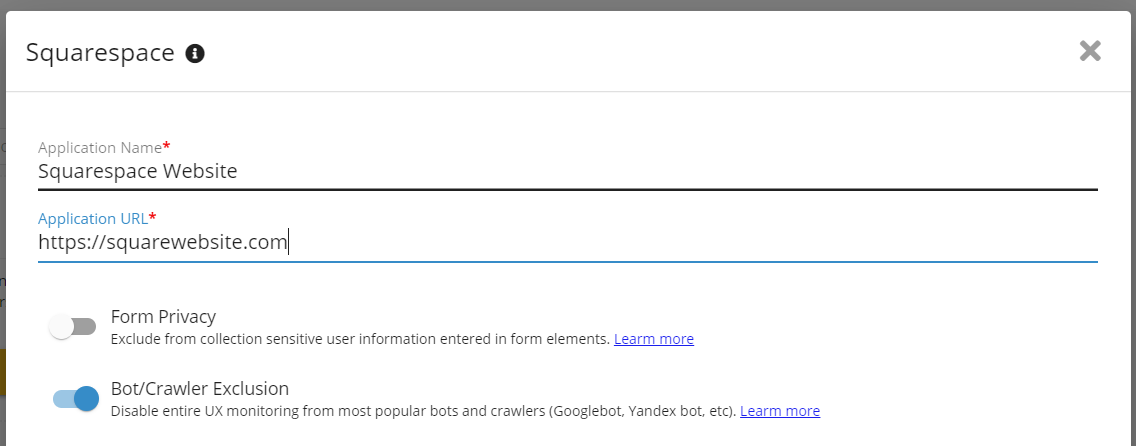
|
|
Environment |
Production, staging, test, development, or another environment |
|
UX monitoring profile |
Monitoring configuration applied to the website |
|
Privacy configuration |
Masking, anonymization, exclusion, and recording rules |
|
Bot and crawler handling |
Determines whether automated traffic is collected or excluded |
|
Allowed domains |
Squarespace and custom domains authorized to use the profile |
Complete the wizard and copy the generated GermainUX RUM JS snippet.
If a Squarespace-specific wizard is unavailable in the installed GermainUX version, create the application and UX monitoring profile manually and use the RUM JS installation snippet generated for that profile.
🚀 Deploy GermainUX RUM JS
🌐 Site-wide code injection
Use site-wide code injection when all supported Squarespace pages must be monitored.
-
Sign in to Squarespace as an authorized administrator.
-
Open the website to monitor.
-
Open the website’s settings.
-
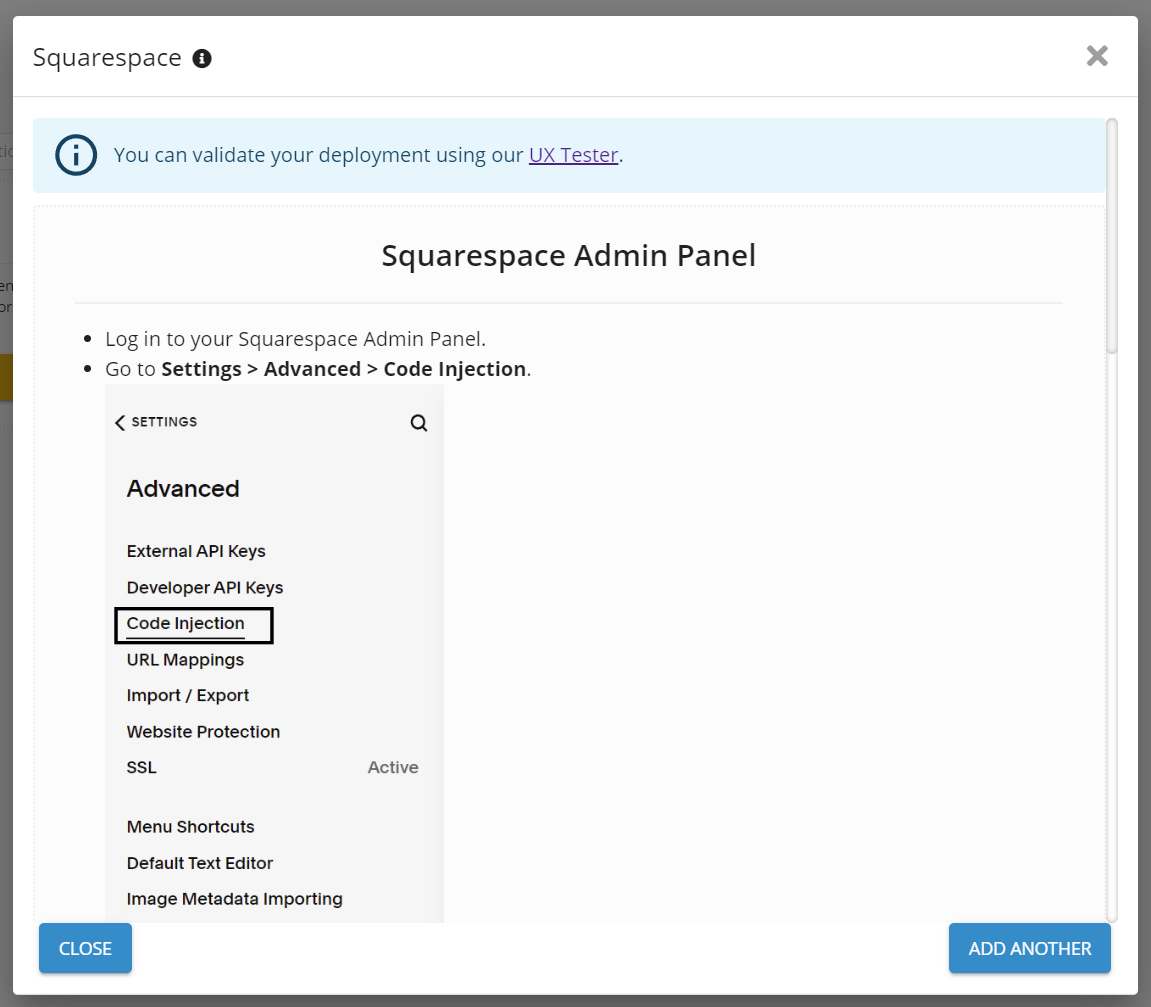
Locate Code Injection under the applicable advanced, developer, or website-tools settings.
-
Paste the RUM JS snippet generated by GermainUX into the Header section.
-
Save the configuration.
-
Open the published website and validate the deployment.
Squarespace navigation labels can vary by platform and interface version. Use the current Code Injection settings provided for the website.
Adding RUM JS to the header enables monitoring to start early enough to capture the initial page load, browser activity, errors, and user interactions.
Do not use a generic example URL in production. Use the snippet generated for the correct GermainUX environment, application, and UX monitoring profile.
📄 Selected-page deployment
If monitoring must be restricted to selected pages, use an approved page-level code block or page-header configuration where Squarespace permits it.
Confirm that:
|
Check |
|---|
|
The code executes in the required page context. |
|
It loads before the interactions that must be monitored. |
|
It is added to every page included in the monitoring scope. |
|
It does not appear visibly as page content. |
|
It is not also injected through the site-wide header. |
Site-wide and page-level deployment must not load the same RUM JS configuration twice.
🔍 Google Tag Manager
When Google Tag Manager is already authorized for the site, RUM JS can be deployed using Google Tag Manager.
-
Create a Custom HTML tag containing the GermainUX RUM JS snippet.
-
Configure it to run on the required Squarespace pages.
-
Coordinate its trigger with consent requirements.
-
Preview and validate the tag.
-
Publish the container.
Ensure that RUM JS is deployed through only one method.
🌐 Configure the monitored domains
Add every authorized production and test domain to the GermainUX UX monitoring profile, including applicable:
|
Domain type |
|---|
|
Squarespace-provided domains |
|
Custom primary domains |
|
Regional domains |
|
Subdomains |
|
Testing or staging domains |
Do not allow unrestricted domains. Remove temporary or obsolete domains after testing is complete.
🔐 Content Security Policy
If the website uses a Content Security Policy or another security control, authorize only the GermainUX origins required to:
-
Download RUM JS
-
Send monitoring data to GermainUX
-
Load enabled feedback or supporting resources
Use HTTPS and the most restrictive directives supported by the deployment. Do not authorize unrelated domains or broad wildcards.
✅ Consent management
Coordinate GermainUX startup with Squarespace’s cookie controls or the website’s consent-management platform.
Depending on the applicable requirements, configure RUM JS to:
-
Start only after the required consent is granted
-
Avoid starting when the visitor rejects the applicable consent category
-
Respect consent withdrawal
-
Apply the correct behavior by geography
-
Preserve the selected consent state across page navigation
-
Avoid creating visitor identifiers before authorization
Test monitoring with consent accepted, rejected, and withdrawn.
🔒 Privacy and Session Replay
Configure compliance, privacy, and security controls before enabling production Session Replay.
Mask or exclude:
|
Item |
|---|
|
Passwords |
|
Authentication and session tokens |
|
Payment information |
|
Names and contact details |
|
Billing and shipping addresses |
|
Account and membership information |
|
Sensitive form fields |
|
URL parameters containing identifiers |
|
Protected or confidential content |
|
Pages containing regulated information |
Configure appropriate retention periods and role-based access to session and replay data.
Test privacy rules across desktop, tablet, and mobile layouts.
🔖 Configure monitored pages
Deploy RUM JS on supported customer-controlled pages involved in important journeys, including:
|
Page type |
|---|
|
Home and landing pages |
|
Content and service pages |
|
Blog pages |
|
Form pages |
|
Registration and login |
|
Membership pages |
|
Scheduling and booking pages |
|
Donation pages |
|
Product and category pages |
|
Cart |
|
Customer-controlled checkout pages |
|
Confirmation and success pages |
Squarespace may prevent injected code from executing on certain platform-managed pages, checkout steps, payment interfaces, account screens, or third-party browser contexts.
Each required page or browser context must independently permit GermainUX code.
📥 Configure forms
Configure the events required for lead-generation and form analysis:
|
Event |
|---|
|
Form displayed |
|
Form started |
|
Validation displayed |
|
Submission attempted |
|
Browser-visible success |
|
Browser-visible failure |
|
Form abandoned |
|
Confirmation displayed |
Do not collect unrestricted form values. Capture only the approved attributes required for analysis.
A success message indicates what the visitor saw. To confirm that a submission was received and processed, correlate it with an accessible API, webhook, CRM, email platform, or other destination system.
🛒 Configure commerce events
For Squarespace Commerce, configure applicable customer events using two mechanism: “phase of interest” and “custom replay insight” or such as:
|
Event |
|---|
|
Product search |
|
Category view |
|
Product view |
|
Product-option selection |
|
Add to cart |
|
Remove from cart |
|
Quantity update |
|
Cart view |
|
Checkout start |
|
Payment result visible to the browser |
|
Order confirmation |
|
Cart abandonment |
|
Checkout abandonment |
Browser activity should not be treated as the authoritative source for completed orders, payments, fulfillment, inventory, or refunds.
When server-confirmed commerce information is required, correlate the browser journey with accessible Squarespace APIs, webhooks, payment-provider information, or another approved source.
📅 Configure subscriptions, bookings, and donations
Depending on the Squarespace capabilities used by the website, configure observable stages for:
|
Use case |
|---|
|
Newsletter subscriptions |
|
Member registration |
|
Account login |
|
Appointment scheduling |
|
Class or event booking |
|
Donation initiation |
|
Payment |
|
Browser-visible confirmation |
For a journey involving an external platform, monitor the transition into and return from that service and correlate it with available APIs, webhooks, or destination records.
🔁 Configure business processes
Model critical Squarespace journeys as GermainUX business processes.
|
Use case |
Example process |
|---|---|
|
Lead generation |
Landing page → call to action → form start → submission |
|
Newsletter subscription |
Content view → subscription form → confirmation |
|
Membership |
Registration → validation → account creation → login |
|
Scheduling |
Service view → date selection → details → booking confirmation |
|
Donation |
Campaign page → donation start → payment → confirmation |
|
Commerce |
Product discovery → product view → cart → checkout → order confirmation |
GermainUX can then analyze:
|
Metric |
|---|
|
Started and completed journeys |
|
Completion and conversion rate |
|
Funnel drop-off |
|
End-to-end duration |
|
Time spent at each stage |
|
Repeated or unnecessary actions |
|
Errors and performance delays |
|
Visitors and segments affected |
|
Potential lead or revenue impact |
🔖 Configure campaign attributes
Capture approved campaign and referral attributes required for marketing analysis, such as:
|
Attribute |
|---|
|
Campaign |
|
Source |
|
Medium |
|
Referrer |
|
Landing page |
|
Promotion |
|
Customer-defined audience segment |
Exclude sensitive or unrestricted query parameters. Preserve only the attributes required for attribution and segmentation.
🔗 Third-party and platform-managed contexts
A Squarespace journey may involve:
-
A Squarespace-managed page that does not execute customer code
-
An external payment provider
-
A scheduling service
-
An authentication provider
-
A cross-origin iframe
-
An embedded third-party application
GermainUX cannot directly inspect the internal activity of these contexts unless its monitoring code is authorized to execute there.
Where direct monitoring is unavailable, configure alternative evidence such as:
-
Navigation into and return from the external context
-
Redirect duration
-
Browser-visible success or failure
-
Order, booking, donation, or subscription status
-
API or webhook responses
-
Integration logs
-
Synthetic transaction results
🖥️ Deploy API and integration monitoring
Deploy a GermainUX Engine when monitoring must extend to customer-accessible APIs, webhooks, and connected services.
Depending on the interfaces and permissions available, configure:
-
Endpoint availability
-
Response time
-
HTTP status
-
Authentication failures
-
Response validation
-
Webhook delivery
-
Form destinations
-
Commerce and payment integrations
-
Scheduling services
-
CRM and marketing platforms
-
Customer-defined services
Squarespace manages the underlying hosting platform. GermainUX cannot directly monitor Squarespace servers, databases, internal logs, or platform services that Squarespace does not expose.
🛠️ Deploy the JS Profiler
Deploy the GermainUX JS Profiler on selected administrator, QA, development, or support browsers for deeper analysis of:
-
JavaScript exceptions
-
Browser console events
-
Slow or failed network requests
-
Custom JavaScript
-
Third-party scripts and tags
-
Browser freezes
-
Long-running JavaScript
-
Client-side performance bottlenecks
The JS Profiler is generally deployed to selected diagnostic browsers rather than every public visitor’s browser.
🤖 Deploy synthetic monitoring
Use the GermainUX RPA Bot Recorder to record representative scenarios, such as:
|
Scenario step |
|---|
|
Open the website |
|
Navigate to a critical page |
|
Search for content or products |
|
Submit a controlled test form |
|
Subscribe to a newsletter |
|
Register or sign in |
|
Book a service |
|
Initiate a donation |
|
Add a product to the cart |
|
Begin checkout |
|
Complete an approved test transaction |
|
Confirm that the expected result appears |
Deploy the scenario through a GermainUX Engine and configure:
-
Execution frequency
-
Execution location
-
Test credentials
-
Validation steps
-
Timeouts
-
Alerts
-
Evidence collection
-
Maintenance windows
-
Test-data cleanup
Production scenarios must use controlled accounts, forms, products, payment methods, and cleanup procedures. Do not create unintended leads, charges, donations, bookings, subscriptions, or orders.
✅ Validate the deployment
-
Save the Squarespace code-injection configuration.
-
Open the published website in a supported browser.
-
Confirm that the GermainUX RUM JS resource loads successfully.
-
Confirm that monitoring requests reach the GermainUX environment.
-
Navigate through representative pages.
-
Exercise the configured forms, membership, booking, donation, or commerce journeys.
-
Verify that sessions, pages, clicks, events, errors, and performance data appear in GermainUX.
-
Open a Session Replay and confirm that it reconstructs the interaction correctly.
-
Verify that sensitive information is masked or excluded.
-
Test accepted, rejected, and withdrawn consent.
-
Validate desktop, tablet, and mobile layouts.
-
Confirm that RUM JS loads only once per page.
-
Test API monitoring, synthetic transactions, and alerts when enabled.
❗ Troubleshooting
|
Issue |
Recommended check |
|---|---|
|
No monitoring data |
Confirm that the header code was saved and that the correct published domain is being tested. |
|
Script is absent |
Confirm that the Squarespace plan supports code injection and that the snippet is in the Header section. |
|
Requests are blocked |
Review network controls, Content Security Policy, consent configuration, and ad-blocking behavior. |
|
Only some pages are monitored |
Confirm whether Squarespace permits injected code on the missing page types. |
|
Duplicate sessions or events |
Confirm that RUM JS is not deployed through both code injection and a tag manager. |
|
Checkout data is incomplete |
Determine whether the checkout or payment step is Squarespace-managed, externally hosted, or contained in a restricted iframe. |
|
Form completion is uncertain |
Correlate the browser-visible result with the destination API, webhook, CRM, or email platform. |
|
Session Replay is incomplete |
Review third-party frames, dynamic content, page transitions, masking, and exclusions. |
|
Consent behavior is incorrect |
Verify the relationship between consent categories and GermainUX startup. |
For additional assistance, contact GermainUX Support.
📁 Deployment and configuration
|
For your Squarespace environment |
|---|
|
Review Squarespace Monitoring. |
|
Confirm that the Squarespace plan and website configuration support code injection. |
|
Create the Squarespace application and UX monitoring profile in GermainUX. |
|
Deploy GermainUX RUM JS through Squarespace header code injection. |
|
Use Google Tag Manager deployment when tag management is the selected deployment method. |
|
Configure consent, masking, anonymization, exclusions, retention, and bot filtering. |
|
Configure navigation, form, subscription, registration, booking, donation, product, cart, checkout, and confirmation events as applicable. |
|
Configure business processes, conversion funnels, drop-offs, segmentation, campaign attribution, and business-impact measures. |
|
Deploy the GermainUX JS Profiler for deeper browser and JavaScript diagnostics. |
|
Deploy the GermainUX Engine for synthetic monitoring, customer-accessible APIs, webhooks, integrations, and automation. |
|
Deploy the GermainUX RPA Bot Recorder to create synthetic Squarespace scenarios. |
|
Configure automated analytics, outlier detection, KPIs, SLAs, dashboards, alerts, and approved automated actions. |
|
Define maintenance windows for planned publications, campaigns, domain changes, and integration updates. |
Component requirements and monitoring coverage depend on the Squarespace plan, website architecture, supported page types, code-injection availability, consent configuration, third-party ownership, accessible APIs, and desired monitoring depth.
ℹ️ Get More Information
GermainUX can help determine which monitoring, analytics and automation capabilities are appropriate for your SquareSpace eCommerce environment.
Component: Engine, JS Profiler, Mobile App, RPA Bot Recorder, RUM JS
Feature Availability: 2017.2