
🚀 Deploy Monitoring for WooCommerce
Deploy GermainUX monitoring for WooCommerce to analyze the customer journey from product discovery through cart, checkout, payment, and order confirmation while monitoring the WordPress application and supporting technology.
🔧 Deployment Options
|
Monitoring Requirement |
GermainUX Component |
Deployment Location |
|---|---|---|
|
Real User Monitoring and Session Replay |
RUM JS |
WooCommerce storefront and customer-controlled checkout pages |
|
Conversion and customer-journey monitoring |
RUM JS |
Storefront, cart, checkout, and confirmation pages |
|
JavaScript and browser diagnostics |
JS Profiler |
Authorized diagnostic browsers |
|
WooCommerce APIs, webhooks, logs, database, and infrastructure |
Engine |
Environment with access to the WooCommerce systems |
|
Synthetic storefront and checkout monitoring |
RPA Bot Recorder and Engine |
Recorder and synthetic execution environment |
|
Native mobile monitoring |
Mobile App |
Customer-controlled native mobile application |
📋 Prerequisites
Before deployment, identify:
|
Item |
|---|
|
WooCommerce storefront |
|
WordPress environment |
|
Production and non-production domains |
|
WooCommerce version |
|
WordPress version |
|
Theme |
|
Important plugins |
|
Checkout architecture |
|
Payment providers |
|
Customer-controlled checkout pages |
|
Third-party checkout pages |
|
Critical customer journeys |
|
Hosting provider |
|
Database access |
|
Log access |
|
API access |
|
Required privacy and consent controls |
1️⃣ Open the WooCommerce Wizard
Go to:
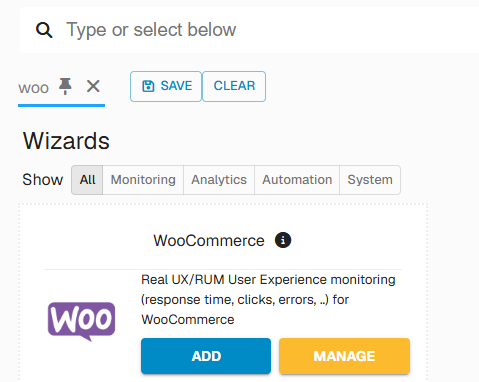
Germain Workspace > Left Menu > Wizards > WooCommerce
Start the WooCommerce Wizard.
⚙️ 2. Configure the Application
Configure:
|
Setting |
|---|
|
Application Name |
|
Storefront URL |
|
Environment |
|
UX Monitoring Profile |
|
Privacy configuration |
|
Bot and crawler handling |
|
Allowed domains |
The Storefront URL should use HTTPS.
Include every authorized customer-controlled domain where GermainUX RUM JS needs to operate.
✅ 3. Complete the Wizard
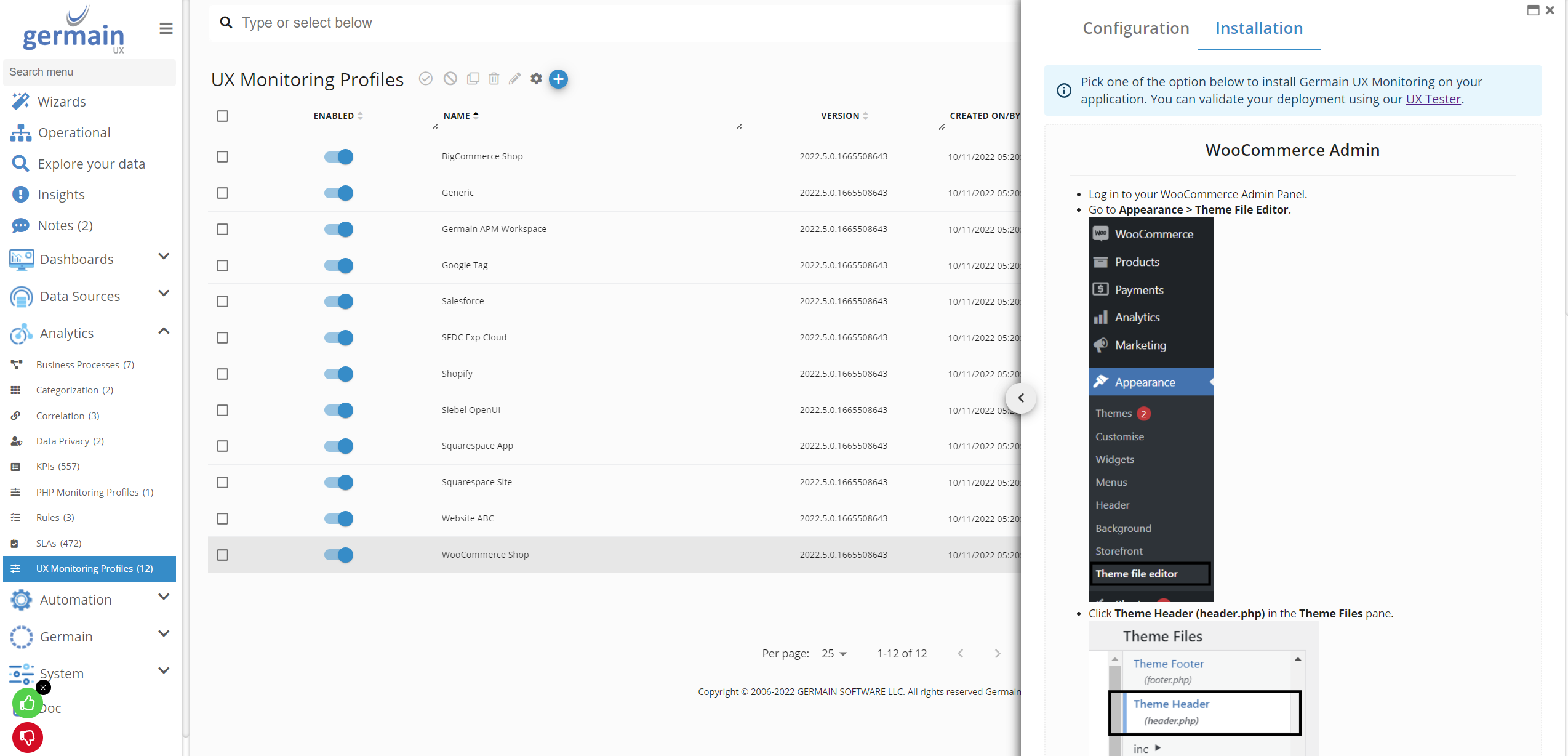
Complete the WooCommerce Wizard and use the generated RUM JS deployment configuration.
Do not manually recreate the monitoring configuration when the Wizard already provides the required installation information.
☁️ 4. Deploy RUM JS
Deploy GermainUX RUM JS on customer-controlled pages involved in the commerce journey.
Examples include:
|
Page |
|---|
|
Home |
|
Landing pages |
|
Category pages |
|
Product-listing pages |
|
Search results |
|
Product-detail pages |
|
Cart |
|
Login |
|
Account |
|
Checkout |
|
Order confirmation |
|
Order status |
|
Customer service |
💡 5. Select the Deployment Method
RUM JS can be deployed using an approved method such as:
|
Method |
|---|
|
WordPress header or script-injection mechanism |
|
WordPress child theme |
|
Customer-managed storefront |
|
Google Tag Manager |
Load RUM JS as early as practical in the page head so initial navigation, performance, errors, and user activity can be captured.
🧹 6. Clear Caches
After deployment, clear applicable caches such as:
|
Cache |
|---|
|
WordPress cache |
|
WooCommerce cache |
|
CDN cache |
|
Optimization-plugin cache |
|
Reverse-proxy cache |
|
Browser cache |
Then reload the storefront and verify that the latest monitoring configuration is active.
🗺️ 7. Deploy Across the Customer Journey
Verify that RUM JS executes on all customer-controlled steps required for journey reconstruction.
Examples include:
Landing → Search → Product → Cart → Checkout → Confirmation
If a checkout step occurs on an external domain or restricted iframe, direct RUM monitoring may not be possible.
🤝 8. Account for Third-Party Checkout and Payment Providers
Some WooCommerce transactions move to:
|
Third Party |
|---|
|
Payment-provider domains |
|
Authentication providers |
|
Financing providers |
|
Fraud-detection providers |
|
Restricted iframe contexts |
GermainUX can directly monitor only browser contexts where its monitoring code is allowed to run.
For restricted steps, plan to use available evidence such as:
|
Evidence |
|---|
|
Navigation to the provider |
|
Return navigation |
|
Redirect duration |
|
Browser-visible result |
|
WooCommerce order state |
|
API result |
|
Webhook |
|
Integration log |
|
Synthetic test |
|
Server-side transaction data |
🔒 9. Configure Privacy Before Production
Before enabling Session Replay broadly, protect sensitive information such as:
|
Sensitive Data |
|---|
|
Passwords |
|
Payment-card information |
|
Authentication tokens |
|
Customer names |
|
Contact details |
|
Billing addresses |
|
Shipping addresses |
|
Sensitive order information |
|
Form fields containing personal information |
|
URL parameters containing identifiers |
|
Administrative credentials |
|
Integration credentials |
Configure:
|
Control |
|---|
|
Masking |
|
Anonymization |
|
Element exclusions |
|
Page exclusions |
|
Consent |
|
Retention |
|
Bot filtering |
|
Access control |
GermainUX should not capture payment-card or authentication data.
💻 10. Deploy Engine Monitoring — Optional
Deploy a GermainUX Engine when monitoring needs to extend beyond the browser.
Depending on hosting architecture and permissions, Engine monitoring can include:
|
Component |
|---|
|
WooCommerce REST API |
|
Webhooks |
|
WordPress |
|
WooCommerce background processing |
|
PHP |
|
Database |
|
Logs |
|
Infrastructure |
|
Integrations |
|
HTTP availability |
Managed hosting providers may restrict some of these monitoring methods.
📁 11. Deploy Log Monitoring — Optional
Configure GermainUX File and Log Monitoring for accessible:
|
Log Type |
|---|
|
WooCommerce logs |
|
WordPress logs |
|
PHP logs |
|
Web-server logs |
|
Payment logs |
|
Integration logs |
|
Operating-system logs |
Verify that the monitoring component has the required read permissions.
🗄️ 12. Deploy Database Monitoring — Optional
When the environment permits access, deploy monitoring for the MySQL or MariaDB database supporting WooCommerce.
Monitor only through customer-authorized database access.
🐛 13. Deploy JS Profiler — Optional
Deploy GermainUX JS Profiler to selected authorized browsers when deeper browser diagnostics are required.
Use it to investigate:
|
Issue |
|---|
|
JavaScript exceptions |
|
Console errors |
|
Theme conflicts |
|
Plugin conflicts |
|
Slow network requests |
|
Failed network requests |
|
Third-party scripts |
|
Payment integrations |
|
Browser freezes |
|
Long-running JavaScript |
🤖 14. Deploy Synthetic Monitoring — Optional
Use GermainUX RPA Bot Recorder to record approved customer scenarios.
Examples include:
|
Scenario |
|---|
|
Open storefront |
|
Search for a product |
|
View a product |
|
Select a variation |
|
Add an item to cart |
|
Remove an item from cart |
|
Apply a coupon |
|
Register |
|
Sign in |
|
Begin checkout |
|
Select shipping |
|
Select payment method |
|
Complete an approved test purchase |
|
Confirm order creation |
Deploy the scenario through GermainUX Engine.
Use controlled test accounts, products, payment methods, and cleanup processes.
🔘 15. Validate Real User Monitoring
Open the storefront and:
-
Navigate from a landing page to a product.
-
Add a product to the cart.
-
Modify the cart.
-
Begin checkout.
-
Execute an approved test flow.
Verify that GermainUX receives:
|
Data |
|---|
|
Sessions |
|
Pages |
|
User interactions |
|
Commerce events |
|
Performance data |
|
Errors |
|
Network requests |
🎥 16. Validate Session Replay
Open a captured test session and confirm:
|
Check |
|---|
|
Expected navigation is visible. |
|
Cart activity appears correctly. |
|
Checkout activity appears where monitoring is permitted. |
|
Sensitive data is masked or excluded. |
|
Restricted external contexts are represented appropriately. |
🧾 17. Validate Server-Side Monitoring
When Engine monitoring is enabled, verify:
|
Verification |
|---|
|
WooCommerce API access |
|
Webhook monitoring |
|
Order data |
|
Log access |
|
Database monitoring |
|
Infrastructure monitoring |
|
Integration monitoring |
Confirm that authoritative order information can be correlated with customer sessions when required.
✅ 18. Validate the Deployment
Confirm:
|
Check |
|---|
|
RUM JS is deployed only once. |
|
Correct application and environment are assigned. |
|
Allowed domains are correct. |
|
Customer journeys are captured. |
|
Third-party checkout limitations are understood. |
|
Privacy controls work. |
|
Consent behavior works. |
|
Bot exclusions work. |
|
Desktop and mobile layouts work. |
|
Caching and optimization plugins do not prevent monitoring. |
|
Engine monitoring works when enabled. |
|
JS Profiler works when deployed. |
|
Synthetic transactions execute correctly. |
Once deployment is validated, continue with Configure Monitoring for WooCommerce.
ℹ️ Get More Information
GermainUX can help determine which monitoring, analytics and automation capabilities are appropriate for your WooCommerce environment. Contact GermainUX Support.
Component: Engine, JS Profiler, Mobile App, RPA Bot Recorder, RUM JS
Feature Availability: 2017.2 or later