
✨ Core Web Vitals
GermainUX RUM JS collects browser performance metrics from real user sessions, helping teams identify pages and user segments affected by slow loading, poor responsiveness, or visual instability.
📋 Current Core Web Vitals
The current Core Web Vitals are:
|
Metric |
Measures |
|---|---|
|
Largest Contentful Paint (LCP) |
Loading performance |
|
Interaction to Next Paint (INP) |
Responsiveness throughout the page lifecycle |
|
Cumulative Layout Shift (CLS) |
Visual stability |
Interaction to Next Paint replaced First Input Delay as a Core Web Vital on . FID can remain available as a legacy browser-performance metric in GermainUX, but it should no longer be presented as a current Core Web Vital. Google Web Vitals documentation
✨ Benefits
Core Web Vitals monitoring helps teams:
-
Measure actual page performance experienced by real users.
-
Identify slow or unstable pages.
-
Detect responsiveness problems affecting user interactions.
-
Compare performance across browsers, devices, locations, and application versions.
-
Identify regressions following a release.
-
Correlate poor performance with abandonment, conversion loss, or reduced productivity.
-
Replay affected sessions to understand the surrounding user experience.
-
Prioritize improvements according to affected users and business impact.
Preconfigured monitoring
Core Web Vitals monitoring is preconfigured in GermainUX RUM JS.
Once RUM JS is deployed, supported browser-performance metrics are automatically collected. No additional configuration is normally required.
Customization is needed only when customers want to:
-
Change thresholds or SLAs.
-
Exclude pages or user segments.
-
Create application-specific measures or pivots.
-
Configure additional performance marks.
-
Add custom notifications or reports.
-
Extend responsiveness monitoring for a GermainUX version that does not yet collect INP.
Largest Contentful Paint
Largest Contentful Paint measures how long it takes for the largest visible image or text block in the viewport to render.
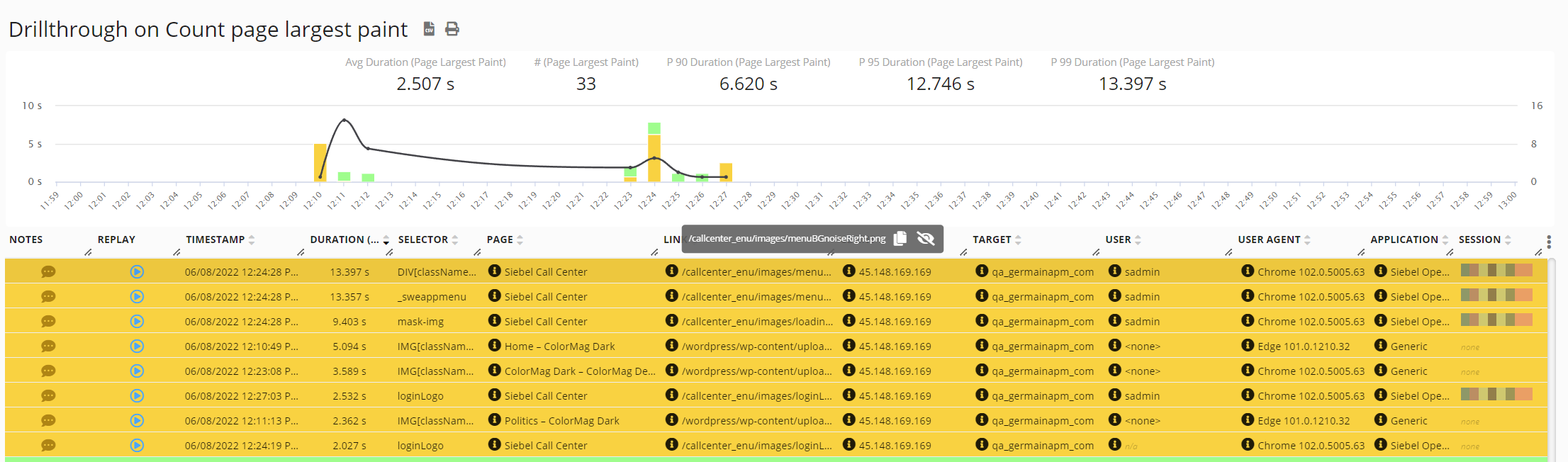
LCP helps identify pages whose primary content appears too slowly.
GermainUX can analyze LCP by:
-
Page or route
-
Application
-
Environment
-
Application version
-
Browser and browser version
-
Device
-
Operating system
-
Geography
-
User or customer segment
-
Network context, when available
A poor LCP can be associated with conditions such as:
-
Slow server response
-
Large images
-
Delayed resource loading
-
Render-blocking JavaScript or CSS
-
Client-side rendering delays
-
Slow third-party resources
Additional monitoring is required to establish the actual cause.
Interaction to Next Paint
Interaction to Next Paint measures page responsiveness across user interactions. It includes input delay, event-handler execution, and the time required to display the next frame.
INP helps identify pages that feel slow or unresponsive when users click, tap, or type.
When INP collection is supported by the installed GermainUX version, it can be analyzed alongside:
-
User Click duration
-
JavaScript long tasks
-
Browser freezes
-
Slow JavaScript functions
-
Network requests
-
Page memory
-
Session Replay
-
Business-process duration
If the installed GermainUX version collects FID but not INP, FID should be treated as a legacy responsiveness metric. Use User Click, long-task, freeze, and JS Profiler insights for additional responsiveness analysis, or upgrade/configure INP collection as supported.
First Input Delay
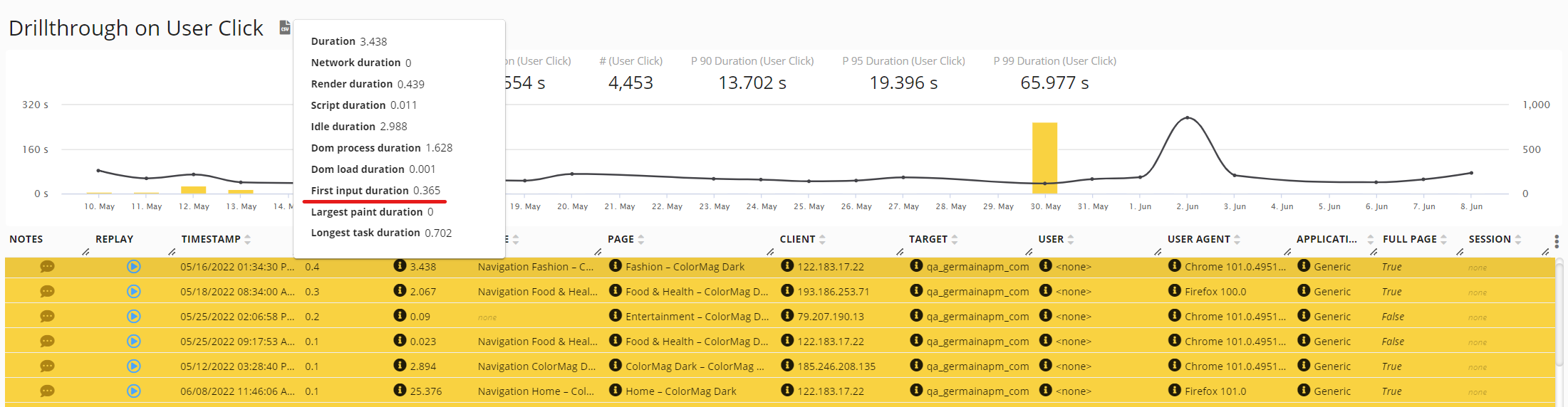
First Input Delay measures the delay between a user’s first interaction and the browser’s ability to begin processing it.
GermainUX versions that collect FID can expose it as a measure associated with the initial user interaction.
FID remains useful for historical comparison but is no longer a current Core Web Vital. It measures only the delay before processing the first interaction and does not measure the complete interaction lifecycle.
Cumulative Layout Shift
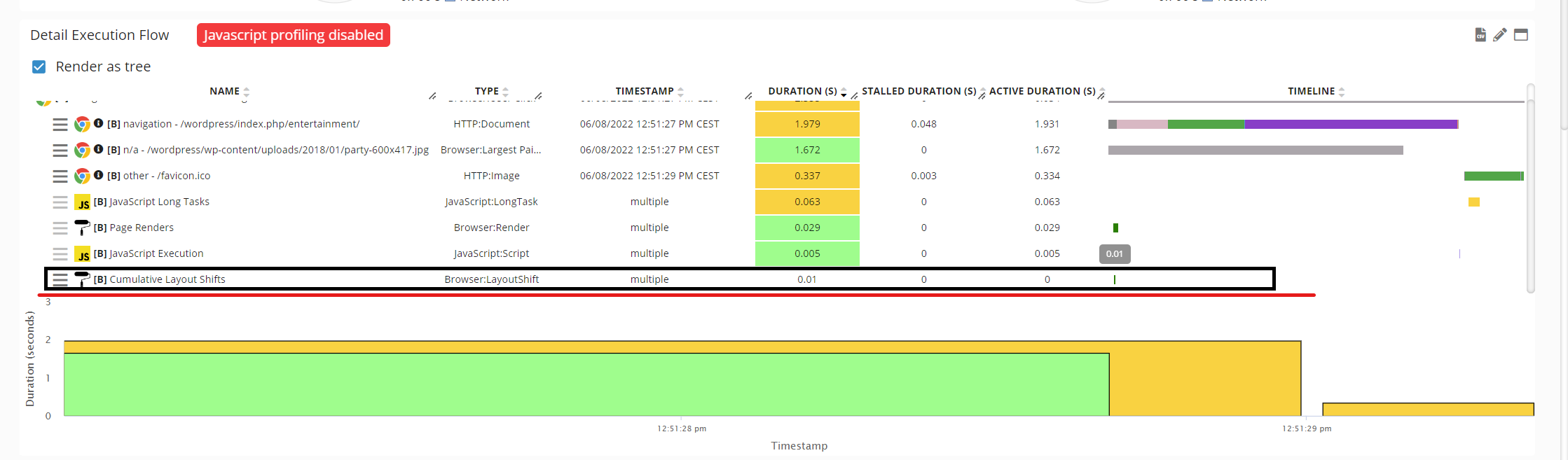
Cumulative Layout Shift measures unexpected movement of visible page content.
A poor CLS can result in:
-
Users clicking the wrong element
-
Buttons or links moving before interaction
-
Forms becoming difficult to complete
-
Content shifting while being read
-
Increased user frustration
-
Checkout or workflow errors
GermainUX can associate CLS information with the relevant page, session, and user activity when the browser exposes the required data.
Analysis
Core Web Vitals can be analyzed using:
-
Average
-
Median
-
Percentiles
-
Minimum and maximum
-
Number of affected users
-
Number of affected sessions
-
SLA-violation count
-
Performance trend
-
Comparison with another period or release
Percentiles are especially important because averages can hide slow experiences affecting a significant group of users.
Results can be segmented by:
-
Page or route
-
Application
-
Environment
-
Application version
-
Browser
-
Browser version
-
Device
-
Operating system
-
Geography
-
User role
-
Customer segment
-
Business process
-
Conversion outcome
Business impact
Core Web Vitals can be correlated with business and user-experience outcomes.
|
Area |
Example analysis |
|---|---|
|
eCommerce |
Compare LCP, INP, and CLS between completed and abandoned checkouts |
|
CRM |
Identify slow pages or interactions that increase task-completion time |
|
Employee applications |
Quantify productivity lost because of poor responsiveness |
|
Customer portals |
Determine whether slow pages increase form abandonment |
|
Release validation |
Identify performance regressions introduced by a new version |
|
User support |
Replay sessions affected by poor performance |
A poor Core Web Vital does not by itself prove that a user abandoned or failed a task. Correlating the metric with user behavior and business outcomes provides the required context.
Session Replay and root-cause analysis
When Session Replay is enabled, teams can review what occurred during an affected session.
GermainUX can correlate Core Web Vitals with:
-
Page loads
-
User interactions
-
JavaScript errors
-
Network requests
-
Browser long tasks
-
Browser freezes
-
Page memory
-
Application version
-
Business-process milestones
-
Conversion or abandonment
For deeper JavaScript analysis, deploy the GermainUX JS Profiler.
For backend analysis, deploy the GermainUX Engine and supported Code Profiler components.
SLAs and notifications
Configure an SLA only when the preconfigured thresholds do not meet the organization’s requirements.
Core Web Vitals can be used to:
-
Identify pages exceeding a performance threshold.
-
Trigger an alert when poor performance affects a significant number of users.
-
Notify interested users through a Watch.
-
Generate a dashboard or report.
-
Compare performance before and after a release.
-
Initiate an approved investigation workflow.
A Watch notifies GermainUX users about an existing performance insight; it does not create a new insight.
Browser support and limitations
Core Web Vitals depend on browser APIs and actual user activity.
Consider the following:
-
Not every metric is available in every browser.
-
INP requires the user to interact with the page.
-
A page with no qualifying interaction may not produce an INP value.
-
LCP can change as larger content appears.
-
CLS depends on layout changes observed during the page lifecycle.
-
Single-page applications require correct route and page identification.
-
Short or interrupted sessions may not produce complete measurements.
-
Cross-origin frames can limit the data visible to RUM JS.
-
Available metrics depend on the deployed GermainUX version.
GermainUX Real User Monitoring measures actual field performance. Results may differ from synthetic or laboratory tools such as Lighthouse because the users, devices, networks, and measurement conditions differ.
Privacy
Core Web Vitals are performance measurements, but their associated sessions can contain user and business context.
Before production deployment:
-
Collect only the metadata required for analysis.
-
Mask or exclude sensitive Session Replay content.
-
Restrict access to user-level information.
-
Configure consent where required.
-
Apply the organization’s retention policy.
-
Avoid unnecessary collection of personal or device identifiers.
Validation
-
Deploy GermainUX RUM JS.
-
Open the monitored application in a supported browser.
-
Load several representative pages.
-
Perform user interactions so responsiveness metrics can be calculated.
-
Confirm that LCP and CLS appear in GermainUX.
-
Confirm whether the installed GermainUX version reports INP.
-
If applicable, verify that legacy FID is labeled separately from current Core Web Vitals.
-
Confirm that page, application, browser, device, and version properties are correct.
-
Compare the results with the browser’s performance tools.
-
Verify associated Session Replay and technical evidence.
Deployment and configuration
|
For your browser-based application |
|---|
|
Deploy GermainUX RUM JS. |
|
Use the preconfigured Core Web Vitals monitoring unless customization is required. |
|
Confirm which GermainUX version is required for LCP, INP, CLS, and legacy FID collection. |
|
Configure stable page and route names for single-page applications. |
|
Review the available Browser Monitoring KPIs. |
|
Customize SLAs, measures, pivots, dashboards, alerts, Watches, or reports only when required. |
|
Use Element and Mark Performance Monitoring for application-specific performance milestones. |
|
Correlate poor performance with Session Replay, JavaScript, network, workflow, and business outcomes. |
Component: GermainUX RUM JS
Feature availability: LCP, CLS, and FID monitoring are documented for GermainUX 2022.2 or later; confirm INP support for the installed GermainUX version.
✨ Feature
Germain collects all Core Web Vitals metrics to boost your website performance and improve user experience.
⏳ Largest Contentful Paint (LCP)
LCP measures perceived load speed as it marks when the page's main content (image or text block) visible within the viewport has likely loaded.
KPI: KPIs for User Monitoring and Replay | Core Web Vitals KPIs
👉 First Input Delay (FID)
First Input Delay (FID) measures load responsiveness as it quantifies the experience users feel when trying to interact with unresponsive pages. Collected data is accessible on User Click KPI as First Input Duration measure.
🖼️ Cumulative Layout Shift (CLS)
Cumulative Layout Shift (CLS) measures visual stability as it quantifies how often users experience unexpected layout shifts. Collected data is accessible on User Click KPI but only on the Detail Execution Flow portlet.
ℹ️ Get Help
The Germain Team can help you set this up. Contact GermainUX Support.
Component: JS Profiler, RUM JS, RUM Extension
Feature Availability: 2022.2 or later
Browser Support: only latest Chrome, Edge, Opera and FireFox (only for FID)