
✨ Impact at Scale for Any Issue
Detecting an issue is only the beginning. Teams must also understand how many users, sessions, transactions, and business processes are affected—and how much the issue matters to the organization.
GermainUX measures the impact of user experience, workflow, and technology issues in real time. It helps teams answer:
|
Question |
|---|
|
How many users, sessions, and transactions are affected? |
|
Which applications, pages, products, workflows, or customer segments are affected? |
|
How frequently does the issue occur? |
|
How much time or productivity is being lost? |
|
Is the issue affecting adoption, conversion, customer satisfaction, or revenue? |
|
Which issues should be addressed first? |
GermainUX helps teams prioritize issues according to their actual impact—not simply their technical frequency or severity.
📈 Types of Impact
GermainUX can measure several dimensions of impact.
|
Impact category |
Examples |
|---|---|
|
User impact |
Affected users, sessions, interactions, errors, negative feedback, frustration, and degraded experiences |
|
Workflow impact |
Delayed, abandoned, repeated, inefficient, or failed business processes |
|
Operational impact |
Overrun, lost employee time, increased support workload, and SLA violations |
|
Technology impact |
Errors, slow requests, application freezes, failed transactions, and performance degradation affecting users or workflows |
|
Business impact |
Lost conversions, revenue at risk, reduced application adoption, customer dissatisfaction, and productivity cost |
🖥️ Impact Analysis Dashboards
GermainUX dashboards aggregate individual events to show the scale, concentration, and evolution of an issue.
|
Dashboard |
Purpose |
|---|---|
|
|
Analyze user behavior, application performance, workflows, errors, conversion, adoption, productivity, and related KPIs. |
|
|
Provides a real-time, 360-degree view of user, business, workflow, and technology activity. |
|
|
Identifies SLA violations and measures their frequency, duration, severity, and affected population. |
From these aggregated views, users can progressively drill down into:
|
Drill-down area |
|---|
|
Affected segments and populations |
|
Individual users and sessions |
|
Specific transactions and events |
|
Related KPIs and technical traces |
|
Session Replay |
|
Evidence supporting the root cause |
💬 User Feedback Impact
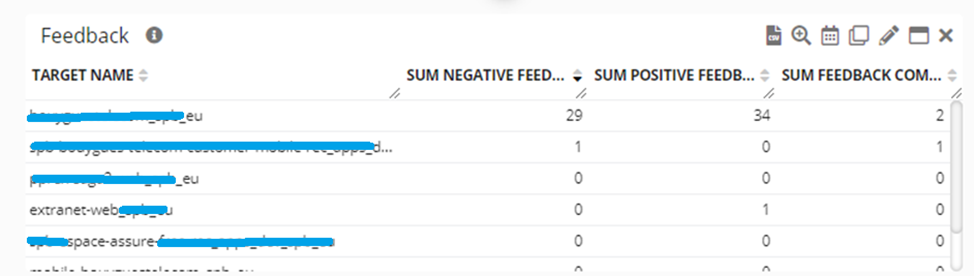
Feedback from real users provides direct evidence of problems affecting their experience. However, feedback becomes significantly more useful when it is correlated with the exact page, product, workflow, session, and technical activity associated with it.
GermainUX can collect feedback through:
|
Source |
|---|
|
The GermainUX Feedback Popup |
|
Third-party chat and feedback platforms |
|
Customer-support integrations |
|
Application-specific feedback mechanisms |
GermainUX correlates this feedback with the surrounding user activity and technical context.
This helps teams determine:
|
Question |
|---|
|
Which pages, products, features, or workflows generate the most negative feedback |
|
Which user populations are affected |
|
What users were doing immediately before submitting feedback |
|
Whether errors or performance problems contributed to the experience |
|
How the issue can be reproduced |
|
Whether the issue is isolated or widespread |
Example: Analysis may reveal that 96% of negative feedback is associated with one page, product, or workflow. This allows the responsible team to prioritize the area producing the greatest impact.
🔧 Workflow and Productivity Impact
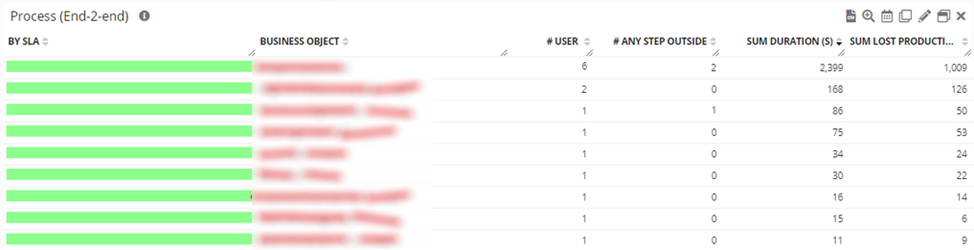
GermainUX monitors business processes and user workflows to identify inefficiency and lost time at scale.
This includes:
|
Issue |
|---|
|
Tasks taking longer than expected |
|
Users waiting for applications or services |
|
Repeated or unnecessary steps |
|
Excessive navigation between applications |
|
Copying and pasting information between systems |
|
Abandoned or failed workflows |
|
Processes exceeding their defined SLA |
⏰ Overrun
Overrun is the amount of time spent beyond the accepted duration or SLA for a task or process.
For example, if a service organization is expected to close a particular type of ticket within 24 hours, every additional hour that the ticket remains open is considered overrun.
GermainUX can aggregate overrun across:
|
Dimension |
|---|
|
Users |
|
Teams |
|
Applications |
|
Process types |
|
Workflow steps |
|
Locations |
|
Departments |
|
Time periods |
This allows organizations to quantify:
|
Metric |
|---|
|
Total time lost |
|
Number of affected employees or customers |
|
Most inefficient workflows |
|
Steps creating the greatest delays |
|
Operational or financial cost of the inefficiency |
|
Trends before and after corrective action |
⚙️ Technology Impact on Users and Workflows
Technology platforms can generate large numbers of errors, warnings, and performance events. However, not every technical event affects a user or business process.
GermainUX correlates technology activity with real user sessions, application interactions, transactions, and workflows to distinguish between:
|
Type |
|---|
|
Technical events with no observed user impact |
|
Issues degrading user experience |
|
Issues delaying or breaking workflows |
|
Issues affecting conversion or adoption |
|
Issues causing measurable productivity loss |
|
Issues preventing users from completing transactions |
Examples include:
|
Example |
|---|
|
Application errors displayed to users |
|
Slow requests delaying user interactions |
|
JavaScript errors preventing actions from completing |
|
Backend failures breaking business transactions |
|
Browser or Windows application freezes |
|
Database or integration failures affecting workflows |
|
Infrastructure constraints degrading application performance |
 Technical Volume Is Not the Same as User Impact
A frequently occurring technical error is not necessarily the most important issue. Conversely, an error occurring only a small number of times may be critical if it prevents high-value transactions or affects an important customer segment.
GermainUX keeps technical volume and user impact separate while preserving the correlation between them.
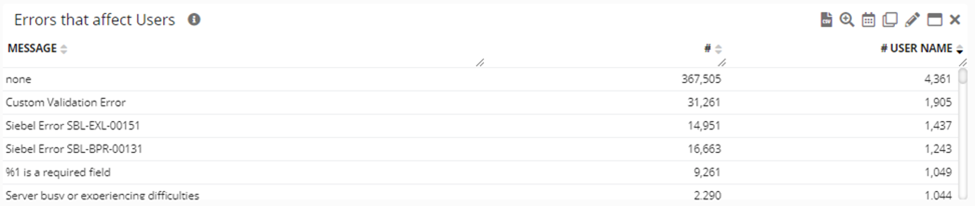
For example, an Oracle Siebel CRM environment may generate millions of technical errors that do not affect users. GermainUX continues to monitor those errors, but it separates them from the errors observed within affected user sessions and workflows.
This helps teams prioritize the technology issues that have a measurable effect on users or business operations.

Learn more about tagging Oracle Siebel CRM errors.
🛒 Conversion Impact
GermainUX helps eCommerce and digital teams identify issues affecting conversion at scale.
It can measure:
|
Measure |
|---|
|
Abandoned journeys |
|
Checkout and payment failures |
|
Products or pages associated with lower conversion |
|
Errors affecting high-value transactions |
|
Slow interactions correlated with abandonment |
|
Customer segments experiencing degraded conversion |
|
Differences by device, browser, region, product, or campaign |
|
Revenue or transactions potentially affected |
Teams can drill down from a conversion change to the affected segments, individual journeys, technical activity, and Session Replay required to understand why it occurred.
👥 Application Adoption Impact
For CRM, ERP, and other employee applications, GermainUX measures how user experience, workflow design, and technology performance affect adoption.
It can identify:
|
Issue |
|---|
|
Features that are rarely or never used |
|
Workflows that users abandon |
|
Steps that generate errors or confusion |
|
Repeated actions indicating friction |
|
Slow screens and transactions |
|
Users relying on workarounds |
|
Differences in adoption across teams, roles, locations, or application versions |
|
Time lost because of application or workflow problems |
This provides product owners, business operations, and support teams with evidence to prioritize training, UX improvements, workflow changes, and technical corrections.
🔁 From Detection to Resolution
GermainUX connects impact measurement with the evidence required to take action.
A typical investigation follows this progression:
-
Detect an unusual KPI, SLA violation, trend, or issue.
-
Measure the number of affected users, sessions, transactions, and workflows.
-
Segment the impact by application, page, product, user group, region, device, version, or other attributes.
-
Prioritize the issue based on its user, workflow, operational, or business impact.
-
Investigate the affected instances using related KPIs, technical traces, and Session Replay.
-
Identify the evidence-backed root cause.
-
Resolve or automate the appropriate corrective action.
-
Validate that the correction reduced the issue and its impact.
💡 Key Takeaway
The number of technical events tells you how often something happened. Impact analysis tells you who was affected, what was disrupted, and how much it mattered.
By measuring impact at scale and connecting it with instance-level evidence, GermainUX helps organizations focus their resources on the issues that matter most
📦 Additional Resources
-
Profiles and Wizard to deploy Monitoring, Analytics or Automation at scale.
-
More Analytics Features
-
More Automation Features
-
Management Features.
ℹ️ Get Help
The Germain Team can help you set this up. Contact GermainUX Support.
Service: Analytics
Feature Availability: 2025.1 or later