
📄 Reports and Data Exports
GermainUX workspace allows users to generate reports and export data from most dashboards with only a few clicks.
⚙️ Export formats
Depending on the dashboard and data being analyzed, information can be exported in the following formats:
|
Format |
Description |
|---|---|
|
|
for sharing complete dashboard views |
|
CSV |
for analyzing dashboard or portlet data in spreadsheets and other tools |
|
HAR |
for investigating browser and HTTP activity |
|
JSON |
for exporting detailed user-session and KPI data |
GermainUX also supports automatically generated reports and on-demand downloads of monitored files.
📃 PDF Report
Export the visible content of an Aggregate Dashboard to a PDF file.
A PDF report preserves the dashboard's current analytical context, including its selected:
|
Item |
|---|
|
Time range |
|
Filters |
|
KPIs |
|
Portlets |
|
Charts |
|
Tables |
|
Visible data |
To generate a PDF report:
-
Open the required Aggregate Dashboard.
-
Select the appropriate time range and filters.
-
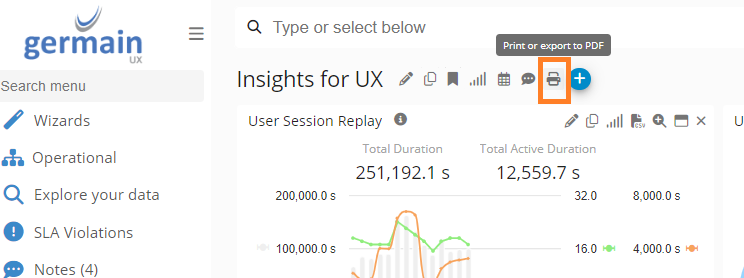
Click Print or Export to PDF.
-
Review or save the generated PDF file.
PDF reports are useful for sharing dashboard results with management, business teams, technical teams, customers, or other stakeholders.
📁 CSV Export
Export the visible data from a portlet or supported dashboard to a CSV file.
CSV exports provide the underlying values in a structured format that can be opened in:
|
Application |
|---|
|
Microsoft Excel |
|
Google Sheets |
|
Business-intelligence tools |
|
Data-analysis applications |
|
Scripts and other processing tools |
To export data to CSV:
-
Open the dashboard containing the required data.
-
Apply the appropriate time range, filters, measure, and pivots.
-
Locate the relevant portlet.
-
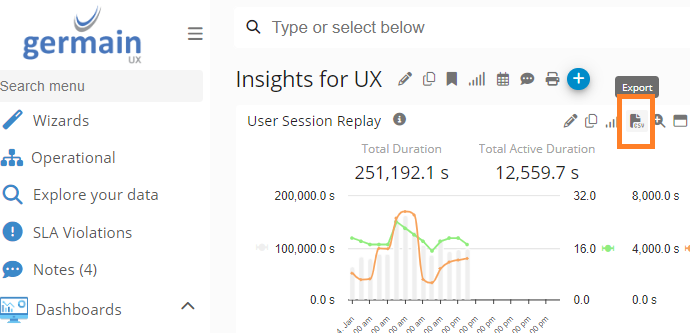
Click the Export icon.
-
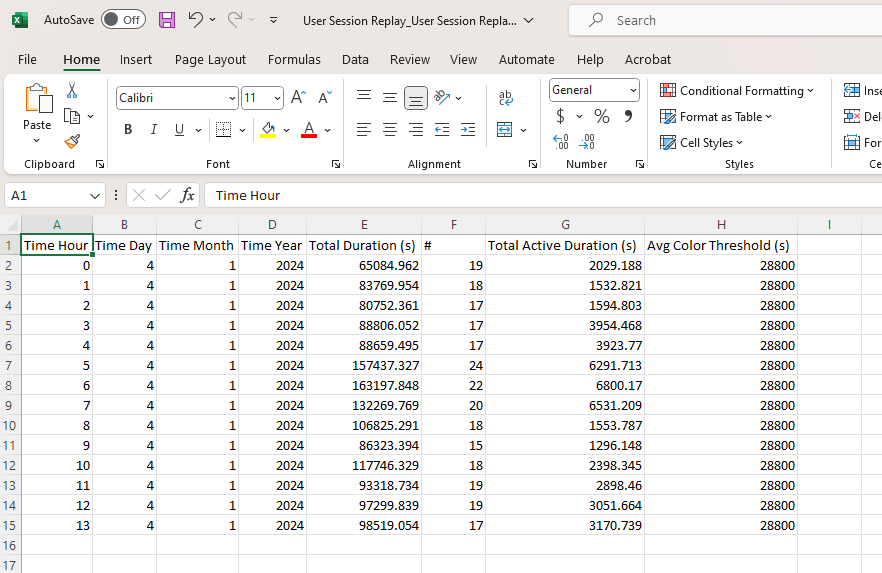
Open or save the generated CSV file.
The exported file reflects the data and analytical context currently displayed in the portlet.
🔍 HAR and JSON Exports
GermainUX can export browser, HTTP, and user-session information for detailed technical investigation.
A HAR file—HTTP Archive—contains information about browser network activity and HTTP requests. It can help developers, support teams, and application owners investigate:
|
Investigation area |
|---|
|
Slow requests |
|
Failed requests |
|
API errors |
|
Server response times |
|
Request and response details |
|
Network activity associated with a user action |
|
Dependencies involved in a user experience issue |
Available exports include:
|
Export |
Description |
|---|---|
|
Entire user session to HAR |
Exports the HTTP activity captured throughout the selected user session. |
|
Entire user session to JSON |
Exports the session and facts collected from all configured KPIs in a structured JSON file. |
|
Selected time range to HAR |
Exports the relevant HTTP activity from a specific period within the user session. |
|
User click to HAR |
Exports the HTTP activity associated with a specific user click. |
|
HTTP request to HAR |
Exports the details of an individual HTTP request. |
The available options may depend on the monitored application, captured data, dashboard, and GermainUX configuration.
⬇️ Export a User Session
To export information from Session Replay:
-
Open the required user session.
-
Select the entire session, a specific time range, a user click, or an HTTP request.
-
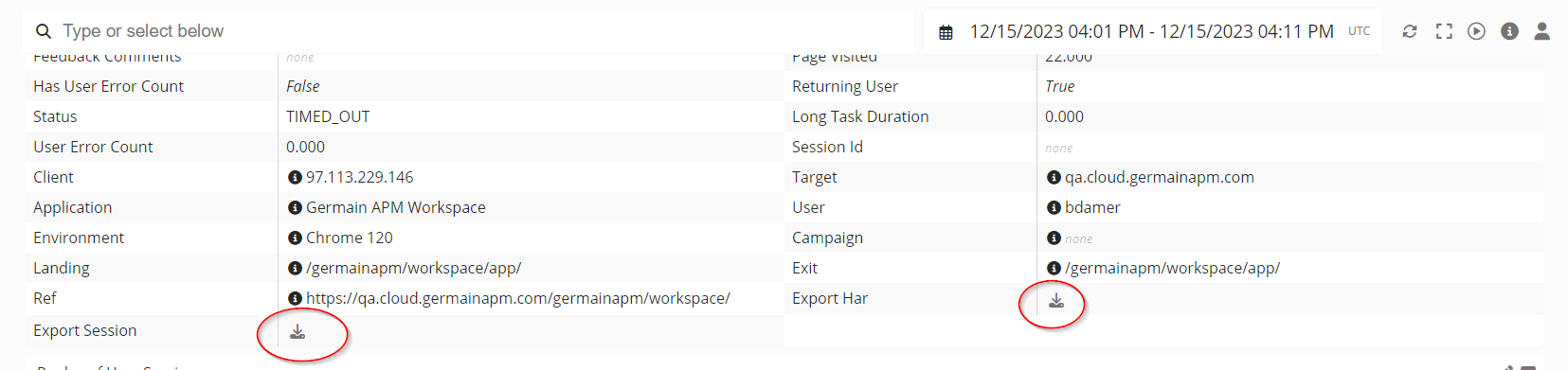
Open the available export actions.
-
Select Export to HAR or Export to JSON, as applicable.
-
Save the generated file.
Exporting a focused time range or individual user click helps reduce unnecessary data and makes it easier to share the activity directly associated with an issue.
To request HAR export support from another dashboard or GermainUX view, contact GermainUX Support.
⏰ Automatic Reports
GermainUX can automatically generate and distribute reports according to a configured schedule or condition.
Automatic reports can be used to provide recurring information to:
|
Recipient |
|---|
|
Business owners |
|
Application owners |
|
Product teams |
|
Support and operations teams |
|
Management |
|
Customers and other stakeholders |
Report automation can reduce manual reporting effort and ensure that recipients receive updated information consistently.
See Automatic Reporting.
💾 Monitored File Download
Files monitored by GermainUX can be downloaded on demand when file download is enabled and the user has the required permissions.
This capability allows authorized users to retrieve relevant monitored files directly from GermainUX for investigation or offline analysis.
See File Download.
📦 Additional Resources
-
Automation/On-a-schedule Reports
-
AI Insights & Recommendations
-
More Analytics Features
-
More Automation Features
-
Management Features.
ℹ️ Get Help
The Germain Team can help you set this up. Contact GermainUX Support.
Feature Availability: 2014.1 or later