

Display Only Errors Seen by Users
Restrict portlets to visible errors
Technology-Specific Configuration
Guides by framework and architecture
Application-Specific Detection
Salesforce, Siebel, Magento, Shopify
GermainUX can distinguish errors displayed to users from background errors that are not directly visible. This helps teams reduce noise and focus their analysis on failures that immediately affect the user experience.
- An error message
- A warning or popup
- A failed action
- A broken page or component
- An HTTP request failure surfaced in the application
- Another visible indication that the software did not operate as expected
Display Only Errors Seen by Users
You can configure most GermainUX dashboard portlets to show only errors that were visible to users.Select an Error KPI
Use any KPI that captures the relevant errors, such as:Select Measures
Choose measures that quantify the error’s frequency and impact, such as:
Other measures can be added according to the KPI and the analysis required.
Select Pivots
Use a pivot that groups similar errors, typically:- Name
- Message
Apply the User-Facing Error Filter
Add the following portlet filter: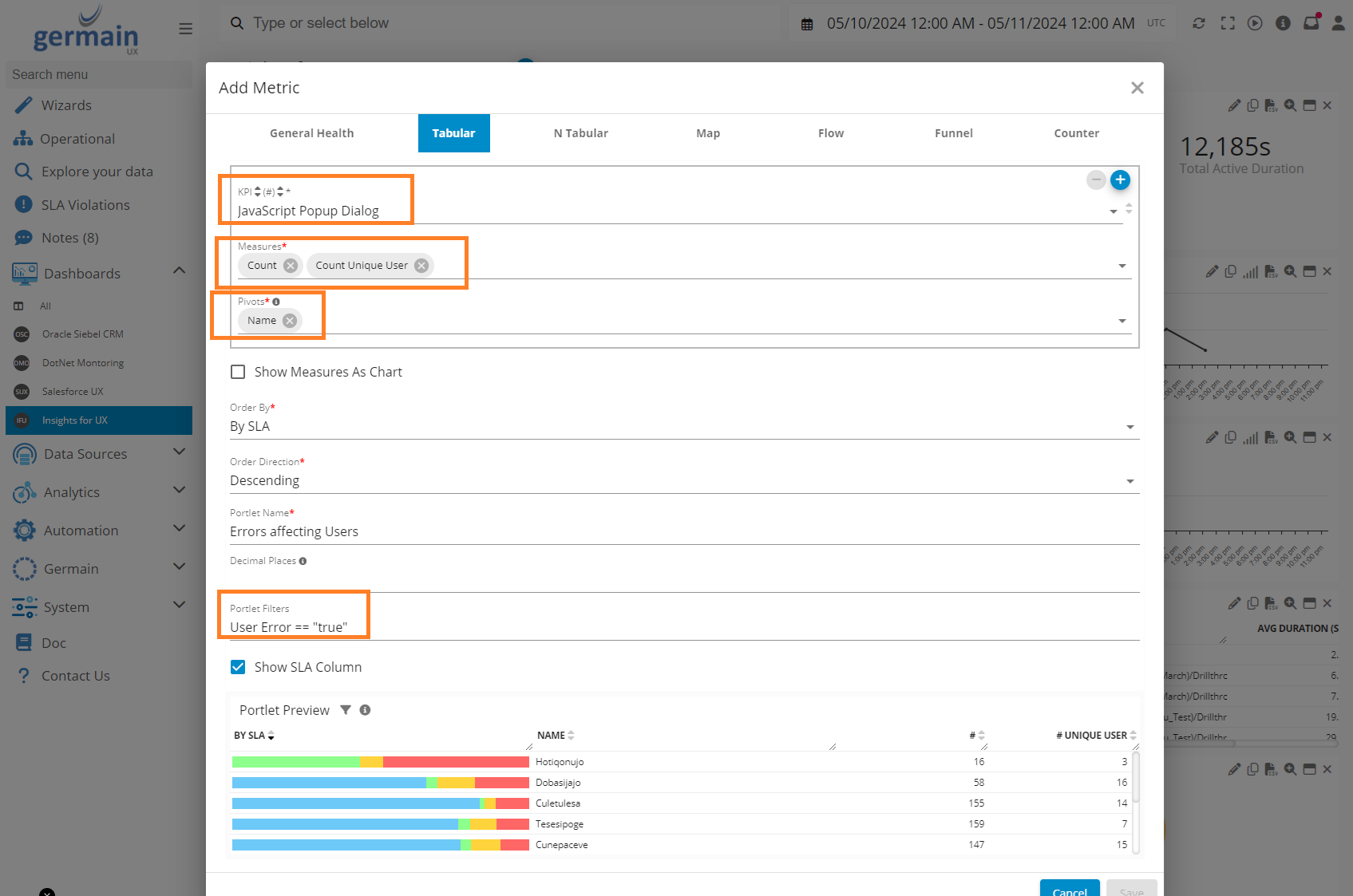
Technology-Specific Configuration
User-facing errors are detected differently depending on the application’s architecture, framework, and error-handling behavior. Use the relevant configuration guide:Application-Specific Detection
GermainUX provides preconfigured error-monitoring capabilities, but some application-specific configuration may be required. Applications such as Salesforce, Oracle Siebel CRM, Magento, and Shopify use different frameworks, architectures, messages, and failure mechanisms. GermainUX must therefore be configured to recognize how each application presents errors to its users.Additional Resources
Troubleshooting Tips
Read more
Manage GermainUX health
Read more
Management
More Management Features
Get Help
Contact GermainUX Support
The Germain Team can help you set this up.
Can't find what you need?
Search all GermainUX docs with Ctrl + K, or use the feedback buttons at the bottom of this page to tell us what is missing.
The content of this document is proprietary to GERMAIN SOFTWARE.