
👀 Overview
A managed Elasticsearch service can be used as the datastore for GermainUX.
This option provides Elasticsearch’s scalability and analytics capabilities without requiring your organization to install and operate the underlying cluster infrastructure.
The managed-service provider typically handles:
|
Capability |
|---|
|
Elasticsearch infrastructure |
|
Node provisioning |
|
Platform maintenance |
|
Cluster upgrades |
|
Hardware replacement |
|
Availability options |
|
Integrated monitoring |
|
Snapshot capabilities |
Your organization remains responsible for sizing, access control, network connectivity, retention, GermainUX configuration, and validation.
 Before You Begin
Confirm the following with Germain Software:
|
Item |
|---|
|
The Elasticsearch version supported by your GermainUX release |
|
The compatible GermainUX Elasticsearch plugin |
|
Required index templates and lifecycle policies |
|
Expected ingestion and storage volume |
|
Raw and aggregated data-retention periods |
|
Session Replay volume |
|
Required node size and topology |
|
Network and security requirements |
|
Whether existing data must be migrated |
The GermainUX plugin version must be compatible with the Elasticsearch version used by the managed deployment. Do not install a plugin from another release without confirming compatibility.
📋 Requirements
You need:
|
Requirement |
|---|
|
An Elasticsearch Cloud account |
|
Permission to create or manage a deployment |
|
Permission to upload and enable custom extensions |
|
A supported Elasticsearch deployment |
|
The compatible GermainUX Elasticsearch plugin |
|
Network connectivity from GermainUX Enterprise |
|
Elasticsearch credentials or an approved authentication method |
|
Sufficient capacity for ingestion, queries, retention, replicas, and snapshots |
📦 Obtain the GermainUX Plugin
Contact Germain Software to obtain the latest plugin compatible with both:
|
Compatibility |
|---|
|
Your GermainUX release |
|
Your Elasticsearch deployment version |
The package is provided as a ZIP file similar to:
germainapm-es-plugin-<version>.zip
Do not extract or modify the archive before uploading it unless instructed by Germain Software.
⬆️ Upload the Plugin to Elasticsearch Cloud
-
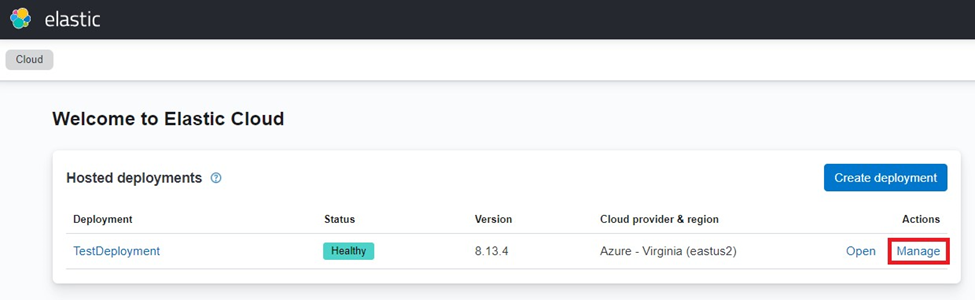
Sign in to the Elasticsearch Service Console.
-
Open the required hosted deployment.
-
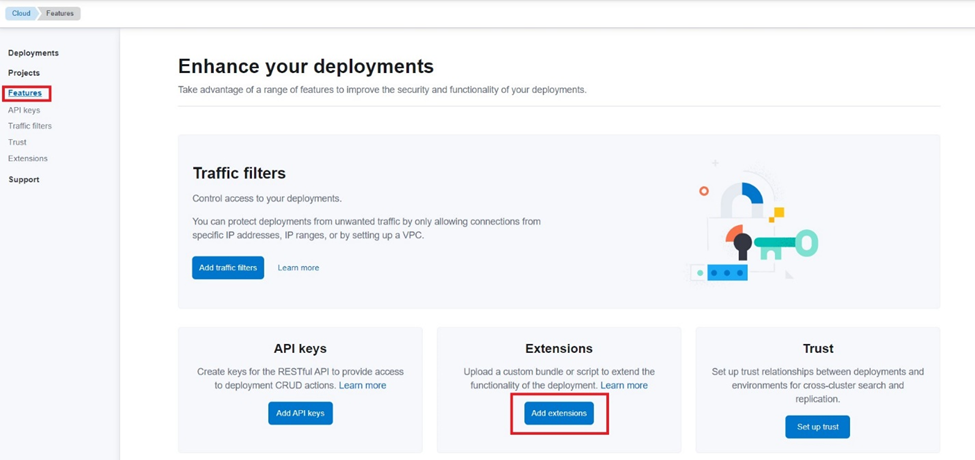
Go to the deployment-management area.
-
Open Extensions.
-
Select Add extension.
-
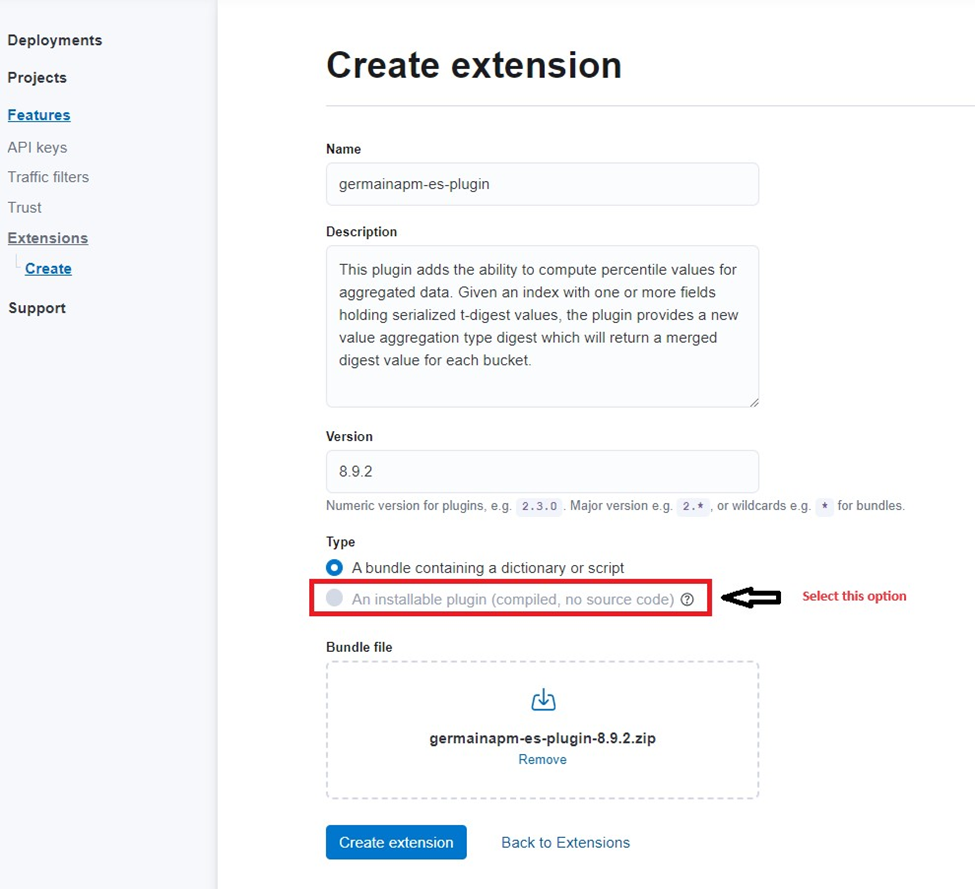
Enter a descriptive name for the GermainUX extension.
-
Select the Elasticsearch version that exactly matches the plugin.
-
For the extension type, select:
An installable plugin—compiled, no source code
-
Upload the GermainUX plugin ZIP file.
-
Create the extension.
The exact interface labels may vary as Elasticsearch Cloud evolves.
⚙️ Enable the Extension
After creating the extension:
-
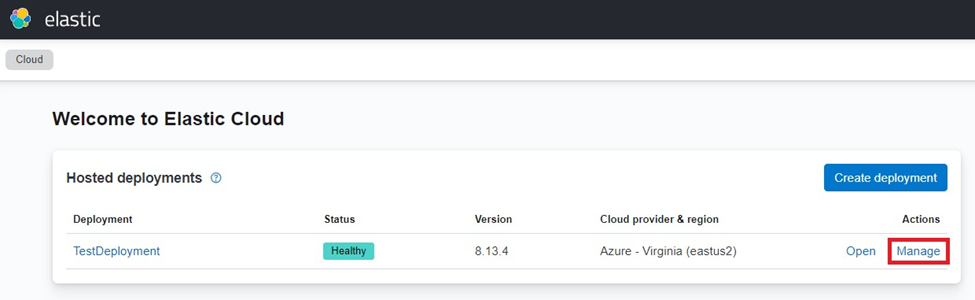
Open the target Elasticsearch deployment.
-
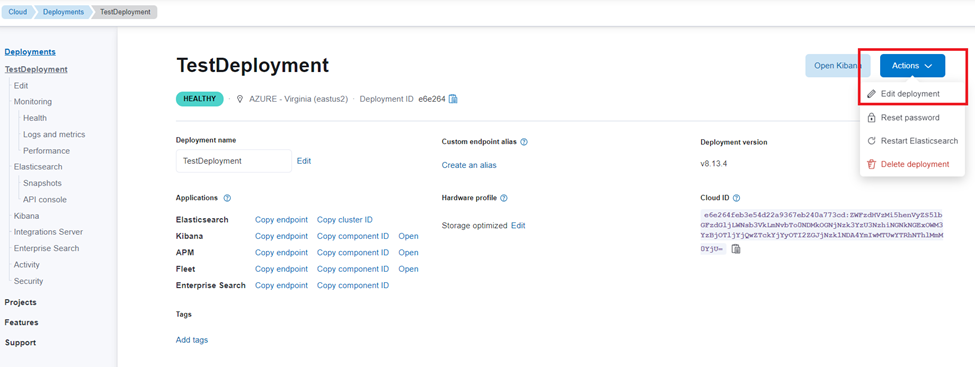
Select Edit deployment from the deployment actions.
-
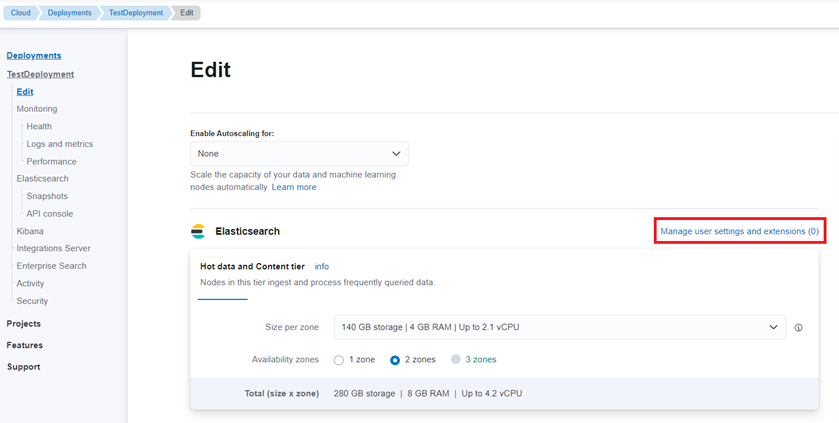
Open Manage user settings and extensions.
-
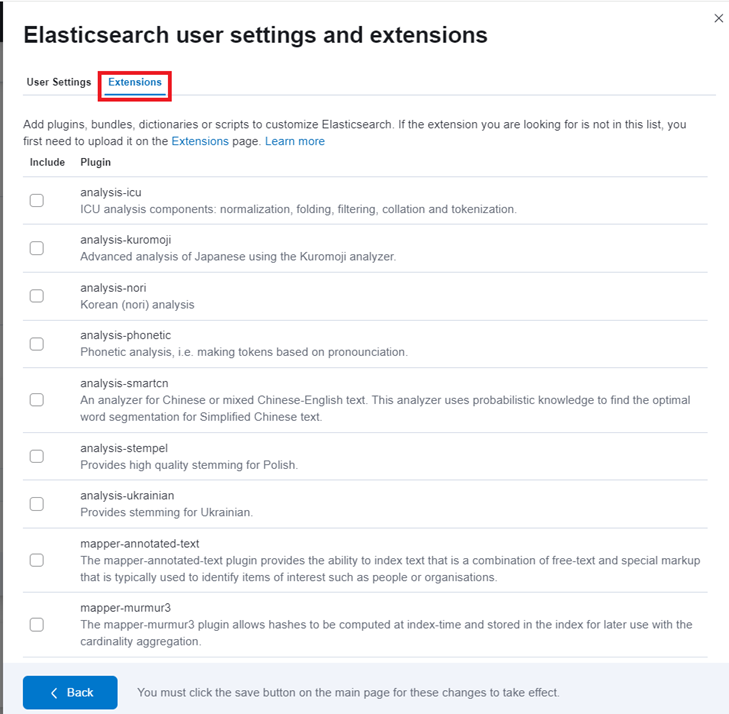
Select the Extensions tab.
-
Select the GermainUX Elasticsearch extension.
-
Return to the deployment editor.
-
Review the proposed changes.
-
Save the deployment.
Elasticsearch Cloud updates the deployment and replaces or restarts nodes as necessary so the plugin is installed across the cluster.
Do not interrupt the update. Monitor deployment health until the operation completes.
🔒 Configure Security
Before connecting GermainUX Enterprise:
|
Action |
|---|
|
Enable TLS. |
|
Create a dedicated GermainUX service account. |
|
Apply least-privilege permissions. |
|
Restrict network access. |
|
Store credentials securely. |
|
Enable audit logging when required. |
|
Protect Elasticsearch and Kibana from public access. |
|
Define credential-rotation procedures. |
Do not use a personal administrator account as the permanent GermainUX connection account.
🔗 Configure Network Connectivity
GermainUX Enterprise must be able to reach the Elasticsearch Cloud endpoint over HTTPS.
Confirm:
|
Network Requirement |
|---|
|
Outbound HTTPS access |
|
DNS resolution |
|
Proxy configuration when required |
|
TLS certificate validation |
|
IP allowlists or traffic filters |
|
Private connectivity when required |
|
Firewall and security-group rules |
Restrict access to approved GermainUX Enterprise hosts and administrator networks.
🖥️ Configure GermainUX Enterprise
Update the GermainUX datastore configuration with:
|
Configuration |
|---|
|
Elasticsearch Cloud endpoint |
|
Authentication credentials |
|
TLS settings |
|
Environment-specific index prefix |
|
Connection and request timeouts |
|
Retention settings |
|
Any plugin-specific properties supplied by Germain Software |
Use a distinct index prefix for each GermainUX environment sharing the deployment, such as development, QA, staging, and production.
🛠️ Initialize GermainUX Data Structures
Use the templates, scripts, or REST endpoint supplied with the matching GermainUX release to create:
|
Structure |
|---|
|
Index templates |
|
Mappings |
|
Data streams |
|
Aliases |
|
Lifecycle policies |
|
Aggregated-data structures |
|
Required GermainUX metadata |
Do not reuse initialization files from another GermainUX version unless compatibility has been confirmed.
✅ Validate the Deployment
After configuration:
-
Confirm that the Elasticsearch deployment is healthy.
-
Verify that the GermainUX extension is enabled.
-
Restart GermainUX Enterprise if required.
-
Confirm successful authentication.
-
Confirm that GermainUX can create or access the required indexes.
-
Start a limited monitoring workload.
-
Verify that raw facts are indexed.
-
Confirm that dashboards and searches return data.
-
Confirm that aggregated data is generated.
-
Test representative analytical queries.
-
Verify retention and lifecycle transitions.
-
Review logs for indexing failures or rejected requests.
📈 Capacity and Performance
Size the managed deployment based on:
|
Factor |
|---|
|
Average and peak daily AA Unit volume |
|
Session Replay |
|
Technical traces |
|
Retention |
|
Query concurrency |
|
Dashboard complexity |
|
Replication |
|
Snapshots |
|
Expected growth |
Monitor:
|
Metric |
|---|
|
JVM heap |
|
CPU |
|
Disk utilization |
|
Disk latency |
|
Ingestion rate |
|
Indexing latency |
|
Search latency |
|
Rejected requests |
|
Cluster health |
|
Node availability |
Increase capacity before resource saturation affects ingestion or analysis.
🔁 Upgrades
Before upgrading Elasticsearch Cloud:
-
Confirm that the target Elasticsearch version is supported by GermainUX.
-
Obtain the matching GermainUX plugin.
-
Review compatibility and migration requirements.
-
Take or verify a current snapshot.
-
Test the upgrade in a non-production environment.
-
Upload the new plugin extension.
-
Update the deployment.
-
Validate ingestion, queries, dashboards, retention, and aggregation.
-
Upgrade production only after successful testing.
Do not upgrade Elasticsearch independently when the required compatible GermainUX plugin is unavailable.
📋 Production Checklist
|
Check |
|---|
|
The Elasticsearch version is supported by GermainUX. |
|
The matching GermainUX plugin has been installed. |
|
The cluster is healthy. |
|
TLS and authentication are enabled. |
|
A dedicated GermainUX service account is configured. |
|
Network access is restricted. |
|
Index templates and mappings are installed. |
|
The correct environment prefix is configured. |
|
Raw and aggregated data are being stored. |
|
Retention policies are operating correctly. |
|
Snapshots are configured. |
|
A restore has been tested. |
|
Capacity monitoring and alerts are configured. |
|
Upgrade procedures have been documented. |
For the current plugin, supported Elasticsearch version, or deployment assistance, contact Germain Software
Service: Datastore
Feature Availability: 2024.1