
📊 Shopify Monitoring, Conversion Analytics and Automation
GermainUX continuously monitors Shopify storefronts, customer journeys and supporting integrations, 24/7 and in real time. It helps eCommerce teams identify and resolve the behavioral, journey, content and technology issues that reduce conversion, revenue, customer satisfaction and retention.
By combining Real User Monitoring, Session Replay, conversion analytics, customer journey analysis, process monitoring, technical observability and automation, GermainUX helps teams understand not only what happened, but also why it happened, how much revenue was affected and what action should be taken. When appropriate and considered safe, remediation can also be automated.
GermainUX is available in the Shopify App Store.
💼 Business Outcomes
GermainUX helps organizations using Shopify:
|
Outcome |
Details |
|---|---|
|
Increase conversion |
Increase conversion by identifying the journey steps, errors, delays and behavioral friction that cause shoppers to abandon. |
|
Recover revenue |
Recover revenue by quantifying the business impact of cart, checkout, payment, inventory and integration issues. |
|
Improve product discovery |
Improve product discovery by analyzing search behavior, search-to-product success and unsuccessful searches. |
|
Improve customer experience |
Improve customer experience by understanding shopper behavior, feedback and conversations. |
|
Reduce diagnosis time |
Reduce the time required to detect, diagnose and resolve conversion and technology issues. |
|
Improve availability & performance |
Improve storefront availability, page performance, mobile experience and integration reliability. |
|
Prioritize improvements |
Prioritize improvements according to the shoppers affected and the resulting revenue impact. |
|
Proactive detection |
Detect emerging issues proactively and automate safe remediation workflows. |
🔍 What GermainUX Monitors
GermainUX provides visibility across the complete Shopify customer journey and supporting technology.
|
Area |
Examples of monitored activity |
|---|---|
|
Shopper experience |
Clicks, navigation, searches, product views, browser activity, errors, feedback and sessions |
|
Conversion |
Product discovery, add-to-cart, cart changes, checkout, payment, purchase and abandonment |
|
Merchandising |
Product availability, inventory conditions, variants, categories and product attributes |
|
Customer journeys |
Campaign arrival, browsing, product-detail pages, cart, checkout and post-purchase activity |
|
Storefront performance |
Page loads, Core Web Vitals, browser freezes, resources, HTTP requests and mobile responsiveness |
|
Conversations |
Chat availability, response quality, sentiment, recommendations and conversion outcomes |
|
Integrations |
Search, payment, inventory, fulfillment, chatbot and other third-party services |
|
Marketing |
Campaign traffic, audiences, landing pages, engagement, conversion and revenue performance |
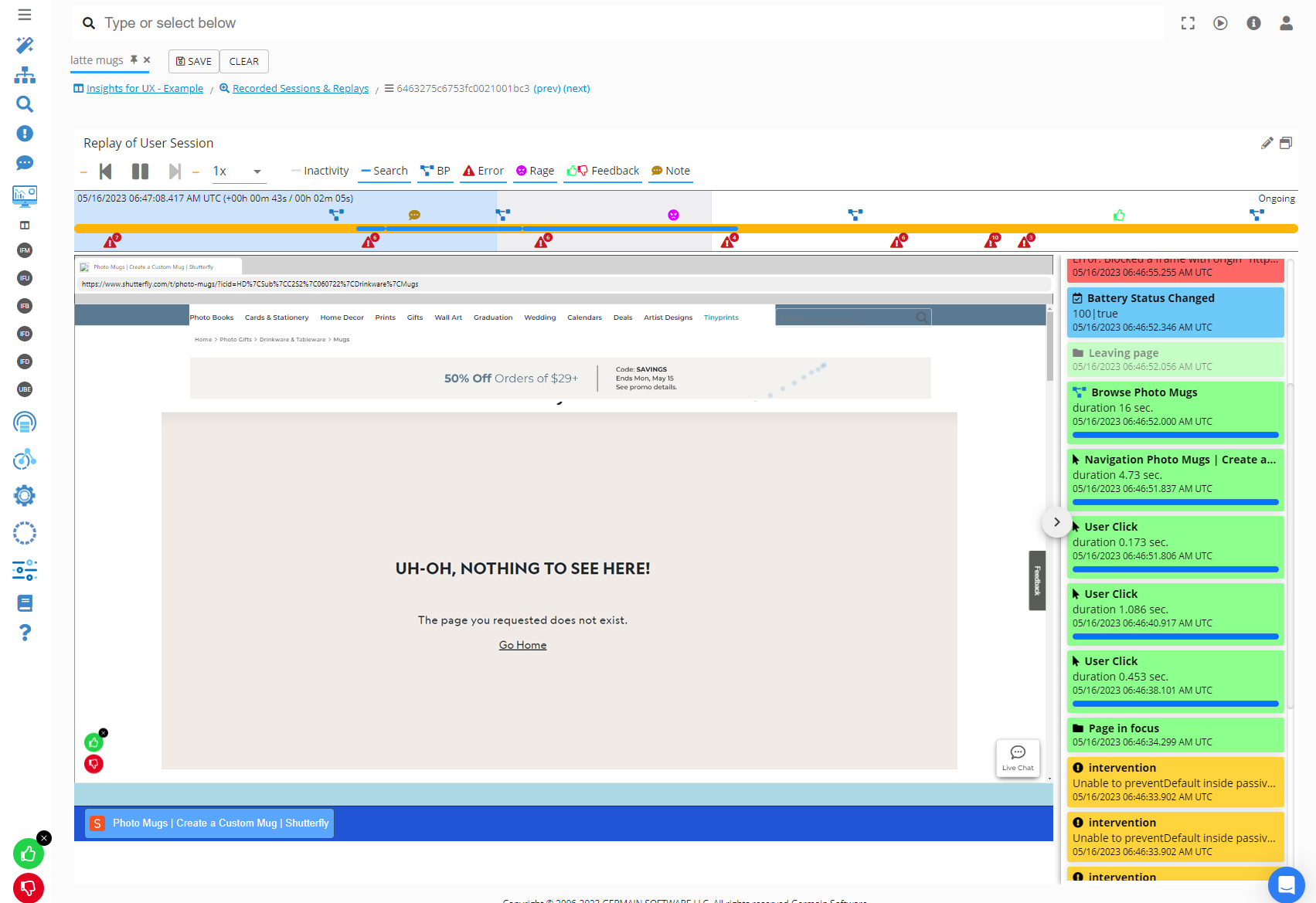
📺 Real User Monitoring and Session Replay
GermainUX records real Shopify shopper activity with millisecond-level timing precision, helping teams quickly understand what shoppers experienced and why a conversion or journey issue occurred.
Instead of reviewing hours of recordings, teams can search for specific shoppers, actions, products, errors, pages, performance conditions or business events and replay the moments that matter. Session data and related commerce metadata remain searchable both across the shopper population and within individual sessions.
Capabilities include:
|
Capability |
Details |
|---|---|
|
Detailed recording and replay |
Detailed recording and replay of real shopper sessions |
|
Correlation |
Correlation of shopper activity with errors, performance, journeys and transactions |
|
Searchability |
Search across sessions, actions, products and business metadata |
|
Friction identification |
Identification of behavioral, workflow and technology friction |
|
Heatmaps |
Six types of heatmaps for analyzing behavior at scale |
|
Privacy controls |
Privacy controls supporting the masking, anonymization or exclusion of sensitive data |
Replay and Understand a Shopify User Experience:
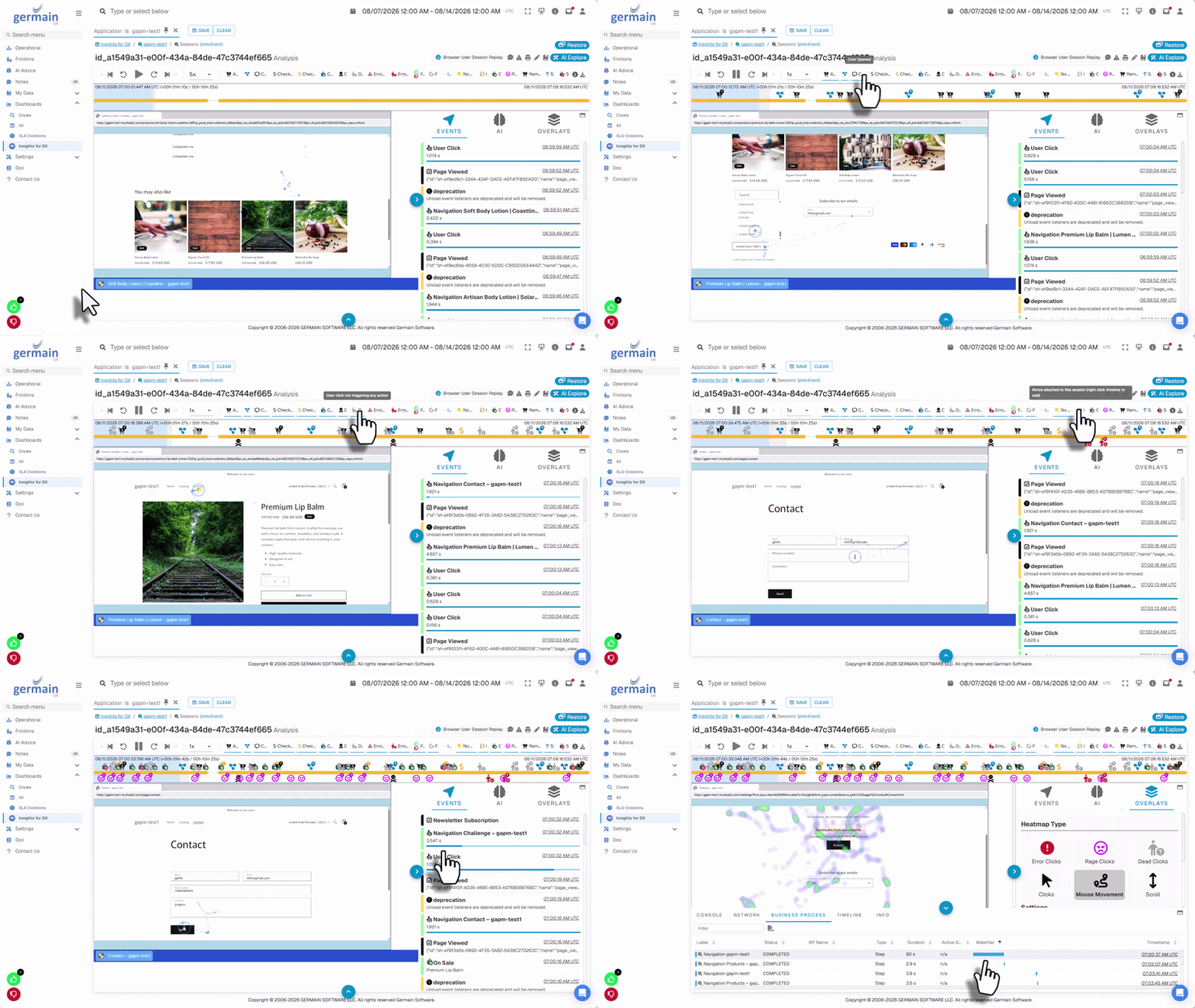
Learn more about Real User Monitoring and Session Replay.
🤖 AI-Generated Session Summaries
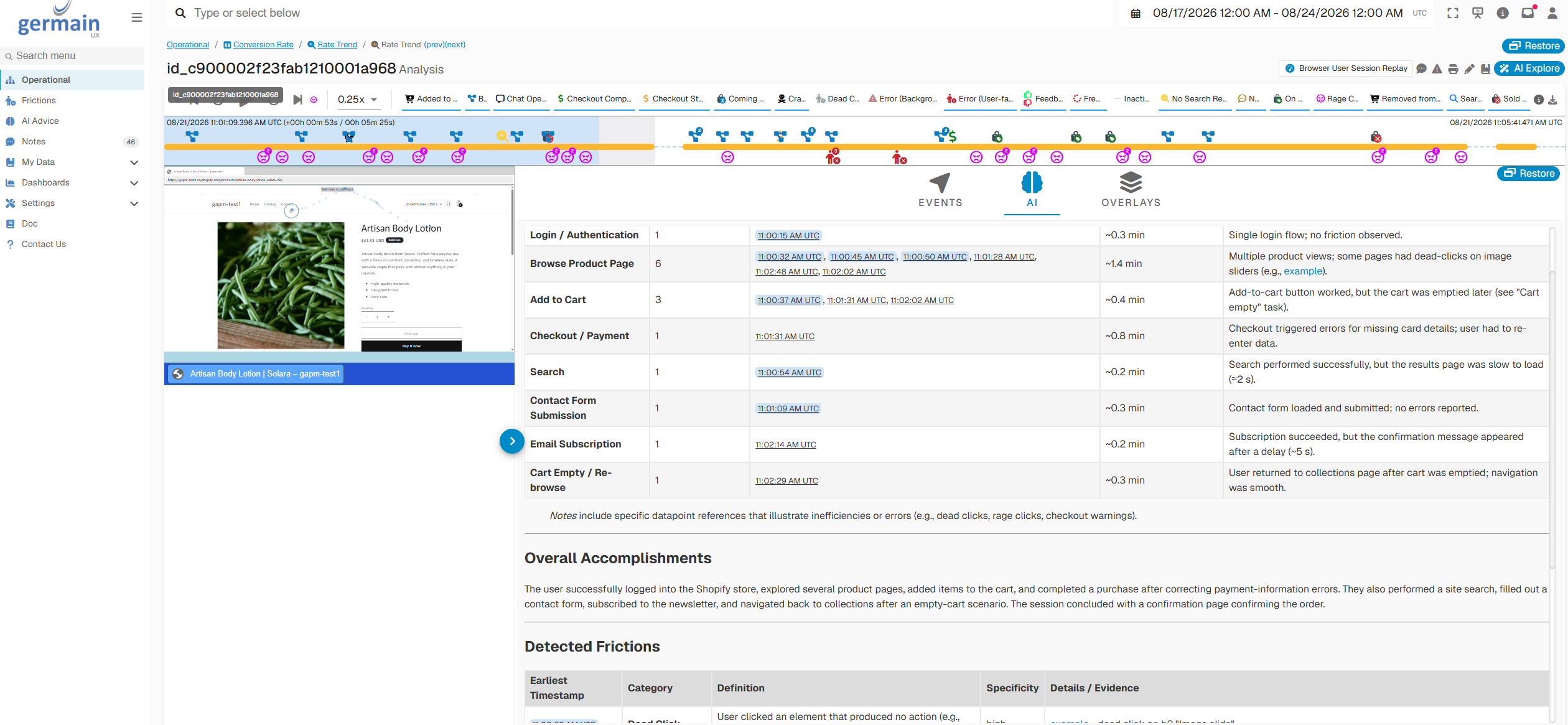
GermainUX can summarize an individual shopper session so teams can quickly understand what the shopper attempted to accomplish, where friction occurred and what may have prevented conversion.
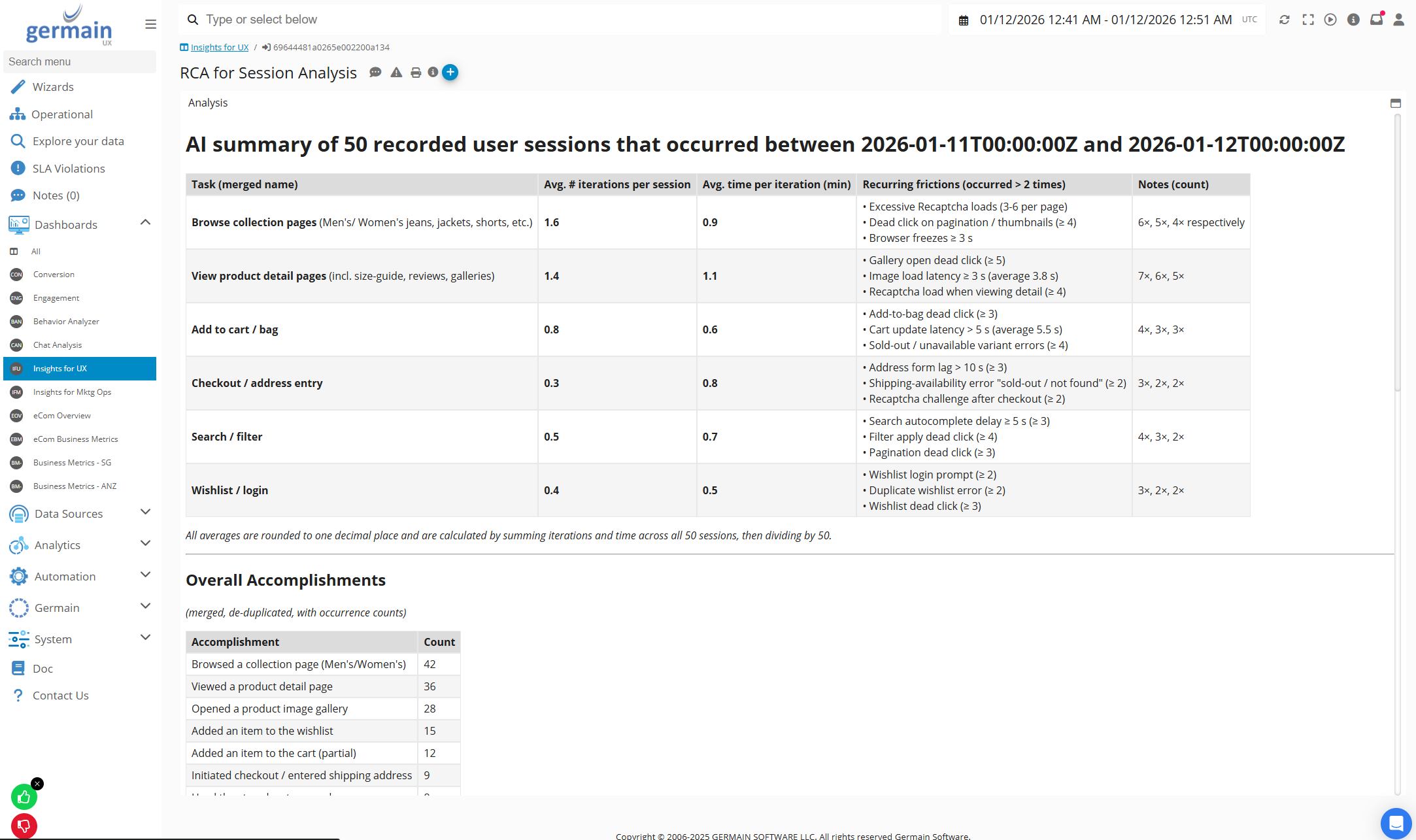
GermainUX can also analyze multiple sessions together to identify, categorize and rank the most frequent or consequential conversion issues. Scheduled analysis can run across a configurable number of sessions and deliver prioritized findings and recommendations through dashboards, alerts or recurring reports.
🌡️ Heatmaps
Six heatmap types help teams understand how individual shoppers and larger audiences interact with pages, product content, navigation and calls to action.
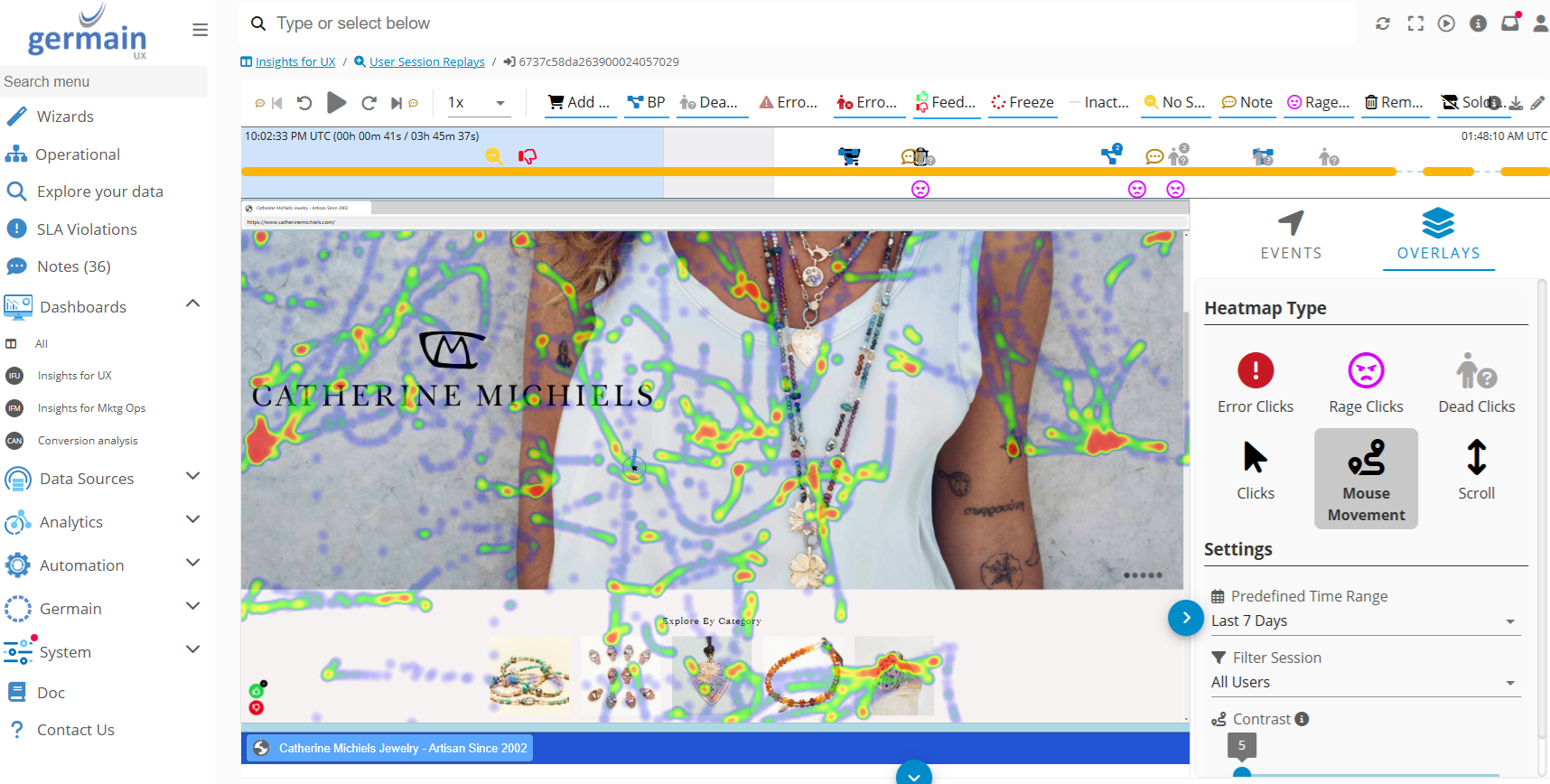
Learn more about GermainUX heatmaps.
💬 Shopper Feedback
The GermainUX Feedback Popup allows shoppers to provide feedback directly within the Shopify storefront. Responses can be analyzed across dashboards and alongside the corresponding recorded session, providing the behavioral and technical context needed to understand dissatisfaction and act before revenue is lost.
Teams can alert on high-risk feedback, investigate the associated session and aggregate recurring themes across the shopper population.

Learn more about the Feedback Popup.
💸 Conversion Analytics and Revenue Impact
GermainUX helps teams identify where conversion is breaking, why shoppers abandon and how much revenue is affected.
Conversion analysis can segment outcomes by dimensions such as:
|
Dimension |
Examples |
|---|---|
|
Shopper type |
New versus returning shoppers |
|
Traffic source |
Campaign and traffic source |
|
Product context |
Product, collection, variant or category |
|
Product attributes |
Product attributes such as color, size or availability |
|
Journey stage |
Journey stage and checkout milestone |
|
Device & geography |
Device, browser, geography or storefront |
|
Technical & behavioral signals |
Errors, performance conditions and behavioral signals |
Teams can move from a conversion-rate change to the affected shopper segment, underlying issue and relevant Session Replay without manually combining evidence from separate analytics, replay and monitoring tools.

🛒 Cart Abandonment Analysis
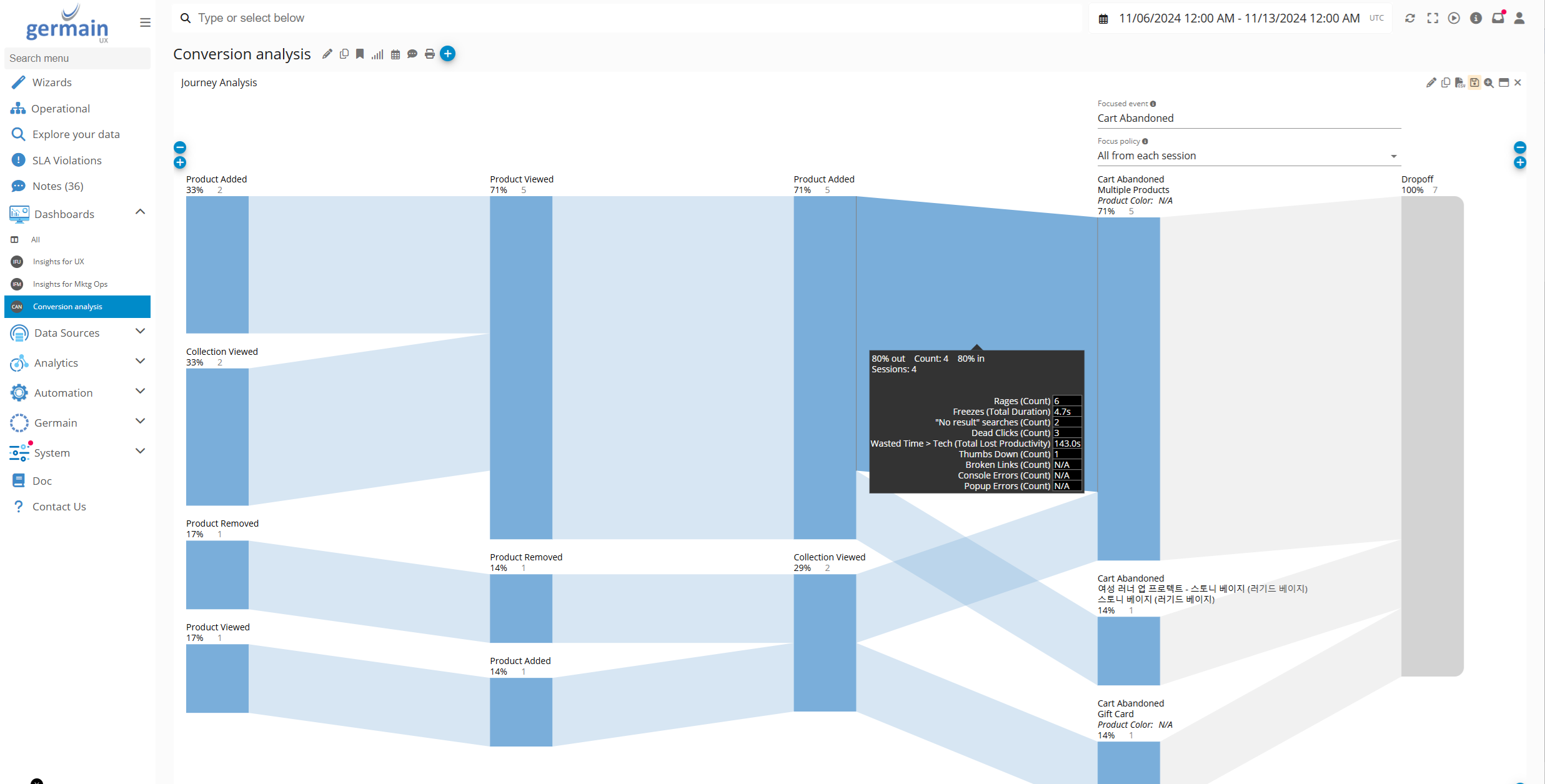
GermainUX correlates abandoned carts with the business, UX and technology conditions surrounding them. Analysis can reveal:
|
Finding |
Details |
|---|---|
|
Products & revenue |
Products and estimated revenue associated with abandonment |
|
Journey steps |
Journey steps completed before the shopper left |
|
Cart changes |
Products added to or removed from the cart |
|
Errors & slowdowns |
Errors, slowdowns or failed integrations encountered |
|
Availability |
Product availability or inventory conditions |
|
Context |
Search, campaign and device context |
|
Replay |
Relevant shopper sessions for replay |
The same analysis can be performed for an individual cart or at scale across shopper segments and time periods.
💳 Checkout and Payment Analysis
GermainUX monitors the journey from checkout initiation through payment and purchase. Shopify Pixel data and configured checkout instrumentation can provide visibility into checkout milestones that are not captured through storefront JavaScript alone.
Teams can identify checkout errors, payment failures, unexpected delays and drop-off patterns and correlate them with shopper behavior, technical evidence and revenue impact.
📦 Product Availability and Inventory Impact
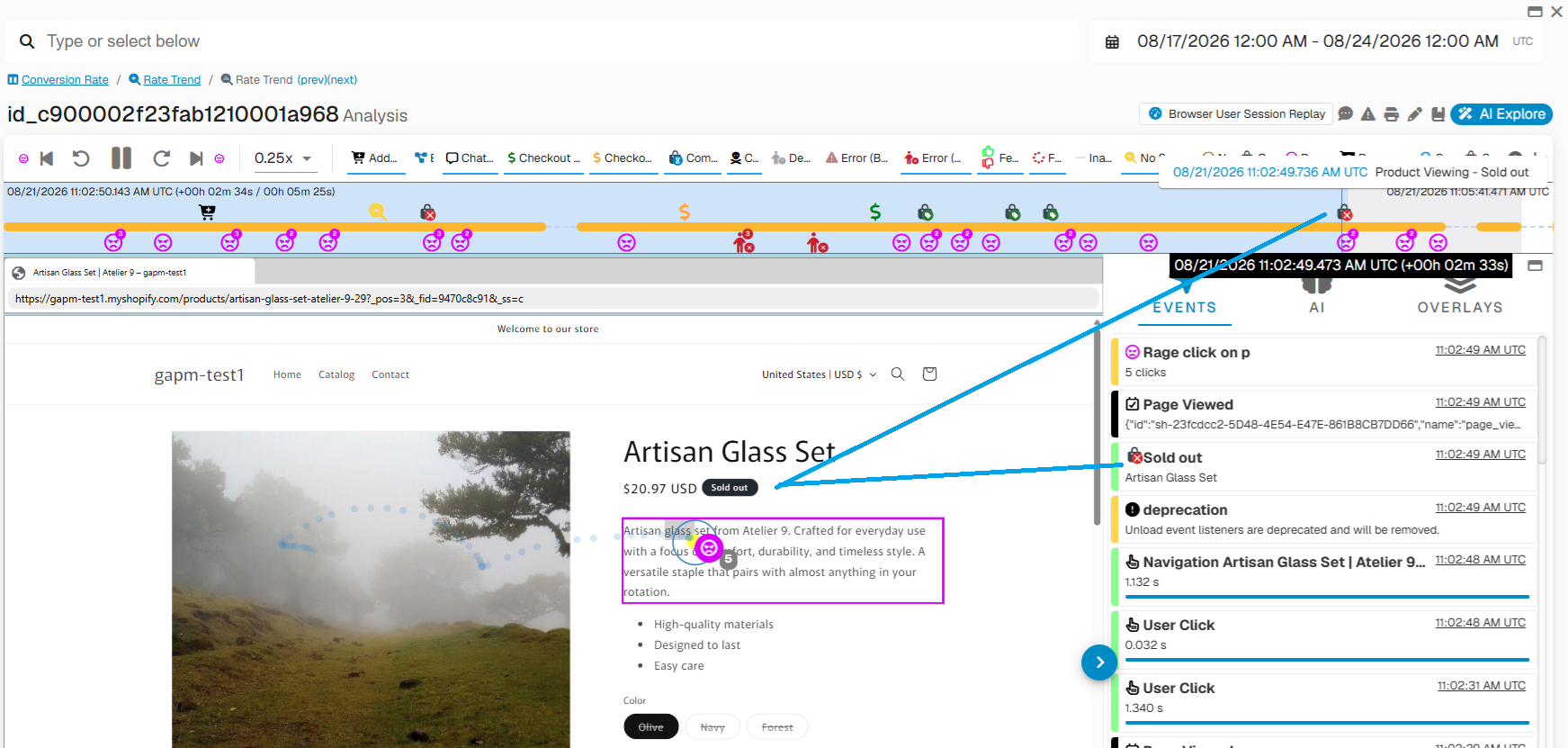
GermainUX can capture and analyze product availability states such as:
|
Availability |
Examples |
|---|---|
|
Available |
Available |
|
Limited availability |
Limited availability |
|
Out of stock |
Out of stock |
|
Coming soon |
Coming soon |
|
Other |
Other custom availability states |
This helps teams distinguish general conversion problems from lost sales caused by availability, variant selection or restocking conditions.
🔻 Funnel and Focused Flow Analysis
Funnel and Focused Flow visualizations analyze progression and drop-off across key commerce milestones. Teams can compare overall journey health with the friction affecting each phase, then drill into the contributing products, shoppers, errors and sessions.
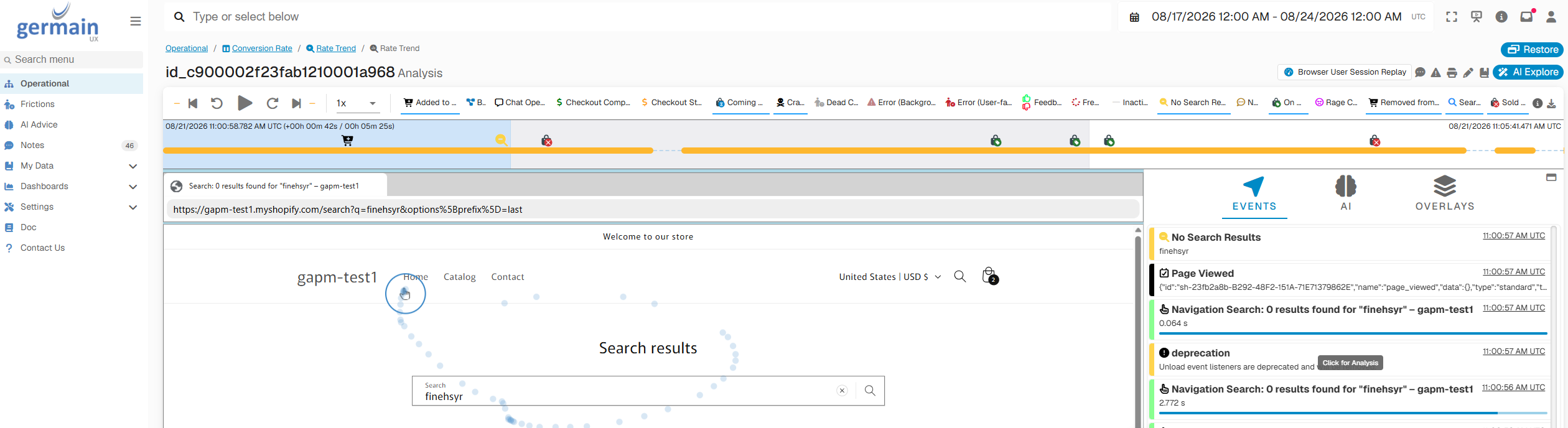
🧭 Product Discovery and Search Analysis
GermainUX helps eCommerce teams understand whether shoppers find the right products and how search quality affects conversion.
Analysis can include:
|
Analysis |
Details |
|---|---|
|
Search usage |
Search usage and search terms |
|
No-result searches |
Searches producing no results |
|
Search success |
Search-to-product-detail-page success |
|
Product views |
Product views originating from search |
|
Cart removals |
Products removed from the cart after discovery |
|
Search performance |
Search-provider errors and performance |
|
Conversion from search |
Conversion and revenue associated with search journeys |
This analysis can also cover third-party search providers when the relevant shopper events and integrations are instrumented.
🗺️ Customer Journey and Process Analysis
GermainUX monitors customer journeys within and beyond the Shopify storefront. A journey can begin with a marketing campaign, continue through product discovery, cart and checkout, and extend into inventory, fulfillment, delivery, support and repeat purchase.
It automatically identifies:
|
Issue |
Details |
|---|---|
|
Ineffective journeys |
Ineffective or incomplete journeys |
|
Bottlenecks |
Bottlenecks and unexpected delays |
|
Complexity |
Excessive journey complexity |
|
Repeated actions |
Repeated or unnecessary actions |
|
Time lost |
Time lost during product discovery, checkout or payment |
|
Disproportionate impact |
Shopper groups, products or milestones disproportionately affected |
Learn more about Customer Journey analysis.
⚙️ Commerce Process Monitoring
|
Process |
Examples of monitored outcomes |
|---|---|
|
Product discovery |
Search success, product engagement and movement to the cart |
|
Cart |
Additions, removals, updates, abandonment and associated revenue |
|
Checkout |
Progression, completion time, errors and drop-off |
|
Payment |
Gateway availability, failures, latency and successful authorization |
|
Inventory |
Availability, low-stock conditions and lost-sales indicators |
|
Fulfillment |
Order processing, connected-system delays and shipment progression |
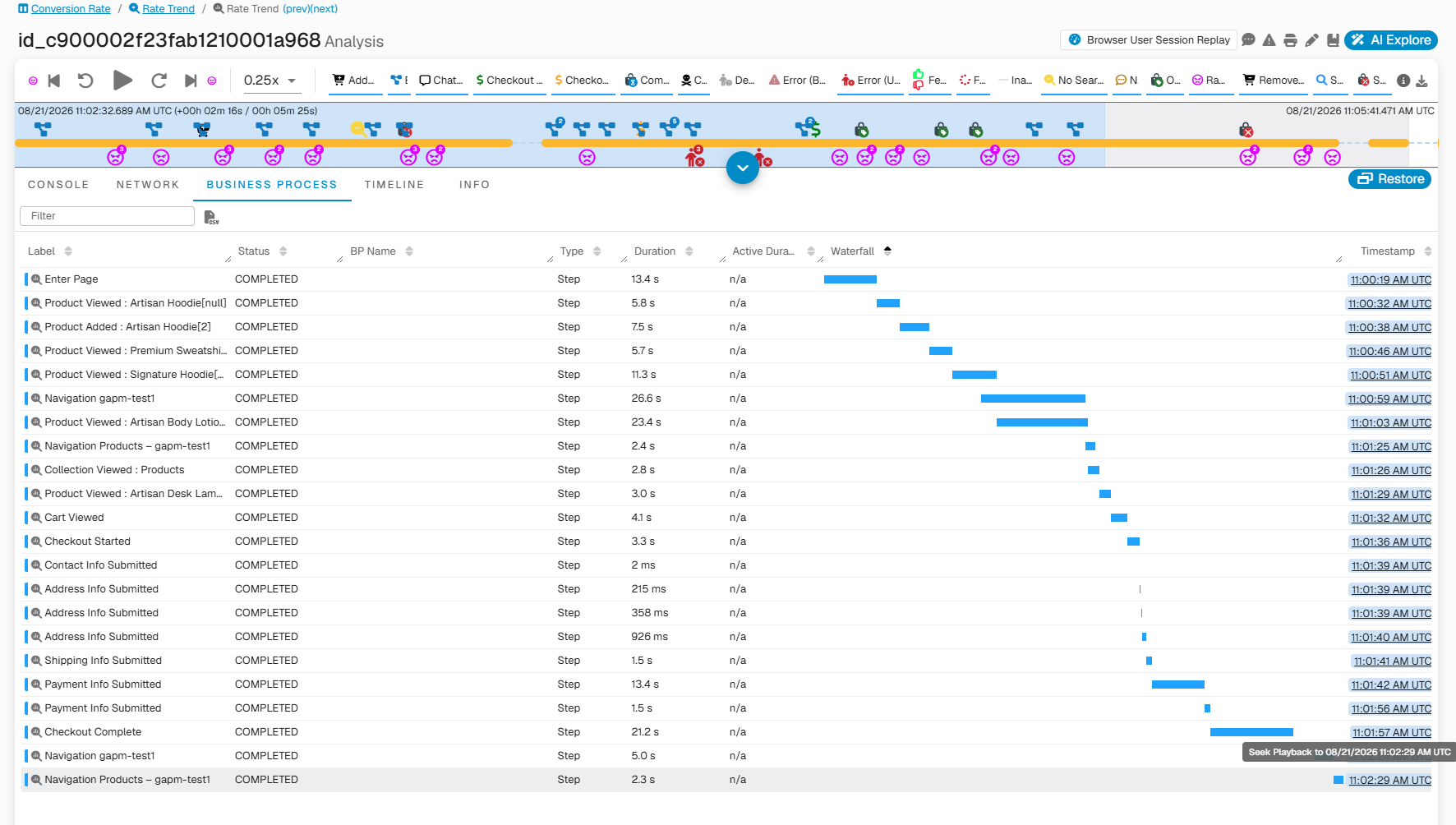
Learn more about Business Process and Workflow Monitoring.
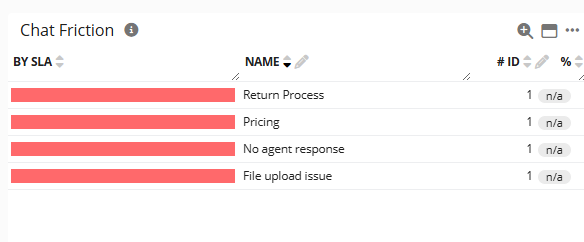
💬 Chat and Conversation Analysis
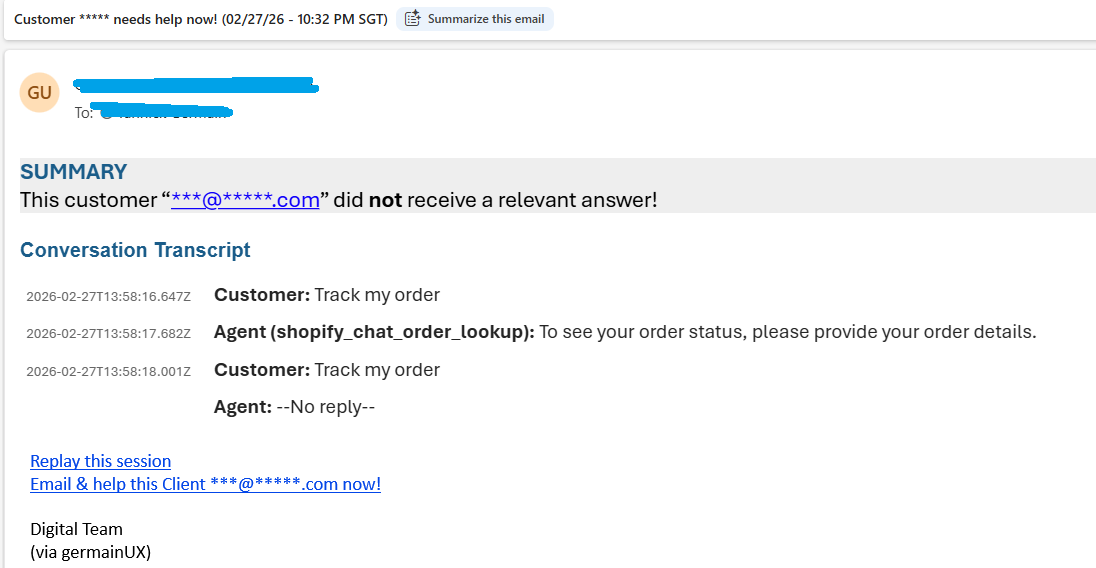
GermainUX analyzes shopper conversations occurring through chatbots, live-chat systems and other integrated communication channels to identify the friction that prevents conversion or damages retention.
Conversation analysis can help determine:
|
Question |
Purpose |
|---|---|
|
Initiation |
Did the shopper successfully initiate a conversation? |
|
Availability |
Was a representative available, and how long did the shopper wait? |
|
Accuracy |
Were the shopper’s questions answered accurately and completely? |
|
Recommendations |
Did the chatbot recommend the right product, article or next action? |
|
Outcomes |
Did the conversation lead to a purchase, abandonment or escalation? |
|
Patterns |
Which recurring conversation patterns create the greatest revenue risk? |
When message collection is enabled and permitted by the organization’s privacy and compliance requirements, GermainUX can analyze sentiment, intent, missed opportunities, ineffective responses and recurring friction patterns.
Conversation evidence can be correlated with the shopper’s storefront session, products, journey, cart activity and technical conditions. These findings can help teams improve chatbot content, agent coaching, follow-up and customer support.
📣 Marketing and Campaign Analytics
GermainUX connects campaign traffic with the Shopify behavior, conversion and revenue that follow. This helps marketing and growth teams determine which campaigns attract valuable shoppers, where those shoppers encounter friction and which experiences convert.
Analysis can include:
|
Area |
Details |
|---|---|
|
Campaign performance |
Campaign and traffic-source performance |
|
Landing pages |
Landing-page engagement and abandonment |
|
Post-arrival behavior |
Shopper behavior after arrival |
|
Conversion |
Product, cart and checkout conversion |
|
Revenue |
Revenue and average order value |
|
Performance issues |
Performance or errors affecting specific campaigns |
|
Segmentation |
Differences across audiences, devices and geographies |
Review the preconfigured GermainUX Marketing KPIs.
📥 Consent Tracking
GermainUX can integrate with Shopify’s consent-tracking mechanisms to align eligible storefront data collection with the shopper’s consent choices. Consent implementation and data handling should be configured according to the organization’s legal, privacy and Shopify requirements.
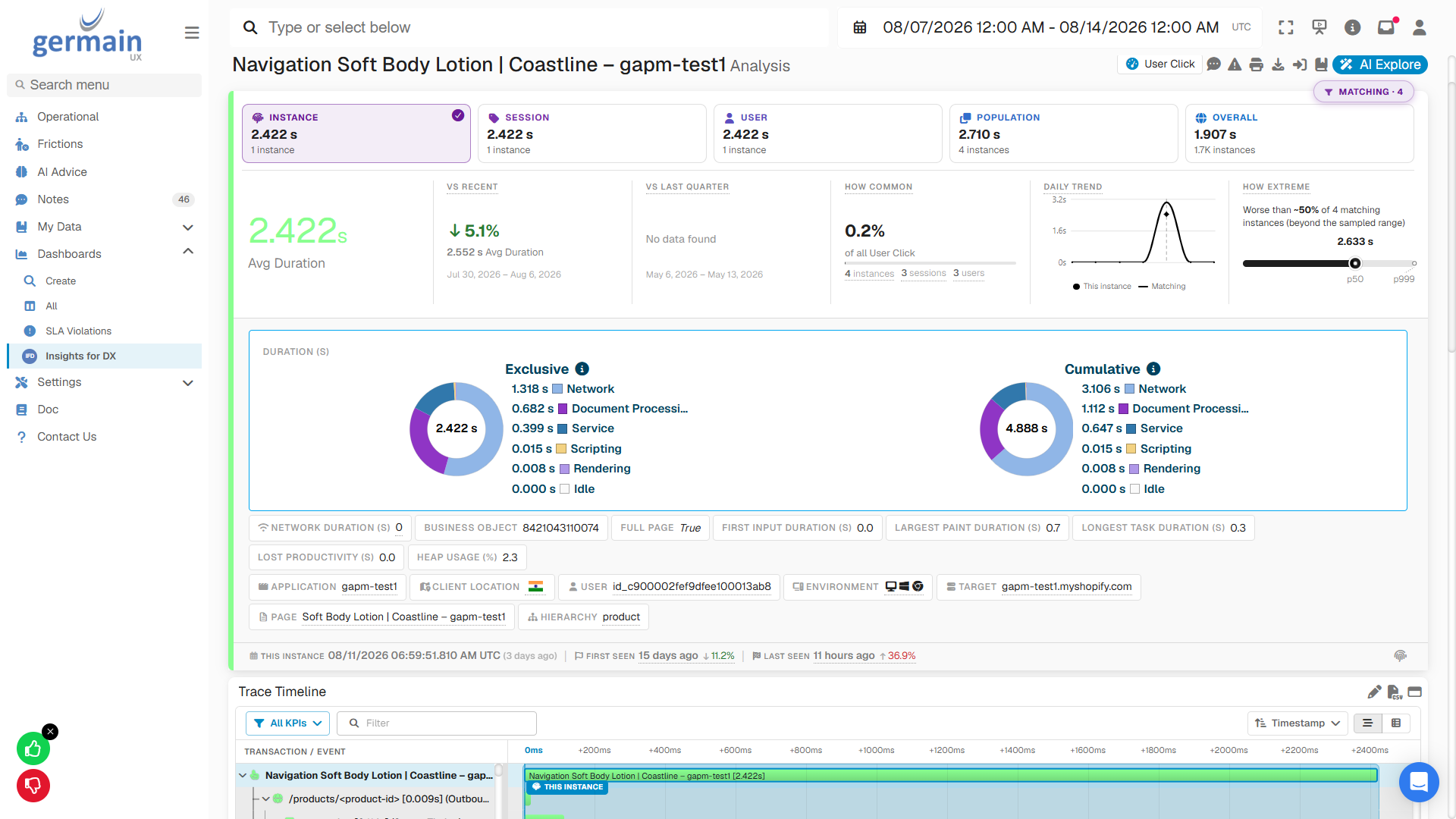
🖥️ Storefront Performance, Availability and Technology Analysis
GermainUX monitors the browser experience and observable technology supporting a Shopify storefront. This helps teams identify whether slow pages, failed requests, third-party services or Shopify events are affecting shoppers and revenue.
📡 Website Availability
GermainUX can monitor storefront and page availability and validate critical links or commerce journeys. Alerts notify the appropriate teams when a storefront, page or essential workflow becomes unavailable.
⏱️ Page and Resource Performance
Performance monitoring can include:
|
Metric |
Details |
|---|---|
|
Load times |
Page load and response times |
|
Core Web Vitals |
Core Web Vitals and rendering performance |
|
Resources |
Page size, images and resource-loading activity |
|
Browser freezes |
Browser freezes and long-running browser activity |
|
Network |
HTTP failures and network latency |
|
Transaction time |
Cart, checkout and transaction completion time |
These metrics can be correlated with shopper behavior, abandonment and revenue to distinguish technical noise from issues that materially affect conversion.
📱 Mobile Experience
GermainUX can segment performance, errors, behavior and conversion by device and screen characteristics. This helps teams identify experiences that work on desktop but create friction for mobile shoppers.
🔗 Integration Monitoring
Shopify journeys commonly depend on third-party systems. GermainUX can monitor observable integration activity to identify failures and latency involving:
-
Search providers
-
Payment gateways
-
Inventory and order-management systems
-
Fulfillment and shipping services
-
Chatbots and customer-service platforms
-
Marketing, personalization and guidance tools
The depth of monitoring depends on the endpoint, available telemetry and instrumentation deployed in connected systems.
Review the preconfigured GermainUX Technology KPIs and Web Analytics KPIs.
 Error Analysis and Business Impact
GermainUX continuously monitors errors affecting Shopify shoppers, journeys, integrations and business operations. Analysis helps teams distinguish:
|
Distinction |
Purpose |
|---|---|
|
New vs recurring |
New errors from known recurring errors |
|
User-facing vs backend |
User-facing errors from errors occurring only in backend systems |
|
High-impact vs noise |
High-impact failures from lower-priority technical noise |
|
Isolated vs widespread |
Isolated events from widespread issues |
|
Technical vs validation |
Technical failures from shopper validation events |
Errors can be correlated with affected shoppers, sessions, products, carts, journeys, conversions and supporting technical activity. This helps teams prioritize the errors that directly affect customers and revenue instead of treating every logged error as equally important.
.
🧠 AI-Assisted Analysis
AI Explore allows teams to ask natural-language questions about shopper experience, conversion, products, journeys, conversations and technology issues. It is available across preconfigured and custom Shopify KPIs and can analyze relationships across multiple KPIs.
GermainUX also assists teams by:
|
Capability |
Details |
|---|---|
|
Anomaly detection |
Detecting anomalies and outliers |
|
Friction identification |
Identifying friction across shopper behavior, journeys and technology |
|
Session summarization |
Summarizing individual or multiple shopper sessions |
|
Categorization |
Categorizing errors, feedback and conversations |
|
Impact identification |
Identifying the segments, products and journeys most affected |
|
Recommendations |
Recommending areas for further investigation or corrective action |
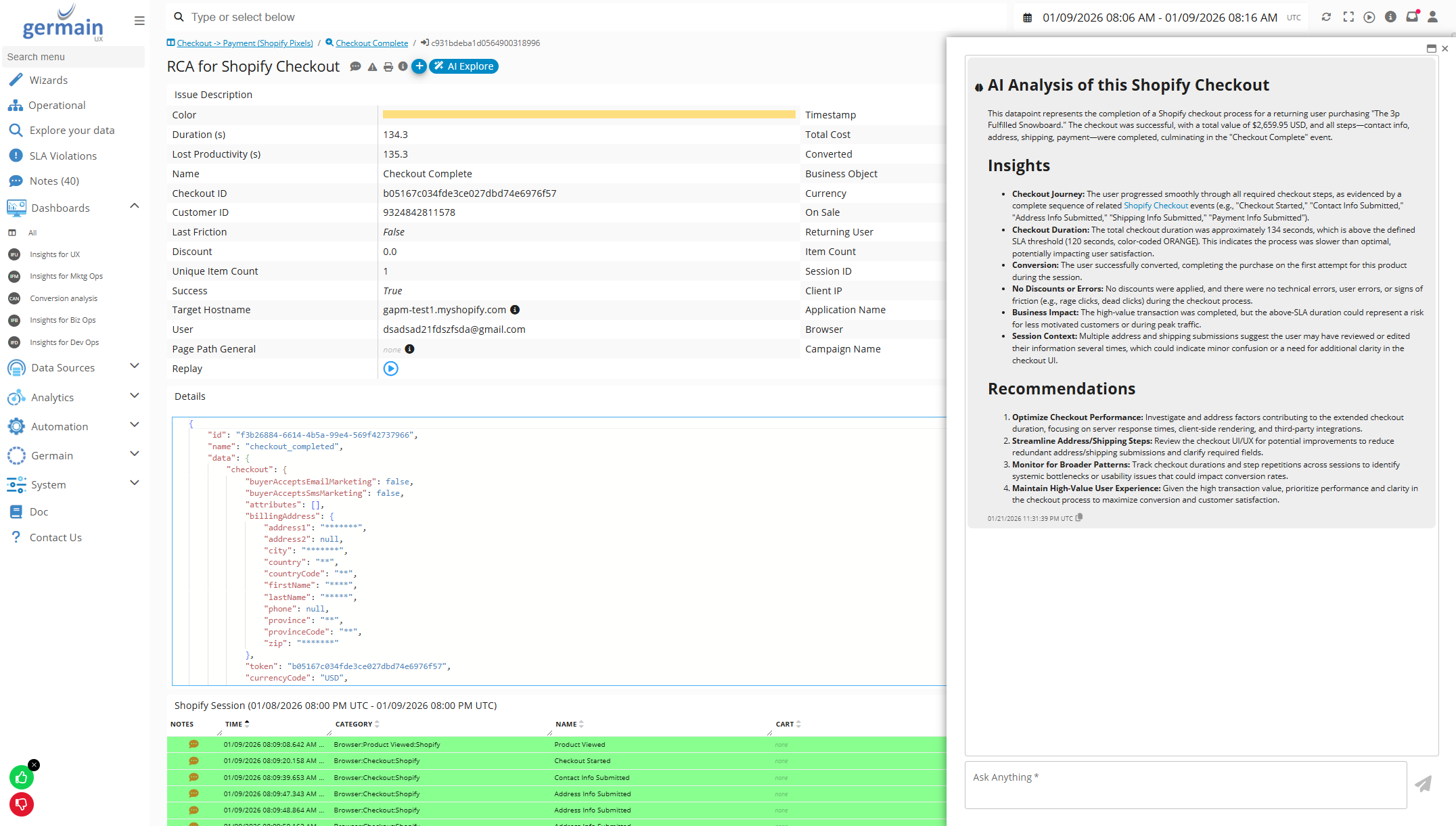
AI-generated findings should support—not replace—appropriate commercial, operational and technical review.
⚙️ Alerts, Proactive Detection and Automated Remediation
GermainUX can turn monitoring and analysis into action through:
|
Automation |
Purpose |
|---|---|
|
Real-time alerts |
Notify the appropriate teams about conversion drops, checkout failures, broken journeys and high-risk sessions |
|
Synthetic monitoring |
Execute critical shopping journeys proactively to detect issues before they affect real shoppers |
|
Anomaly detection |
Identify unusual conversion, behavior, performance and error patterns |
|
Guided investigation |
Provide direct access to relevant analysis, Session Replay and AI Explore |
|
Automated remediation |
Execute approved recovery or data-correction workflows when automation is considered safe |
Synthetic RPA bots can continuously validate activities such as browsing, product selection, cart updates and checkout. Automated remediation can address selected recoverable issues that do not require human judgment.
📁 Automated Reports
GermainUX can generate and distribute scheduled reports according to the urgency of the issue and the needs of each stakeholder. Report layouts, included KPIs, AI prompts, recommendations and calls to action are configurable.
Examples include:
|
Report |
Purpose |
|---|---|
|
Weekly Conversion Report |
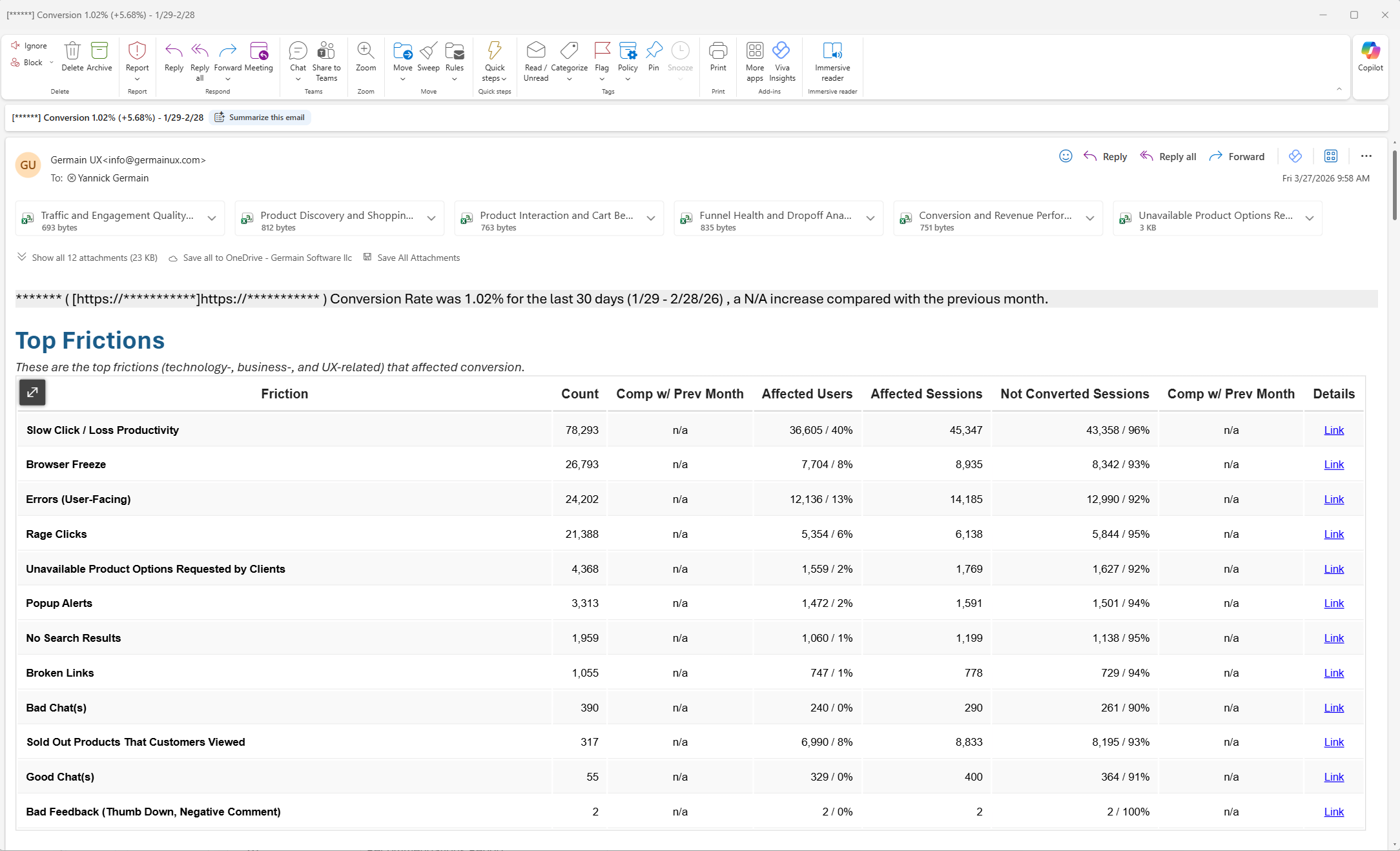
|
|
Top Conversion Issues and Recommendations Report |
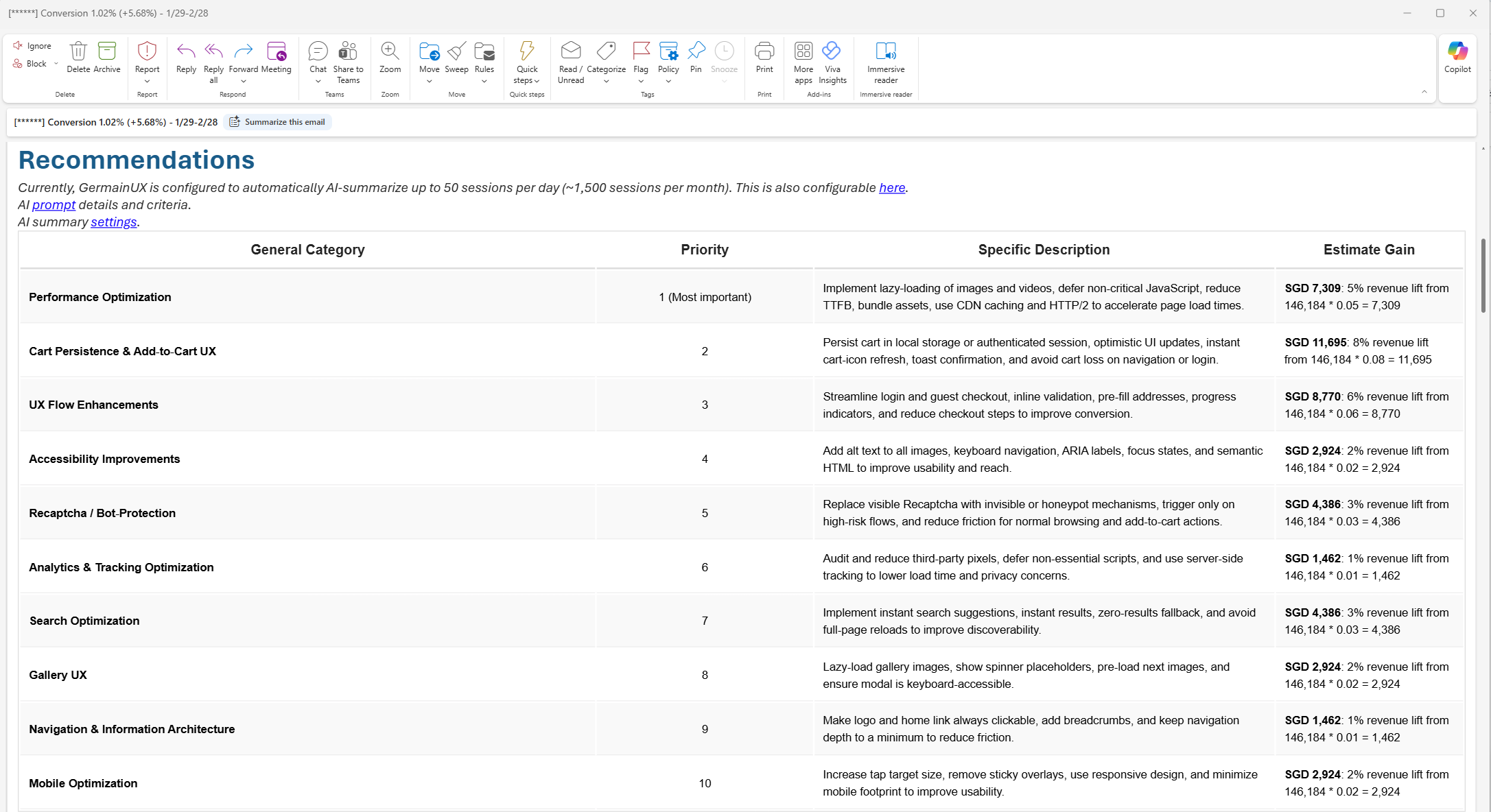
|
|
Cart Abandonment Report |
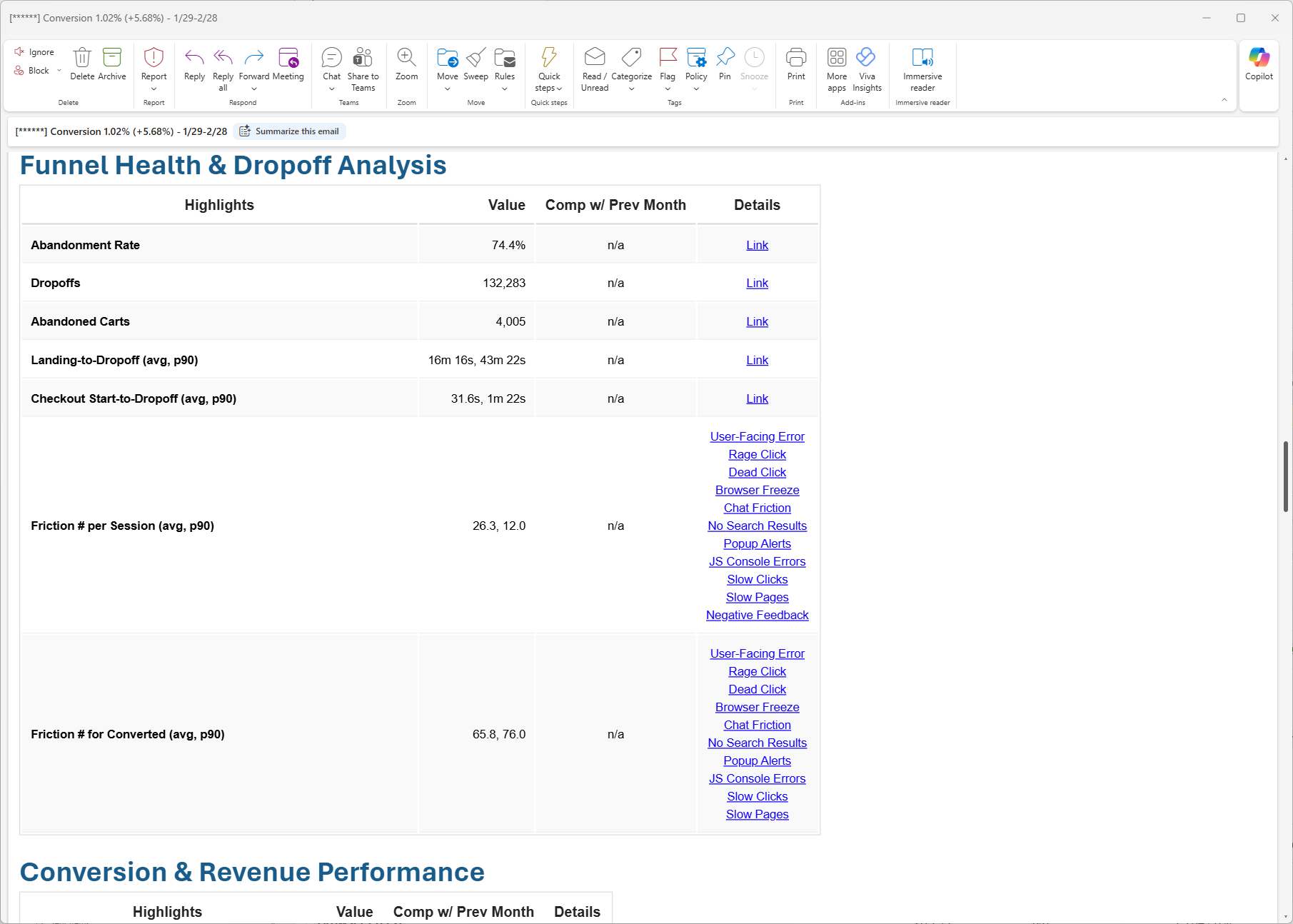
|
|
Customer Satisfaction and NPS Report |
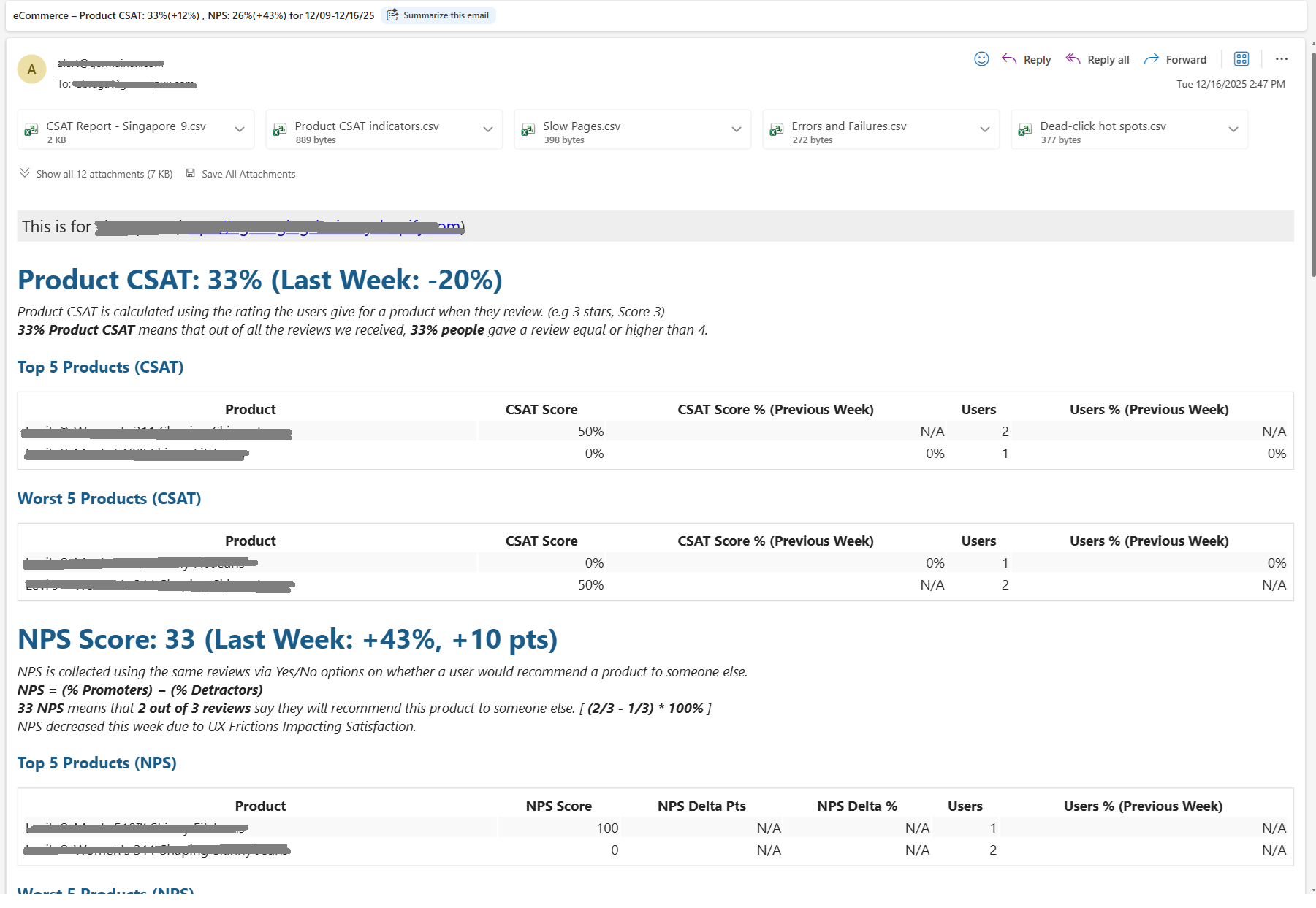
|
|
AI Summary of Multiple Shopper Sessions |
|
Reports can rank issues by affected shoppers, conversion impact, estimated revenue loss or another business measure so each team knows what to investigate or fix first.
🛡️ Security and Privacy
Security and privacy controls help restrict access to sensitive Shopify data and support organizational requirements such as GDPR. Depending on the deployment, sensitive information can be masked, anonymized or excluded from collection.
The monitoring of conversations, personal information, payment-related journeys and authenticated customer activity depends on the organization’s permissions, retention policies, consent requirements and configured privacy controls.
🚀 Deployment and Shopify Coverage
GermainUX typically monitors Shopify storefront experiences using GermainUX RUM JS. Shopify Pixels and server-side Shopify data sources can complement browser monitoring, including for checkout and commerce events that are not available through storefront JavaScript alone.
The precise feature set depends on the Shopify plan, theme and checkout architecture, enabled Shopify APIs, consent configuration, third-party applications, connected systems and GermainUX components deployed.
📦 GermainUX Components
The components used for a Shopify deployment can include:
|
Component |
Link |
|---|---|
|
GermainUX Engine |
|
|
GermainUX RUM JS |
|
|
GermainUX JS Profiler |
|
|
GermainUX Mobile App |
|
|
GermainUX RPA Bot Recorder |
Component requirements and feature availability depend on the desired monitoring depth and the architecture of the Shopify environment. The source page identifies GermainUX 2023.3 or later as the general availability baseline; individual capabilities may require a later version.
ℹ️ Get More Information
GermainUX can help determine which monitoring, conversion analytics and automation capabilities are appropriate for your Shopify environment.
Component: Engine, JS Profiler, Mobile App, RPA Bot Recorder, RUM JS
Feature Availability: 2023.3 or later