
🚀 Deploy Monitoring, Automated Insights & Actions for Shopify
Deploy GermainUX on Shopify to monitor real-user experience, session replay, conversion funnels, errors, customer feedback, storefront performance, checkout activity, integrations, and critical customer journeys.
The recommended deployment method is the GermainUX Shopify App. A manual theme deployment is also available when the app cannot be installed or when storefront-only monitoring is required.
🔍 Monitoring components
|
Shopify access point |
GermainUX component |
Capabilities |
|---|---|---|
|
Online storefront and checkout |
RUM JS
|
Real-user monitoring, session replay, page views, clicks, errors, requests, funnels, heatmaps, and conversion analysis |
|
Online storefront only |
RUM JS
|
Storefront monitoring for pages rendered by the selected theme |
|
Browser-side diagnostics |
JS Profiler
|
Advanced JavaScript, browser, and network diagnostics |
|
Shopify APIs and integrations |
Engine
|
Application health, API, integration, order, and usage monitoring |
|
Native mobile application |
Mobile App
|
User-experience monitoring for supported mobile applications |
|
Synthetic customer journeys |
RPA Bot Recorder
|
Records Selenium scenarios for continuous synthetic monitoring |
🎯 Before you begin
You need:
-
A Shopify account with permission to install apps or modify the active theme
-
A GermainUX Cloud or on-premise environment
-
Your GermainUX hostname
-
The Shopify stores and environments to monitor
-
Approved privacy, consent, masking, and data-retention requirements
-
Test access to the monitored storefront and checkout journey
For manual theme deployment, create a backup or duplicate of the active theme before editing its code.
⚙️ Choose a deployment method
|
Method |
Recommended use |
Coverage |
|---|---|---|
|
GermainUX Shopify App |
Standard deployment |
Storefront, Shopify events, and supported checkout monitoring |
|
Shopify theme |
App installation is unavailable or storefront-only monitoring is sufficient |
Pages rendered through the modified theme |
|
Both methods |
Only when explicitly required by the deployment design |
Must be configured carefully to prevent duplicate monitoring |
Do not enable the app and theme snippet simultaneously unless GermainUX Support confirms that the profiles prevent duplicate collection.
📦 Method 1: Install the GermainUX Shopify App
This is the recommended and simplest deployment method.
⬇️ Install the app
-
Open the GermainUX app in the Shopify App Store.
-
Click Install.
-
Sign in to Shopify if prompted.
-
Select the store you want to monitor.
-
Review the permissions requested by the app.
-
Approve the installation.
-
Open the GermainUX app from the Shopify Admin.
The application may request access to storefront activity, Shopify analytics, web pixels, customers, orders, and related store information required by the enabled monitoring features. Review the permissions and the GermainUX privacy policy before approving production access.
📋 Complete onboarding
Complete the onboarding form in the GermainUX Shopify App.
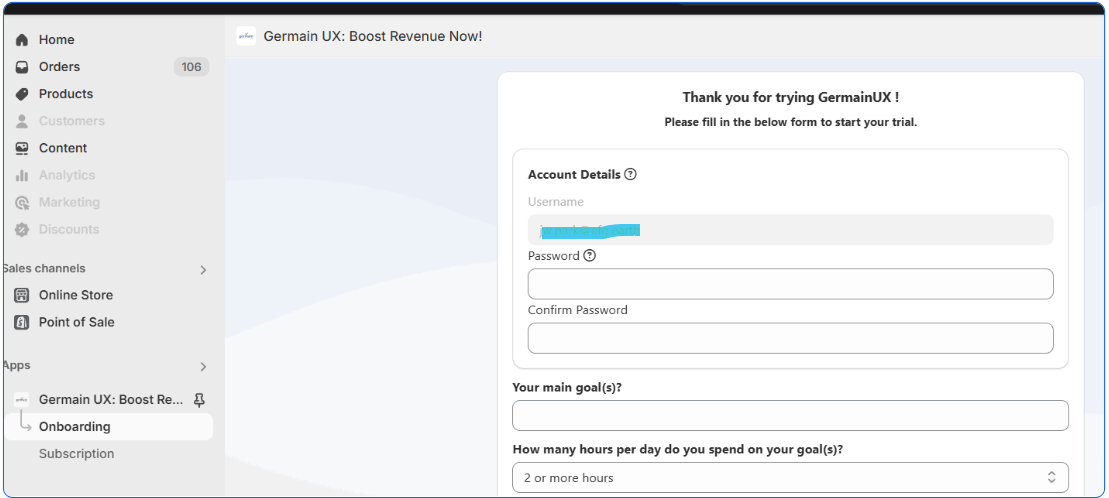
Provide or confirm:
-
GermainUX environment or hostname
-
Shopify store name
-
Storefront domain
-
Environment name, such as Production or Test
-
Monitoring profile
-
Data-privacy settings
-
Consent requirements
-
Features to enable
-
Contact information, if requested
The application installs and configures the required Shopify integration, including supported web-pixel and checkout monitoring.
✅ Validate the installation
After onboarding:
-
Open the storefront in a new browser session.
-
Accept or reject tracking consent according to the configured test case.
-
Browse a collection and product page.
-
Search for a product.
-
Add a product to the cart.
-
Begin checkout.
-
Complete a test purchase when permitted.
-
Open GermainUX and confirm that the session and Shopify events were collected.
Verify both storefront and checkout events. A successful storefront test does not, by itself, confirm checkout coverage.
🔧 Method 2: Deploy RUM JS through the Shopify theme
Use this method when you cannot install the Shopify App or only need to monitor storefront pages rendered by the theme.
A theme-based deployment does not automatically provide the same coverage as the Shopify App. In particular, it may not monitor checkout pages, third-party checkouts, or pages that do not render the modified theme.
✏️ Add the GermainUX script
-
Sign in to the Shopify Admin.
-
Go to Online Store > Themes.
-
Locate the active theme.
-
Open the theme actions menu.
-
Select Edit code.
-
Open the primary theme layout, normally:
layout/theme.liquid -
Add the following code inside the
<head>element:
<!-- GermainUX integration -->
<script
type="text/javascript"
async
crossorigin="anonymous"
src="https://GERMAIN_UX_HOSTNAME/config/download/file/agents%7Cwebux%7Cgermainapm.js?appName={{ shop.name | replace: '|', ' ' | url_param_escape }}&germainApmRootUrl=GERMAIN_UX_HOSTNAME&defaultProfileName=Shopify">
</script>
<!-- End GermainUX integration -->
-
Replace both occurrences of
GERMAIN_UX_HOSTNAMEwith the hostname of your GermainUX environment. -
Save the file.
-
Preview the theme before publishing it.
For example, if your GermainUX environment is hosted at mycompany.germainux.com, the script source begins with:
https://mycompany.germainux.com/config/download/file/...
Do not add another https:// prefix if the value supplied for the placeholder already includes one. Follow the hostname format used by your GermainUX environment and generated monitoring profile.
🔁 Deploy to multiple themes
Shopify executes the snippet only on pages rendered by a theme containing it. If you publish a different theme, confirm that the GermainUX snippet is present in the newly published theme.
Repeat the deployment for:
-
Production themes
-
Development or staging themes
-
Country- or brand-specific storefront themes
-
Additional Shopify stores
Use different application or environment names when the data must remain distinguishable in GermainUX.
✅ Validate the theme deployment
-
Open the storefront.
-
Use the browser’s developer tools to confirm that
germainapm.jsloads successfully. -
Confirm that the request is not blocked by Content Security Policy, consent management, an ad blocker, or a network proxy.
-
Navigate across several storefront pages.
-
Perform clicks, searches, cart updates, and other monitored actions.
-
Confirm that a new session appears in GermainUX.
-
Open the session and verify page views, clicks, network requests, and replay data.
🔒 Configure data privacy and consent
Before production rollout, configure collection according to the store’s privacy requirements.
Review:
-
Cookie and tracking consent
-
Text and input masking
-
Payment and checkout information
-
Customer names and contact information
-
Addresses and order information
-
Authentication credentials
-
Cart and product attributes
-
Request URLs, parameters, bodies, and headers
-
Session Replay capture and exclusion rules
-
Data-retention requirements
-
Geographic privacy requirements
Never capture passwords, payment-card details, security codes, authentication tokens, or other protected credentials.
Where Shopify consent APIs or a consent-management platform are used, validate all consent states:
-
Consent granted
-
Consent denied
-
Consent changed during the session
-
Consent withdrawn
-
Consent unavailable or delayed
💬 Deploy customer-feedback monitoring
GermainUX can display a feedback popup that allows shoppers to report satisfaction, frustration, or a specific problem while it occurs.
Feedback can be correlated with:
-
The affected user session
-
Session Replay
-
Page and product
-
Cart or checkout stage
-
Browser and device
-
Errors and failed requests
-
Performance conditions
-
Conversion outcome
After deploying RUM JS, enable and configure the feedback feature in the Shopify monitoring profile. Apply privacy controls to free-text comments because shoppers may enter personal or confidential information.
📈 Deploy business-process and conversion monitoring
Configure critical Shopify journeys as GermainUX business processes.
Common processes include:
-
Landing page to product view
-
Product search to product selection
-
Product view to add-to-cart
-
Cart to checkout
-
Checkout to completed purchase
-
Customer registration
-
Login and password recovery
-
Discount-code application
-
Order tracking
-
Return or refund request
-
Contact or support request
GermainUX can measure completion, duration, abandonment, errors, and delays for the entire journey and each configured step.
For example, GermainUX can identify customers who require eight minutes to place an order when the expected duration is two minutes, then associate the delay with the affected steps, errors, requests, or user behavior.
📢 Deploy Shopify event monitoring
The Shopify App can collect supported Shopify storefront and commerce events. Configure the events required for your analysis, such as:
-
Page viewed
-
Product viewed
-
Collection viewed
-
Search submitted
-
Product added to cart
-
Product removed from cart
-
Cart viewed
-
Checkout started
-
Checkout contact information submitted
-
Checkout address information submitted
-
Checkout shipping information submitted
-
Payment information submitted
-
Checkout completed
Available events depend on the Shopify integration, store configuration, consent status, and GermainUX version.
Validate event names, product identifiers, currency, order values, discounts, quantities, and journey correlation before using the data for conversion or revenue reporting.
🔗 Deploy monitoring for third-party checkout
Some Shopify stores redirect customers to an external checkout, payment provider, subscription platform, or marketplace.
The Shopify storefront deployment cannot automatically monitor a separate domain unless GermainUX is also deployed there or the external system exposes an integration that GermainUX can use.
For third-party checkout monitoring:
-
Identify every domain involved in the journey.
-
Determine whether RUM JS can be deployed on each domain.
-
Configure cross-domain session correlation.
-
Exclude payment credentials and protected fields.
-
Configure API or Engine monitoring when browser deployment is unavailable.
-
Validate that the shopper journey remains connected after the redirect.
-
Distinguish abandonment from a loss of monitoring coverage.
🖥️ Deploy Shopify API and integration monitoring
RUM JS provides browser-side storefront telemetry. Use the GermainUX Engine when you also need backend or integration monitoring.
The Engine can monitor supported:
-
Shopify REST or GraphQL APIs
-
Orders and transactions
-
Inventory and fulfillment integrations
-
Product and catalog synchronization
-
Customer and CRM integrations
-
Payment and tax integrations
-
ERP and warehouse integrations
-
Webhooks
-
Scheduled jobs
-
API availability, duration, throughput, and errors
Engine deployment and credentials must be configured separately. Use the minimum permissions required for the enabled monitoring operations.
🐛 Deploy the JS Profiler
Deploy the GermainUX JS Profiler when standard RUM telemetry does not provide enough browser-side diagnostic detail.
The JS Profiler can provide advanced information about:
-
JavaScript execution
-
Browser activity
-
Network requests
-
Long-running browser operations
-
Browser freezes
-
Client-side errors
-
Resource and object activity
The JS Profiler is typically deployed to controlled diagnostic users, support teams, QA users, or test devices. It is not required for standard Shopify RUM and Session Replay.
The JS Profiler analyzes browser-side JavaScript and network activity. It does not directly profile Shopify’s server-side code.
🤖 Deploy synthetic monitoring
Use the GermainUX RPA Bot Recorder to record a Shopify customer journey as a Selenium scenario.
Typical scenarios include:
-
Open the storefront
-
Search for a product
-
Open a product page
-
Add an item to the cart
-
Start checkout
-
Validate availability, price, or shipping information
-
Confirm that a critical page or integration is working
After recording the scenario, GermainUX can schedule and manage its execution across supported locations and environments.
Synthetic monitoring helps detect:
-
Storefront outages
-
Slow pages
-
Broken searches
-
Add-to-cart failures
-
Checkout failures
-
Missing products or content
-
Integration failures
-
Regional or network-specific issues
Use dedicated synthetic accounts and test data. Avoid completing real purchases or modifying production data unless the scenario has been designed to do so safely.
🤖 Deploy automation
After monitoring produces reliable data, configure GermainUX automation to detect, analyze, notify, or remediate problems.
Examples include:
-
Alert when checkout failures exceed a threshold
-
Detect an increase in cart abandonment
-
Identify dead-end searches
-
Notify a team when a third-party service fails
-
Run a synthetic scenario after a deployment
-
Trigger an API or webhook action
-
Restart a failed integration where authorized
-
Generate recurring conversion or experience reports
-
Use AI-driven analysis to summarize affected sessions and likely causes
Configure safeguards, authorization, and auditability before enabling corrective actions in production.
✅ Production rollout checklist
Before completing the deployment, verify that:
-
The correct Shopify store and environment are identified.
-
Only one intended RUM deployment loads on each page.
-
Storefront sessions appear in GermainUX.
-
Supported checkout activity is collected.
-
Shopify events contain the correct products, currency, quantities, and values.
-
Guest and authenticated customer journeys are correlated as intended.
-
Session Replay reconstructs the expected storefront activity.
-
Sensitive elements and values are masked or excluded.
-
Consent choices are respected.
-
Third-party checkout transitions are understood and tested.
-
Errors and failed requests are captured.
-
Business-process steps appear in the correct order.
-
Synthetic scenarios use safe accounts and data.
-
Engine credentials use minimum required permissions.
-
Alert thresholds are based on representative production baselines.
🛠️ Troubleshooting
⛔ No Shopify data appears
Confirm that:
-
The GermainUX App is installed and onboarding is complete.
-
The theme containing the snippet is published.
-
The GermainUX hostname is correct.
-
germainapm.jsloads successfully. -
The configured application and profile names exist.
-
Tracking consent has been granted when required.
-
Browser extensions or network security tools are not blocking collection.
-
The storefront URL matches the monitoring profile.
🛒 Storefront data appears but checkout data does not
A theme snippet normally covers pages rendered by that theme. Confirm that:
-
The GermainUX Shopify App and its supported web-pixel integration are installed.
-
Checkout monitoring is enabled.
-
The relevant Shopify events are enabled.
-
Consent permits checkout collection.
-
The checkout is hosted by Shopify rather than an unmonitored third party.
-
The store and Shopify plan support the required integration.
🔁 Sessions or events are duplicated
Check whether RUM JS is being loaded by more than one source, such as:
-
The GermainUX Shopify App
-
theme.liquid -
A tag manager
-
A custom pixel
-
Another theme integration
Retain only the intended deployment unless the monitoring profiles explicitly deduplicate the data.
🎞️ Session Replay is incomplete
Review:
-
Consent status
-
Privacy exclusions
-
Capture limits
-
Dynamic or iframe-hosted content
-
Cross-domain transitions
-
Unsupported checkout or third-party pages
-
Network interruptions
-
RUM profile settings
Session Replay reconstructs the user experience from captured browser events; it is not a video recording.
📖 Related documentation
-
Configure Third-Party Checkout Monitoring
-
Configure Error Monitoring
-
Configure Shopify Events
-
Configure User Feedback
-
KPIs for Shopify Monitoring
-
GermainUX in Shopify Store
ℹ️ Get Help
The Germain Team can help you set this up. Contact GermainUX Support.
Component: Engine, JS Profiler, Mobile App, RPA Bot Recorder, RUM JS
Feature Availability: 2023.3 or later