
✅ Validate Customizations After a GermainUX Upgrade
After upgrading GermainUX, review and test all customized objects to confirm that they remain compatible with the new version.
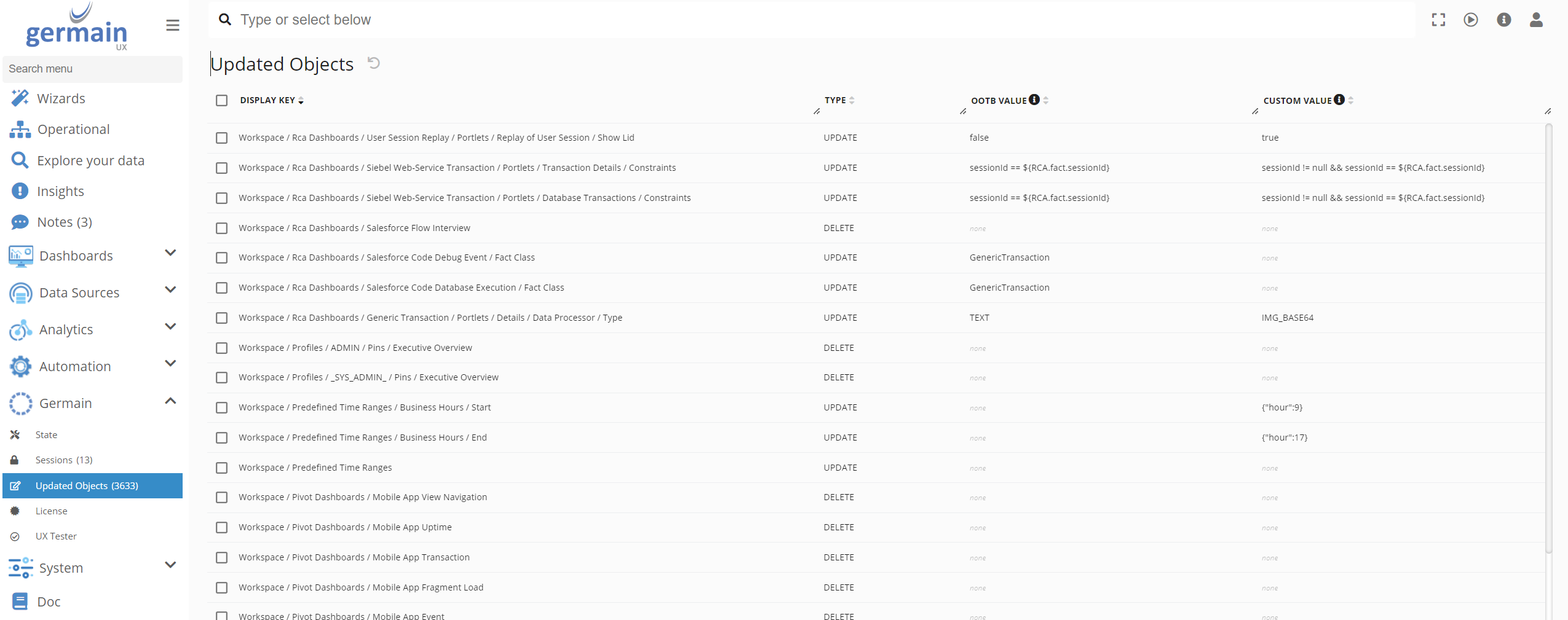
The Updated Objects screen identifies configuration objects that changed during the upgrade, making it easier to determine whether standard GermainUX updates affect customer-specific configurations.
📅 When to perform this validation
Validate customizations:
|
When |
|---|
|
After every GermainUX upgrade |
|
After importing a new standard configuration package |
|
After restoring configuration from another environment |
|
Before promoting an upgraded environment to production |
Perform the review in a development, QA, or staging environment whenever possible.
📋 Before you begin
Confirm that:
|
Check |
|---|
|
The GermainUX upgrade completed successfully. |
|
Germain Enterprise and all required services are running. |
|
The Workspace is accessible. |
|
The new standard configuration was imported successfully. |
|
A backup of the pre-upgrade configuration is available. |
|
You have a record of customer-specific customizations. |
|
Your account has permission to review and modify configuration objects. |
Do not remove or overwrite a customization solely because it appears on the Updated Objects screen. First determine why the object changed and which version should be retained.
📂 Open Updated Objects
-
Sign in to the GermainUX Workspace.
-
Open the left navigation menu.
-
Select Germain.
-
Select Updated Objects.
The screen displays objects that may require review following the upgrade.
🔍 Review each updated object
For every object listed, determine:
|
Question |
|---|
|
Whether it is a standard GermainUX object or a customer-created object |
|
Whether the object was customized before the upgrade |
|
What changed in the new GermainUX version |
|
Whether the customization is still required |
|
Whether the customization conflicts with the updated standard configuration |
|
Whether the standard enhancement should be retained |
|
Whether the customized and standard changes must be merged |
Pay particular attention to objects related to:
|
Area |
|---|
|
Applications and data sources |
|
KPIs and measures |
|
Rules and SLAs |
|
Monitoring profiles |
|
Dashboards and portlets |
|
Alerts and reports |
|
Automated actions |
|
Scripts |
|
Data privacy and masking |
|
User roles and permissions |
|
Technology-specific integrations |
🌳 Decide how to handle each object
An updated object generally requires one of the following actions:
|
Situation |
Recommended action |
|---|---|
|
No customization exists |
Keep the updated GermainUX object |
|
The customization is no longer required |
Keep the updated GermainUX object and retire the customization |
|
The customization remains compatible |
Retain it and validate its behavior |
|
Both versions contain required changes |
Merge the standard update with the customization |
|
The changes conflict |
Review them with the customization owner before selecting or merging a version |
|
The object is obsolete |
Disable or remove it only after confirming that nothing depends on it |
Preserve a copy of the original and upgraded versions before manually merging configuration.
🔍 Test the customizations
After resolving the updated objects, validate the affected functionality.
Confirm that:
|
Check |
|
|---|---|
|
1 |
Monitoring components start without configuration errors. |
|
2 |
Expected telemetry continues to be collected. |
|
3 |
KPIs and measures calculate correctly. |
|
4 |
Rules and SLAs trigger under the expected conditions. |
|
5 |
Alerts reach the intended recipients. |
|
6 |
Reports generate successfully. |
|
7 |
Dashboards and portlets load correctly. |
|
8 |
Filters, pivots, and drilldowns return the expected data. |
|
9 |
Automated actions execute safely. |
|
10 |
Data masking and privacy controls remain effective. |
|
11 |
Roles and permissions provide the intended access. |
|
12 |
Custom scripts and integrations complete without errors. |
Use representative test data and business workflows—not just confirmation that the configuration loads.
📜 Review the logs
During validation, review the Germain Enterprise and GermainUX Service logs for:
|
Log item |
|
|---|---|
|
1 |
Missing configuration references |
|
2 |
Unsupported or renamed properties |
|
3 |
Parsing and deserialization errors |
|
4 |
Script failures |
|
5 |
Invalid KPI, Rule, SLA, or dashboard references |
|
6 |
Authentication or authorization failures |
|
7 |
Integration and datastore errors |
An object may appear valid in the Workspace while still generating runtime errors.
📝 Record the outcome
For each reviewed customization, document:
|
Field |
|
|---|---|
|
1 |
Object name and type |
|
2 |
Configuration owner |
|
3 |
Previous customized behavior |
|
4 |
Standard changes introduced by the upgrade |
|
5 |
Resolution: retained, replaced, merged, disabled, or removed |
|
6 |
Test performed |
|
7 |
Test result |
|
8 |
Reviewer and approval date |
This record simplifies validation during future upgrades.
✅ Complete the upgrade
Before promoting the upgraded environment to production, confirm that:
|
Confirmation |
|
|---|---|
|
1 |
Every updated object has been reviewed. |
|
2 |
Required customizations were retained or merged. |
|
3 |
Obsolete customizations were identified. |
|
4 |
Critical workflows were tested successfully. |
|
5 |
Monitoring, analytics, alerts, reports, and automations work as expected. |
|
6 |
Privacy and security controls were revalidated. |
|
7 |
No unexplained errors remain in the logs. |
|
8 |
The final configuration was backed up. |
If an object cannot be reconciled safely, restore the previous configuration in the test environment and contact GermainUX Support before proceeding.
Component: Enterprise
Feature Availability: