
⚙️ Configure Salesforce User Click Analysis
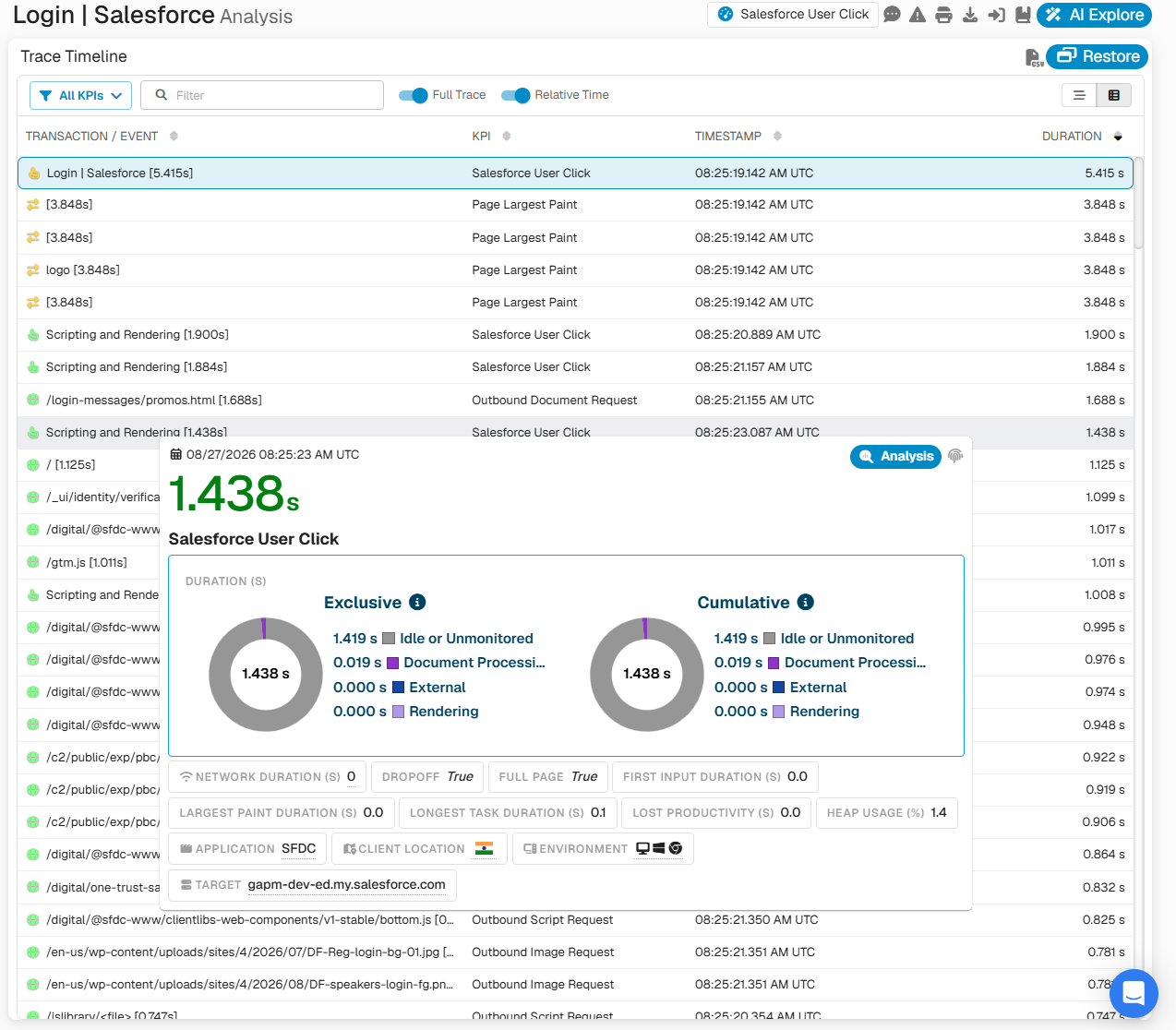
GermainUX captures and analyzes Salesforce user clicks as individual KPIs, allowing teams to measure adoption, responsiveness, productivity, and technical activity associated with each interaction.
🔗 Correlated events
A Salesforce User Click can be correlated with:
-
JavaScript execution
-
Browser errors
-
Network requests
-
Salesforce Aura calls
-
Apex execution
-
SOQL queries
-
Database activity
-
API and integration calls
-
User-facing errors
-
Business-process steps
-
Session Replay
This helps teams move from “the user clicked a button” to “the interaction was slow or failed because of this browser, Salesforce, Apex, database, or integration activity.”
Salesforce User Click is a distinct KPI. It complements Session Replay but does not replace it.
📊 User Click KPI vs. Session Replay
|
Capability |
Salesforce User Click |
Session Replay |
|---|---|---|
|
Measures an individual interaction |
Yes |
Provides the surrounding visual sequence |
|
Calculates response duration |
Yes |
Shows how the wait appeared to the user |
|
Supports aggregation across users |
Yes |
Primarily used for instance-level investigation |
|
Supports averages and percentiles |
Yes |
No |
|
Supports adoption and usage counts |
Yes |
Not its primary purpose |
|
Correlates with technical calls |
Yes |
Displays correlated evidence for the session |
|
Shows what the user saw |
Limited to captured metadata |
Yes |
|
Helps reproduce an issue |
Provides the exact action and related trace |
Provides the complete sequence and UI context |
Use User Click KPIs to identify and prioritize patterns at scale. Open Session Replay to understand an individual occurrence.
✅ Raw Clicks vs. Business-Meaningful Clicks
Not every browser click has business value.
|
Click type |
Description |
Example |
|---|---|---|
|
Raw click |
Any detected mouse click in the Salesforce UI |
Clicking a tab, icon, blank area, or control |
|
Business-meaningful click |
A named action relevant to adoption, productivity, conversion, or workflow analysis |
Save Case, Submit Approval, Convert Lead |
|
Workflow step |
An interaction used to mark progression through a defined process |
Opportunity moved to the next stage |
|
Error-related click |
An interaction associated with a failure or unsuccessful result |
Save followed by an error toast |
|
Repeated or frustrated click |
Multiple clicks indicating delay or unclear UI feedback |
Repeatedly clicking Submit |
Configure meaningful names and context so dashboards report understandable actions instead of unstable HTML or framework details.
📋 Prerequisites
Before configuring Salesforce User Click Analysis:
-
Complete Salesforce Monitoring Deployment.
-
Deploy the GermainUX RUM Extension to the intended Salesforce users.
-
Configure the Salesforce application and UX Monitoring Profile.
-
Confirm that browsers can send data to GermainUX.
-
Configure Salesforce CSP Trusted Sites.
-
Apply masking, anonymization, and exclusion rules.
-
Enable Engine-based Salesforce monitoring if backend correlation is required.
For the broader RUM configuration, see Salesforce User Monitoring and Session Replay.
🧭 Select the Monitoring Method
|
Salesforce context |
Recommended method |
|---|---|
|
Salesforce Lightning |
RUM Extension |
|
Salesforce Classic |
RUM Extension |
|
A controlled custom page where JavaScript can be injected |
RUM JS may be used if technically and organizationally supported |
|
Complete Salesforce page monitoring |
RUM Extension |
A custom Aura or Lightning component cannot independently monitor the complete Salesforce root page because Salesforce security isolates component code. Use the RUM Extension when complete user-interaction coverage is required.
🔧 Configure the Salesforce UX Monitoring Profile
In GermainUX Workspace, navigate to:
Analytics → UX Monitoring Profiles → Salesforce
The profile determines how GermainUX:
-
Detects Salesforce clicks
-
Identifies the clicked control
-
Assigns an action name
-
Captures the active page and component
-
Measures response duration
-
Enriches the click with Salesforce context
-
Processes related network activity
-
Correlates the click with other facts
Use the current Salesforce profile supplied for your GermainUX version.
🏷️ Configure Click Naming
A click name should describe the user’s action in language understood by Salesforce administrators, product owners, and business teams.
Good names include:
-
Click on Save Case -
Click on Submit for Approval -
Click on Convert Lead -
Click on New Opportunity -
Click on Search -
Click on Add Product -
Click on Next -
Click on Close Case
Avoid names based only on:
-
Generated CSS classes
-
Dynamic DOM IDs
-
Framework-internal component names
-
Icon filenames
-
Element positions
-
Unstable Salesforce implementation details
A reliable naming strategy may use:
-
Visible button or link text
-
Accessible label
-
aria-label -
Salesforce component metadata
-
Stable attributes
-
Parent or neighboring label
-
A custom mapping for critical actions
🔍 Capture Click Context
Enrich each click with the available context needed for analysis.
Recommended attributes include:
|
Attribute |
Purpose |
|---|---|
|
Application |
Identifies Salesforce or a Salesforce application |
|
Page or view |
Identifies where the action occurred |
|
Salesforce component |
Identifies the relevant Lightning or Classic component |
|
Action name |
Describes what the user clicked |
|
User |
Supports user-level analysis, subject to privacy policy |
|
Profile or role |
Supports segmentation by user group |
|
Salesforce organization |
Distinguishes monitored organizations |
|
Environment |
Separates production, staging, and test |
|
Business object |
Identifies the relevant object type or anonymized record |
|
Business-process step |
Connects the click to a workflow |
|
Session ID |
Correlates the click with the user session |
|
Correlation ID |
Connects browser and backend telemetry |
|
Result or status |
Identifies success or failure |
|
Duration |
Measures the response time following the click |
Do not capture raw Salesforce record IDs, customer data, or other sensitive values unless required and approved.
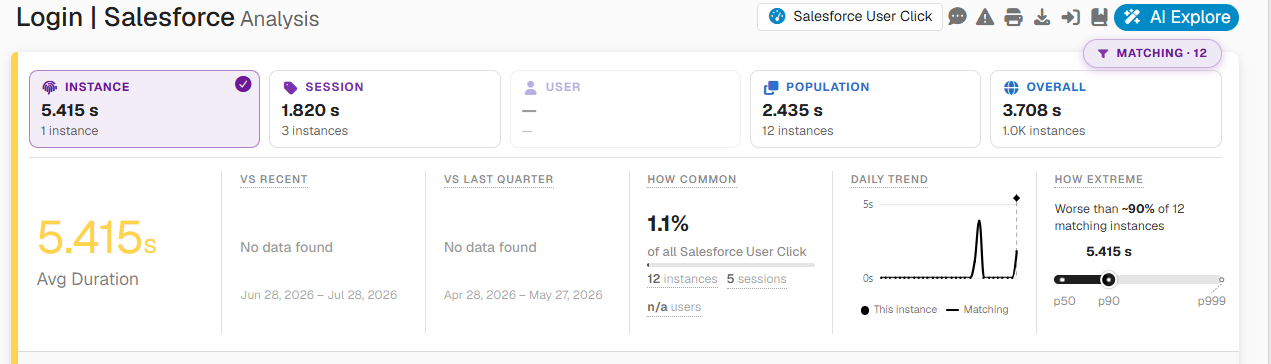
⏱️ Measure Click Response Time
GermainUX measures the duration of supported Salesforce interactions so teams can analyze:
-
Average response time
-
Median response time
-
p75, p90, p95, or p99
-
Maximum duration
-
SLA compliance
-
Trends over time
-
Differences by user, browser, location, application, or action
Percentiles are especially important because averages can conceal a smaller group of users experiencing severe delays.
🔗 Correlate Clicks With Technology Activity
When the appropriate sources are configured, a Salesforce User Click can be correlated with events such as:
-
JavaScript execution
-
JavaScript console errors
-
Browser freezes
-
HTTP requests
-
Aura requests
-
API calls
-
Apex classes and triggers
-
SOQL queries
-
Database operations
-
Server-side exceptions
-
Integration calls
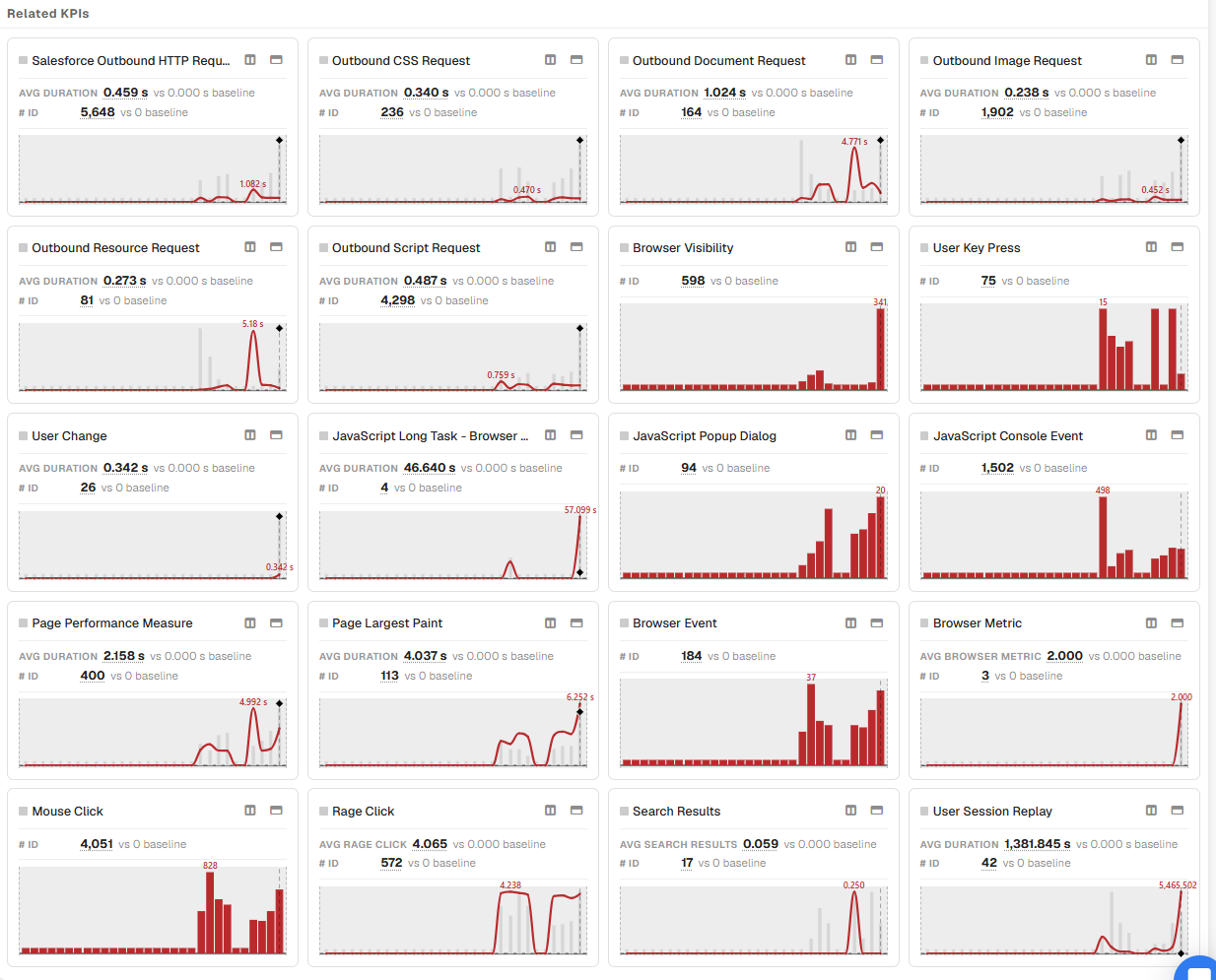
This correlation helps determine whether a slow or failed interaction originated in:
-
The browser
-
Salesforce Lightning
-
Custom code
-
Apex
-
A query
-
Salesforce infrastructure
-
A connected service
-
The user’s network or device

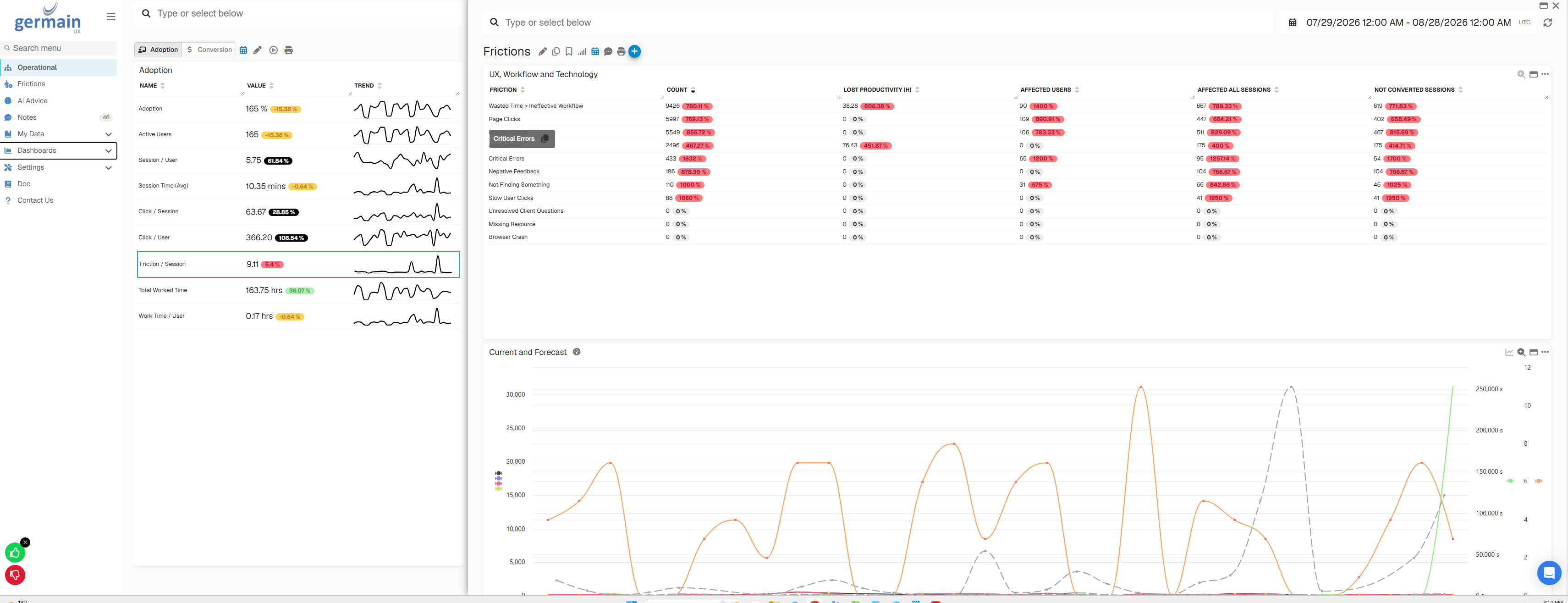
💡 Configure Important Business Actions
Start with actions that directly affect adoption, productivity, or critical workflows.
🔧 Service and Case Management
-
Create Case
-
Save Case
-
Assign Case
-
Escalate Case
-
Close Case
-
Search Customer
-
Add Case Comment
💰 Sales
-
Create Lead
-
Convert Lead
-
Create Opportunity
-
Update Opportunity
-
Add Product
-
Submit Quote
-
Submit for Approval
-
Close Opportunity
👥 General Salesforce Usage
-
Open Record
-
Edit
-
Save
-
Cancel
-
Search
-
Next
-
Back
-
Submit
-
Delete
-
Export
Do not configure every possible click initially. Begin with critical actions, validate the data quality, and expand based on business priorities.
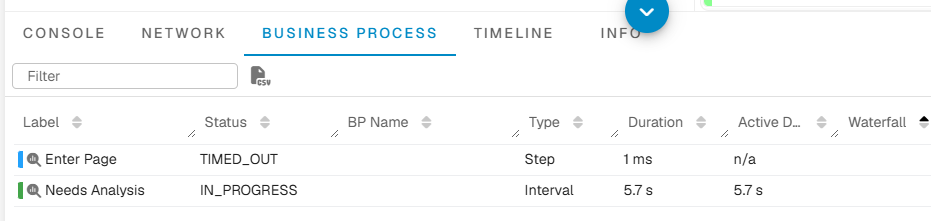
🔁 Configure Business-Process Correlation
User clicks can define or enrich Salesforce workflow steps.
For example:
Open Case
→ Edit Case
→ Search Customer
→ Update Details
→ Save Case
→ Close Case
GermainUX can use the resulting events to identify:
-
Step duration
-
End-to-end workflow duration
-
Drop-offs
-
Repeated steps
-
Unexpected paths
-
Process overruns
-
Lost productivity
-
Differences between user groups
-
Technical problems affecting specific steps
See Business Process and Workflow Monitoring.
✅ Configure Success and Failure
Where possible, determine whether a click achieved its intended outcome.
A click may be considered unsuccessful when followed by:
-
A Salesforce error toast
-
An application error
-
An Apex exception
-
A failed HTTP request
-
An expected page or state not appearing
-
A repeated click
-
Workflow abandonment
-
An excessive response time
Success and failure context makes click counts more useful. High usage does not imply successful usage.
📈 Configure Adoption Analysis
User Click data can measure:
-
Feature adoption
-
Usage frequency
-
Active users
-
New versus returning users
-
Adoption by profile, role, or business unit
-
Underused functionality
-
Workflow completion
-
Training opportunities
-
Changes following a Salesforce release
For example, compare:
-
Users who adopted a new Salesforce feature
-
Users who still use an older workflow
-
Response time for each approach
-
Error rate
-
Completion time
-
Business outcomes
🔒 Configure Privacy
Click metadata can expose:
-
User identity
-
Record identifiers
-
Customer or patient names
-
Search terms
-
Form values
-
Business-object details
-
Error messages
Before production rollout:
-
Anonymize user identities where required.
-
Exclude sensitive record identifiers.
-
Mask search terms or field values.
-
Avoid using private data in click names.
-
Review request and response-body collection.
-
Restrict access to user-level analytics and Session Replay.
-
Apply appropriate retention.
🔑 Salesforce Click KPIs
See Salesforce Click KPIs.
Relevant measures can include:
-
Click count
-
Unique users
-
Unique sessions
-
Average duration
-
Percentile duration
-
Maximum duration
-
Error count
-
Failure rate
-
SLA violation count
-
Total lost-productivity time
Useful pivots include:
-
Click name
-
Salesforce application
-
Page or view
-
Component
-
User
-
Profile
-
Role
-
Business unit
-
Browser
-
Location
-
Business process
-
Business-process step
-
Result
-
Error category
-
Environment
🖥️ View User Click Data
In GermainUX Workspace:
-
Open Dashboards.
-
Select All.
-
Search for:
Salesforce User Click -
Open the applicable portlet or KPI.
-
Select a click name to drill into its instances.
-
Open an instance to review related events and Session Replay.
⭐ Recommended Dashboard Views
Create views that answer specific questions.
👥 Adoption
-
Most and least used actions
-
Unique users by action
-
Adoption by team or profile
-
Usage before and after a release
🚀 Performance
-
Slowest actions
-
p95 response time by action
-
SLA violations
-
Degradation by browser, location, or application version
🎨 Insights for DX or UX
-
Time spent on high-volume actions
-
Repeated or unnecessary interactions
-
Workflow overruns
-
Total lost productivity
📋 Validate User Click Monitoring
Test representative Salesforce actions after configuration.
For each action, verify that:
-
One click fact is generated.
-
The click has a meaningful name.
-
The correct application and page are assigned.
-
User and session context are present.
-
Duration is reasonable.
-
Related HTTP or Aura activity is correlated.
-
Backend evidence appears when configured.
-
Errors are attached to unsuccessful interactions.
-
Session Replay opens at the relevant moment.
-
Sensitive values are masked or excluded.
-
Repeated clicks are not incorrectly counted as separate business actions unless intended.
Test multiple Salesforce layouts, profiles, browsers, and record types because the underlying UI structure may vary.
❓ Clicks Are Missing
If expected clicks do not appear:
-
Confirm that the RUM Extension is installed and enabled.
-
Confirm that the Salesforce website and profile are configured.
-
Verify Salesforce CSP Trusted Sites.
-
Confirm browser connectivity to GermainUX.
-
Check that the Salesforce UX Monitoring Profile is active.
-
Inspect the clicked control’s text, accessible label, and stable attributes.
-
Confirm that the control is not inside an unmonitored context.
-
Review inclusion and exclusion rules.
-
Check the selected dashboard time range and environment.
-
Compare behavior across Salesforce profiles and browsers.
 Click Names Are Incorrect or Unstable
If the same action appears under multiple names:
-
Normalize capitalization and whitespace.
-
Remove dynamic record values.
-
Avoid generated identifiers.
-
Prefer visible or accessible labels.
-
Add Salesforce-specific mappings.
-
Group equivalent names through categorization.
-
Test across Salesforce layouts and user profiles.
⏰ Click Durations Are Incorrect
If interaction duration appears too short or too long:
-
Confirm which completion event closes the interaction.
-
Check for asynchronous Salesforce updates.
-
Review related Aura and HTTP calls.
-
Identify background calls unrelated to the click.
-
Confirm that repeated clicks do not overlap.
-
Compare the measurement with Session Replay.
-
Review the Salesforce UX profile’s event-processing logic.
🔇 Too Many Clicks Are Collected
If raw activity creates excessive noise:
-
Focus on business-meaningful selectors.
-
Exclude decorative or low-value controls.
-
Aggregate repeated UI patterns.
-
Separate raw click heatmaps from business-action KPIs.
-
Retain only the context required for analysis.
-
Prioritize actions tied to critical Salesforce workflows.
📚 Related Documentation
-
Other Analytics Features
-
Other Automation Features
ℹ️ Get Help
The Germain Team can help you set this up. Contact GermainUX Support.
Component: Engine, JS Profiler, Mobile App, RPA Bot Recorder, RUM Ext, RUM JS
Feature Availability: 2017.1 or later