
❓ What is GermainUX?
📋 Overview
GermainUX is an AI-powered Operational Experience Intelligence platform that helps organizations improve conversion, application adoption, and employee productivity by connecting three dimensions that are usually analyzed separately:
|
Dimension |
Description |
|---|---|
|
User Experience |
what customers and employees actually experience |
|
Business Workflows |
how users and systems complete critical processes |
|
Technology Performance |
how applications, code, services, databases, networks, and infrastructure perform |
By correlating these dimensions in real time, GermainUX helps teams identify what is happening, who or what is affected, why it is happening, and what should be improved first.
✨ Key Benefits
GermainUX helps organizations:
|
Goal |
How GermainUX Helps |
|---|---|
|
Increase Conversion |
Identify friction, errors, performance issues, and workflow failures that cause customers to abandon digital journeys |
|
Improve Adoption |
Understand how applications and features are actually used and identify barriers preventing successful adoption |
|
Increase Productivity |
Identify slow applications, inefficient workflows, repeated actions, errors, and technology issues that waste employee time |
|
Reduce Resolution Time |
Correlate user experience, workflows, and technology evidence to identify causes faster |
|
Prevent Issues |
Continuously detect conditions, alert teams, run synthetic checks, and trigger automated actions |
|
Prioritize Improvements |
Focus teams on issues affecting the greatest number of users or having the greatest business impact |
🧠 Operational Experience Intelligence
Traditional tools typically specialize in one area—digital experience, product analytics, process mining, APM, observability, or automation.
But many business problems cross several of these layers.
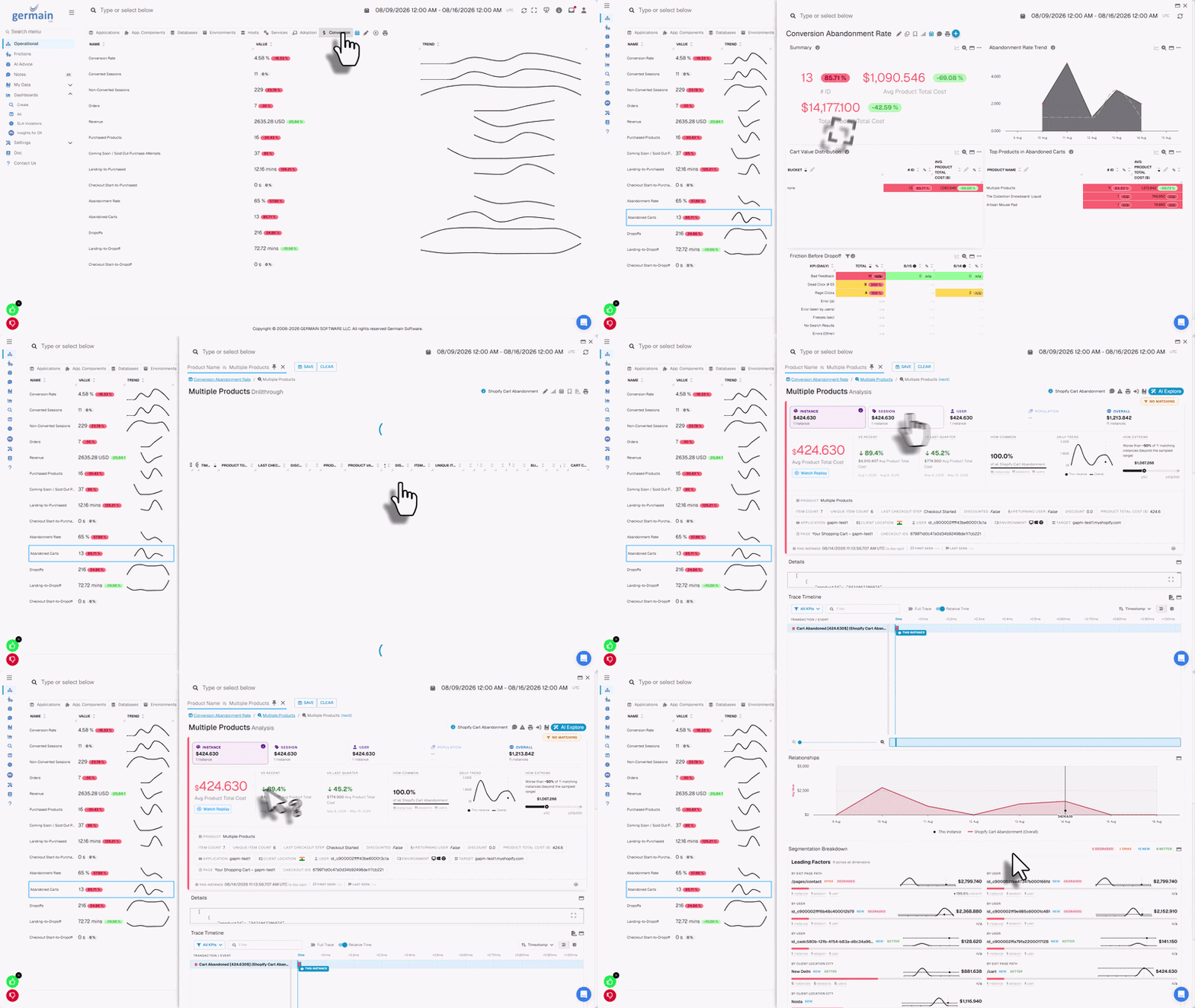
A checkout abandonment may involve user friction, a failed API, slow JavaScript, or a backend error.
A CRM productivity problem may involve an inefficient workflow, application latency, repeated user actions, or an integration failure.
GermainUX connects these perspectives through Operational Experience Intelligence so teams can understand the complete operational experience rather than investigating each layer separately.
🔁 From Detection to Resolution
GermainUX brings monitoring, analytics, AI, and automation together in a continuous operational loop:
Observe → Analyze → Prioritize → Act → Validate
👁️ Observe
Learn more about automatic monitoring and preconfigured integrations.
🔍 Analyze
GermainUX Analytics and AI continuously analyze collected data to identify:
|
Finding |
|---|
|
User friction |
|
Conversion barriers |
|
Adoption issues |
|
Productivity loss |
|
Application errors |
|
Performance degradation |
|
Process inefficiencies |
|
Anomalies and patterns |
|
Opportunities for improvement |
Learn more about analytics mechanisms.
⚖️ Prioritize
Not every issue has the same impact.
GermainUX helps teams automatically prioritize issues and opportunities based on factors such as:
This helps teams focus on improvements with the greatest potential business value.
-
Number of affected users
-
Frequency
-
Severity
-
Conversion impact
-
Productivity impact
-
Process impact
-
Application or technology impact
⚙️ Act
Insights can trigger automated actions such as:
✅ Validate
GermainUX continues monitoring after an action or change so teams can determine whether the issue was resolved and whether user experience, conversion, adoption, productivity, or technology performance improved.
🎞️ Session Replay
GermainUX Session Replay provides detailed, searchable replay of real user sessions across supported web and native Windows applications.
It helps teams see exactly what a user experienced and correlate that experience with:
This helps move investigations from “What happened?” to “Why did it happen?”.
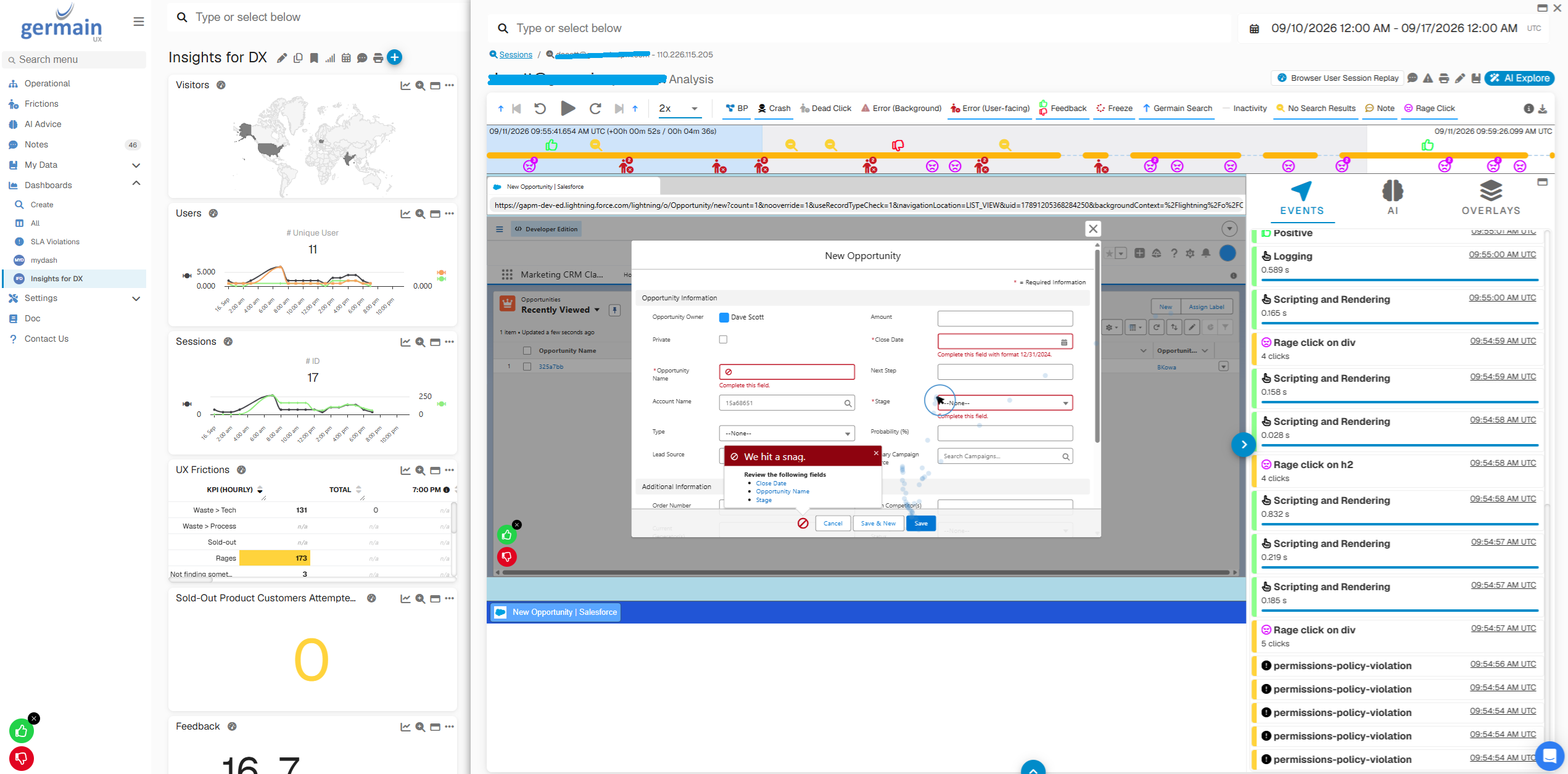
Learn more about GermainUX’s Session Replay.
🚀 AI-Powered Analytics
GermainUX uses AI to help analyze large volumes of user, workflow, application, and technology data.
Depending on the use case, AI can help:
|
Example |
|---|
|
Identify top 10 frictions |
|
Identify new errors and ignore others |
|
Understand poor sales or service interactions |
|
Explain findings |
|
Surface likely causes |
|
Make recommendations |
AI works alongside GermainUX's real-time analytics, correlation, Session Replay, rules, and automation. Learn more about AI-Powered Analytics, at scale, in GermainUX.
🔗 Complements Your Existing Platforms
GermainUX does not have to replace your existing monitoring, analytics, automation, or digital-experience platforms.
Organizations often use GermainUX to complement larger platforms and fill specific gaps where they need greater flexibility, deeper correlation, or a highly customized monitoring, analytics, or automation solution.
🔧 Customized for You
GermainUX is highly customizable.
When an out-of-the-box capability does not fully address your requirement, the Germain Team can configure and customize GermainUX for your specific use case at no additional cost.
This can include:
|
Customization |
|---|
|
Integrating new data sources |
|
Monitoring additional technologies |
|
Creating custom KPIs |
|
Building dashboards |
|
Creating analytics |
|
Configuring alerts |
|
Developing reports |
|
Building automation |
This allows organizations to address highly specific requirements without having to build and maintain the solution themselves.
▶️ Next
ℹ️ Get Help
The Germain Team can help you set this up. Contact GermainUX Support.
Component: Agent, Engine, JS Profiler, Mobile App, RPA Bot Recorder, RUM Extension,
RUM JS, RUM Windows
Supported Version: 2014.1 or later