
User Feedback
Overview
GermainUX User Feedback captures feedback directly from users and connects it with their actual experience.
Feedback can be correlated with the user's session, application activity, business journey, errors, performance, and Session Replay, helping teams understand not only what the user said, but also what the user experienced.
GermainUX can analyze feedback individually or across larger populations to identify recurring friction, measure satisfaction, understand impact, and prioritize improvements.
Capabilities
User Feedback can be used to:
-
Collect positive and negative feedback
-
Collect written comments
-
Capture ratings and survey responses
-
Measure customer or employee satisfaction
-
Support NPS-style surveys
-
Analyze feedback across users and sessions
-
Segment feedback by available business, user, application, or technology dimensions
-
Correlate feedback with Session Replay
-
Identify errors, performance issues, or friction associated with feedback
-
Categorize recurring feedback
-
Analyze sentiment
-
Analyze feedback using AI
-
Trigger alerts and notifications
-
Initiate automated workflows
Feedback Popup
The Feedback Popup allows users to provide feedback directly within a monitored application.
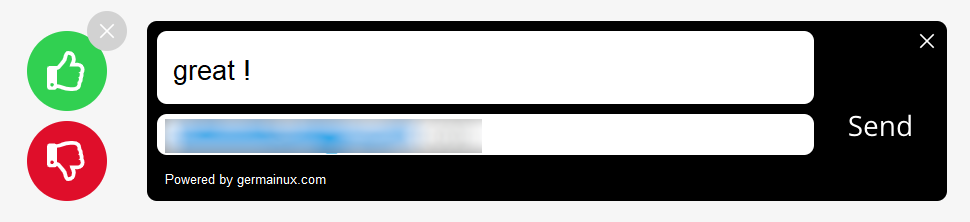
Depending on its configuration, the popup can collect:
-
Positive or negative feedback
-
Ratings
-
Comments
-
Survey responses
Because feedback is collected during the monitored experience, GermainUX can preserve the context surrounding the response.
The popup can be customized for the monitored application and feedback requirements.
Feedback KPIs & Measures
User Feedback KPI
Feedback submitted through the Feedback Popup is captured using the preconfigured User Feedback KPI.
|
KPI |
Data Model |
Description |
|---|---|---|
|
User Feedback |
|
Captures positive or negative feedback and any associated comment submitted by a user. |
Feedback can be analyzed independently or correlated with the associated User Session Replay.
Session-Level Feedback Measures
The User Session Replay KPI includes measures for quantifying feedback submitted during a recorded session.
|
Measure |
Description |
|---|---|
|
Positive Feedback Count |
Number of positive feedback submissions during the session. |
|
Negative Feedback Count |
Number of negative feedback submissions during the session. |
|
Feedback Comment Count |
Number of feedback comments submitted during the session. |
These measures can be used to filter, segment, and prioritize sessions according to the feedback they contain.

Analyze Feedback at Scale
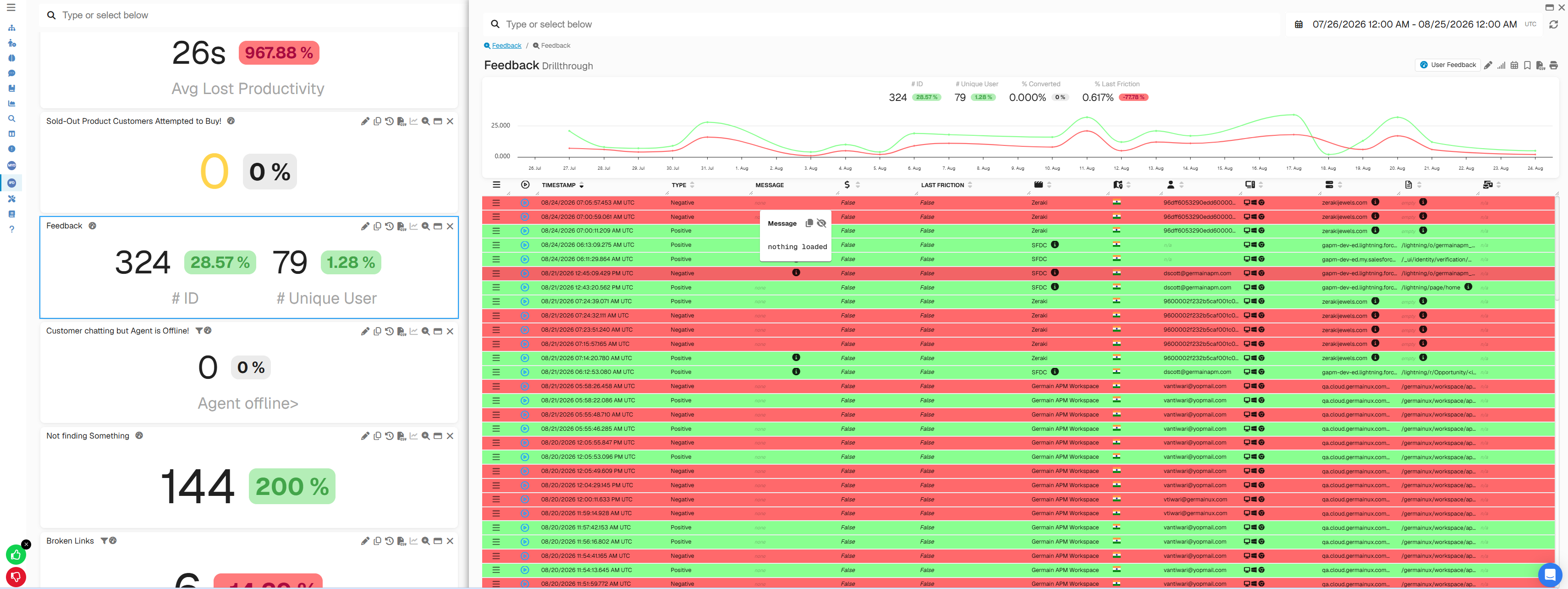
GermainUX dashboards can quantify feedback across a selected population and time period.
Analysis can include:
-
Total feedback
-
Positive versus negative feedback
-
Feedback trends
-
Comment volume
-
Satisfaction
-
Unique users or sessions providing feedback
-
Feedback associated with errors or friction
-
Feedback by application, process, product, or other business dimension
This helps determine whether feedback represents an isolated experience or a broader pattern.
Segment Feedback
Feedback can be segmented using available GermainUX Pivots.
Depending on the monitored data, this can include:
-
Application
-
Page or screen
-
Feature
-
Business process or workflow
-
Product or service
-
User group or role
-
Customer segment
-
Geography
-
Device
-
Browser
-
Application version
-
Campaign or traffic source
-
Feedback category
-
Sentiment
This helps identify which populations are most affected and where feedback is concentrated.
Analyze Individual Feedback
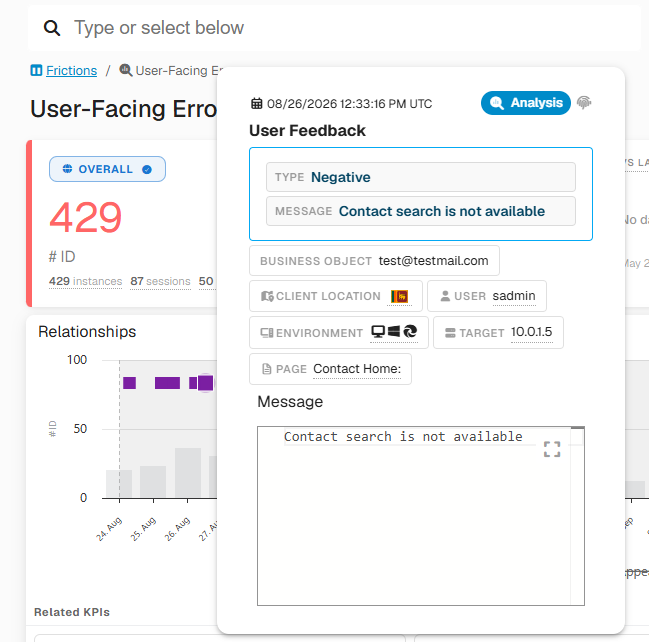
Drill into individual feedback responses to understand the evidence behind aggregate results.
Teams can:
-
Read individual comments
-
Compare responses within a selected population
-
Identify recurring themes
-
Locate users or sessions requiring investigation
-
Select representative sessions for deeper analysis
Analyze Feedback with AI
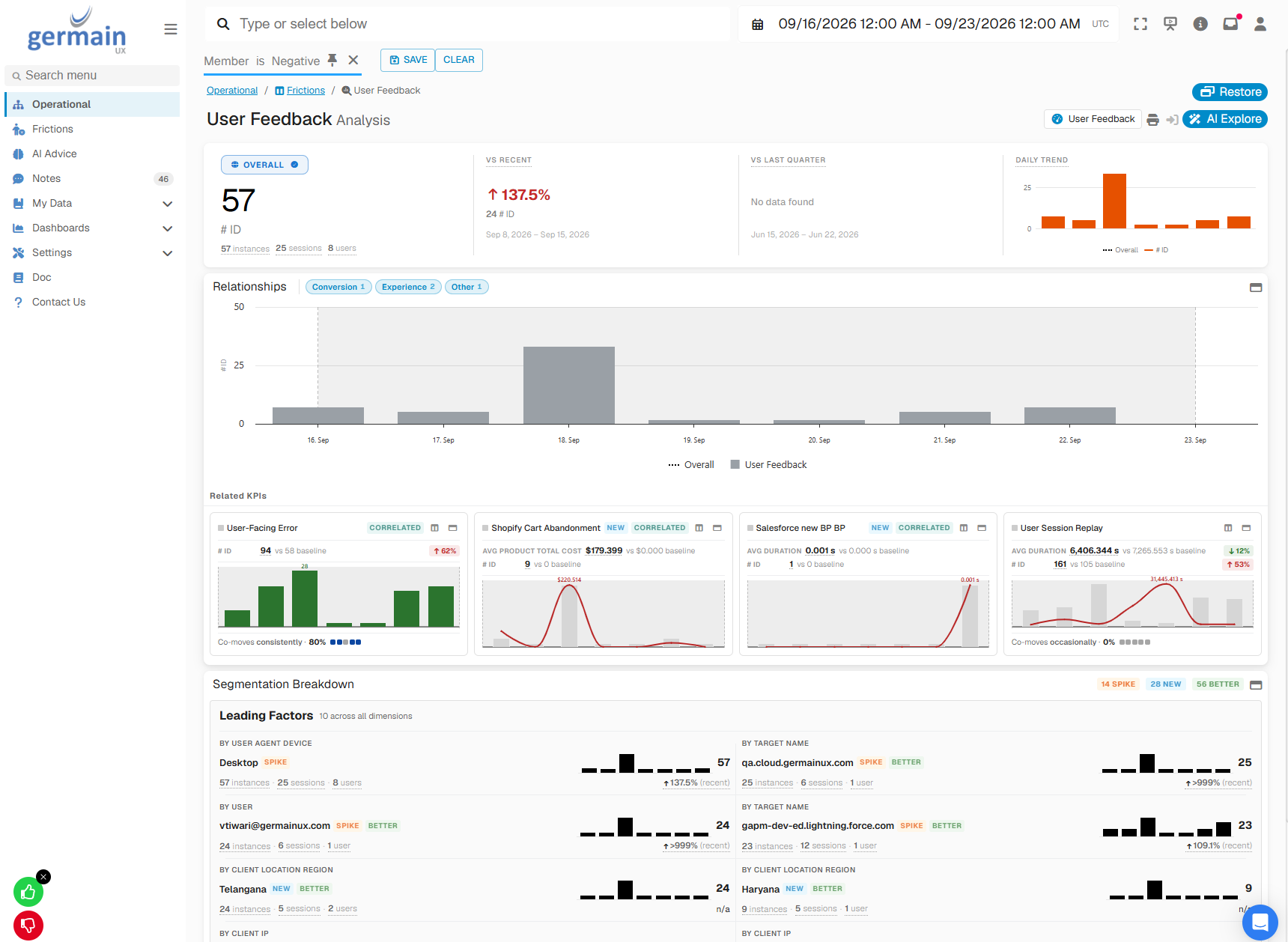
GermainUX AI can analyze large volumes of feedback to identify patterns that may be difficult to discover by reviewing responses individually.
AI can help:
-
Summarize feedback
-
Categorize feedback
-
Analyze sentiment
-
Identify recurring themes
-
Identify emerging friction
-
Associate feedback with available user and session context
-
Surface affected applications, workflows, products, or populations
-
Recommend areas for improvement
This helps teams move from individual comments to prioritized insights at scale.
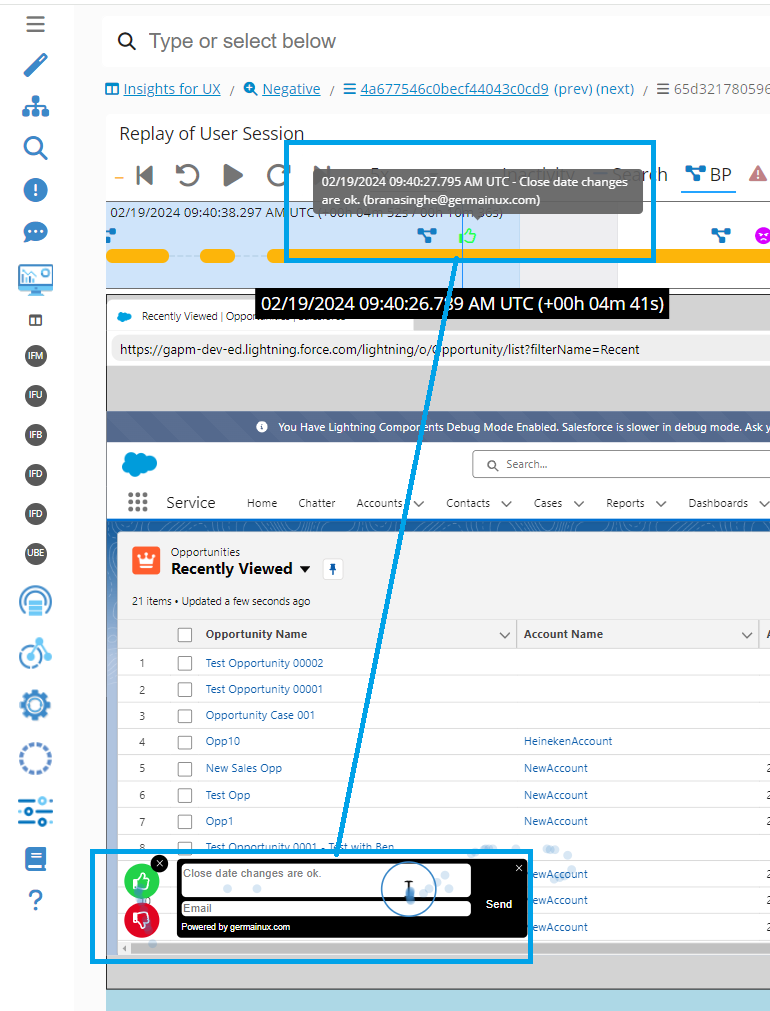
Investigate with Session Replay
When Session Replay is available, feedback can be connected with the corresponding user session.
Teams can review what happened before and around the time feedback was submitted to understand:
-
What the user was trying to accomplish
-
Which page or workflow was involved
-
What the user saw
-
Whether an error occurred
-
Whether the application was slow or unresponsive
-
Whether the user repeated an action
-
Whether the user abandoned or completed the task
This provides the context needed to move from:
What did the user say?
to:
What did the user actually experience?
Both positive and negative feedback can provide useful evidence. Positive feedback can help identify successful experiences, while negative feedback can help identify potential UX, process, or technology friction.
Correlate Feedback with Other Analytics
Feedback becomes more valuable when analyzed together with other GermainUX data.
For example, negative feedback can be correlated with:
-
Application errors
-
Slow response times
-
Failed transactions
-
Drop-offs
-
Repeated actions
-
Rage clicks
-
Business workflow issues
-
Conversion outcomes
-
User journeys
This helps determine whether feedback is associated with a broader user, business, or technology issue.
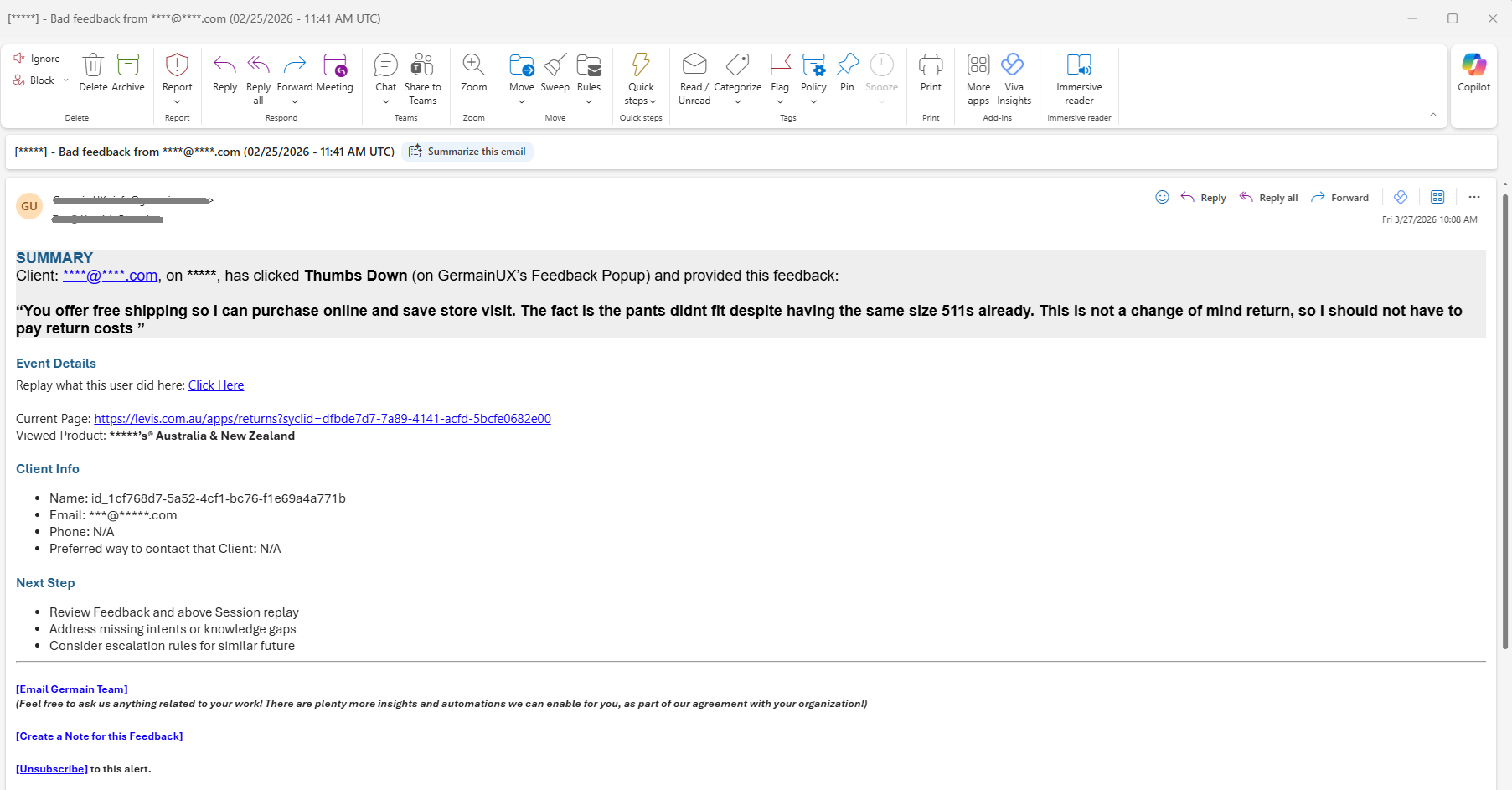
Alerts & Automation
Feedback can trigger GermainUX alerts or automated actions when configured conditions are met.
For example:
Negative Feedback → Analyze Context → Categorize → Create Ticket → Notify Team
Other workflows can:
-
Alert a support or operations team
-
Create or update a ticket
-
Trigger AI analysis
-
Notify an application or product owner
-
Escalate high-priority feedback
-
Generate a recurring feedback report
-
Initiate a custom follow-up workflow
Advanced Rules can be used when custom decision logic is required.
API Integration
GermainUX APIs can be used to integrate feedback and its associated user/session context with custom applications and workflows.
API-based integrations can support use cases such as:
-
Processing feedback externally
-
Retrieving associated user or session context
-
Triggering custom workflows
-
Enriching feedback with additional business context
-
Generating custom transactions
-
Using feedback within custom Analytics or Automation
Refer to the User Monitoring and Session Replay APIs for applicable API operations.
From Feedback to Improvement
A typical User Feedback workflow is:
-
Capture — Collect feedback during the actual user experience.
-
Analyze — Identify sentiment, categories, patterns, and associated friction.
-
Understand — Review the relevant Session Replay and supporting evidence.
-
Prioritize — Determine the affected population and potential business impact.
-
Act — Improve the experience or trigger the appropriate workflow.
-
Validate — Monitor subsequent feedback and user behavior to determine whether the experience improved.
Security & Privacy
Feedback comments and associated Session Replay data may contain personal, confidential, or sensitive information.
Organizations should:
-
Collect only the information required for the feedback use case.
-
Configure appropriate data masking and exclusions.
-
Restrict access to feedback and Session Replay.
-
Protect API credentials and integrations.
-
Apply appropriate data-retention policies.
-
Follow applicable privacy, consent, security, and compliance requirements.
Configuration
User Feedback and the Feedback Popup can be customized for your applications and requirements.
See Configure User Feedback for deployment and configuration instructions.
📦 Additional Resources
-
Enable Feedback
-
AI Insights & Recommendations
-
More Analytics Features
-
More Automation Features
-
Management Features.
ℹ️ Get Help
The Germain Team can help you set this up. Contact GermainUX Support.
Service: Analytics, Automation
Feature Availability: 2017.1 or later