
Configure Crash Monitoring for Oracle Siebel CRM
GermainUX detects, correlates, categorizes, and analyzes Oracle Siebel Object Manager crashes.
It combines evidence from:
-
Siebel Enterprise and component errors
-
Object Manager logs
-
Core dump files
-
Flight Data Recorder (FDR) files
-
Server and component context
-
User sessions and browser activity, when RUM is deployed
This helps teams determine which crashes are new, which are recurring, which users and components were affected, and which error code or stack trace is most likely responsible.
How crash analysis works
A single Object Manager crash can produce several related artifacts.
|
Artifact |
Information provided |
|---|---|
|
Siebel error |
Error code, message, component, server, process, and time |
|
Object Manager log |
Activity leading to the failure |
|
FDR file |
Flight Recorder diagnostic activity surrounding the crash |
|
Core dump |
Stack trace and low-level failure evidence |
|
Server Manager data |
Component, task, process, and availability context |
|
RUM session |
User activity and experience preceding the crash |
GermainUX correlates these records into a Siebel Component Crash event and categorizes similar crashes together.
Prerequisites
Before configuring crash monitoring:
-
Deploy and connect a GermainUX Engine.
-
Add the Siebel servers to GermainUX.
-
Confirm that the Engine can access the log, FDR, and core dump directories.
-
Verify that the required parsers and directory-monitor types are installed.
-
Confirm that clocks are synchronized across the Engine and Siebel servers.
-
Identify the Siebel version and server operating system.
-
Determine where Object Manager logs, FDR files, and core dumps are written.
-
Review file volume and retention before processing historical files.
-
Optionally deploy RUM JS to correlate crashes with affected users.
See:
Verify the required component types
Confirm that the following component types exist under:
germain.apm.monitoringConfig.components
Required types include:
-
Siebel Crash Parser -
Siebel 7.x FDR Parser -
Siebel 8.x FDR Parser -
Siebel Crash Directory Monitor -
Siebel Log Directory Monitor
If they are missing from a new or manually installed environment, import the Siebel seed configuration from:
Server Distribution/configuration/siebel
Use the REST client in the GermainUX Configuration Console and select Merge to preserve existing configuration.
Configure the core dump parser
Go to:
Workspace > Settings > Wizards > Parser
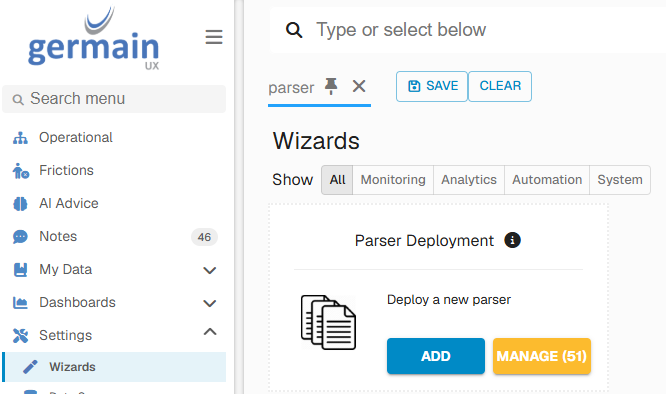
Configure:
|
Field |
Value |
|---|---|
|
Monitoring node |
Select the applicable monitoring node |
|
Engine |
Select the Engine monitoring the Siebel server |
|
Component type |
|
|
Monitored application |
|
|
Monitored application component |
Leave empty unless a specific component must be assigned |
|
Number of instances |
|
Review the configuration and select Submit.
The parser extracts the stack trace and other diagnostic information from the Siebel core dump.
Configure the FDR parser
Go to:
Workspace > Settings > Wizards > Parser
Select the parser matching the monitored Siebel version:
|
Siebel version |
Parser |
|---|---|
|
Siebel 7.x |
|
|
Siebel 8.x or later supported versions |
|
Configure:
|
Field |
Value |
|---|---|
|
Monitoring node |
Select the applicable monitoring node |
|
Engine |
Select the Engine monitoring the Siebel server |
|
Component type |
The applicable FDR parser |
|
Monitored application |
|
|
Monitored application component |
Leave empty unless required |
|
Number of instances |
|
Review the configuration and select Submit.

Configure the crash directory monitor
Go to:
Workspace > Settings > Wizards > Directory Monitor
Configure:
|
Field |
Recommended value |
|---|---|
|
Directory component type |
|
|
Name |
|
|
Monitored server |
The applicable Siebel server |
|
Path to monitor |
Directory containing Siebel core dump files |
|
Watch subdirectories |
|
|
Process existing files |
|
|
Process empty files |
|
|
Force polling |
|
|
Polling interval |
|
Although some older interfaces label the polling interval in seconds, the documented value 300000 is in milliseconds.
The Engine service account must have read access to the configured directory.
Configure FDR-file collection
Create a directory monitor for the location where Siebel writes FDR files.
Associate the monitor with the parser matching the Siebel version:
-
Siebel 7.x FDR Parser -
Siebel 8.x FDR Parser
Confirm that:
-
The path points to the active FDR directory.
-
The Engine can read the files.
-
File patterns match the generated FDR files.
-
File rotation does not prevent collection.
-
FDR and core files from the same crash retain compatible timestamps and context.
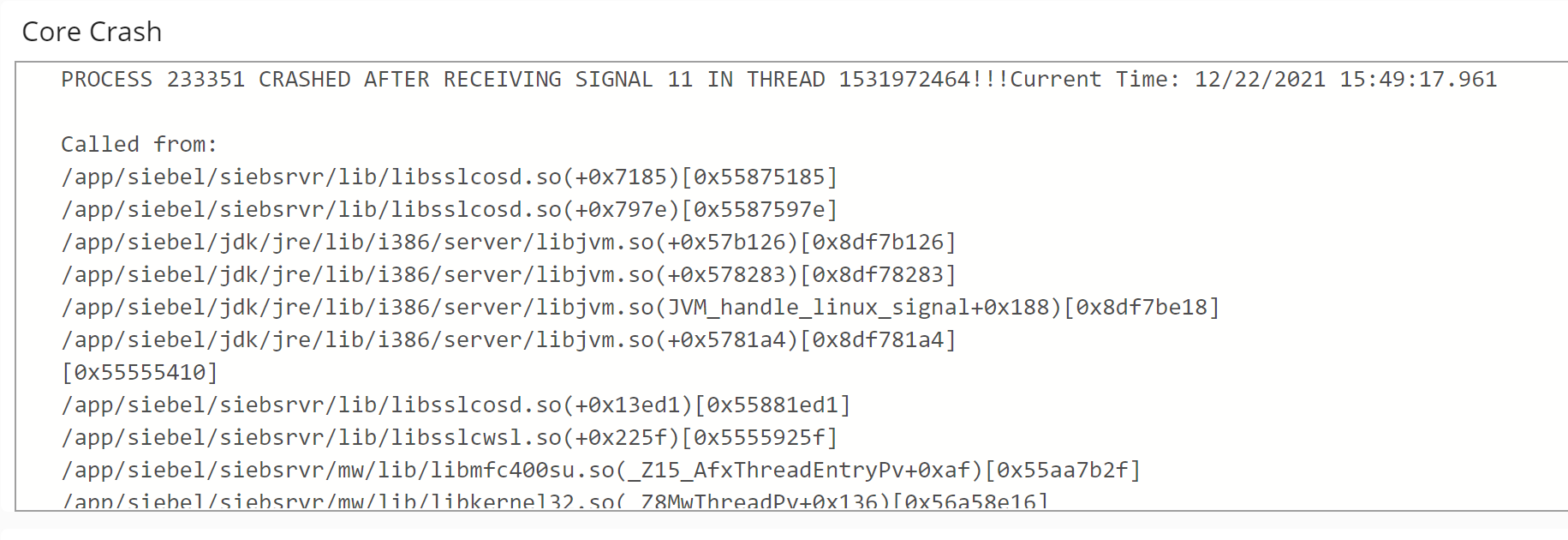
Siebel Core File detected and analyzed by Germain UX
Configure Object Manager log monitoring
Object Manager logs provide the error and activity context required to correlate the crash.
Configure a Siebel Log Directory Monitor for the applicable Object Manager log directories and associate it with the Siebel Object Manager parser.
Verify that:
-
The correct directories are monitored.
-
The parser matches the operating system and log language.
-
Component aliases are extracted correctly.
-
Process and task identifiers are available.
-
Error codes populate the expected KPIs.
-
Log timestamps align with FDR and core dump timestamps.
Crash correlation
GermainUX is preconfigured to correlate the following evidence:
-
Siebel Enterprise or component error
-
Object Manager log data
-
FDR file
-
Core dump
-
Server, component, process, and time
-
Related RUM session, when available
Correct correlation depends on:
-
Synchronized clocks
-
Accurate server and component names
-
Matching process identifiers
-
Complete collection of the related files
-
Consistent application and environment assignments
-
Appropriate correlation time windows
If the evidence appears as unrelated records, verify these values before changing the correlation rules.
Configure crash categorization
GermainUX distinguishes new Object Manager crashes from known, recurring crashes.
Go to:
Workspace > Analytics > Categorization
Search for:
Siebel Component Crash
The categorization configuration processes facts from the Siebel Component Crash KPI. Other KPI facts are ignored.
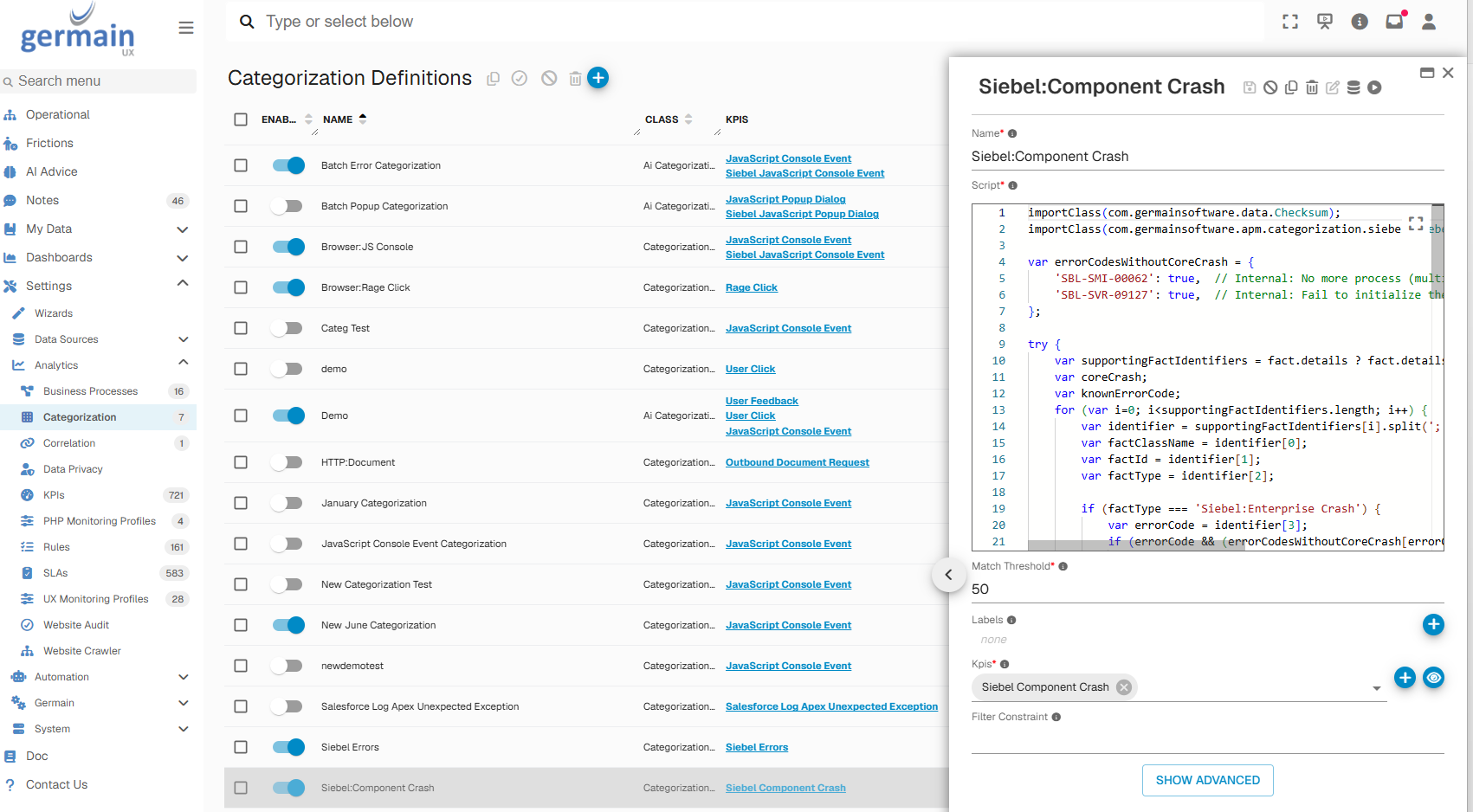
Categorization logic
The standard categorization uses two values:
|
Value |
Purpose |
|---|---|
|
Exact match |
Must be identical for two crashes to be considered part of the same category |
|
Fuzzy match |
Must fall within the configured string-distance threshold |
The categorization logic evaluates the available crash evidence as follows:
-
If the crash is associated with an error known not to generate a core dump, categorize it by error code.
-
If a core dump is available, parse its stack trace.
-
Remove recursive and non-distinctive stack frames.
-
Retain relevant Siebel stack frames.
-
Build the exact-match value from the first five distinctive function calls.
-
Build the fuzzy-match value from the first ten function calls and their locations.
-
Compare the result with existing categories.
-
Classify the crash as known or new.
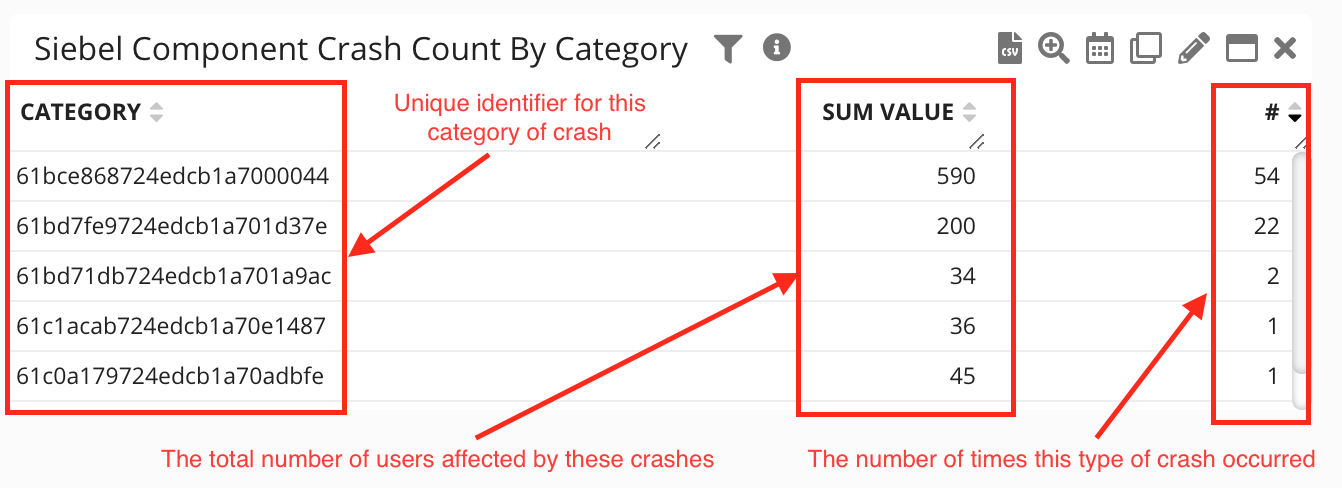
Siebel Object Manager Crash Analyzed by Germain UX 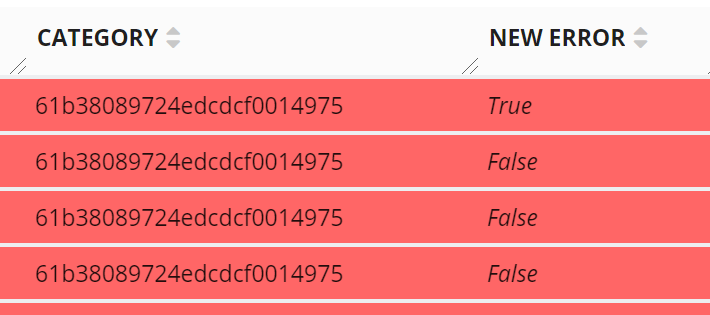
new vs known om crash - Germain UX 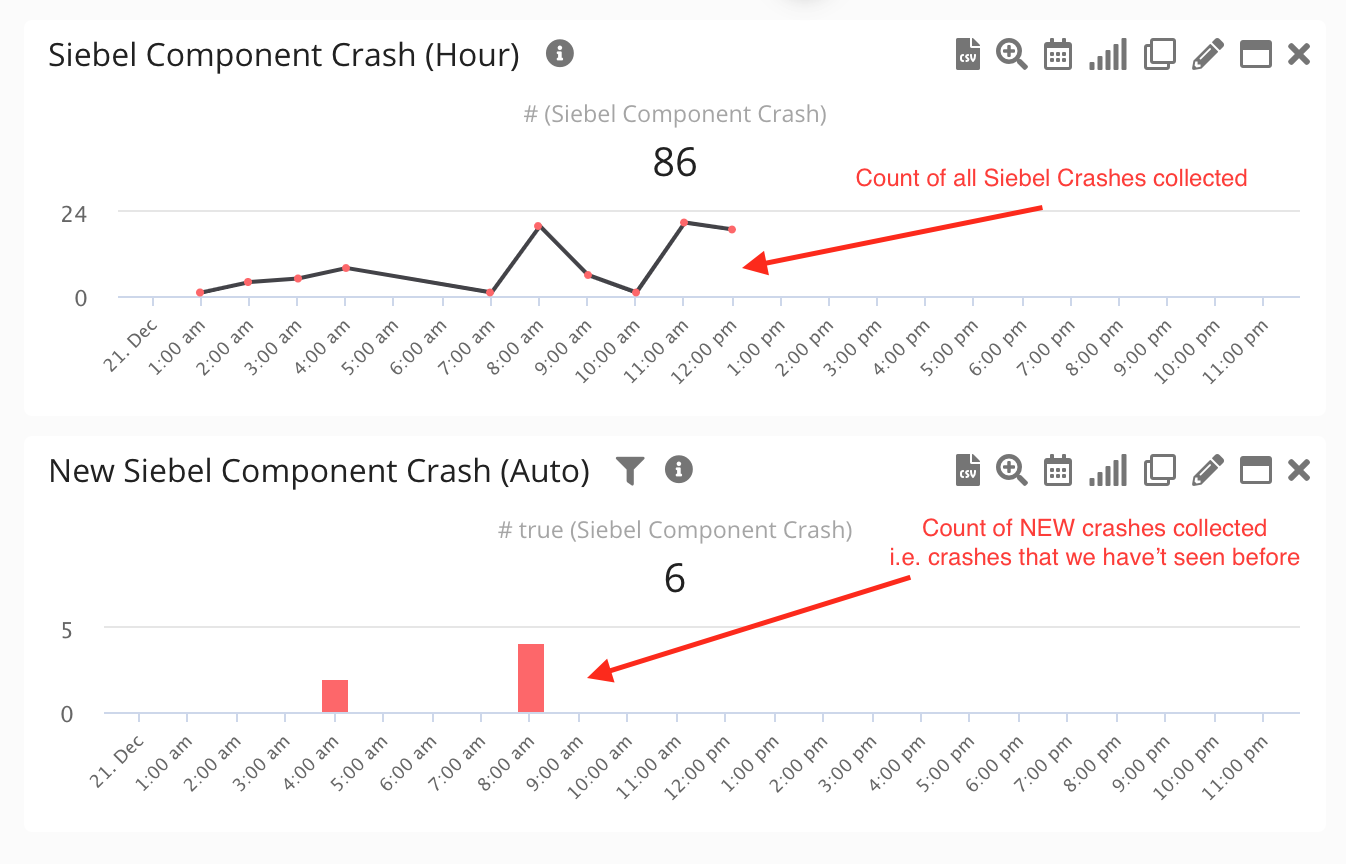
Siebel Object Manager Crash Trend Reported by Germain UX
Errors that may not generate a core dump
The standard configuration recognizes these error codes:
|
Error code |
Meaning |
|---|---|
|
|
No more multithreaded-server process slots are available |
|
|
Failed to initialize the shared-memory resource for the process |
|
|
Generic Siebel errors handled through error-code categorization |

Review this list against the behavior of the monitored Siebel version. Add organization-specific cases only after confirming that they reliably identify equivalent crashes.
Uninformative stack frames
The standard categorization removes recursion and generic frames that do not help distinguish one root cause from another.
When customizing the ignored-frame list:
-
Exclude only functions confirmed to be non-distinctive.
-
Do not remove application-specific frames that identify the root cause.
-
Test the change against known crash examples.
-
Confirm that unrelated crashes are not grouped together.
Match threshold
A permissive fuzzy-match threshold can combine unrelated crashes. A restrictive threshold can create multiple categories for the same underlying problem.
Validate the threshold using:
-
Repeated instances of a known crash
-
Crashes with minor location differences
-
Crashes caused by different code paths
-
Crashes from different Siebel components
-
Crashes before and after a Siebel patch
Back up the categorization configuration before modifying its script or matching threshold.
Validate crash detection
If possible, use existing diagnostic files or a controlled non-production test. Do not intentionally crash a production Object Manager solely to validate monitoring.
Confirm that:
-
The directory monitor detects the file.
-
The correct parser processes it.
-
A crash fact appears in GermainUX.
-
The application, environment, server, and component are correct.
-
The error, FDR, and core dump are correlated.
-
The stack trace is available.
-
The crash is assigned to the expected category.
-
A recurring crash appears as known.
-
A different crash appears as new.
-
The expected alert is generated.
-
The related user session is available when RUM correlation is enabled.
Configure KPIs and alerts
Use the Siebel crash and error KPIs to track:
-
Number of crashes
-
Affected servers and components
-
New versus known crashes
-
Crash recurrence
-
Related error codes
-
Affected users and sessions
-
Crash trends
-
Availability impact
See KPIs for Oracle Siebel CRM.
Recommended alerting logic includes:
|
Condition |
Recommended treatment |
|---|---|
|
New crash category |
High-priority notification with diagnostic evidence |
|
Known crash recurrence |
Alert based on volume, frequency, or operational impact |
|
Crash burst |
Alert when multiple crashes occur within a short period |
|
Critical component crash |
Immediate alert |
|
User-impacting crash |
Include affected users, sessions, and workflow context |
|
Missing diagnostic files |
Notify when a crash is detected but expected evidence is absent |
Avoid generating an identical high-priority incident for every occurrence of a known crash. Use categorization and recurrence thresholds to reduce alert noise.
Dashboards
Go to:
Workspace > Dashboards > All
Search for Siebel dashboards such as:
-
Siebel User Experience
-
Siebel Availability
Also search for portlets containing Crash.
Useful crash visualizations include:
-
Crashes over time
-
New versus known crashes
-
Crashes by Object Manager
-
Crashes by server
-
Crashes by category
-
Recurring error codes
-
Users and sessions affected
-
Related availability events
Troubleshooting
No crash is detected
Verify:
-
The Engine is online.
-
The directory monitor is enabled.
-
The path points to the active crash directory.
-
The Engine service account can read the file.
-
The file pattern matches the core dump.
-
Existing-file processing is configured as intended.
-
The polling interval has elapsed.
-
The correct crash parser is enabled.
The core file is detected but not parsed
Check:
-
Siebel version
-
Operating system
-
Parser component type
-
File format
-
File completeness
-
Parser errors in the Engine log
-
Whether the file was still being written when collected
The FDR file is missing
Confirm:
-
FDR is enabled in Siebel.
-
The correct FDR directory is monitored.
-
The parser matches the Siebel version.
-
File permissions permit access.
-
Retention or cleanup did not remove the file before collection.
Related crash evidence is not correlated
Compare:
-
Timestamps and time zones
-
Server names
-
Component aliases
-
Process and task IDs
-
Application and environment
-
Correlation time window
-
Log, FDR, and core-file availability
Unrelated crashes are grouped together
Review:
-
Exact-match generation
-
Fuzzy-match threshold
-
Ignored stack frames
-
Number of stack frames included
-
Generic error-code handling
The same crash creates several categories
Check for:
-
Build or library-path differences
-
Changing memory locations
-
Recursive stack frames
-
Insufficient normalization
-
An overly restrictive fuzzy-match threshold
-
Missing core dumps causing fallback to a different categorization method
Related documentation
ℹ️ Get Help
The Germain Team can help you set this up. Contact GermainUX Support.
Component: Engine, JS Profiler, Mobile App, RPA Bot Recorder, RUM JS
Feature Availability: 2014.1 or later