
⚙️ GermainUX Engine Configuration
The GermainUX Engine Manager controls all Engine instances deployed on the same host. Administrators can manage the Engine Manager at the operating-system level and control individual Engines centrally through the GermainUX Workspace.
This page explains the day-to-day management of the Engine Manager and its Engines. Memory and proxy settings are covered in their dedicated guides.
🏗️ Engine Manager and Engine
|
Component |
Responsibility |
|---|---|
|
Engine Manager |
Connects the host to Germain Enterprise and starts, stops, or restarts its Engine instances |
|
Engine |
Runs the monitoring and automation components assigned to it |
A host normally runs one Engine Manager and one or more Engines. Stopping the Engine Manager also affects its managed Engines.
💻 Manage the Engine Manager on Windows
On Windows, the Engine Manager runs as a system service.
🔧 To manage it:
-
Open the Windows Services console:
services.msc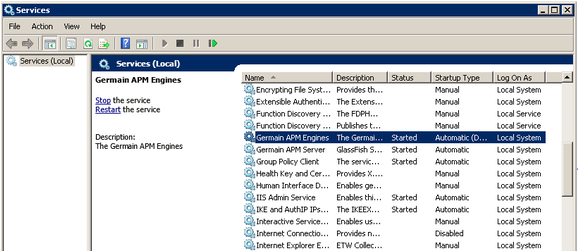
-
Find the GermainUX Engine Manager service.
-
Use the available controls to start, stop, or restart it.
-
Confirm that its status changes to Running after startup.
You can also manage it from an administrative Command Prompt:
sc query "<engine-manager-service-name>"
sc start "<engine-manager-service-name>"
sc stop "<engine-manager-service-name>"
The exact service name depends on the Engine distribution and installation method.
🐧 Manage the Engine Manager on Linux
▶️ Start the Engine Manager manually
From ENGINE_HOME, run:
nohup bin/startEngineManager.sh &
This is suitable for initial validation or troubleshooting. For production, run the Engine Manager through systemd or another operating-system service manager.
🔍 Find the Engine Manager process
ps -ef | grep apm-engine-manager.jar
Identify the Java process running:
apm-engine-manager.jar
🛑 Stop the Engine Manager
Send a standard termination signal to the identified process:
kill <process-id>
Wait for the Engine Manager and its managed Engines to stop:
ps -ef | grep apm-engine
Do not use
kill -9for a routine shutdown. A forced termination prevents the Engine Manager from stopping its managed Engines cleanly and may leave separate Engine processes running.
For production, prefer:
sudo systemctl start germain-engine-manager
sudo systemctl stop germain-engine-manager
sudo systemctl restart germain-engine-manager
sudo systemctl status germain-engine-manager
Use the actual service name configured on the host.
📃 Review the Engine Manager log
The primary Engine Manager log is:
ENGINE_HOME/logs/EngineManager.log
Some older distributions may use:
ENGINE_HOME/log/EngineManager.log
Use this log to verify:
|
Item |
|---|
|
Connection to Germain Enterprise |
|
Node registration |
|
Authorization status |
|
Configuration retrieval |
|
Engine startup and shutdown |
|
Heartbeats |
|
Proxy or network errors |
|
Java and memory errors |
|
Component startup failures |
|
Local state-store errors |
A successful startup includes a message similar to:
Started EngineManagerApplication in <duration> seconds
🔓 Authorize an Engine Manager
A newly installed Engine Manager may appear in GermainUX but remain unable to retrieve its configuration until authorized.
In the GermainUX Workspace:
-
Open Germain > State.
-
Select Nodes.
-
Find the Engine Manager.
-
Select the lock in the Sessions column.
-
Confirm the authorization.
After authorization, review EngineManager.log and confirm that the Manager retrieves its configuration and starts its Engines.
⚙️ Manage individual Engines
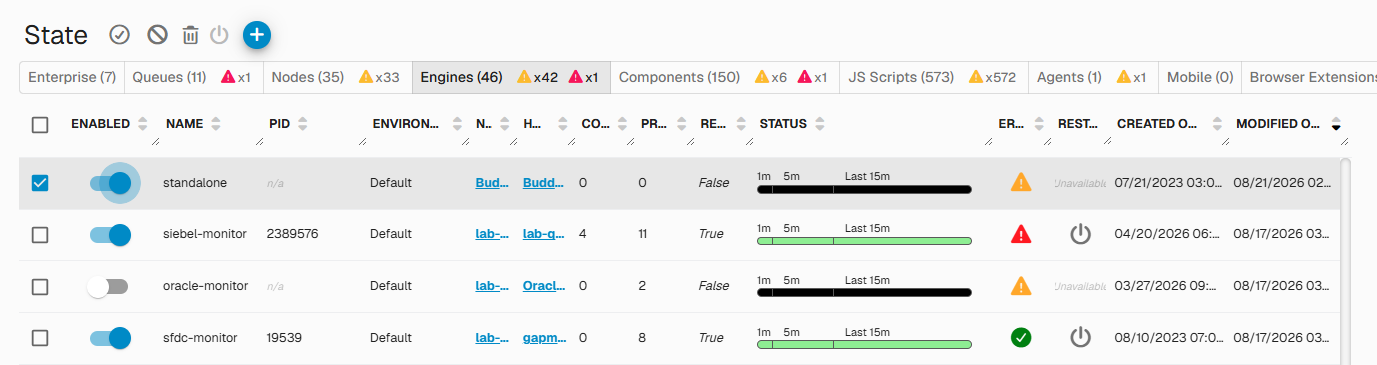
Individual Engines can be enabled or disabled without disabling every Engine managed by the same Engine Manager.
In the GermainUX Workspace:
-
Sign in as an administrator.
-
Open Germain > State.
-
Select the Engines view.
-
Search for the Engine by name or browse the list.
-
Select the Engine.
-
Change its status to enabled or disabled.
-
Confirm the requested state is reflected in the Workspace and logs.
⛔ Disable an Engine when
|
Reason |
|---|
|
Performing maintenance on its host |
|
Investigating repeated component failures |
|
Moving components to another Engine |
|
Preventing monitoring during an approved change |
|
Retiring the Engine |
✅ Enable an Engine when
|
Reason |
|---|
|
Initial configuration is complete |
|
Maintenance has ended |
|
Required dependencies are available |
|
Its assigned components are ready to run |
Disabling an Engine does not necessarily stop the Engine Manager or other Engines on the same host.
🔁 Restart an individual Engine
Restart an Engine after changing settings that are applied only at startup, including:
|
Setting |
|---|
|
JVM memory |
|
JVM system properties |
|
Proxy settings |
|
Engine-specific runtime options |
|
Certain component configurations |
From Germain > State:
-
Select the Engine.
-
Save the updated configuration.
-
Select Restart this Engine.
-
Monitor its status.
-
Review the Engine logs.
-
Confirm that its monitoring components resume execution.
Avoid restarting multiple production Engines simultaneously unless the resulting interruption has been reviewed and approved.
💾 Configure Engine memory
Engine heap settings can be updated from Germain > State. After modifying the JVM options, save the configuration and restart the affected Engine.
Use the dedicated Engine Memory Configuration guide for the complete procedure, default JVM parameters, and validation steps.
Increase memory only when the Engine host has sufficient free capacity. If the host is constrained, move components or Engines to another host instead.
🌐 Configure proxy access
Proxy settings may need to be configured separately for:
|
Component |
|---|
|
The Engine Manager |
|
Individual Engines |
You can also configure the node to relay the Engine Manager’s proxy settings to its Engines.
Use Engine Proxy Configuration for the required JVM properties and configuration procedure.
✅ Validate the configuration
After changing the Engine configuration, confirm that:
|
Check |
|---|
|
The Engine Manager is running. |
|
Its node is authorized. |
|
The heartbeat appears in Germain > State. |
|
All expected Engines are listed. |
|
Required Engines are enabled. |
|
Engine restarts complete successfully. |
|
The effective JVM command line contains the expected settings. |
|
Proxy connectivity works when required. |
|
Monitoring components resume execution. |
|
New telemetry appears in GermainUX. |
|
No repeated errors appear in |
|
CPU, memory, and disk utilization remain acceptable. |
 Troubleshooting
⛔ Engine Manager does not start
Check:
|
Area |
|---|
|
Java version and |
|
Germain Enterprise connectivity |
|
Service-account permissions |
|
JVM memory settings |
|
Proxy configuration |
|
Port and firewall access |
|
|
❗ Engine appears but does not load
Confirm that:
|
Check |
|---|
|
The node was authorized. |
|
The Engine is enabled. |
|
Germain Enterprise is reachable. |
|
The configuration account is valid. |
|
The Manager can retrieve the node configuration. |
|
The configured messaging transport is available. |
🔧 Configuration changes are not applied
Verify that:
|
Check |
|---|
|
You updated the intended Engine. |
|
The configuration was saved successfully. |
|
The Engine was restarted when required. |
|
No invalid JVM option prevents startup. |
|
The effective command line contains the new setting. |
|
No node- or host-level configuration overrides it. |
🔁 Engine repeatedly restarts
Review the logs for:
|
Possible cause |
|---|
|
Out-of-memory errors |
|
Invalid JVM options |
|
Component initialization failures |
|
Local state-store problems |
|
Missing drivers |
|
Permission failures |
|
Unavailable dependencies |
Do not repeatedly restart the Engine without identifying the first relevant error.
🔗 Related guides
|
Guide |
Purpose |
|---|---|
|
adjust JVM memory and restart the Engine |
|
|
configure proxy access for the Engine Manager and Engines |
|
|
resolve startup, state-store, and capacity issues |
Component: Engine
Feature Availability: 8.6.0 or later