
GermainUX monitors business processes in real time to measure how long users spend completing specific tasks and workflows.
⏳ Work Time Insights
🔍 Overview
GermainUX Work Time Insights measures how long users spend completing business tasks and workflows and identifies where time is being lost.
By analyzing actual user activity across monitored business processes, GermainUX helps organizations understand:
|
Insight |
|
|---|---|
|
1 |
How long work takes |
|
2 |
Where users spend the most time |
|
3 |
Where delays and bottlenecks occur |
|
4 |
Which steps require repeated or unnecessary actions |
|
5 |
Which workflows take longer than expected |
|
6 |
Where user productivity is being lost |
|
7 |
Which workflows are abandoned or not completed |
|
8 |
How work time differs across users, teams, roles, departments, applications, and other populations |
These insights help organizations identify opportunities to improve productivity, streamline workflows, and increase application adoption.
📋 What GermainUX Measures
Once a business process is configured, GermainUX automatically tracks its execution and measures the time associated with the workflow and its individual steps.
⏱️ Workflow Duration
Measure the total time required to complete a business process.
This helps identify workflows that consistently take longer than expected and compare actual completion times across different populations.
⚙️ Time by Process Step
Measure how much time users spend at each step of a workflow.
This helps identify the specific steps responsible for the greatest amount of work time.
 Delays & Bottlenecks
Identify steps where users wait, pause, or spend significantly more time than expected.
Bottlenecks can then be investigated using the available user, application, workflow, and technology context.
🔁 Repeated or Unnecessary Actions
Identify workflows where users repeatedly perform the same actions or move back and forth between process steps.
These patterns can indicate:
|
Indicator |
|---|
|
Workflow complexity |
|
Poor application usability |
|
Missing information |
|
Training opportunities |
|
Application or process inefficiencies |
❗ Process Overruns
Identify workflows or individual steps that exceed expected completion times.
This helps teams focus on processes where actual work time differs significantly from the expected or targeted duration.
📈 Lost Productivity
Measure the work time associated with inefficient processes, delays, repeated actions, errors, and other available sources of friction.
This provides a way to move beyond individual UX issues and understand their potential productivity impact at scale.
✋ Workflow Abandonment
Identify workflows that users start but do not complete as expected.
Abandoned workflows can then be investigated to determine where users stopped and what happened before the drop-off.
🗺️ Analyze Work Time at Scale
Work Time Insights can be analyzed across the entire monitored population or segmented using available dimensions such as:
|
Dimension |
|---|
|
Business process |
|
Process step |
|
Application |
|
User |
|
Team |
|
Role |
|
Department |
|
Location |
|
Other available business or user dimensions |
For example:
Business Process
Create Service Request
↓
Average Work Time
8 minutes
↓
Slowest Step
Customer Search — 3.2 minutes
↓
Affected Population
Customer Service Agents
↓
Investigation
Review user activity, errors, performance, and Session Replay
This helps teams move from:
How long does the work take? → Where is time being spent? → Who is affected? → Why is it taking longer? → What should we improve?
👥 Compare Users & Populations
Work Time Insights can reveal significant differences in how users perform the same workflow.
For example, GermainUX can help identify whether a process takes longer for:
|
Example |
|---|
|
Particular teams |
|
Specific roles |
|
New versus experienced users |
|
Particular applications or application versions |
|
Specific locations |
|
Other available populations |
These differences can help uncover opportunities related to application usability, workflow design, training, configuration, or technology performance.
A difference between populations indicates an area worth investigating; it does not by itself establish the cause.
🔬 Investigate Why Work Takes Longer
Work Time Insights can be combined with other GermainUX analytics to investigate why a workflow or step is taking longer than expected.
Depending on the monitored application and available data, this can include:
|
Analysis Type |
|---|
|
User behavior |
|
Errors |
|
Application performance |
|
Network activity |
|
Repeated actions |
|
Dead, Error, and Rage Clicks |
|
Drop-offs |
|
Business-process events |
|
Session Replay |
|
Other available KPIs and monitored context |
This connects business-process performance with the actual user and technology experience.
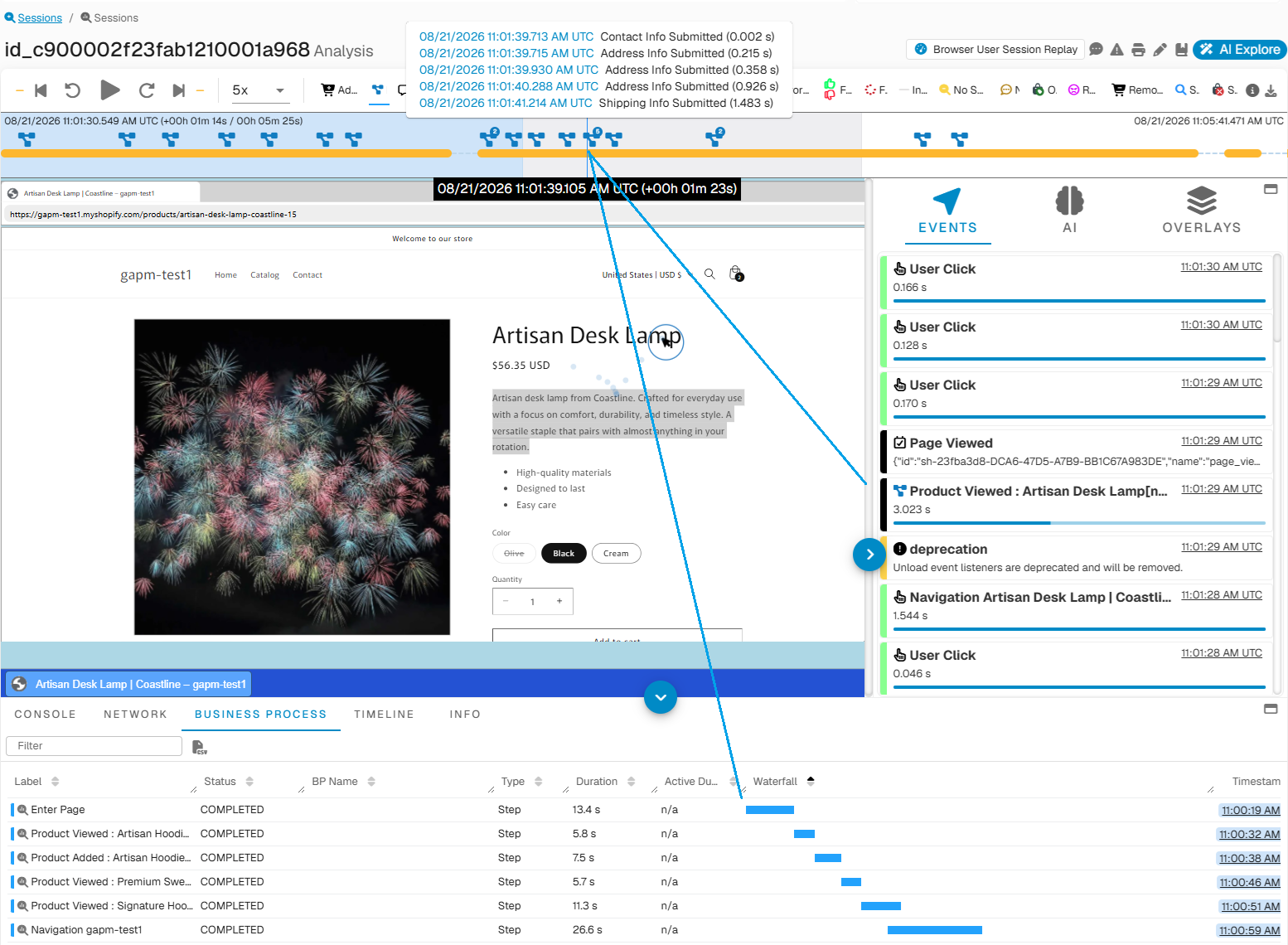
📡 Monitor Business Processes
GermainUX monitors configured workflows from beginning to end.
For each business process, GermainUX can identify its:
Start → Steps → Progression → Completion or Drop-Off
The resulting data can then be analyzed across individual workflow executions or at population scale.
See Business Process & Workflow Mining for additional information about monitoring and analyzing business processes.
🔧 Configure a Business Process
To generate Work Time Insights, define the business process and the criteria GermainUX should use to identify:
|
Configuration Item |
|---|
|
Process start |
|
Process steps |
|
Process progression |
|
Process completion |
|
Potential drop-off |
Once configured, GermainUX can automatically identify and analyze subsequent executions of the workflow.
See Configure a Business Process for detailed configuration instructions.
👥 Use Work Time Insights with Adoption Insights
Work Time Insights focuses on how efficiently users complete work.
Adoption Insights can provide complementary information about how applications, features, and workflows are being used.
Together, they can help answer:
Are users adopting the application?
and
Are they able to complete their work efficiently once they use it?
This is particularly useful for CRM, ERP, and other enterprise applications where adoption alone does not necessarily mean that users are productive.
📦 Additional Resources
-
Business Process & Workflow Mining
-
Session Replay Player
-
AI Insights & Recommendations
-
Adoption Insights
-
Conversion Insights
-
More Analytics Features
-
More Automation Features
-
Management Features.
ℹ️Get Help
The Germain Team can help you set this up. Contact GermainUX Support.
Component: RUM JS, RUM Ext, RUM Windows
Feature Availability: 2017.1 or later