
⚙️ Manage KPIs in GermainUX
GermainUX provides preconfigured Key Performance Indicators (KPIs) for analyzing user experience, business processes, marketing outcomes and technology health. You can also create and manage custom KPIs that reflect your own applications, data and business objectives.
✨ Create a KPI
A KPI can be created in two primary ways:
|
Method |
Best used for |
Navigation |
|---|---|---|
|
KPI Wizard |
Creating or configuring a KPI through a guided interface. |
Germain Workspace → Wizards → KPI |
|
Rule |
Generating KPI facts or events through custom conditions, transformations or business logic. |
Germain Workspace → Analytics → Rules |
🪄 Create a KPI with the KPI Wizard
Use the KPI Wizard when you want a guided workflow for defining a KPI and its analytical behavior.
👉 Go to:
Germain Workspace → Wizards → KPI
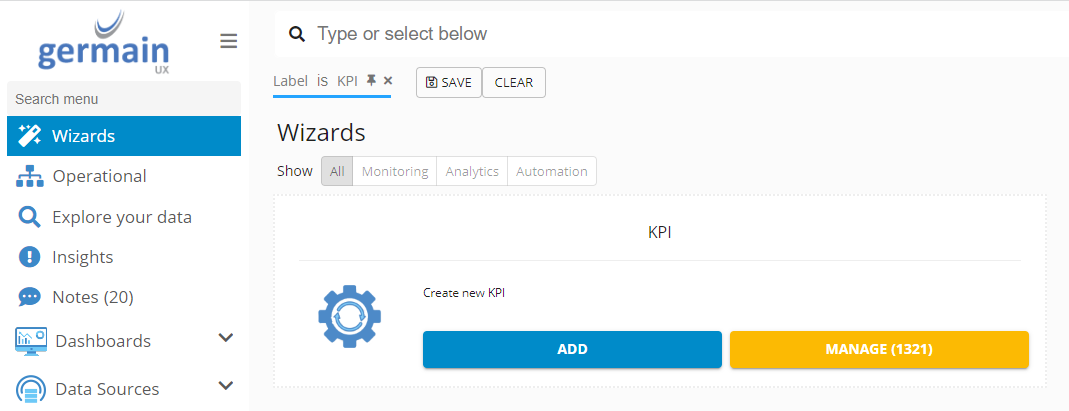
Depending on the KPI type and configuration, you can define elements such as:
|
Element |
|---|
|
KPI name and description |
|
Data or fact model |
|
Default measure |
|
Available pivots |
|
Filters and constraints |
|
Display and formatting options |
|
SLA thresholds |
|
Drilldown and analysis behavior |
⚙️ Generate KPI Data with a Rule
Use a Rule when custom logic is required to detect, transform or generate the facts analyzed by a KPI.
👉 Go to:
Germain Workspace → Analytics → Rules
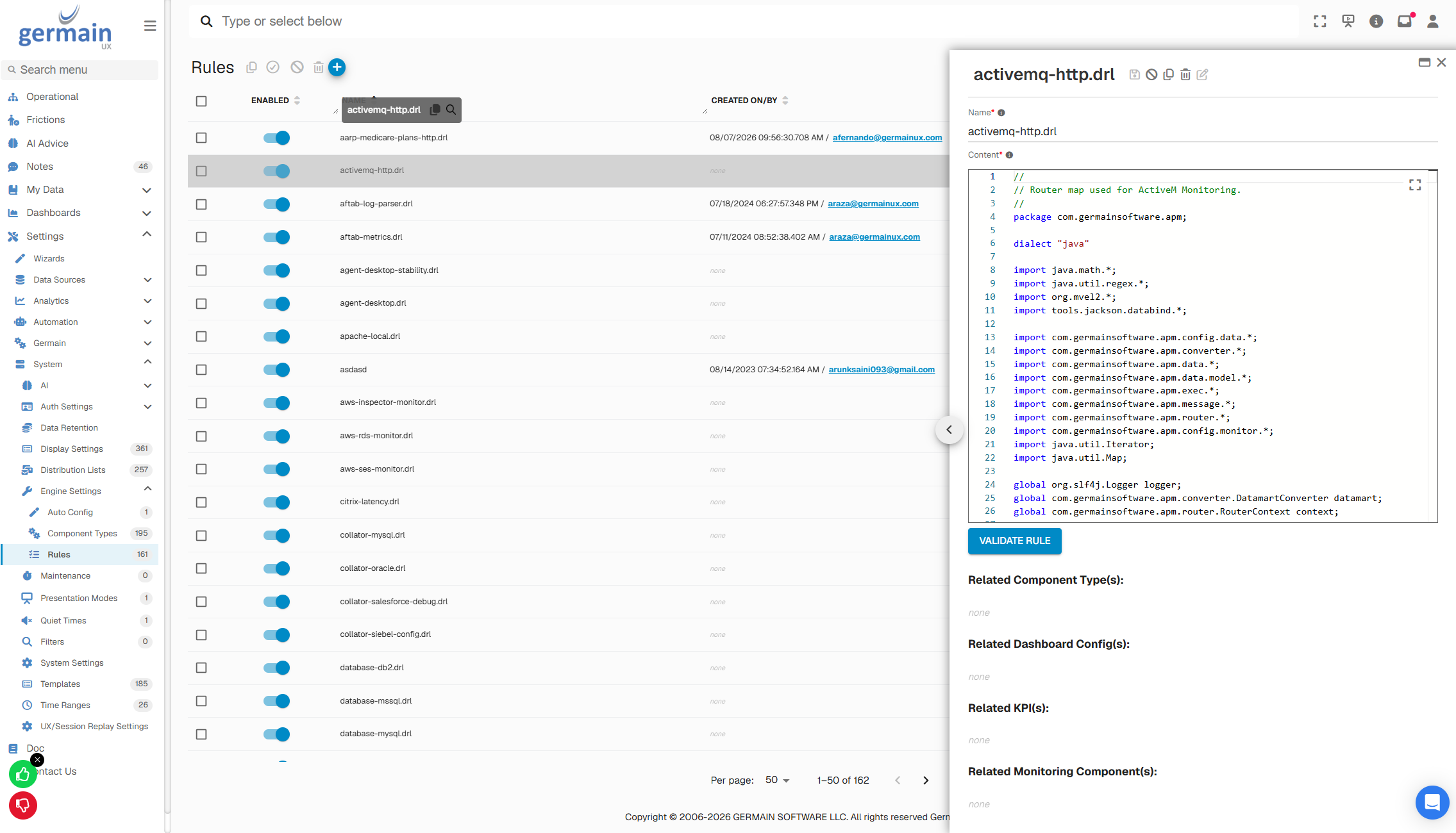
Rules can be used to:
|
Use |
|---|
|
Detect a specific event or condition |
|
Transform collected data |
|
Create a custom fact, event, metric or transaction |
|
Apply business-specific categorization |
|
Enrich data with additional context |
|
Trigger alerts or automated actions |
See Rules for configuration details.
👀 View and Manage KPIs
To view the configured KPI catalog, go to:
Germain Workspace → Analytics → KPI
From the KPI configuration area, authorized users can review and manage available KPI definitions, including their measures, pivots, constraints, display behavior and related analytical settings.
✅ Validate a New KPI
After creating or modifying a KPI:
-
Confirm that the expected facts or events are being collected.
-
Add the KPI to a test dashboard or portlet.
-
Verify that its default measure returns the expected value.
-
Test the available pivots and filters.
-
Confirm that drilldowns expose the relevant instances and context.
-
Validate SLA thresholds, alerts or automations if configured.
-
Compare the result with a known sample before using it for operational decisions.
🧭 Choosing the Right Method
Use the KPI Wizard when the required data already exists and the primary task is configuring how it should be measured and analyzed.
Use a Rule when custom logic is needed to create, transform, enrich or classify the underlying data before the KPI can analyze it.
In some implementations, both are required: a Rule produces the custom data, and the KPI defines how that data is measured, segmented and displayed.
📦 Additional Resources
-
Preconfigured KPIs
-
AI Insights & Recommendations
-
More Analytics Features
-
More Automation Features
ℹ️ Get Help
The Germain Team can help you set this up. Contact GermainUX Support.
Service: Analytics
Feature Availability: 2014.1 or later