
📡 GermainUX RUM Extension
GermainUX RUM Extension provides Real User Monitoring for browser-based applications where GermainUX RUM JS cannot be deployed directly.
It captures user interactions, application performance, errors, workflow activity, and Session Replay from supported browsers.
🔎 Overview
Use RUM Extension when your organization does not control the application source code or when browser or application restrictions prevent direct JavaScript deployment.
The extension retrieves monitoring configuration centrally from GermainUX Enterprise.
❓ When to Use RUM Extension
Use RUM Extension for:
|
Use Case |
|---|
|
SaaS applications |
|
Third-party web applications |
|
Applications whose source code you do not control |
|
Applications that prohibit custom JavaScript injection |
|
Centrally managed browser environments |
|
Supported cross-origin application contexts |
The extension provides the telemetry required to identify, reproduce, and analyze the UX, process, and technical issues affecting real users.
For details about the resulting analytics, see User Session Monitoring, Replay, and Heatmaps.
❓ RUM Extension or RUM JavaScript?
Choose the deployment method based on your control over the monitored application.
|
Method |
Recommended when |
|---|---|
|
RUM JS |
You control the application and can add the GermainUX monitoring script to its pages. |
|
RUM Extension |
You cannot modify the application, JavaScript injection is restricted, or monitoring must run within the browser’s page context. |
Both methods send real-user telemetry to GermainUX for analysis. The extension provides access to applications and page contexts that an externally injected script may not be able to monitor.
✨ Capabilities
Depending on the selected UX monitoring profile and privacy configuration, the extension can capture:
|
Capability |
|---|
|
Page views and navigation |
|
User clicks and interactions |
|
Application response times |
|
JavaScript errors |
|
Network and service activity |
|
User-perceived performance |
|
Browser freezes and unresponsive behavior |
|
Workflow and business-process activity |
|
Session-replay data |
|
Data used to generate click, movement, scroll, rage-click, dead-click, and error-click heatmaps |
Captured activity can be correlated with application, service, infrastructure, and business-process telemetry available in GermainUX.
👑 Centralized configuration
The extension retrieves its monitoring configuration from GermainUX Enterprise. Administrators can define which applications are monitored and apply consistent settings across the organization without configuring every browser separately.
Centralized configuration supports:
|
Feature |
|---|
|
Monitored application and URL definitions |
|
UX monitoring profiles |
|
Privacy and data-capture policies |
|
Multiple GermainUX environments |
|
Central activation or deactivation |
|
Locked configurations |
|
Configuration refresh |
🌐 Multiple GermainUX environments
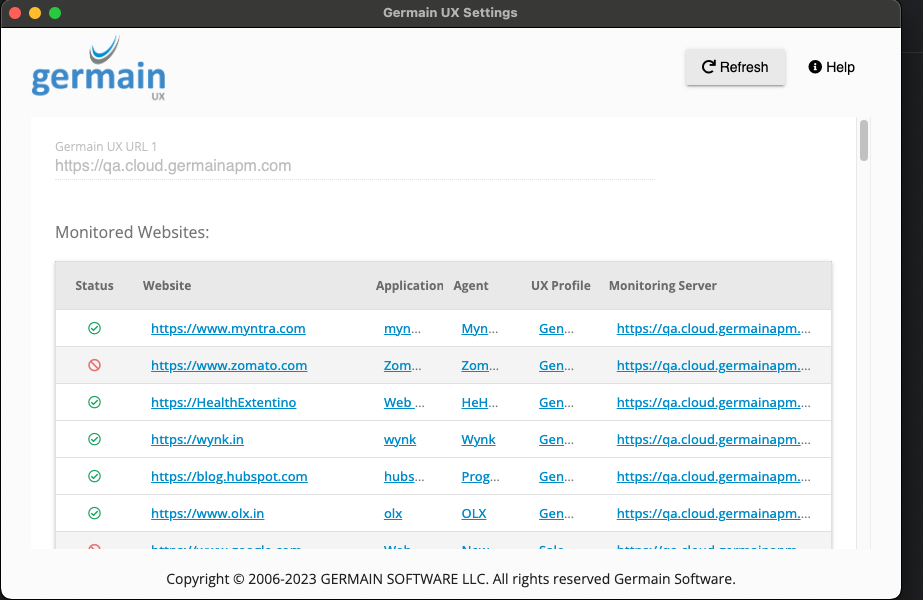
A single extension installation can support multiple GermainUX URLs. This is useful when an organization operates separate QA and production environments for both its monitored applications and GermainUX.
The extension determines the appropriate GermainUX environment from its configuration and sends the captured telemetry to the corresponding destination.
🖼️ Cross-origin frames
The extension can monitor supported content embedded in cross-origin frames. This extends visibility into applications that combine content from different domains.
Confirm that monitoring such content complies with your organization’s security, privacy, and third-party application policies.
🔒 Locked configuration
Administrators can lock the distributed extension configuration so that monitored users cannot change or remove the GermainUX URLs or disable the configured monitoring.
Use managed browser policies when monitoring must remain consistently enabled across the organization.
🔁 Configuration refresh
The extension periodically retrieves its configuration from GermainUX Enterprise. A manual refresh option is also available, allowing administrators and testers to apply updated website definitions without reinstalling the extension or waiting for the next automatic refresh.
🛡️ Privacy and compliance
The extension can be deployed centrally without requiring each user to install it manually. However, users must be informed about monitoring in accordance with your organization’s privacy notices, employment policies, consent requirements, and applicable regulations.
Before deployment:
|
Action |
|---|
|
Identify the data that the extension is permitted to collect. |
|
Disable the collection of unnecessary fields and interactions. |
|
Mask, exclude, or anonymize sensitive information. |
|
Avoid collecting credentials, payment information, health information, or personal data unless expressly required and authorized. |
|
Restrict access to session replays and monitoring data. |
|
Define appropriate retention periods. |
|
Validate the configuration in a non-production environment. |
|
Document the purpose and scope of monitoring. |
GermainUX privacy controls can prevent selected data from being collected or anonymize it before storage. See the GermainUX security and privacy documentation for the available controls and recommended policies.
⬇️ Download the extension
The RUM Extension is available for supported Chromium-based browsers and Firefox.
|
Option |
Link / Details |
|---|---|
|
Download the Chrome extension |
|
|
Download the Firefox add-on |
|
|
Microsoft Edge distribution |
Contact GermainUX Support for Microsoft Edge distribution options. |
|
Internal extension store distribution |
Contact GermainUX Support if you need to distribute the extension through an internal extension store. |
Organizations may self-host the extension when required by their security, governance, or browser-management policies.
🚧 Deployment options
The extension can be installed manually for an individual user or deployed centrally to managed browsers.
👤 Individual installation
For a local Chrome installation:
-
Open the GermainUX RUM Extension in the Chrome Web Store.
-
Select Add to Chrome.
-
Select Add extension to confirm.
-
Verify that the GermainUX extension appears in the browser’s extension list.
-
Refresh any application pages that were already open.
Manual installation is appropriate for evaluations, troubleshooting, and small test groups. Use managed deployment for production rollouts.
🏗️ Enterprise deployment
Use your organization’s browser-management platform to install and configure the extension across managed devices.
Common deployment mechanisms include:
|
Mechanism |
|---|
|
Microsoft Group Policy |
|
Microsoft Intune |
|
Google Admin Console |
|
Enterprise browser-management platforms |
|
An internally managed extension store |
For Chrome environments managed through Windows Group Policy, install Google’s current policy templates and configure the extension as force-installed.
Example Chrome extension-management policy:
{
  "fkcljfeejffnjajnpjflfammljcmdfnh": {
    "installation_mode": "force_installed",
    "update_url": "https://clients2.google.com/service/update2/crx"
  }
}
Enter the policy in the format required by your browser-management platform. Some Group Policy fields require the JSON to be provided on a single line.
Because browser-management procedures and policy formats can change, refer to the current Google Chrome Enterprise documentation when preparing a production deployment.
🔧 Configure monitoring in GermainUX
After installing or deploying the extension, define the application that it should monitor.
-
Sign in to Germain Workspace.
-
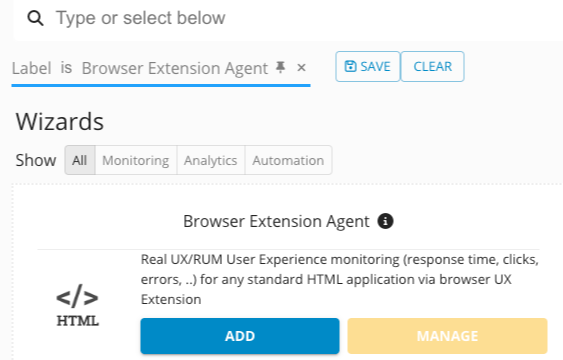
Go to Wizards.
-
Open Browser Extension Agent.
-
Select Add.
-
Select or create the host associated with the monitored application.
-
Select or create the monitored application.
-
Enter a descriptive label for the extension configuration.
-
Select the appropriate UX monitoring profile.
-
Configure the application URL and scheme.
-
Review the configuration and select Finish.
Use a label that clearly identifies the application and environment, such as:
|
Example label |
|---|
|
|
|
|
|
|
The UX monitoring profile determines the data collected, privacy rules, and monitoring behavior. Review it carefully before enabling the configuration for production users.
✅ Verify the configuration
After creating the Browser Extension Agent:
-
Go to Germain > State in Germain Workspace.
-
Open the Browser Extensions view.
-
Search for the label assigned during configuration.
-
Open the corresponding entry.
-
Confirm that the extension is registered and receiving its configuration.
-
Open the monitored application in a browser where the extension is installed.
-
Perform several representative actions.
-
Confirm that the resulting sessions and telemetry appear in GermainUX.
Test the configuration with a small pilot group before deploying it to the entire organization.

📋 Production rollout recommendations
For a controlled enterprise rollout:
-
Configure the monitored application and privacy rules in a test environment.
-
Install the extension for administrators and testers.
-
Confirm that only the intended applications and URLs are monitored.
-
Validate masking, exclusion, and anonymization rules.
-
Confirm that performance, error, interaction, and replay data are received.
-
Deploy to a limited pilot group.
-
Review data quality, browser performance, and user impact.
-
Inform affected users according to company policy.
-
Expand the deployment in stages.
-
Monitor extension status and incoming telemetry after rollout.
🐛 Troubleshooting
⛔ The extension is installed but no data appears
Confirm that:
|
Check |
|---|
|
The monitored application has been configured in GermainUX. |
|
The application URL and scheme match the actual browser URL. |
|
The correct UX monitoring profile is assigned. |
|
The extension can reach GermainUX Enterprise. |
|
Proxy and firewall rules permit the connection. |
|
The browser has refreshed its extension configuration. |
|
Monitoring is enabled for the application. |
|
The extension has permission to access the target site. |
🔄 A new configuration is not applied
Use the extension’s manual refresh option, and then reload the monitored application. For managed browsers, also confirm that the latest organizational policies have been applied.
In Chrome, open chrome://policy, select Reload policies, and verify that the GermainUX extension policy is present.
🔕 Users can disable or modify monitoring
Enable the lock option in the distributed configuration and deploy the extension through a managed browser policy. Verify that the policy is applied at the appropriate computer or user level.
🔍 Only part of the application is monitored
Check for:
|
Possible cause |
|---|
|
Additional application domains |
|
Cross-origin frames |
|
Redirected authentication domains |
|
Dynamically generated URLs |
|
Missing extension permissions |
|
URL definitions that are too restrictive |
Add only the domains required for the intended monitoring scope.
📋 Requirements
A GermainUX Cloud or on-premises environment is required to configure the extension, receive its telemetry, and analyze the resulting data.
|
Property |
Value |
|---|---|
|
Component |
RUM Extension |
|
Feature availability |
GermainUX 8.6.0 or later |
|
Supported deployment |
Manual, managed browser policy, or internal extension store |
|
GermainUX deployment |
Cloud or on-premises |
📞 Support
For assistance installing, configuring, or troubleshooting GermainUX-Agent, contact GermainUX Support.
Component: RUM Extension
Feature Availability: 8.6.0 or later