
📡 Deploy Monitoring for ReactJS
Deploy GermainUX monitoring for ReactJS applications to capture actual-user experience, session replay, ReactJS activity, browser performance, errors, network requests, and application behavior.
🔌 Monitoring Options
GermainUX provides several monitoring options for ReactJS.
|
Monitoring Requirement |
GermainUX Component |
|---|---|
|
Real User Monitoring |
RUM JS, Mobile |
|
Session Replay |
RUM JS, Mobile |
|
ReactJS Experience Monitoring |
RUM JS, Mobile |
|
Browser Performance |
RUM JS, Mobile |
|
Error Monitoring |
RUM JS, Mobile |
|
Network/API Monitoring |
RUM JS, Mobile |
|
Advanced JavaScript Profiling |
JS Profiler |
|
Synthetic User Monitoring |
RPA Bot Recorder |
|
Custom Automation |
Engine |
Start with RUM JS for standard ReactJS monitoring.
Deploy JS Profiler or synthetic monitoring only where the additional capability is required.
🚀 1. Start the ReactJS Wizard
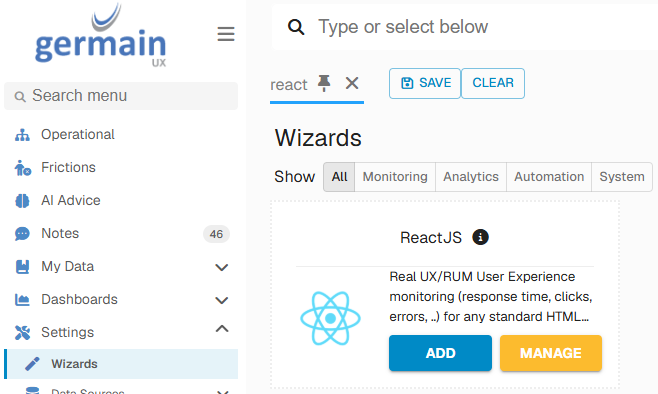
In Germain Workspace, navigate to:
Left Menu → Wizards → ReactJS
The ReactJS Wizard creates the UX Monitoring Profile and provides the appropriate RUM JS installation instructions for the ReactJS application.
🏷️ 2. Configure the Application
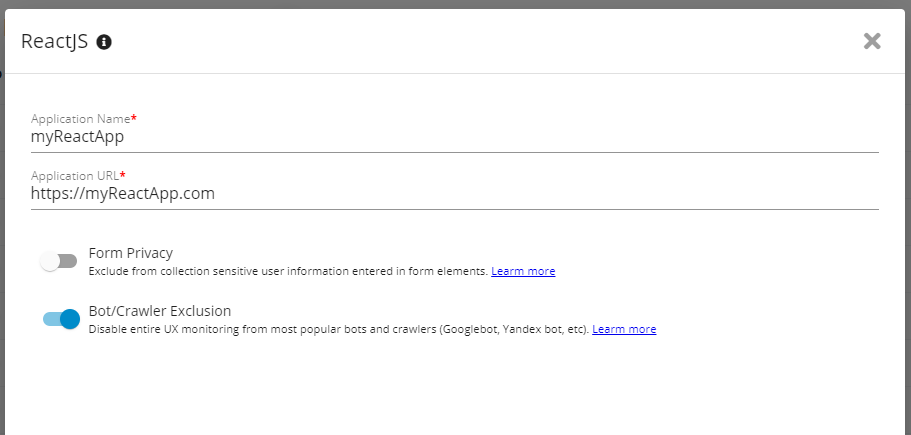
Configure the ReactJS application information.
Enter the application information requested by the Wizard, including:
-
Application name
-
Application URL
-
Environment where applicable
-
Privacy settings
-
Bot/crawler exclusion where appropriate
Use consistent application names across Production, Staging, and other monitored environments.
⚙️ 3. Complete the Wizard
Review the monitoring configuration and complete the Wizard.
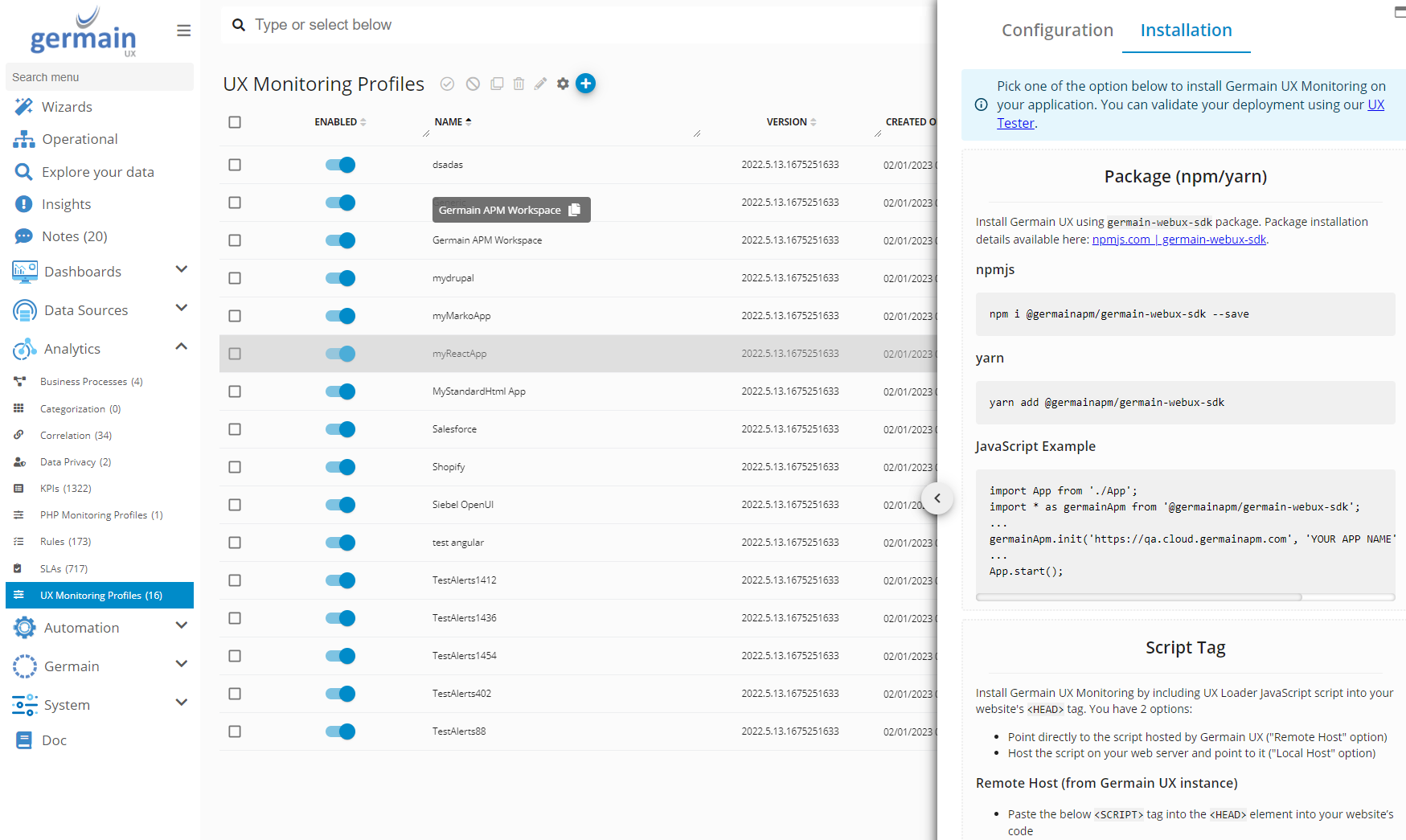
The resulting UX Monitoring Profile contains the configuration used by GermainUX RUM JS for the ReactJS application.
📥 4. Deploy GermainUX RUM JS
Follow the installation instructions generated by the Wizard to deploy GermainUX RUM JS into the ReactJS application.
The RUM JS must load in the user's browser on the pages where monitoring is required.
Once loaded, RUM JS can collect real-user activity and browser telemetry according to the UX Monitoring Profile.
🔄 5. Revisit Installation Instructions
The deployment instructions can be reviewed later from the ReactJS UX Monitoring Profile.
Navigate to:
Germain Workspace → Settings → Analytics → UX Monitoring Profiles
Select the ReactJS profile and open:
Installation
Use these instructions whenever the RUM deployment needs to be reviewed or updated.
✅ 6. Validate Real User Monitoring
Open the ReactJS application and generate representative activity.
For example:
Open Application → Navigate → Interact with React Components → Submit Action → Call API
Verify that GermainUX receives:
-
User session
-
Navigation
-
User actions
-
Browser telemetry
-
ReactJS application activity
-
Network activity
Confirm that data is associated with the correct application and environment.
🎥 7. Validate Session Replay
Verify that monitored sessions can be replayed where Session Replay is enabled.
Check:
-
Navigation
-
User actions
-
Application state
-
Relevant errors
-
Timeline events
Review privacy settings before enabling Session Replay broadly in production.
🚨 8. Validate Error Monitoring
Generate or use an approved test error and verify that GermainUX detects the expected browser/application condition.
Depending on configuration, this can include:
-
JavaScript errors
-
Console errors
-
Resource errors
-
Network failures
-
Application-specific errors
Verify that the error can be associated with the corresponding user session.
🌐 9. Validate Network Monitoring
Exercise functionality that calls backend APIs or external integrations.
Verify visibility into:
-
Requests
-
Response time
-
Latency
-
HTTP status
-
Failed requests
Confirm that network activity is associated with the correct ReactJS session.
🔬 10. Deploy JavaScript Profiling — Optional
For deeper JavaScript execution analysis, enable GermainUX JavaScript Profiling.
Navigate to:
Germain Workspace → Settings → Analytics → UX Monitoring Profiles
Select the ReactJS profile and enable:
JavaScript Profiling Monitoring
Depending on the browser and deployment model, JavaScript profiling can use:
-
JavaScript Self-Profiling API
-
GermainUX JS Profiler extension
-
Appropriate response-header configuration
JavaScript Profiling is optional and should be enabled where deeper code-level troubleshooting is required.
🤖 11. Deploy Synthetic Monitoring — Optional
Use GermainUX RPA Bot Recorder to record important ReactJS user journeys.
Examples include:
-
Login
-
Search
-
Critical navigation
-
Form submission
-
Checkout
-
Business workflow
Configure the resulting scenario to execute according to the required monitoring schedule.
Synthetic monitoring complements RUM by testing critical workflows even when no actual user is executing them.
🔗 12. Deploy Supporting Monitoring — Optional
Where end-to-end correlation is required, deploy GermainUX monitoring for the technologies supporting the ReactJS application.
Examples include:
-
APIs
-
Java
-
Node.js
-
PHP
-
Databases
-
Logs
-
Servers
-
Kubernetes
-
Network
This enables correlation such as:
User → ReactJS → API → Backend → Database
🔐 13. Review Privacy
Before production deployment, review the information captured from the ReactJS application.
Depending on the application, consider:
-
Form fields
-
User input
-
Usernames
-
URLs
-
Query parameters
-
Request/response content
-
DOM content
-
Session Replay
-
Application-specific sensitive information
Configure masking, anonymization, encryption, or exclusions where required.
🧪 14. Validate Production Deployment
After production deployment, verify:
-
RUM JS loads
-
UX Monitoring Profile is active
-
User sessions are collected
-
Session Replay operates as configured
-
ReactJS activity is captured
-
Errors are detected
-
Network requests are captured
-
Application identification is correct
-
Privacy controls operate as expected
-
Monitoring introduces acceptable browser overhead
📊 Next Steps
Once ReactJS monitoring is operational, configure:
-
Session Replay
-
React component analysis
-
Performance monitoring
-
Error monitoring
-
JavaScript Profiling
-
Network/API monitoring
-
Privacy and exclusions
-
KPIs
-
SLAs
-
Categorization
-
Correlation
-
Alerts
-
Automation
-
Dashboards
-
Reports
ℹ️ Get More Information
ReactJS monitoring can be customized according to the application's components, user journeys, errors, performance requirements, privacy requirements, APIs, and integrations.
See Configure Monitoring for ReactJS.
GermainUX can help determine which monitoring, analytics and automation capabilities are appropriate for your POP3 Mailbox environment. Contact GermainUX Support.
Component: Engine, JS Profiler, Mobile App, RPA Bot Recorder, RUM JS
Feature Availability: 2017.1 or later