
❓ Choose a Datastore for GermainUX
💡 Recommendation
Elasticsearch is the recommended datastore for GermainUX, particularly for new deployments and environments that collect large volumes of monitoring, analytics, tracing, or Session Replay data.
Its distributed search and analytics architecture is well suited to:
|
Capability |
|---|
|
High-volume, near-real-time ingestion |
|
Large and evolving telemetry schemas |
|
Fast filtering and aggregation |
|
Full-text search |
|
Time-based data retention |
|
Horizontal scaling |
|
Large dashboards and investigative queries |
GermainUX also supports relational datastores when required by an organization’s existing infrastructure, operational expertise, or database standards.
📦 Supported Datastores
|
Datastore |
Recommended use |
|---|---|
|
Elasticsearch |
Preferred for new deployments, large data volumes, advanced analytics, search-intensive workloads, and horizontal scalability |
|
PostgreSQL |
Suitable when an enterprise-standard relational datastore and SQL administration are preferred |
|
MySQL |
Suitable for smaller or established relational deployments |
|
Oracle Database |
Suitable for organizations standardized on Oracle infrastructure and administration |
|
Microsoft SQL Server |
Suitable for organizations standardized on Microsoft database technologies |
|
Amazon Aurora with MySQL compatibility |
May be considered for AWS-hosted relational deployments after compatibility and performance validation |
Confirm the supported product version with Germain Software before deploying or upgrading.
🎯 Selection Criteria
Choose the datastore based on the complete workload rather than existing database availability alone.
Evaluate:
|
Criterion |
|---|
|
Daily volume of AA Units |
|
Peak ingestion rate |
|
Total retained data |
|
Raw and aggregated data-retention periods |
|
Session Replay volume |
|
Number and complexity of dashboards |
|
Search and analysis workload |
|
Concurrent GermainUX users |
|
High-availability requirements |
|
Backup and disaster-recovery requirements |
|
Expected growth |
|
Internal database expertise |
|
Infrastructure and licensing costs |
|
Security and compliance standards |
✅ When to Choose Elasticsearch
Choose Elasticsearch when:
|
Condition |
|---|
|
You are deploying GermainUX for the first time. |
|
Monitoring volume is expected to be high. |
|
The volume or structure of collected telemetry may grow rapidly. |
|
Users frequently search, filter, segment, and aggregate large datasets. |
|
Near-real-time ingestion and analysis are important. |
|
Horizontal scalability is required. |
|
You need efficient time-based data management. |
|
Session Replay, tracing, or detailed real-user monitoring will produce large datasets. |
Elasticsearch should normally be the starting recommendation unless your environment has a specific requirement for a relational datastore.
🗄️ When to Choose a Relational Datastore
Consider PostgreSQL, MySQL, Oracle, Microsoft SQL Server, or a compatible managed service when:
|
Condition |
|---|
|
Your organization requires an approved relational database. |
|
Your database administrators already operate the selected platform. |
|
Monitoring volume is moderate and predictable. |
|
Existing backup, replication, security, and disaster-recovery processes must be reused. |
|
Licensing or operational standards favor the selected database. |
|
Required GermainUX queries and retention can be supported at the expected scale. |
Using an existing relational platform can reduce operational change, but it does not guarantee that the platform is appropriately sized for GermainUX’s ingestion and analytics workload.
⚖️ Comparison
|
|
Elasticsearch |
Relational datastore |
|---|---|---|
|
Recommended for new GermainUX deployments |
Yes |
When organizational requirements favor SQL |
|
High-volume telemetry ingestion |
Strong |
Depends heavily on schema, indexing, and infrastructure |
|
Search and analytical filtering |
Strong |
Depends on indexes and query design |
|
Horizontal scalability |
Native distributed architecture |
Product- and architecture-dependent |
|
Time-based retention |
Well suited |
Requires database-specific design and maintenance |
|
Flexible telemetry structure |
Strong |
More schema-dependent |
|
Existing enterprise DBA expertise |
May require Elastic expertise |
Often already available |
|
Traditional SQL access |
Limited/different query model |
Native |
|
Licensing and operating costs |
Deployment-dependent |
Product- and license-dependent |
|
Backup and disaster recovery |
Elastic-specific procedures |
Existing enterprise procedures may be reusable |
🔬 Benchmark Scope
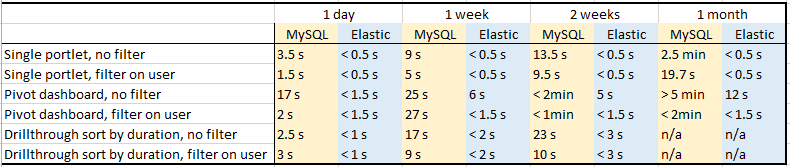
Germain Software performed internal comparative testing using:
|
Tested Product |
|---|
|
Amazon Aurora with MySQL 5.7 compatibility |
|
MySQL 5.7 |
|
Elasticsearch 7.13 |
The test workload included:
|
Workload Characteristic |
|---|
|
Approximately 3 TB of stored data |
|
An ingestion rate of 300–400 million AA Units per day |
The benchmark was intended to compare GermainUX behavior under a high-volume workload across different datastore technologies.
These versions describe the historical benchmark configuration. They are not the current GermainUX compatibility matrix or a recommendation to deploy those exact versions.
📈 Interpreting Benchmark Results
Benchmark results should not be applied directly to another deployment because performance depends on:
|
Factor |
|---|
|
CPU and memory |
|
Disk latency, throughput, and IOPS |
|
Node count and topology |
|
Network performance |
|
Index and schema design |
|
Replication |
|
Data distribution |
|
Retention and cleanup activity |
|
Query concurrency |
|
Dashboard complexity |
|
Session Replay volume |
|
Backup and maintenance workload |
|
Datastore configuration |
A smaller environment can perform poorly if storage is slow or the datastore is incorrectly configured. A larger environment can perform efficiently when ingestion, retention, indexing, and infrastructure are properly designed.
📋 Validate the Selected Datastore
Before finalizing a production datastore:
-
Estimate daily and peak ingestion volume.
-
Define raw, aggregated, and Session Replay retention.
-
Calculate usable and physical storage requirements.
-
Include indexes, replicas, backups, and free-space reserves.
-
Reproduce representative production ingestion.
-
Test commonly used dashboards, searches, and analyses.
-
Test retention and cleanup processes.
-
Measure CPU, memory, disk latency, throughput, and IOPS.
-
Test backup and recovery.
-
Confirm that the architecture supports expected growth.
-
Validate the selected datastore and version with Germain Software.
🏁 Final Recommendation
For most new GermainUX deployments:
Use Elasticsearch unless a specific technical, operational, security, or organizational requirement justifies another supported datastore.
If your organization prefers a relational datastore, perform a representative benchmark before production deployment to confirm that it can support the expected ingestion, retention, and analytical workload.
Contact Germain Software to discuss an on-premise deployment or request assistance.
Component: Enterprise
Feature Availability: 2014.1 or later