
🔖 Introduction to the GermainUX 2026.2 release (Available as of )
Here is PART 2! (Part 1 was released in 2026.1)
✨ RELEASE SUMMARY
The GermainUX 2026.2 release:
|
Benefit |
Detail |
|
|---|---|---|
|
1 |
Reduced analysis time by 30-70% |
Reduces the time required to analyze adoption, conversion, productivity, and technology issues. |
|
2 |
Reduced resolution time by 50-90% |
Reduces the time required to diagnose and resolve issues (UX, Workflow or Technology-related) in Windows applications. |
The two highlights of this release are:
|
Highlight |
Description |
|---|---|
|
Analysis Dashboard |
The new Analysis Dashboard, which helps teams resolve adoption, conversion, productivity, and technology issues faster! |
|
Real User Monitoring for Windows Application |
GermainUX’s new proprietary Real User Monitoring and Session Replay for Windows applications! |
The release also introduces five alert enhancements—including dynamic remediation actions and high-priority email alerts—along with improved log file downloads, sentence-based search, enhanced PII/PHI protection, Sentinel self-monitoring improvements for Kubernetes environments, and JDK 25 support.
While we had hoped to deliver all the capabilities planned for Part 2, Part 3 will introduce additional enhancements, particularly for eCommerce conversion teams.
📊 DIGITAL EXPERIENCE ANALYTICS AND AUTOMATION FEATURES
🔎 ANALYSIS DASHBOARD
Customers: Most customers have been asking for this
The new GermainUX Analysis Dashboard is a major milestone because it brings the entire investigation—from a business symptom to its evidence-backed root cause—into one workflow. This new Analysis Dashboard replaces the RCA Dashboard that GermainUX has offered since 2011.
It helps teams:
-
Reduce analysis time by 30–70%.
-
Determine whether an issue is abnormal, seasonal, isolated, or widespread.
-
Automatically identify related KPIs and the user segments most affected.
-
Diagnose technology, workflow, and user-experience issues in one place.
-
Move seamlessly from trends and business impact to individual traces and Session Replay.
-
Eliminate manual spreadsheet analysis, guesswork, and switching between tools.
-
Prioritize fixes based on the number of users, sessions, journeys, and business outcomes affected.
-
Provide developers and business teams with clear evidence for faster resolution.
|
Use Case |
Description |
|---|---|
|
eCommerce Conversion Optimization: |
Identify the causes of lost conversions, abandoned journeys, and poor customer experiences across products, pages, devices, regions, and customer segments. |
|
CRM Adoption Improvement: |
Find the screens, user actions, errors, and performance issues that frustrate users and reduce adoption. |
|
Productivity Improvement: |
Detect workflow bottlenecks, quantify lost time, and identify the issues affecting the most employees. |
|
Technology Performance Optimization: |
Diagnose errors, slowness, failed requests, and other technical problems affecting users and business outcomes. |
Ultimately, the Analysis Dashboard helps organizations improve application adoption, e-commerce conversion, and employee productivity by identifying what is hurting performance, why it is happening, who is affected, and what should be fixed first.
Examples:
|
Example |
Media / Caption |
|---|---|
|
Cart Abandon Rate |
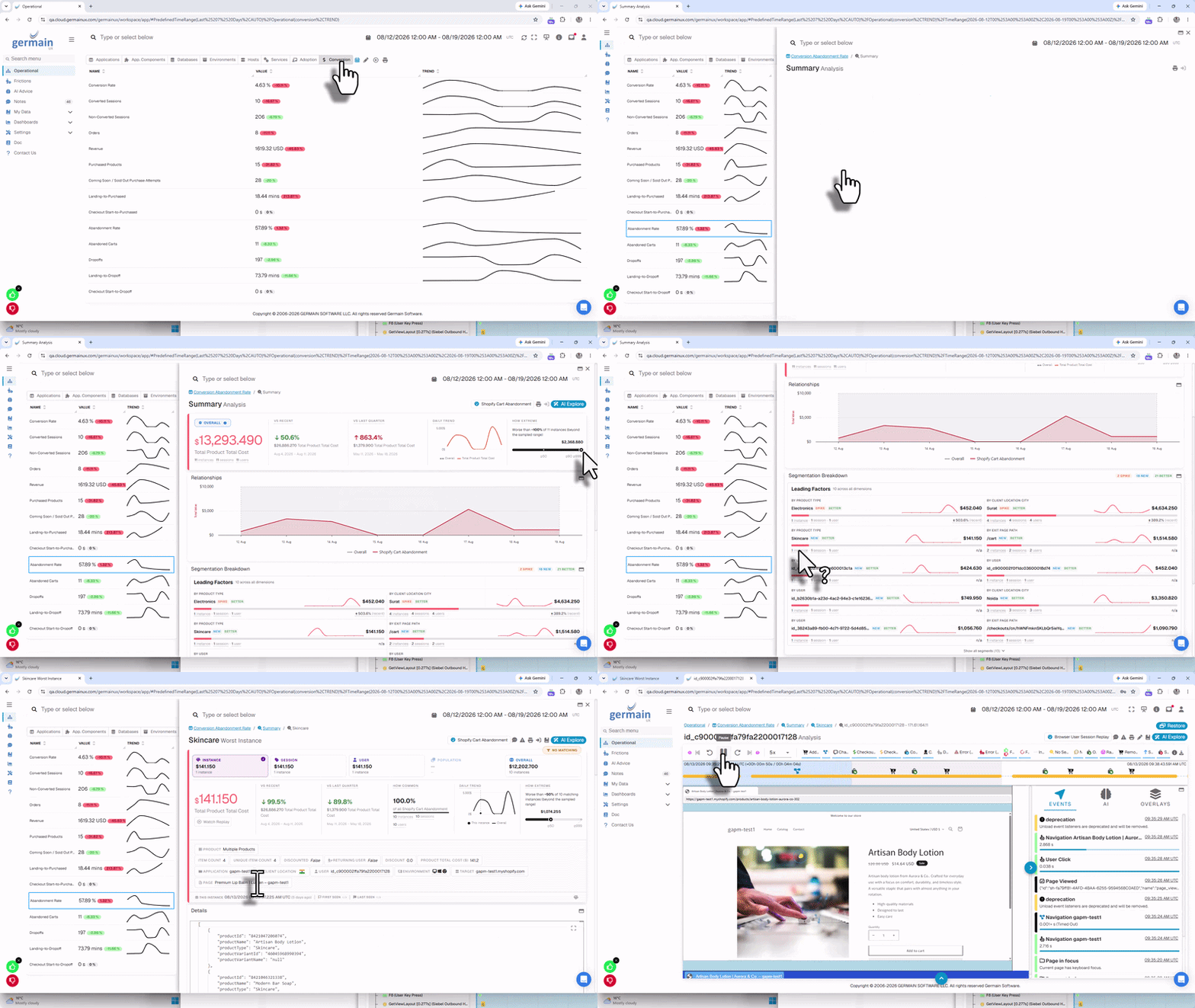
|
|
User Experience Issue |
|
|
Wasted Time on eCommerce |
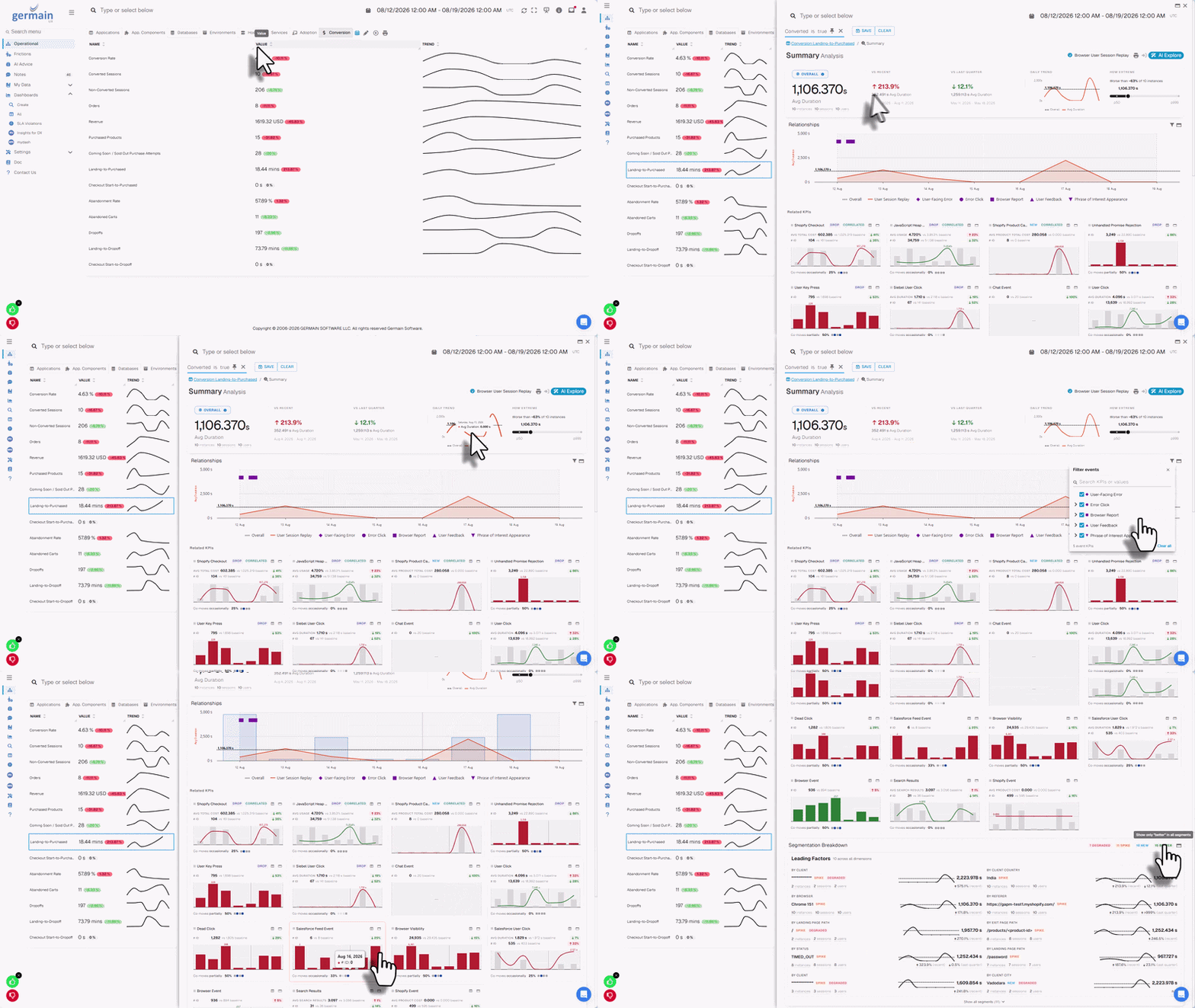
|
|
Slow Click |
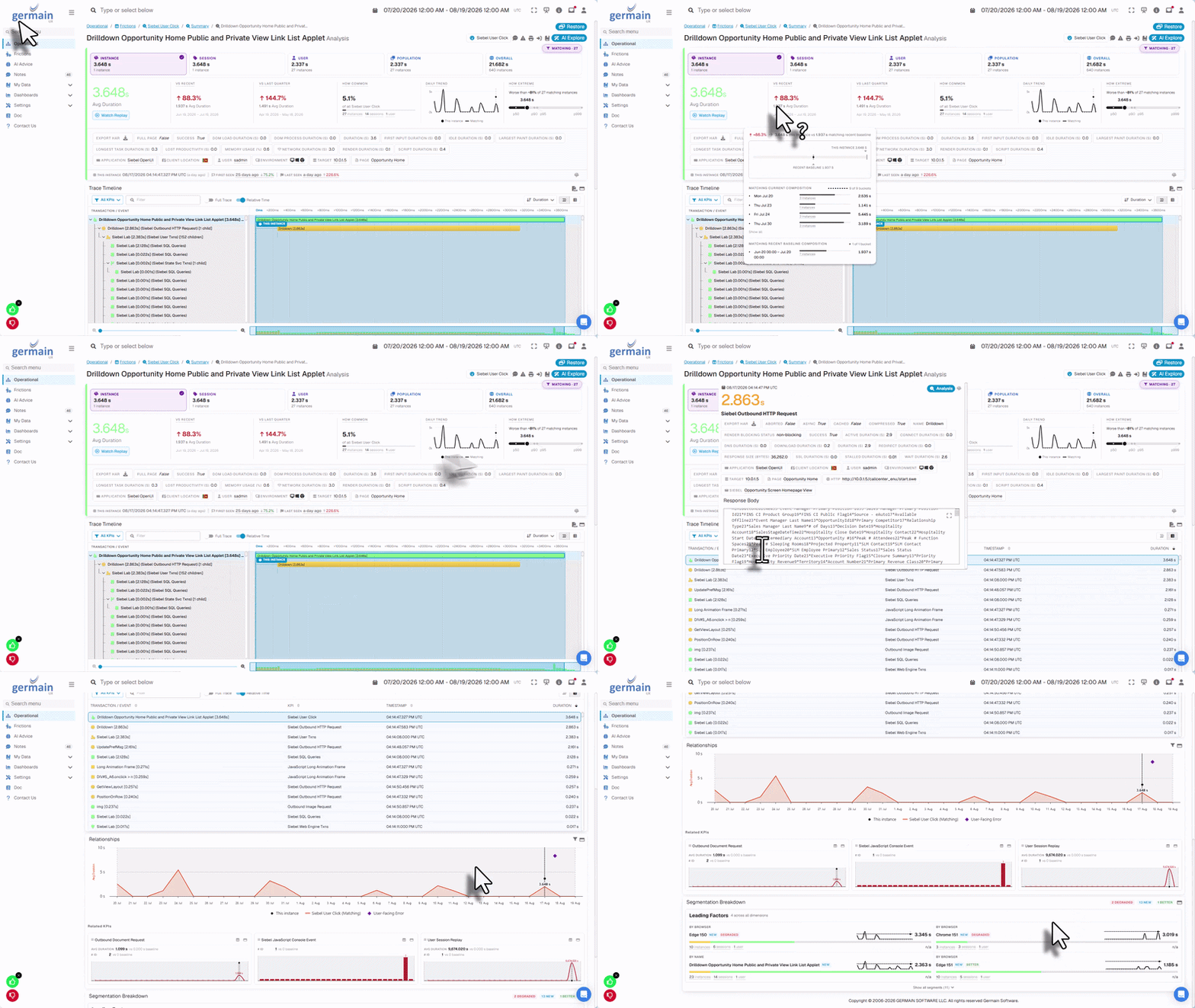
|
More details on the .
👁️ REAL USER MONITORING & REPLAY FOR WINDOWS APPS
Customers: Several customers requested this
GermainUX now provides real-time monitoring and on-demand Session Replay for native Windows applications built with .NET, C++, C#, and other Windows-supported technologies.
Organizations can now see exactly how employees use their Windows applications, replay any session, and quickly identify the user-experience, workflow, and technical issues affecting productivity.
This capability helps teams:
-
Reduce the time required to investigate and resolve Windows application issues by 50–90%.
-
Identify application crashes, freezes, errors, slowness, and unresponsive screens.
-
Detect workflow bottlenecks, repeated actions, user confusion, and lost productivity.
-
Understand what happened before, during, and after an issue.
-
Determine which users, workflows, application versions, or environments are affected.
-
Replace difficult-to-reproduce problem reports with clear, replayable evidence.
-
Prioritize improvements based on their actual impact on users and business operations.
This brings the same deep visibility and diagnostic capabilities GermainUX has delivered for web applications for more than a decade to virtually any native Windows application.
More details about this new Real-time User Monitoring & Replay for Windows Applications.
 ALERT ENHANCEMENTS
Customers: American Airlines, Pepsico
Five new enhancements to the alert mechanism.
⚙️ CONFIGURABLE SUMMARY MEASURE
Expose summary measures for the current alert via template variables. Example usages:


Introduce three query types:
|
Query Type |
Details |
|---|---|
|
Number of attempts |
Number of attempts — consecutive failures for a stateful SLA |
|
Number of occurrences |
Number of occurrences in the last N days |
|
Occurrences over SLA |
Number of occurrences over SLA in the last N days |
These queries are available as template variables. Inside the alert template, reference them directly instead of configuring separate queries:
Total workflow executions over SLA in the last {context.summaryMetrics[0].range}: {context.summaryMetrics[0].value}
📈 CONFIGURABLE TREND GRAPH
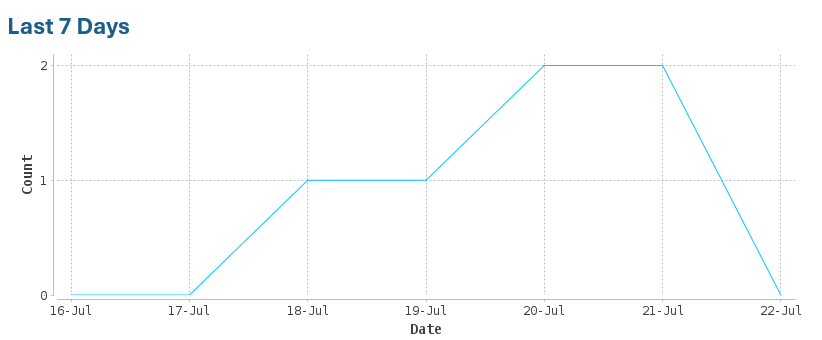
Provide a configurable trend result using these parameters:
|
Parameter |
Notes |
|---|---|
|
Measures |
Measures |
|
Pivots |
Pivots |
|
Time range |
Time range |
|
Filters |
Filters (template syntax supports expressions like |
Example:
<h1>Last 7 Days</h1>
<#include "SLA-ALERT-TREND">
🔗 PRE-BUILT LINKS
Provide shared templates for links to reduce the overhead of generating them.
Examples:
Instead of building links inside each template, include a single shared template:
<#include "SLA-ALERT-DETECT">
📧 HIGH-IMPORTANCE EMAIL ALERT
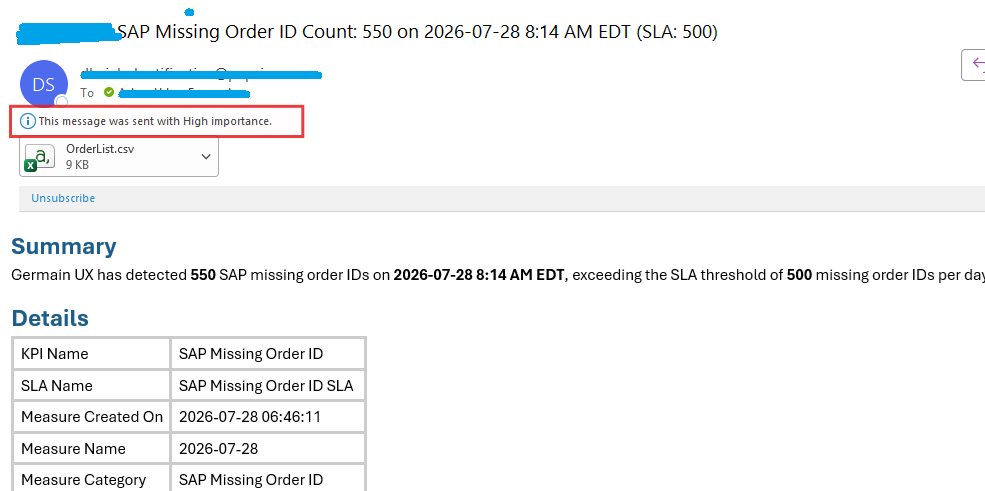
GermainUX email alerts now inherit importance from KPI/SLA priority, giving critical alerts greater visibility in recipients’ inboxes.
|
SLA Priority |
X-Priority |
Email Importance |
|---|---|---|
|
CRITICAL |
1 |
High |
|
VERY_HIGH |
1 |
High |
|
HIGH |
2 |
High |
|
MEDIUM |
3 |
Normal |
|
LOW |
4 |
Low |
Configure each KPI/SLA priority so the most important alerts receive elevated visibility.
Example of an alert sent while monitoring Orders processed by SAP:
🔌 DYNAMIC ACTION MECHANISM
Provide the ability to trigger an action directly from a GermainUX alert (email, SMS, Teams notification, etc.), such as “Unstick a task” or “Kill a long-running process.”
Before 2026.2, operators could run a program on a specific server, database, or engine, but alerts could not pass dynamic arguments such as a Process ID or Task ID to the ActionController.
Starting with 2026.2, alerts can pass dynamic values to the ActionController so the appropriate action executes automatically.
More details on the Alert Mechanism.
🔎 SENTENCE-BASED SEARCH
Customers: Most customers have been asking for this
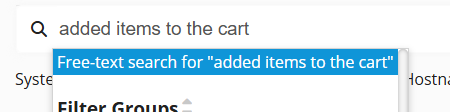
Ability to search for an exact sentence within a data source—for example, find all user sessions where the message “Added items to the cart.” appeared on screen.
More details on Search and Filters.
📁 LOG FILE DOWNLOAD
Customers: Most customers have been asking for this
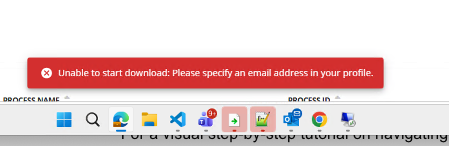
Ability to download an application log file from a GermainUX Workspace account that lacks an associated email address.
Previously, when GermainUX customers attempted to download an application log from their Workspace and the account had no associated email address, they received the following error message:
More details on Application Log File Management.
🔧 MAINTENANCE
📚 JDK 25 SUPPORT
Customers: All Customers
GermainUX Tech stack nows supports JDK 25.
More details on Germain Tech Stack.
🔎 PII/PHI SECURITY MECHANISM
Customers: All Customers
New PII/PHI exclusion mode has been built to accelerate the rollout of GermainUX faster and safer.
More details on PII/PHI Security Mechanism.
🛡️ SENTINEL SELF-MONITORING IN KUBERNETES ENVIRONMENTS
Customers: On-premise customers
Enhancements of Sentinel:Sentinel: GermainUX Self-Monitoring
More details on Sentinel.
🔒 SECURITY AND VULNERABILITIES FIXES
Customers: All customers are required to apply the following patches to update Germain
In alignment with SOC 2 and HITRUST compliance requirements, patches have been released to remediate vulnerabilities identified in GermainUX version 2026.1 and earlier. Please create a support ticket or contact Germain support for assistance.
|
Vulnerability |
Severity |
Scope |
Detected |
Reviewed |
Resolved |
Affected versions |
Fix implemented in |
Link |
|
[CVE-2025-33042] |
HIGH |
avro [ 1.11.4] -> [1.11.5] |
2/22/2026 |
2/26/2026 |
2/26/2026 |
2025.1, 2025.2 |
2025.1-136, 2025.2-40 |
|
|
[CVE-2026-25747] |
HIGH |
camel [4.0.4] -> [4.10.9] |
3/1/2026 |
3/2/2026 |
3/2/2026 |
2025.2 |
2025.2-42 |
|
|
[CVE-2025-66614] |
CRITICAL |
Apache Tomcat [10.1.48] -> [10.1.52] |
3/21/2026 |
3/23/2026 |
3/23/2026 |
2025.1, 2025.2 |
2025.1-136, 2025.2-47 |
|
|
[CVE-2026-24308] |
HIGH |
Apache Zookeeper [3.8.4] -> [3.8.6] |
3/21/2026 |
3/23/2026 |
3/23/2026 |
2025.1, 2025.2 |
2025.1-136, 2025.2-47 |
|
|
[CVE-2026-22732] |
CRITICAL |
spring-security [6.5.4] -> [6.5.9] |
3/21/2026 |
3/24/2026 |
3/24/2026 |
2025.1, 2025.2 |
2025.2-49 |
|
|
[CVE-2026-33871] |
HIGH |
netty [4.1.125.Final] -> [4.1.132.Final] |
4/5/2026 |
4/6/2026 |
4/6/2026 |
2025.1, 2025.2, 2026.1 |
2025.1-138, 2025.2-50, 2026.1-22 |
|
|
[CVE-2026-33870] |
HIGH |
netty [4.1.125.Final] -> [4.1.132.Final] |
4/5/2026 |
4/6/2026 |
4/6/2026 |
2025.1, 2025.2, 2026.1 |
2025.1-138, 2025.2-50, 2026.1-22 |
|
|
[CVE-2026-33186] |
CRITICAL |
grpc-api [1.60.1] -> [1.80.0] |
4/12/2026 |
4/13/2026 |
4/13/2026 |
2025.1, 2025.2, 2026.1 |
2025.1-138, 2025.2-50, 2026.1-31 |
|
|
[CVE-2026-4800] |
CRITICAL |
Lodash [4.17.23] -> [4.18.1] |
4/12/2026 |
4/13/2026 |
4/14/2026 |
2025.1, 2025.2, 2026.1 |
2026.1-31 |
|
|
[CVE-2026-29145] |
CRITICAL |
Apache Tomcat [10.1.52] -> [10.1.53] |
4/19/2026 |
4/20/2026 |
4/20/2026 |
2025.1, 2025.2, 2026.1 |
2025.1-139, 2025.2-51, 2026.1-36 |
|
|
[CVE-2026-40453] |
CRITICAL |
Apache camel [4.10.9] -> [ 4.14.6] |
5/3/2026 |
5/4/2026 |
5/4/2026 |
2025.1, 2025.2, 2026.1 |
2025.2-54, 2026.1-61 |
|
|
[CVE-2026-42583] |
HIGH |
netty [4.1.132.Final] -> [4.2.13.Final] |
5/3/2026 |
5/8/2026 |
5/8/2026 |
2026.1 |
2026.1-67 |
|
|
[CVE-2025-66453] |
HIGH |
rhino [1.17.14] -> [1.7.15.1] |
5/3/2026 |
5/8/2026 |
5/8/2026 |
2025.1, 2025.2, 2026.1 |
2026.1-67 |
|
|
[CVE-2026-5598] |
HIGH |
bcprov-jdk18on [1.79] -> [1.84] |
5/3/2026 |
5/8/2026 |
5/8/2026 |
2025.1, 2025.2, 2026.1 |
2026.1-67 |
|
|
[CVE-2025-12183] |
HIGH |
l4z [1.8.0] -> [1.8.1] |
5/3/2026 |
5/8/2026 |
5/8/2026 |
2025.1, 2025.2, 2026.1 |
2026.1-67 |
|
|
[CVE-2026-40860] |
CRITICAL |
Apache camel [4.14.6] -> [ 4.14.7] |
5/10/2026 |
5/11/2026 |
5/11/2026 |
2025.1, 2025.2, 2026.1 |
2025.2-54, 2026.1-68 |
https://web.nvd.nist.gov/view/vuln/detail?vulnId=CVE-2026-40860 |
|
[CVE-2026-41293] |
CRITICAL |
Apache tomcat [11.0.21] -> [11.0.22], [10.0.54] -> [10.0.55] |
5/17/2026 |
5/20/2026 |
5/20/2026 |
2025.1, 2025.2, 2026.1 |
2025.1-140, 2025.2-53, 2026.1-73 |
|
|
[CVE-2026-5795] |
HIGH |
jetty [9.4.58.v20250814] -> [12.1.8] |
4/26/2026 |
4/27/2026 |
5/21/2026 |
2026.1+ |
2026.1-77 |
|
|
[CVE-2026-2332] |
CRITICAL |
jetty [9.4.58.v20250814] -> [12.1.8] |
5/17/2026 |
5/20/2026 |
5/21/2026 |
2026.1+ |
2026.1-77 |
|
|
[CVE-2026-42581] |
CRITICAL |
netty [4.2.12] -> [4.2.13] |
5/23/2026 |
5/26/2026 |
5/26/2026 |
2026.1+ |
2026.1-77 |
|
|
[CVE-2015-5237] |
HIGH |
protobuf-javanano [3.0.0-alpha-7] -> [removed] |
5/30/2026 |
6/1/2026 |
6/1/2026 |
2026.1+ |
2026.1-88 |
|
|
[CVE-2026-42582] |
HIGH |
netty [4.1.133.FINAL] -> [4.1.134.FINAL] |
5/30/2026 |
6/1/2026 |
6/1/2026 |
2026.1+ |
2026.1-88 |
|
|
[CVE-2026-42582] |
HIGH |
netty [4.1.134.FINAL] -> [4.1.135.FINAL] |
6/6/2026 |
6/8/2026 |
6/8/2026 |
2026.1+ |
2026.1-88 |
|
|
[CVE-2026-45674] |
CRITICAL |
netty [4.2.13] -> [4.2.15] |
6/13/2026 |
6/15/2026 |
6/15/2026 |
2026.1+ |
2026.1-88 |
|
|
[CVE-2024-7254] |
HIGH |
protobuf-java [3.21.9] -> [3.25.9] |
6/13/2026 |
6/15/2026 |
6/15/2026 |
2026.1+ |
2026.1-88 |
|
|
[CVE-2026-41838] |
HIGH |
spring-core [7.0.7] -> [7.0.8] |
6/13/2026 |
6/15/2026 |
6/15/2026 |
2026.2+ |
2026.2-1 |
|
|
[CVE-2026-41731] |
HIGH |
spring-kafka [3.3.9] -> [3.3.16] |
6/19/2026 |
6/19/2026 |
6/19/2026 |
2026.1+ |
2026.1-88 |
|
|
[CVE-2026-35554] |
HIGH |
kafka-clients [3.9.1] -> [3.9.2] |
6/19/2026 |
6/19/2026 |
6/19/2026 |
2026.1 |
2026.1-88 |
|
|
[CVE-2026-41851], [CVE-2026-41838], [CVE-2026-41848] |
spring [6.2.11] -> [6.2.19] |
6/19/2026 |
6/19/2026 |
6/19/2026 |
2026.1 |
2026.1-88 |
|
|
|
[CVE-2026-54512] |
HIGH |
jackson [2.19.2] -> [2.22.0] |
6/28/2026 |
6/29/2026 |
6/29/2026 |
2026.1 |
2026.1-95 |
|
|
[CVE-2025-11226] |
HIGH |
logback-core [1.5.3] -> [1.5.37] |
6/28/2026 |
6/29/2026 |
6/29/2026 |
2026.1 |
2026.1-95 |
|
|
[CVE-2026-53434] |
CRITICAL |
Apache Tomcat [10.1.55] -> [10.1.56], [11.0.22] -> [11.0.23] |
7/5/2026 |
7/6/2026 |
7/6/2026 |
2026.1 |
2026.1-103 |
|
|
[CVE-2026-47838] |
HIGH |
spring-security [6.5.9] -> [6.5.11] |
7/5/2026 |
7/6/2026 |
7/6/2026 |
2026.1 |
2026.1-103 |
|
|
[CVE-2026-43867] |
CRITICAL |
Apache camel [4.20.0] -> [4.21.0] |
7/12/2026 |
7/13/2026 |
7/13/2026 |
2026.1 |
2026.1-107 |
|
|
[CVE-2026-54399] |
HIGH |
Apache HTTP Core5 [5.3.5] -> [5.4.3] |
7/12/2026 |
7/13/2026 |
7/13/2026 |
2026.1 |
2026.1-107 |
|
|
[CVE-2026-59083] |
CRITICAL |
Apache Tomcat [10.1.56] -> [10.1.57] |
7/19/2026 |
7/20/2026 |
7/20/2026 |
2026.1 |
2026.1-112 |
|
|
[CVE-2026-54399] |
HIGH |
Apache httpcore5-h2 [5.3.6] -> [5.4.3] |
7/12/2026 |
7/20/2026 |
7/20/2026 |
2026.1 |
2026.1-112 |
|
|
[CVE-2026-44891] |
HIGH |
netty [4.2.15.Final] -> [4.2.16.Final] |
7/26/2026 |
7/27/2026 |
7/27/2026 |
2026.1 |
2026.1-112 |
|