
🔧 Deploying GermainUX Monitoring for PHP Applications: Installation and Configuration Guide
Deploy GermainUX monitoring for PHP applications to capture PHP transactions, code execution, network requests, SQL execution, integrations, and correlated user activity.
ℹ️ Overview
PHP monitoring uses:
|
Component |
|---|
|
GermainUX - Agent |
|
GermainUX - Code Profiler |
|
GermainUX - Engine |
|
GermainUX - PHP Monitoring Profile |
|
GermainUX - PHP Server Profile |
|
xhprof |
📋 Requirements
Before deployment, verify:
-
PHP 7.4 or later
-
Access to the PHP application server
-
Ability to install the
xhprofPHP extension -
Ability to install a GermainUX Engine
-
Ability to deploy
germainapm.php -
Ability to modify the PHP application's entry points
-
Network connectivity between the PHP environment and GermainUX
🚀 1. Start the PHP Monitoring Wizard
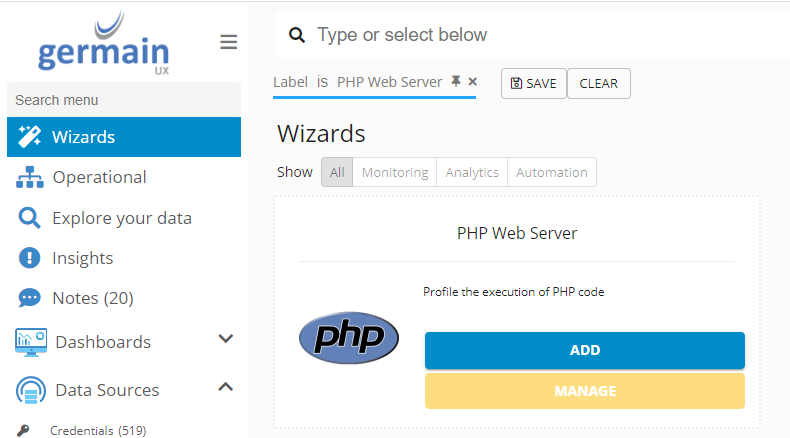
In Germain Workspace, navigate to:
Left Menu → Wizards
Select the PHP monitoring deployment Wizard available for your GermainUX environment.
Use the Wizard as the primary workflow for creating or applying the PHP monitoring configuration.
The resulting configuration should include the PHP monitoring profile, components, component templates, server profile, KPIs, correlation scenarios, and RCA dashboard required for PHP monitoring.
🖥️ 2. Select or Create the PHP Server
Select the server hosting the PHP application.
If the server does not yet exist in GermainUX, create it during the deployment workflow.
Use consistent server and application naming across environments such as:
-
Production
-
Staging
-
Development
🏷️ 3. Select the Monitored Application
Select or create the PHP application that GermainUX will monitor.
The application association allows PHP telemetry to be correlated with:
-
Browser activity
-
PHP transactions
-
SQL
-
Network requests
-
Integrations
-
Infrastructure
📦 4. Install xhprof
Install the xhprof extension on the PHP application server.
xhprof provides the profiling capability required for PHP execution monitoring.
⚙️ 5. Enable the xhprof Extension
Enable xhprof in the PHP configuration.
For example:
[xhprof]
extension = xhprof.so
Restart or reload the appropriate PHP or web-server process after updating php.ini.
Verify that the extension loads successfully.
⚙️ 6. Apply the PHP Monitoring Configuration
The PHP monitoring deployment includes configuration in the following GermainUX areas:
-
germain.apm.monitoringClient.phpMonitoringProfiles -
germain.apm.monitoringConfig.components -
germain.apm.monitoringConfig.componentTemplates -
germain.apm.monitoringConfig.serverProfiles -
germain.apm.monitoringConfig.keyPerformanceIndicators -
germain.apm.analytics.streamCorrelationScenarios -
germain.apm.workspace.rcaDashboards
The standard PHP configuration includes:
PHP Monitoring Profile: Basic Sampling
Server Profile: PHP Server
Use the Wizard-generated configuration where available instead of manually creating each object.
🧩 7. Apply the PHP Server Profile
Apply the:
PHP Server
profile to the PHP application server.
The server profile associates the PHP monitoring components and configuration with the selected environment.
⚙️ 8. Deploy the GermainUX Engine
PHP monitoring requires a GermainUX Engine.
If an appropriate Engine is not already available, deploy one through:
Germain Workspace → Left Menu → Wizards → Engine
Install the Engine on the PHP web server or another supported host with the required connectivity.
Verify that the Engine registers successfully with GermainUX.
📥 9. Install the PHP Agent
Install the GermainUX PHP Agent file on the web server:
germainapm.php
Place the file where it can be loaded by the PHP application.
🔧 10. Configure germainapm.php
Populate the required settings in germainapm.php.
These include values such as:
GERMAIN_SERVICES_URL
PROFILE_NAME
and any other environment-specific values required by the PHP monitoring package.
PROFILE_NAME should correspond to the PHP monitoring profile applied to the application.
🔗 11. Instrument the PHP Application
Include the GermainUX PHP Agent in the PHP application's entry points.
For example:
include 'germainapm.php';
Add the include to the entry points that initiate the PHP transactions GermainUX should monitor.
Depending on the application architecture, this may be a common bootstrap or front-controller file rather than every individual PHP file.
🌐 12. Configure Browser Correlation — Where Required
Where PHP transactions need to be correlated with actual user activity, deploy GermainUX browser monitoring for the associated web application.
This enables transaction paths such as:
User Action → Browser → PHP Transaction → SQL / API
Use the corresponding UX Monitoring Profile and RUM deployment workflow for the browser application.
🔄 13. Restart or Reload the Application Environment
Restart or reload the PHP environment where required after:
-
Installing xhprof
-
Updating
php.ini -
Installing the PHP Agent
-
Updating the application bootstrap or entry points
-
Applying monitoring configuration
🧪 14. Generate Representative Transactions
Exercise representative PHP application activity.
For example:
Browser → PHP → SQL → Response
Browser → PHP → External API → Response
PHP → Integration → Downstream Service
Use transactions containing the components that GermainUX is expected to monitor.
✅ 15. Validate PHP Telemetry
Verify that GermainUX receives:
-
PHP transactions
-
PHP code execution
-
Network requests
-
SQL execution
-
Integration activity
-
Correlation context
Also verify that telemetry is associated with the correct:
-
Application
-
Server
-
PHP monitoring profile
-
PHP Server profile
🔍 16. Verify in Germain State
Open:
Germain Workspace → Germain → State
Confirm that the required:
-
Engine
-
Node
-
Monitoring configuration
-
PHP environment
are active and operating as expected.
🔐 17. Review Privacy
Before broad production deployment, review information collected from PHP transactions.
Pay particular attention to:
-
URL parameters
-
Request parameters
-
Form data
-
SQL values
-
Session identifiers
-
Authentication information
-
User information
-
API payloads
-
Application-specific sensitive data
Apply masking, anonymization, or exclusions where required.
📊 Next Steps
Once PHP monitoring is operational, configure:
-
PHP monitoring profile
-
Sampling
-
Transaction monitoring
-
Code profiling
-
Network requests
-
SQL
-
Integrations
-
KPIs
-
SLAs
-
Correlation
-
RCA
-
Categorization
-
Alerts
-
Automation
-
Dashboards
-
Reports
ℹ️ Get More Information
PHP environments can vary significantly depending on storefront customization, extensions, integrations, infrastructure, and security requirements.
The GermainUX team can help configure the appropriate monitoring scope, privacy controls, analytics, alerts, and automation for your PHP environment.
Please contact us for any help.
Component: Engine, JS Profiler, RPA Bot Recorder, RUM JS
Feature Availability: 2017.1 or later