

Install MySQL
Using an approved distribution
Secure MySQL
Hardening before database setup
Create the GermainUX Databases
Two databases and init scripts
Production Checklist
Contact support before launch
Overview
GermainUX supports MySQL as an on-premise datastore. MySQL may be appropriate when:- Your organization already operates MySQL.
- Database administrators have established MySQL backup, security, and monitoring procedures.
- A relational datastore is required.
- The expected GermainUX ingestion and analytics workload has been validated against MySQL.
MySQL Deployment Options
GermainUX can use a standard MySQL deployment or a highly available MySQL architecture approved by your organization. A clustered architecture can provide:
The appropriate architecture depends on data volume, retention, availability requirements, and internal MySQL standards.
Before You Begin
Confirm with Germain Software:- The MySQL version supported by your GermainUX release
- Required JDBC driver version
- Character set and collation
- Schema scripts required for the release
- Expected daily AA Unit volume
- Retention requirements
- Storage and performance requirements
- High-availability requirements
- Upgrade or migration requirements
Requirements
Prepare:- A supported 64-bit operating system
- A supported MySQL Server version
- Administrative access to MySQL
- A supported MySQL JDBC driver
- Network connectivity from GermainUX Enterprise
- Sufficient CPU, memory, SSD storage, and IOPS
- Backup and recovery procedures
- TLS and authentication
- The GermainUX Service distribution package
Install MySQL
Use your organization’s approved MySQL distribution and installation process.Debian or Ubuntu
Update the package index and install MySQL Server:Red Hat Enterprise Linux or Compatible Distribution
Configure an approved MySQL repository for the operating-system version, then install and start MySQL Server using the system package manager. Example:Windows
Download and install:- Download the MySQL Installer for Windows.
- Run the installer with administrator privileges.
- Select Server Only for a production database host, or Custom when additional tools are required.
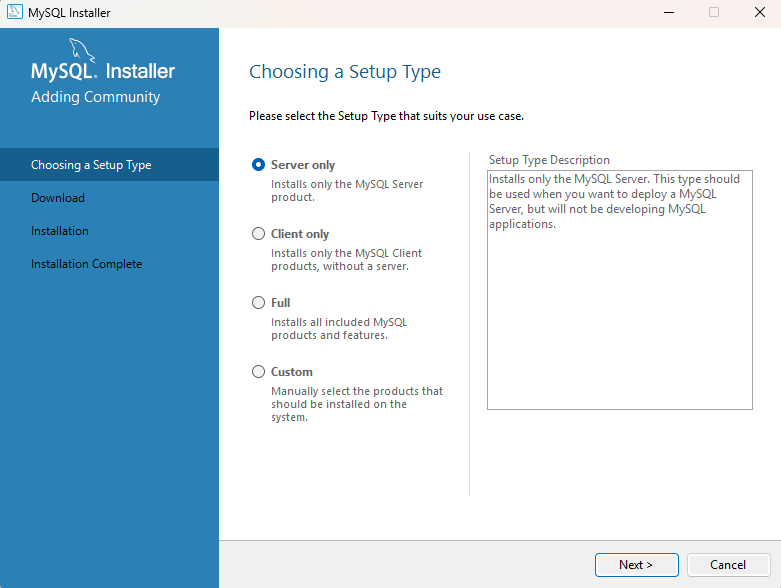
The MySQL Installer setup type screen with Server Only selected.
- Configure the MySQL service.
- Configure the administrative account.
- Enable TCP/IP connectivity.
- Configure TLS.
- Complete the installation.
- Confirm that the MySQL Windows service is running.
Secure MySQL
Before creating the GermainUX databases:- Remove anonymous users.
- Disable unnecessary remote administrative access.
- Do not use default or example passwords.
- Require strong, unique credentials.
- Enable TLS for GermainUX connections.
- Restrict access by host and network.
- Apply least-privilege permissions.
- Protect credentials outside source control.
- Configure audit logging when required.
- Define credential-rotation procedures.
root account as the GermainUX runtime account.
Create the GermainUX Databases
GermainUX uses two MySQL databases:
The release package includes the SQL scripts required to create and initialize these databases.
1. Extract the Service Distribution
Extract the GermainUX Service release package to a directory referenced below as:2. Review the Database Instructions
Open:3. Locate the MySQL Scripts
The MySQL scripts are located under: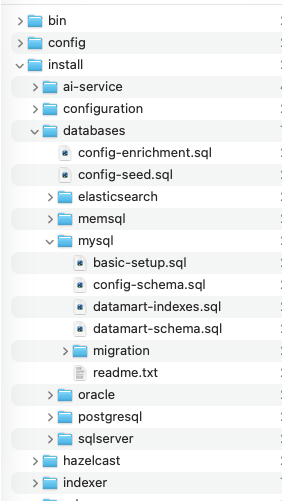
MySQL scripts in install/databases/mysql - GermainUX
4. Update the Initial Setup Script
Open: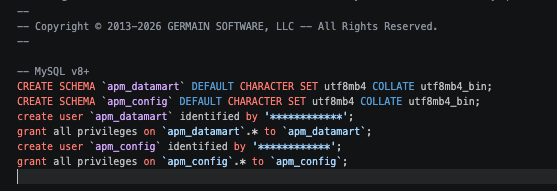
basic-setup.sql creating the apm_config and apm_datamart schemas and users - GermainUX
The example script creates each user without a host restriction, which allows connections from any host. To restrict access as recommended in Secure MySQL, create the accounts as
'user'@'host' with the GermainUX Enterprise host or network.5. Run basic-setup.sql
Execute:
apm_configapm_datamart- The corresponding GermainUX database accounts and permissions
6. Initialize apm_config
Select:
7. Initialize apm_datamart
Select:
Configure GermainUX Enterprise
Configure GermainUX Enterprise with:- MySQL hostname
- MySQL port
apm_configdatabase nameapm_datamartdatabase name- Dedicated database usernames
- Securely stored passwords
- TLS settings
- Connection-pool settings
- Query and connection timeouts
- JDBC driver
Validate the Setup
Before starting production monitoring:- Connect to MySQL using each GermainUX service account.
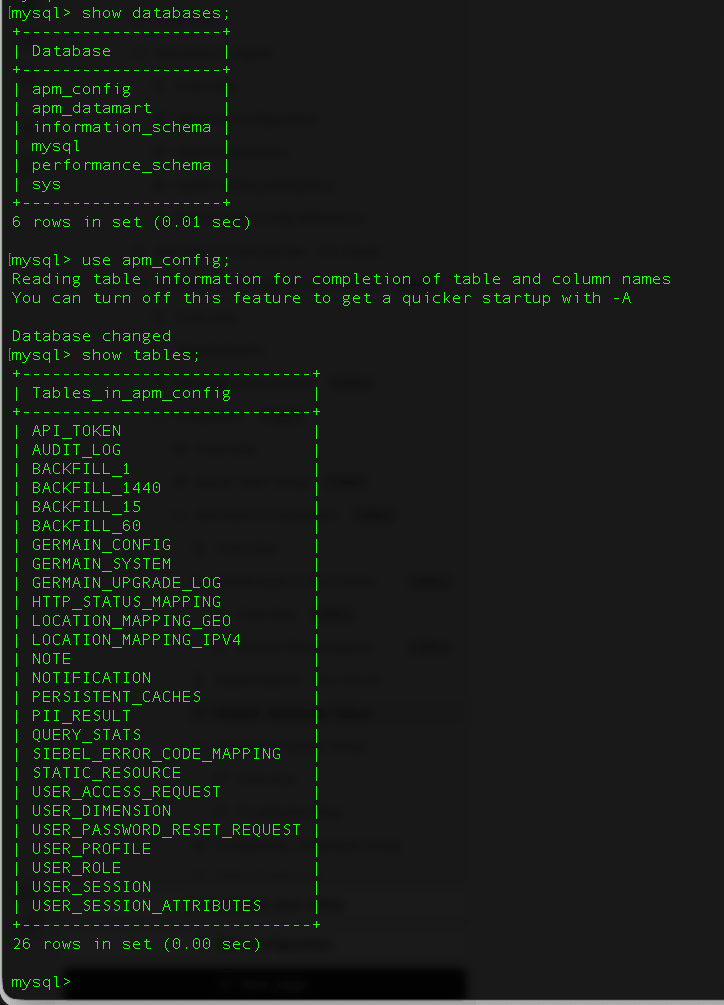
SHOW DATABASES output lists both apm_config and apm_datamart.
- Confirm that all required tables and indexes were created.
- Verify that GermainUX Enterprise can connect.
- Start GermainUX Enterprise.
- Review logs for schema or permission errors.
- Confirm that GermainUX configuration can be saved.
- Ingest a limited monitoring workload.
- Confirm that data is written to
apm_datamart. - Open representative dashboards and analyses.
- Test retention and cleanup.
- Measure query and ingestion performance.
Backup and Recovery
Configure backups for both:- Regular full backups
- Incremental or binary-log recovery where required
- Off-host backup storage
- Encryption
- Retention
- Monitoring of backup failures
- Periodic restore testing
Performance and Capacity
Monitor:- CPU and memory
- Disk capacity
- Disk latency and IOPS
- Connection count
- Buffer-pool utilization
- Query latency
- Lock contention
- Replication lag
- Table and index growth
- Backup duration
- Slow queries
Production Checklist
For supported versions, database scripts, migration assistance, or production sizing, contact Germain Software.Get Help
Contact GermainUX Support
The GermainUX team helps you get up and running faster, empower your team, turn data into actionable insights, and optimize performance to deliver measurable business outcomes.
Can't Find What You Need?
Search all GermainUX docs with Ctrl + K, or use the feedback buttons at the bottom of this page to tell us what is missing.
The content of this document is proprietary to GERMAIN SOFTWARE.