

Supported Datastores
Check compatible versions
When to Choose a Relational Datastore
Pick relational for existing stacks
Comparison
Compare datastore options
Interpreting Benchmark Results
Apply benchmarks carefully
Recommendation
Elasticsearch is the recommended datastore for GermainUX, particularly for new deployments and environments that collect large volumes of monitoring, analytics, tracing, or Session Replay data. Its distributed search and analytics architecture is well suited to:- High-volume, near-real-time ingestion
- Large and evolving telemetry schemas
- Fast filtering and aggregation
- Full-text search
- Time-based data retention
- Horizontal scaling
- Large dashboards and investigative queries
Supported Datastores
Confirm the supported product version with Germain Software before deploying or upgrading.
Selection Criteria
Choose the datastore based on the complete workload rather than existing database availability alone. Evaluate:When to Choose Elasticsearch
Choose Elasticsearch when:- You are deploying GermainUX for the first time.
- Monitoring volume is expected to be high.
- The volume or structure of collected telemetry may grow rapidly.
- Users frequently search, filter, segment, and aggregate large datasets.
- Near-real-time ingestion and analysis are important.
- Horizontal scalability is required.
- You need efficient time-based data management.
- Session Replay, tracing, or detailed real-user monitoring will produce large datasets.
When to Choose a Relational Datastore
Consider PostgreSQL, MySQL, Oracle, Microsoft SQL Server, or a compatible managed service when:- Your organization requires an approved relational database.
- Your database administrators already operate the selected platform.
- Monitoring volume is moderate and predictable.
- Existing backup, replication, security, and disaster-recovery processes must be reused.
- Licensing or operational standards favor the selected database.
- Required GermainUX queries and retention can be supported at the expected scale.
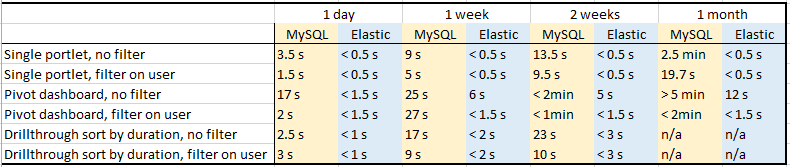
Comparison
Benchmark Scope
Germain Software performed internal comparative testing using:- Amazon Aurora with MySQL 5.7 compatibility
- MySQL 5.7
- Elasticsearch 7.13
- Approximately 3 TB of stored data
- An ingestion rate of 300–400 million AA Units per day
Interpreting Benchmark Results
Benchmark results should not be applied directly to another deployment because performance depends on: A smaller environment can perform poorly if storage is slow or the datastore is incorrectly configured. A larger environment can perform efficiently when ingestion, retention, indexing, and infrastructure are properly designed.Validate the Selected Datastore
Before finalizing a production datastore:1
Estimate daily and peak ingestion volume
2
Define raw, aggregated, and Session Replay retention
3
Calculate usable and physical storage requirements
4
Include indexes, replicas, backups, and free-space reserves
5
Reproduce representative production ingestion
6
Test commonly used dashboards, searches, and analyses
7
Test retention and cleanup processes
8
Measure CPU, memory, disk latency, throughput, and IOPS
9
Test backup and recovery
10
Confirm that the architecture supports expected growth
11
Validate the selected datastore and version with Germain Software
Final Recommendation
For most new GermainUX deployments:Use Elasticsearch unless a specific technical, operational, security, or organizational requirement justifies another supported datastore.
Get Help
Contact GermainUX Support
The GermainUX team helps you get up and running faster, empower your team, turn data into actionable insights, and optimize performance to deliver measurable business outcomes.
Can't Find What You Need?
Search all GermainUX docs with Ctrl + K, or use the feedback buttons at the bottom of this page to tell us what is missing.
The content of this document is proprietary to GERMAIN SOFTWARE.