
💬 Conversation and Chat Analysis, Friction Detection and Automation
GermainUX analyzes human-agent and chatbot conversations occurring through chat, messaging, voice and other communication features integrated with applications such as eCommerce sites, CRM platforms and customer-service portals.
It helps organizations identify conversations that failed to produce the intended result, understand why they failed and determine what action should be taken. Friction may come from the conversation itself, the representative or bot, the business process, the surrounding digital experience or the communication technology.
By combining AI-assisted conversation analysis, business outcomes, application context, Real User Monitoring, Session Replay and technical observability, GermainUX helps teams move beyond basic sentiment and transcript review to understand what happened, why the conversation was ineffective and how it affected the business.
🎯 Business Outcomes
GermainUX helps organizations:
-
Identify and rank conversations that failed to achieve the intended outcome.
-
Understand why sales, service, support, recruiting or self-service conversations were ineffective.
-
Improve chatbot answers, agent effectiveness and conversation workflows.
-
Detect missed conversations caused by unavailable representatives or failed chat technology.
-
Connect conversation quality with conversion, case resolution, satisfaction, retention or another business outcome.
-
Find recurring friction across large volumes of conversations without reviewing every transcript or recording.
-
Correlate conversations with the user’s activity and experience inside the surrounding application.
-
Alert the appropriate teams and trigger approved follow-up or remediation workflows.
🔍 What GermainUX Analyzes
GermainUX can analyze observable conversation activity from compatible human and automated communication channels.
|
Area |
Examples |
|---|---|
|
Conversation content |
Questions, answers, topics, intent, sentiment, empathy and clarity |
|
Human-agent behavior |
Response quality, response time, process adherence, transfers and escalation |
|
Chatbot behavior |
Answer relevance, recommended content, fallback responses, repetition and handoff |
|
Conversation flow |
Start, queue, assignment, response, transfer, resolution and abandonment |
|
Business outcome |
Conversion, lead progression, case resolution, appointment, application or another configured result |
|
User experience |
Page activity, searches, clicks, errors and Session Replay surrounding the conversation |
|
Technology |
Failed chat attempts, unavailable channels, delays, dropped sessions and integration errors |
The available analysis depends on the conversation data, metadata, business outcomes and application telemetry provided by the integrated systems.
❓ Questions GermainUX Helps Answer
Conversation Analysis helps teams answer questions such as:
-
Which conversations did not produce the intended result?
-
Why did a shopper, customer, candidate or employee disengage?
-
Did the representative or chatbot understand the request?
-
Was the answer accurate, relevant, complete and empathetic?
-
Was the required business process followed?
-
Did the user wait too long, repeat information or experience unnecessary transfers?
-
Was a representative available when needed?
-
Did chat technology or an integration fail?
-
What was the user doing in the application before, during and after the conversation?
-
Which recurring conversation problems create the greatest business impact?
:robot: AI-Assisted Conversation Analysis
GermainUX can search and analyze conversations manually or automatically to identify friction patterns and unsuccessful outcomes.
AI-assisted analysis can evaluate:
-
Conversation topic and user intent
-
Questions asked and answers provided
-
Answer relevance and completeness
-
Sentiment and changes in sentiment
-
Empathy and communication quality
-
Repeated questions or misunderstood requests
-
Missing information or next steps
-
Process or policy adherence
-
Escalation, abandonment and resolution
-
Likely reasons the intended outcome was not achieved
GermainUX can summarize individual conversations and analyze multiple conversations at scale. Teams can categorize findings, quantify recurring patterns and rank issues according to frequency, severity or business impact.
AI-generated findings should support—not replace—appropriate human review, particularly for high-impact employment, financial, healthcare, legal or customer decisions.
:bust_in_silhouette: Human-Agent Conversation Analysis
GermainUX helps organizations understand where conversations with sales, service, support or recruiting representatives become ineffective.
Analysis can identify:
-
Slow first responses or extended silence
-
Incomplete, unclear or inaccurate answers
-
Lack of empathy or inappropriate tone
-
Missed questions or misunderstood intent
-
Repeated transfers and unnecessary escalation
-
Failure to follow the expected process
-
Failure to communicate an appropriate next step
-
Conversations ending without resolution or progress
Results can be analyzed by representative, team, channel, topic, customer segment, application, business outcome or another captured dimension.
These insights can support coaching, process improvement, knowledge-base changes, staffing decisions and targeted follow-up. They should not be used as the sole basis for evaluating an employee without appropriate review and organizational safeguards.
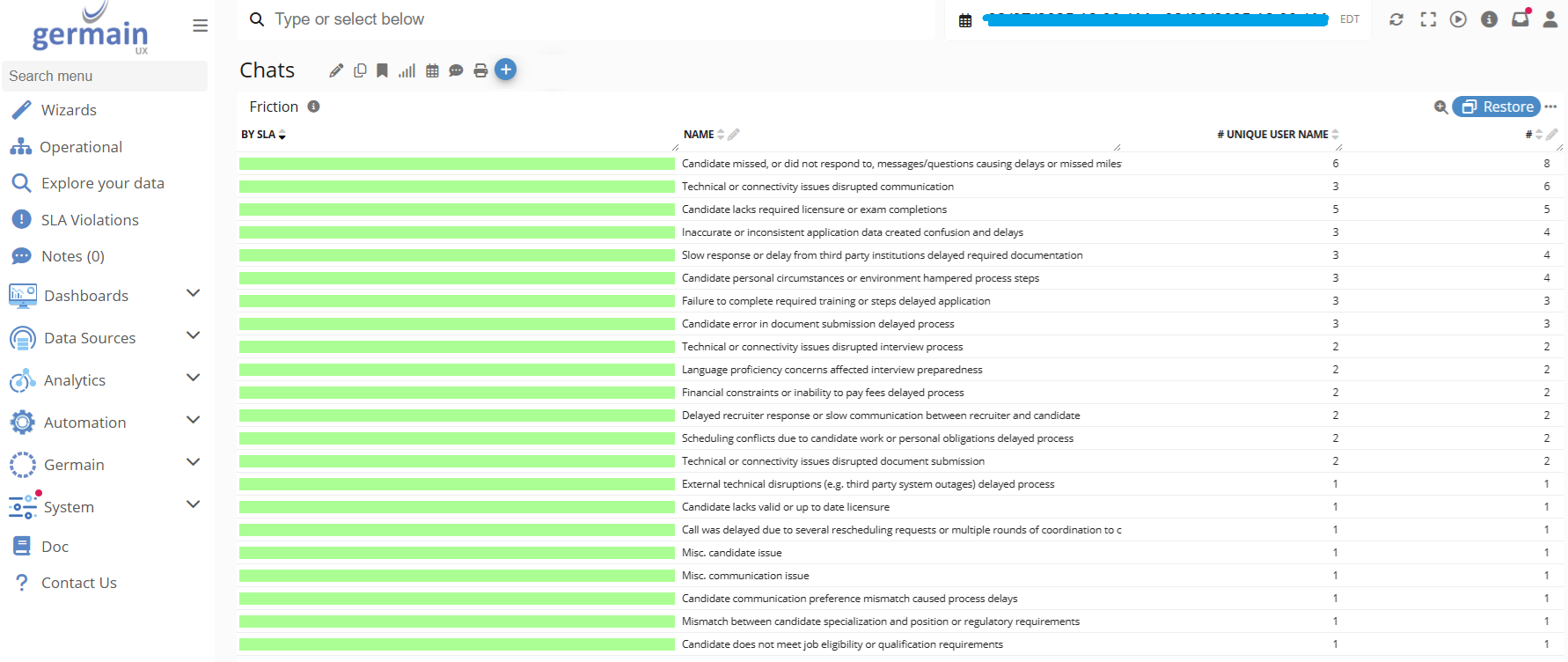
💬 Chatbot Conversation Analysis
GermainUX analyzes conversations occurring through chatbots and AI assistants integrated with monitored applications. GermainUX does not need to provide the chatbot itself; it analyzes the conversation and related telemetry made available by the integrated chat service and application.
Analysis can identify whether the chatbot:
-
Understood the user’s intent
-
Answered the question accurately and completely
-
Recommended the correct product, article or next action
-
Repeated ineffective answers or fallback responses
-
Sent the user into an unnecessary loop
-
Recognized when human assistance was required
-
Transferred the user successfully and with sufficient context
-
Contributed to conversion, self-service success, abandonment or escalation
These findings can help teams improve bot instructions, knowledge content, routing, fallback behavior and human-handoff rules.
📈 Conversation Outcomes and Business Impact
A conversation is only effective if it supports the intended user and business outcome. GermainUX can associate conversation activity with configured results such as:
-
Purchase or conversion
-
Lead qualification or sales progression
-
Case or issue resolution
-
Successful self-service
-
Appointment or booking
-
Form, application or registration completion
-
Candidate progression
-
Customer satisfaction or retention
-
Escalation, abandonment or churn risk
Teams can compare successful and unsuccessful conversations to identify the behaviors, content, workflow conditions and technical signals most associated with each outcome.
When revenue, conversion, productivity or another business measure is available, issues can be prioritized according to their observed impact rather than transcript sentiment alone.
:movie_camera: Real User Monitoring and Session Replay Context
For conversations embedded in a monitored web, CRM, eCommerce or desktop application, GermainUX can correlate the conversation with the user’s surrounding activity.
Teams can investigate:
-
What the user searched for or viewed before starting the conversation
-
Which product, case, record, page or workflow was involved
-
What the user clicked or entered during the interaction
-
Whether the user encountered errors, slowness or confusing content
-
What happened after the conversation ended
-
Whether the user converted, abandoned, escalated or returned later
Session Replay provides the experience context that a transcript alone cannot show. For example, an apparently negative chat may have been triggered by a failed checkout, an unavailable product, a slow CRM screen or an application error.
The available correlation depends on the identifiers and timestamps shared across the chat service, monitored application and GermainUX data sources.
:telephone_receiver: Representative Availability and Queue Analysis
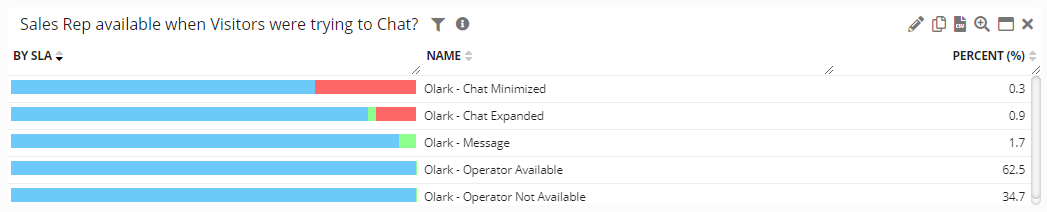
Missed conversations may occur even when the conversation content itself is not the problem. GermainUX can analyze available operational metadata to identify conditions such as:
-
No representative available
-
Excessive queue or first-response time
-
Failed assignment or routing
-
Conversation accepted but not answered
-
Repeated transfers
-
Dropped or abandoned conversations
-
Excessive handling or resolution time
-
Inadequate staffing during specific periods
These insights help teams distinguish a quality problem from an availability, staffing or routing problem.
 Chat Technology and Integration Failures
GermainUX can correlate conversation outcomes with observable technology conditions involving the integrated communication service and surrounding application.
Examples include:
-
Chat widget failing to load or open
-
Message send or delivery failures
-
Delayed messages or responses
-
Authentication or session problems
-
Failed bot-to-agent handoff
-
Routing or assignment errors
-
API and integration failures
-
Dropped voice, chat or messaging sessions
-
Application errors occurring during the conversation
This helps teams determine whether an unsuccessful interaction was caused by the representative, chatbot, business process, user experience or technology.
💼 Use Cases
eCommerce and Sales
GermainUX can identify conversations that did not convert, determine what prevented progress and help teams improve answers, offers, product guidance, follow-up and agent coaching.
Examples include:
-
A shopper could not find the right product or variant.
-
A chatbot recommended irrelevant products or articles.
-
A representative did not address a purchasing concern.
-
A checkout or payment error caused the shopper to seek help and then abandon.
-
A high-value conversation ended without an appropriate follow-up.
CRM and Customer Service
GermainUX can analyze conversations associated with leads, opportunities, cases and service workflows.
Examples include:
-
A lead conversation did not progress to the next stage.
-
A support interaction failed to resolve the customer’s issue.
-
The customer repeated information after a transfer.
-
The representative did not follow the required process.
-
A CRM or integration problem delayed the response or resolution.
Recruiting and Interviews
GermainUX can analyze observable recruiting conversations or interviews to identify process breakdowns, unanswered questions, delays and ineffective communication.
AI analysis should assist appropriate human review and should not independently make employment decisions or infer sensitive personal characteristics.
Internal Support and Employee Workflows
Conversation Analysis can also help organizations improve employee help desks, internal chatbots and support workflows by identifying unresolved requests, ineffective knowledge content and repeated escalation.
📊 Dashboards, Search and Ranking
GermainUX can provide dashboards and searchable analysis across individual conversations and larger populations.
Conversations can be filtered, compared and ranked by dimensions such as:
-
Outcome and conversion status
-
Friction category
-
Topic and intent
-
Sentiment or satisfaction
-
Representative, team, bot or channel
-
Response, handling and resolution time
-
Transfer or escalation count
-
Customer or user segment
-
Application, page, product, case or workflow
-
Technology errors and performance conditions
This enables teams to focus first on the conversations and recurring patterns with the greatest impact.
Alerts, Follow-Up and Automation
GermainUX can turn conversation analysis into action through:
|
Capability |
Purpose |
|
Real-time alerts |
Notify teams about high-risk conversations, failures or SLA violations |
|
Scheduled analysis |
Summarize and rank conversation friction across a configurable period |
|
Guided investigation |
Link findings to the conversation, application session and technical evidence |
|
Follow-up workflows |
Create an approved task or trigger a customer, sales or service follow-up |
|
Automated remediation |
Execute predefined recovery actions when automation is considered safe |
Examples can include alerting a supervisor, routing an unresolved conversation, initiating follow-up, updating knowledge content workflows or responding to a recoverable chat-technology failure.
Security, Privacy and Responsible Use
Conversation content can contain personal, confidential or regulated information. Collection and analysis must follow the organization’s consent, retention, access, employment and privacy requirements.
Depending on the deployment, GermainUX can mask, anonymize or exclude sensitive content. Access to transcripts, recordings, AI findings and Session Replay should be restricted to authorized users.
Organizations should validate AI findings before taking consequential action and configure the system to avoid collecting information that is unnecessary for the intended analysis.
Data Sources and Integration Requirements
GermainUX analyzes conversations and metadata made available through compatible chat, chatbot, messaging, voice, CRM, eCommerce and application integrations.
The available capabilities depend on:
-
Access to conversation content or transcripts
-
Conversation timestamps and identifiers
-
Participant, agent, bot and channel metadata
-
Queue, assignment, response and resolution events
-
Configured business outcomes
-
Identifiers used to correlate conversations with application sessions
-
Real User Monitoring and technical telemetry deployed in the application
📦 Additional Resources
-
AI Insights and Recommendations
-
Integrations to Various Communication Channels.
-
More Analytics Features
-
More Automation Features
-
Management Features.
ℹ️ Get Help
The Germain Team can help you set this up. Contact GermainUX Support.
Service: Analytics
Feature Availability: 2025.1 or later